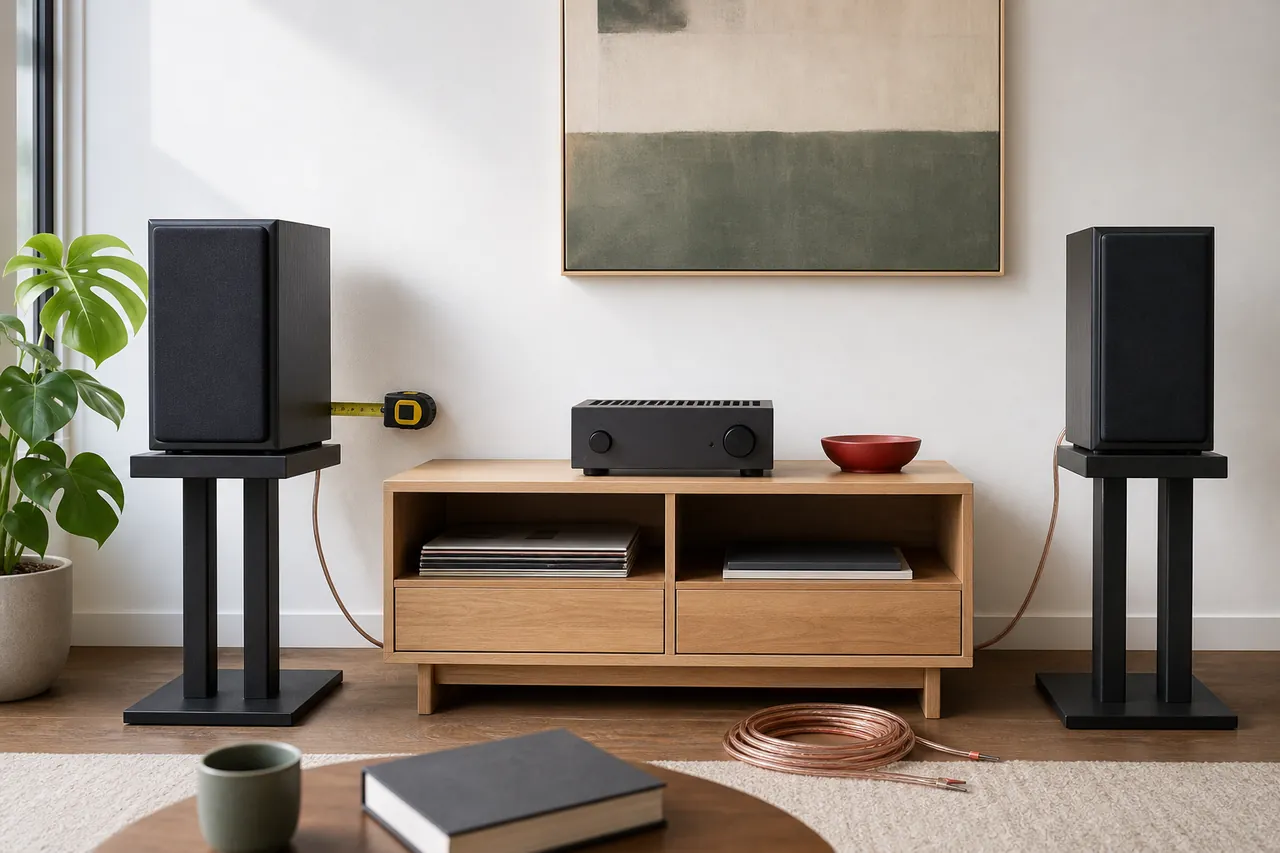
Powered / active pair
An amplifier is built into one or both speaker cabinets.
You can connect a supported line-level or digital source without buying a separate power amp.
Check mains outlet location, inter-speaker cable length and which cabinet holds controls.
Powered does not guarantee every TV or turntable connects directly.
Passive speaker
A cabinet with drivers and crossover but no built-in power amplifier.
Polk XT15 needs a compatible receiver or amplifier and speaker cable.
Match impedance guidance, amplifier power, cable termination and volume control.
Bluetooth in a phone cannot drive passive binding posts.
Line level
The low-power audio signal from a DAC, interface, computer output or many source components.
RCA, TRS and 3.5 mm line connections carry signal, not speaker-driving power.
Identify output level and connector on every source.
A turntable cartridge often needs a phono preamp before a line input.
Balanced TRS
A three-conductor 1/4-inch connection that can reject some cable-borne noise when both devices support balanced wiring.
It suits an audio-interface desk.
Use two correct balanced cables, one per channel.
A 1/4-inch socket is not automatically a guitar or headphone input.
Optical / coaxial digital
Two ways to carry stereo digital audio into the Edifier pair.
They can simplify TV or streamer connection when compatible PCM output is available.
Check TV output format, connector and volume-control behavior.
Digital input is not HDMI ARC and may not follow the TV remote.
Subwoofer output
A line-level output for a powered subwoofer, present on the R1280DBs.
It creates a documented expansion path for lower frequencies.
Confirm connector, crossover/level controls and placement on the future sub.
A socket does not include bass management or prove seamless integration.
Nearfield placement
Listening at short desk distance so direct speaker sound dominates more of what you hear.
Small 3.5-inch monitor pairs are designed around compact workspaces, not party coverage.
Form an approximate left-listener-right triangle and keep tweeters near ear height.
“Studio monitor” does not certify neutral sound in every room.