Guitar dynamics tools, not automatic tone upgrades
Best Compressor Pedals for the Controls You Will Actually Use
Choose the Keeley Compressor Plus for dry/compressed blend, the MXR M102 Dyna Comp for a deliberate two-knob effect, the Boss CP-1X for a visible meter with simple multiband processing, or the Empress Compressor MKII when attack, release, ratio and sidechain filtering all belong on the pedal.
We checked maker specifications, manuals, warranties and exact-model Sweetwater/Thomann orderability on . We did not plug in, record or own these units. Noise, feel, tonal colour and interaction with your pickups remain level-matched rig tests.
- Start here: decide whether compression should be audible, invisible, or switchable between both.
- Budget the power outlet: current draw ranges from 3.3 mA to 100 mA, and only three accept a battery.
- Preserve the suffix: M102, CP-1X and Compressor MKII are not interchangeable with related variants.
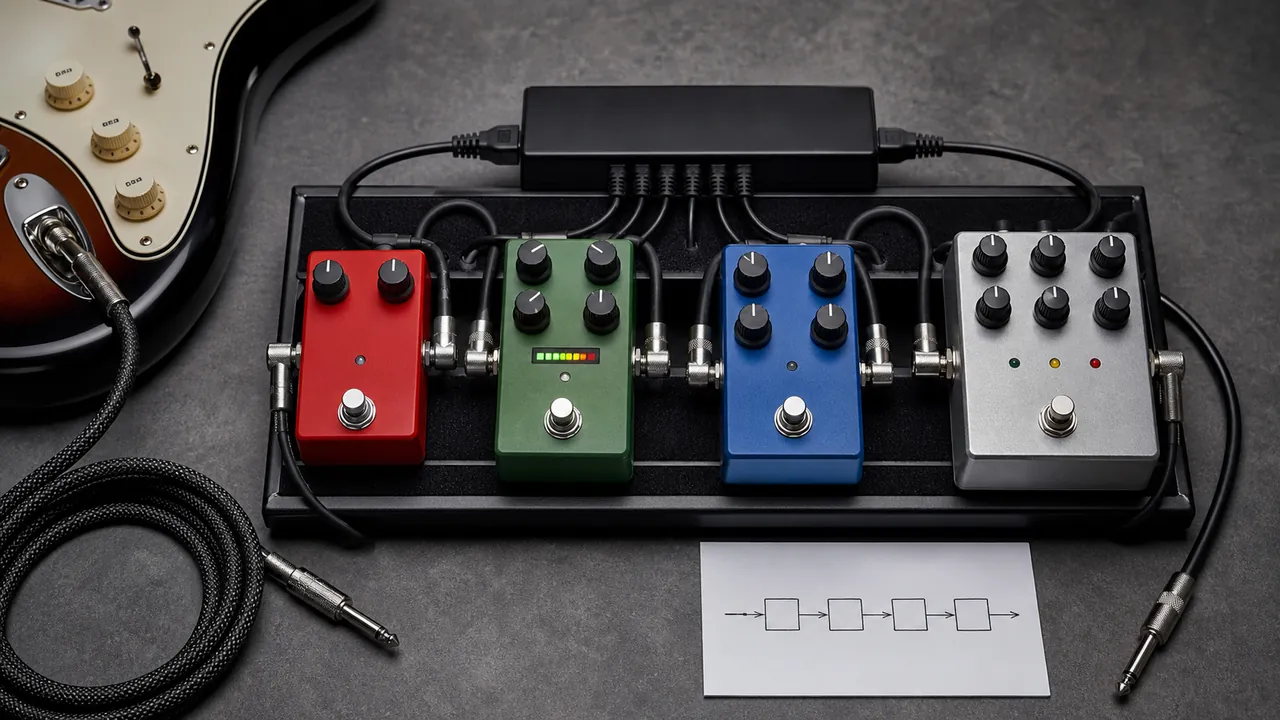
- Map the pedalboard before ordering.
Translate compressor controls into playing decisions
Threshold
Threshold is the signal level above which gain reduction begins.
Many stompboxes hide it inside a sensitivity or input control.
Use the maker's manual to learn which knob drives the detector.
More input is not simply more output.
Ratio
Ratio describes how strongly signal above threshold is reduced.
A higher ratio can make the effect more obvious and reduce level differences more strongly.
Begin at the lowest useful ratio and level-match before deciding.
A larger number is not a quality score.
Attack
Attack controls how quickly compression responds after the signal crosses its operating point.
It changes how much initial pick transient passes.
Compare hard single notes and chords at the same output level.
Fast attack does not mean a faster pedal.
Release
Release controls how quickly gain reduction relaxes after the signal falls.
Too short or long for the part can make level recovery conspicuous.
Listen through pauses, repeated notes and chord tails.
Release is not reverb decay.
Blend or mix
Blend combines dry and compressed paths in parallel.
It can retain more uncompressed attack while adding the processed path.
Start fully dry, match output, then add compression gradually.
Halfway does not necessarily mean equal loudness.
Makeup/output level
Output restores or changes level after gain reduction.
A louder bypass comparison is easily mistaken for a better sound.
Match engaged and bypassed loudness before judging colour or feel.
Unity knob position is not always noon.
Gain-reduction meter
A meter shows when and roughly how much the circuit is reducing gain.
It helps reveal whether compression is continuous or only catching peaks.
Use it as feedback while listening, not as a target to maximize.
More LEDs do not prove better audio.
Sidechain high-pass filter
A sidechain filter reduces how strongly low frequencies trigger the detector without necessarily removing those lows from the audio path.
It can stop low notes from dominating the compression decision.
Compare the Empress switch both ways on your lowest strings.
It is not the same as an audible bass-cut EQ.
How the shortlist survived the variant check
The pool began with current maker lines, then exact product pages at Sweetwater and Thomann. Each recommendation needed a distinct control philosophy, official specifications or manual, live order controls, and an observable store signal. Thomann listed Keeley first in its compressor sales rank with 299 ratings and the M102 with 347; Sweetwater showed 156 Keeley reviews and 66 M102 reviews. Those numbers establish broad market presence, not sonic superiority.
Boss CS-3 was excluded because its conventional single-band control set overlaps the value lane while CP-1X adds metering and multiband processing. Wampler Ego is popular but overlaps Keeley's blend-led role. MXR Dyna Comp Deluxe and Script Dyna Comp are separate models; neither is silently substituted for M102. Empress Bass Compressor is also a distinct circuit/voicing and is outside this guitar-focused exact-model comparison.
Choose the control surface before chasing adjectives
Prices are dated snapshots. Sweetwater and Thomann prices can differ by sale, tax, currency presentation and destination.
| Exact model | Control lane | Bypass/power | Checked price and stock | Main catch |
|---|---|---|---|---|
| Keeley Compressor Plus | Blend-led four-knob | True bypass; 9 V, 10 mA; battery | $149 Sweetwater / $158 Thomann; both in stock | No gain-reduction meter or separate release |
| MXR M102 Dyna Comp | Two-knob audible compression | True hardwire; 9 V, 3.3 mA; battery | $99.99 Sweetwater / $105 Thomann; in stock | No blend, attack, release or meter |
| Boss CP-1X | Metered multiband simplicity | Buffered; 9 V, 90 mA; battery | $158.50 sale Sweetwater / $159 Thomann; in stock | About two hours stated battery life |
| Empress Compressor MKII | Full manual control | True bypass; 9 V, 100 mA; no battery | $274 direct/Sweetwater; $287 Thomann silver | Most controls and highest checked price |
The recommendations, including reasons to leave them
For dry/compressed blend without a studio panel
Keeley Compressor Plus
Blend, Tone, Sustain and Level give useful control without separate attack/release knobs; the single-coil/humbucker switch changes the attack/release preset. Its first-place Thomann category rank and 299 ratings are concrete availability/popularity evidence.
- US-made exact model with battery option
- Immediate stock at both required stores
Tradeoff: there is no gain-reduction meter, ratio choice or user release control. High Sustain can also raise the audible noise floor in some rigs.
Avoid if: you need visible reduction or repeatable attack/release values.
Closest alternative: Empress MKII when full timing control justifies cost and space.
Controls, dimensions, origin and store signals agree; audible transparency remains a rig audition.
For a simple, deliberate compression effect
MXR M102 Dyna Comp
Output and Sensitivity are the entire interface. The official manual publishes 5 ms attack, 1 s release and up to 36 dB compression, so the M102 earns the classic-effect lane rather than being mislabeled a neutral utility.
- Lowest price and current draw here
- 347 Thomann ratings and 66 Sweetwater reviews
Tradeoff: fixed timing, no dry blend and no meter mean the basic sound must suit the part. Compression can amplify upstream hiss.
Avoid if: preserving more dry transient or tuning release is essential.
Closest alternative: Keeley Compressor Plus for blend and tone controls.
Manual and retailer evidence are strong; this guide makes no claim that current M102 sounds identical to every vintage unit.
For visible reduction with fewer decisions
Boss CP-1X
Boss combines Comp, Ratio, Attack and Level with a 16-segment gain-reduction display while its MDP system handles frequency-dependent processing internally. That suits the player who wants visual feedback without a sidechain or release control.
- Five-year Boss warranty headline
- 43 Sweetwater reviews and 87 Thomann ratings
Tradeoff: 90 mA current and roughly two hours of stated alkaline battery life make isolated adapter power the sensible board plan. Bypass is buffered, not true bypass.
Avoid if: you want an all-analog signal path or direct release/mix controls.
Closest alternative: Empress MKII for manual detector and mix decisions.
Boss publishes full electrical specifications; MDP's audible result remains a personal comparison.
For metering and studio-style control in one pedal
Empress Compressor MKII
Input, Output, Attack, Release, Mix, Tone, ratio switching, gain-reduction LEDs and a sidechain high-pass switch expose the decisions hidden by simpler pedals. The sidechain TRS jack also supports an external detector signal.
- Blue and silver variants at the same direct price
- Made in Canada with extendable warranty
Tradeoff: it costs $274 direct, requires 100 mA adapter power and cannot run on a battery. More controls increase setup time.
Avoid if: two knobs are already more compression adjustment than you want on stage.
Closest alternative: Boss CP-1X for a meter with fewer manual controls.
Maker/store specifications, Canadian origin and warranty agree; blue/silver retailer rating counts differ.
Audit the outlet, footprint and cable path
A pedal that fits by width can still fail when side jacks, a power plug and switch access are included.
1. Reserve current
Write each pedal's required voltage, polarity and current. Use an isolated 9 V centre-negative output with capacity above the requirement; never assume a higher-voltage outlet is safe.
2. Tape the working footprint
Mark enclosure width/depth, then add patch-plug projection and enough toe space for the footswitch. CP-1X is 129 mm deep; Empress side connections expand its nominal 66 mm width.
3. Price missing pieces
None includes the assumed board supply in the checked retailer descriptions. Add an isolated output, two short patch cables and any sidechain TRS cable before comparing totals.
Make a bypass comparison that does not reward loudness
Use four repeatable phrases
Record or repeat a hard single-note line, soft chord, muted rhythm and sustained chord with the same pickup and amp setting. Match engaged output to bypass first. Then change one compressor control at a time and note pick attack, chord tail, noise between phrases and level into the next pedal.
Test two chain positions
Try compressor before and after one overdrive at matched output. The first position changes what drives the overdrive; the second compresses the overdrive's output. Keep the quieter/more usable result for that song rather than declaring one order universal.
Noise check: disconnect the compressor, then add guitar, cable, compressor, power supply and downstream pedals one at a time. Compression raises quiet content as well as notes; the loudest stage identifies a chain problem more usefully than a brand adjective.
Where the specifications stop
Attack/release numbers help only when they are published and implemented in comparable circuits. M102 provides fixed values, Empress exposes controls without printing knob-by-knob milliseconds, Keeley uses a pickup switch, and Boss calculates multiple internal parameters. Ranking those systems by knob count would be false precision.
Origin evidence is exact for Keeley (Oklahoma), Empress (Canada), and Thomann's M102 listing (USA). Boss states its corporate Japanese history but the checked CP-1X page does not identify the unit's manufacturing country; inspect the physical label rather than converting brand origin into factory origin.
Physical, electrical and support details
| Product | Size and weight | Materials/construction | Manufacturing origin | Brand | Warranty/support |
|---|---|---|---|---|---|
| Keeley Compressor Plus | 112 x 68 x 51 mm; 280 g | Metal enclosure; true bypass; four knobs and pickup toggle; 9 V, 10 mA, battery or adapter | Made in Oklahoma, USA per Keeley and Thomann | Keeley Electronics, Oklahoma City; operating about 25 years; effects design/manufacture and repairs | Keeley repair/warranty contact; checked stores add 2-year Sweetwater or 3-year Thomann coverage |
| MXR M102 Dyna Comp | Approx. 108 x 57 x 32 mm; 0.9 lb in Sweetwater data | Metal two-knob enclosure; true hardwire; 9 V at 3.3 mA; battery or adapter | Thomann lists Made in USA for current exact model | MXR began in Rochester, New York in the early 1970s; now a Dunlop effects brand | Dunlop warranty terms depend on market/seller; checked stores provide their stated coverage |
| Boss CP-1X | 73 x 129 x 59 mm; 450 g with battery | Boss compact enclosure; buffered bypass; digital MDP; 9 V, 90 mA; battery or PSA adapter | Not stated for exact unit; Japanese brand history is not factory proof | Boss, Roland guitar-effects brand originating in Osaka R&D in 1973 | Boss page states five years; registration, market and authorized-dealer conditions can apply |
| Empress Compressor MKII | 66 x 122 x 64 mm; 454 g | Metal enclosure; FET compressor; true bypass; sidechain jack; 9 V, 100 mA adapter only | Made in Canada | Empress Effects, Kanata/Ottawa, Canada; founded 2005; effects design and manufacture | Two years standard, extended to four by registration; direct returns accepted within 45 days |
At checkout, keep every suffix and colour attached
Buy M102, not M228 Deluxe, M291 Mini or CSP102SL Script, unless you have re-run the comparison. CP-1X is the guitar model; BC-1X is the bass model. Empress MKII comes in blue and silver, and Sweetwater review totals differ by finish while direct pricing did not. Keeley also has limited graphics at the same nominal price. Confirm exact item ID, included power accessories, bypass type, seller warranty and destination price.
Sources checked
- Keeley Compressor Plus product page
- Keeley manufacturing and company background
- Sweetwater Keeley listing
- Thomann Keeley listing
- Dunlop MXR current product catalog
- MXR M102 official manual
- Sweetwater MXR M102 listing/reviews
- Thomann MXR M102 listing
- Dunlop MXR history
- Boss CP-1X specifications/support
- Sweetwater Boss CP-1X listing
- Thomann Boss CP-1X listing
- Boss official history
- Empress Compressor MKII product page
- Empress warranty registration
- Empress history
- Sweetwater Empress silver listing
- Thomann Empress silver listing
Found something that needs correcting? Contact the Consordini editorial team.