Four different jobs, no universal podium
Best Guitar Effects Pedals for Distortion, Delay, Modulation, and Looping
Start with BOSS DS-1 for a distinct distortion voice, BOSS DD-8 when repeat timing and stereo routing matter, MXR M101 Phase 90 for one-knob modulation, or TC Electronic Ditto 2 when the real goal is recording and overdubbing your own phrases.
We checked current maker specifications, manuals, warranties, and exact-model Sweetwater and Thomann listings on . We did not play, record, or electrically measure these pedals. Sound, switch feel, noise, and interaction with your guitar and amplifier still need a level-matched trial.
- Start here: name the missing job in one verb: distort, repeat, sweep, or record.
- Avoid if: your amplifier or existing multi-effects unit already performs that job well enough.
- Verify before buying: exact model suffix, voltage, polarity, current, included power supply, and mono/stereo routing.
- Jump to the sound-job comparison.
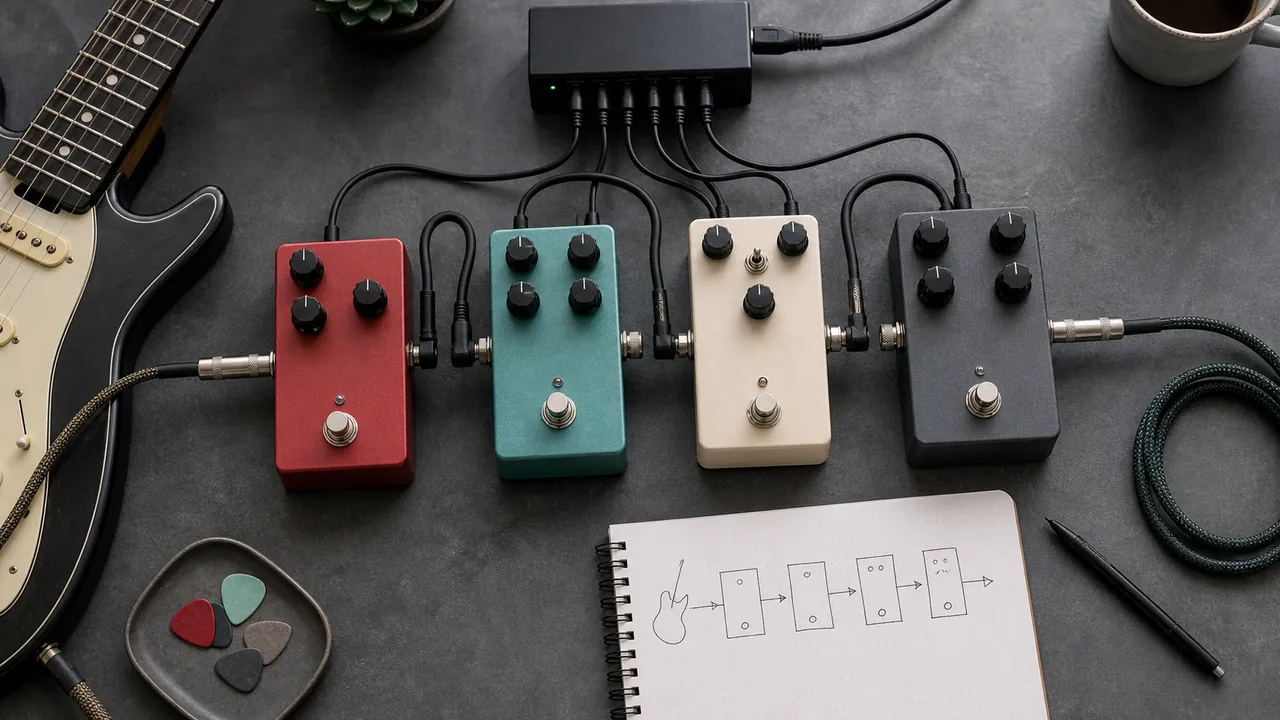
Read the labels as signal-chain instructions
Gain and distortion
Gain increases signal inside a circuit; deliberate clipping reshapes peaks into distortion.
It changes attack, harmonics, noise, and how the amp responds.
Compare low and high pedal gain at matched final loudness.
More gain is not simply more volume or a better heavy sound.
Delay time and feedback
Delay time sets the gap before a repeat; feedback sends repeats back through the delay to create more repeats.
Both controls alter rhythmic space and can become cluttered quickly.
Tap or set the time against the actual song tempo, then raise feedback only as needed.
Longer delay does not mean a larger-sounding mix.
Tap tempo
Tap tempo lets a footswitch or external control set repeat time from taps.
It is useful when tempos change between songs.
Check whether tapping uses the main switch or requires an external footswitch.
A tap input does not guarantee every subdivision or MIDI synchronization.
Modulation rate
Rate controls how quickly a repeating sweep moves through its cycle.
Slow settings can add motion; fast settings can dominate the part.
Audition the rate with chords and sustained notes, not only an isolated lick.
One knob does not make a phaser universally subtle.
Looper overdub
A looper records a phrase and plays it repeatedly; an overdub adds another layer.
Foot timing and stop/delete commands matter as much as recording length.
Rehearse record, close, overdub, undo, stop, and erase before using it live.
Unlimited overdubs do not create independent editable tracks.
Buffered and true bypass
True bypass routes around the effect when off; buffered bypass keeps an active buffer in the dry path.
Buffers can help long cable runs, while individual rigs can react differently to placement.
Test the complete board both engaged and bypassed at equal cable length.
True bypass is not automatically quieter or more faithful in every chain.
Current draw
Current draw is the amount of electrical current a pedal requires, usually stated in milliamps.
A supply outlet must match voltage and polarity and provide at least the required current.
Write the requirement beside each outlet before connecting anything.
A supply with spare milliamps is fine; a higher voltage is not an equivalent substitute.
Why these pedals are compared without ranking their sounds
The candidate pool began with current official lines and the pedal categories stocked by Thomann and Sweetwater. Each exact model needed a distinct musical job, a current maker page or manual, same-run orderability, and a visible specialist-store signal. The DS-1 also has the unusually concrete maker claim that it is BOSS's top-selling compact pedal; Sweetwater and Thomann currently list all four exact products.
We excluded overdrive and fuzz from the distortion lane because they are not interchangeable labels, and left out multi-effects processors because their workflow is a separate purchase. The original Ditto remains listed, but Ditto 2 is the current successor stocked by both anchors. BOSS RC-1 is a credible looping alternative with a circular loop-status display and optional external stop control, yet it would duplicate the looping lane rather than answer another sound job.
Match the pedal to the sentence you want to play
Use this table to choose the job first. The controls describe capability; they do not predict which circuit will sound best with your pickups and amplifier.
| Model | Job | Key controls | Power and routing | Main catch |
|---|---|---|---|---|
| BOSS DS-1 Distortion | Add a hard-edged distortion voice | Tone, Level, Dist | 9 V battery/PSA; 10 mA; mono; buffered | Tone and amp pairing need an audition |
| BOSS DD-8 Digital Delay | Create timed repeats and stereo space | 11 modes, time, feedback, level, carryover | 9 V battery/PSA; 100 mA; stereo; buffered | Many modes, short stated battery life |
| MXR M101 Phase 90 | Add a repeating phase sweep | Rate only | 9 V battery/adapter; 5 mA; mono; true hardwire | No depth, mix, or feedback control |
| TC Electronic Ditto 2 Looper | Record and overdub practice phrases | Loop level, foot commands, app profiles | 9 V DC, 100 mA; mono; selectable bypass | One-switch commands require rehearsal |
Choose the drawback you can work around
Distinct distortion from a simple three-knob box
BOSS DS-1 Distortion
The DS-1 earns this lane because the exact circuit is current, inexpensive relative to the other jobs, and exceptionally easy to source. BOSS publishes its 1978 introduction and top-selling compact-pedal status, while the current page provides full electrical and physical specifications.
- Battery operation and low 10 mA draw
- Five-year BOSS warranty headline and broad retailer presence
Tradeoff: its active Tone control raises highs while reducing lows clockwise, so familiar knob positions can sound sharply different through different amps.
Avoid if: you want transparent boost, soft overdrive, or fuzz rather than this specific distortion class.
Closest alternative: BOSS SD-1 for an overdrive job; audition both through your own clean and driven amp channels.
Check before ordering: exact DS-1 identity, power, current regional warranty and return terms. Tone and rig interaction remain untested here.
Compact delay with stereo and external control
BOSS DD-8 Digital Delay
The DD-8 covers eleven delay modes, up to ten seconds of delay time, tap-tempo input, stereo I/O, and optional external foot or expression control in a standard BOSS enclosure. It fits the player who needs several repeat types before needing presets or MIDI.
- Mono, stereo, wet/dry, and wet-only routing options
- Carryover switch and a basic 40-second looper mode
Tradeoff: BOSS specifies 100 mA and estimates about 3.5 hours from an alkaline battery; Thomann currently lists 65 mA, so follow the current BOSS documentation and exact unit label when assigning a power outlet. The mode knob also asks you to remember different behaviors without a screen.
Avoid if: saved presets, MIDI clock, or a dedicated multi-track looper are requirements.
Closest alternative: a simpler analog-delay design when one repeat character matters more than routing breadth.
Check before ordering: exact DD-8 routing, external-control accessories, current BOSS power requirement and unit label. No claim is made about analog or tape emulation accuracy.
One-knob modulation with no menu
MXR M101 Phase 90
The M101 has one Rate knob, a footswitch, true hardwire bypass, and a 5 mA requirement. That deliberate constraint is useful when the buyer wants a recognizable moving texture without balancing mix, feedback, stages, or presets.
- Current manufacturer-direct order control
- Runs from battery or standard 9 V adapter
Tradeoff: there is no wet/dry blend, depth, resonance, or output control. The fixed voicing may be too strong or too specific in a given rig.
Avoid if: you need to reduce phase depth or synchronize modulation to tempo.
Closest alternative: MXR Phase 95 for additional phase-stage and Script-mode choices in a different exact model.
Check before ordering: exact M101 dimensions, weight, factory origin and written regional warranty. The current maker page and manual support operation, power and bypass.
Practice loops with a compact control surface
TC Electronic Ditto 2 Looper
Ditto 2 updates the single-switch practice format with ten minutes of loop time, selectable bypass, USB-C/Bluetooth setup, and optional LoopSnap and SingleTap profiles. Both major anchors showed the exact current model orderable.
- Small enclosure and direct loop-level control
- Original-style profile remains available alongside newer foot-command options
Tradeoff: record, play, overdub, stop, undo, and erase still share one footswitch. App-dependent configuration adds a separate support lifecycle.
Avoid if: you need independent stop, multiple parallel tracks, MIDI sync, or on-pedal session browsing.
Closest alternative: BOSS RC-1 when a circular loop-status display, stereo routing, or optional external stop control matters more than the smallest footprint.
Check before ordering: current app/phone support, included power supply, manufacturing origin and written regional warranty. Exact identity and the visible feature set are current.
Rehearse four chain positions before fixing hook-and-loop
Use one short clean phrase and move only one pedal at a time. Record the result on a phone at the same amp volume; this is a routing comparison, not a measurement.
1. Distortion first
Guitar → DS-1 → modulation/delay. Hear how later effects process the distorted signal.
2. Phaser around gain
Try Phase 90 before and after DS-1. Before changes what enters clipping; after sweeps the clipped result.
3. Delay after gain
Place DD-8 after distortion for repeated distorted notes, then compare the reverse once so the difference is explicit.
4. Looper last
Place Ditto 2 after the effects to capture the whole sound. Move it earlier only when you want to change effects over a dry recorded phrase.
Write a power strip before buying a power supply
9 V DC, centre-negative PSA type, 10 mA; battery accepted.
9 V DC, centre-negative PSA type; BOSS specifies 100 mA while Thomann lists 65 mA. Follow the maker documentation and unit label; battery accepted but short-lived.
9 V DC, 5 mA; Dunlop-compatible adapter or battery.
9 V DC, centre-negative, 100 mA; confirm whether a supply is included.
Give each outlet the exact voltage and polarity the maker specifies, with current capacity at or above the requirement. Do not add voltages in a daisy chain, and do not use an 18 V outlet merely because it has enough milliamps. Add side-jack cable projection to the enclosure dimensions before declaring a board fit.
What pedal specifications cannot settle in your rig
A distortion pedal is an interaction between guitar output, pickups, playing level, the pedal, downstream gain, and the amplifier. Delay modes likewise describe algorithms and routing, not whether their repeats sit correctly in your arrangement. Phase speed does not reveal how prominent the fixed sweep will feel. A looper's recording minutes do not reveal whether its foot grammar works under pressure.
Run every candidate at matched bypass and engaged loudness. Then test the quietest and loudest guitar pickup settings, both clean and driven amp channels, and the actual cable length. Listen for useful contrast, unwanted level jumps, idle noise, and whether one control move can recover the sound between songs. Return policy matters because those answers are rig-specific.
Pedalboard dimensions, build, origin and support
| Product | Size and weight | Construction | Manufacturing origin | Brand | Warranty/support |
|---|---|---|---|---|---|
| BOSS DS-1 Distortion | 73 × 129 × 59 mm; 360 g. | BOSS compact metal enclosure; three controls; buffered bypass; battery or adapter. | Not disclosed for the current exact unit; check its physical label. | BOSS grew from a Roland effects division established in Osaka in 1973 and focuses on musician electronics. | Official page states five years; confirm registration and market conditions. |
| BOSS DD-8 Digital Delay | 73 × 129 × 59 mm; 440 g including battery. | Metal compact enclosure; stereo quarter-inch I/O; external-control jack; buffered bypass. | Not disclosed for the current exact unit; check its physical label. | BOSS, established from Roland's 1973 effects operation, is known for compact pedals and music tools. | Official page states five years; adapter and external controls are sold separately. |
| MXR M101 Phase 90 | Published exact dimensions/weight not found on the current maker page; verify seller figures as item, not package, measurements. | Metal single-knob enclosure; true hardwire bypass; battery or 9 V adapter. | Not verified for this exact current unit; MXR history is not factory evidence. | MXR began in Rochester in the 1970s and is now a Dunlop effects brand based in California. | Current written duration was not verified; request market terms before purchase. |
| TC Electronic Ditto 2 Looper | Approx. 50.8 × 42.9 × 92.9 mm; 0.42 lb dealer/editor fallback; verify exact current seller data. | Compact metal enclosure; wide footswitch; mono I/O; USB-C and Bluetooth configuration. | Not disclosed for this exact model; brand origin is not manufacturing proof. | TC Electronic was founded in Denmark in 1976 and develops guitar and professional-audio processing. | No current manufacturer duration verified; Sweetwater advertises its separate two-year coverage. |
Take these questions to the shop or support desk
- Is this the exact DS-1, DD-8, M101 Phase 90, or Ditto 2 SKU shown in the order?
- Which power supply is included, and what voltage, polarity, and minimum current does this unit require?
- Can I return it after a careful home audition, and must adhesive or packaging remain untouched?
- For DD-8, which cable and footswitch are required for my intended stereo or tap setup?
- For Ditto 2, which features work without the app and what phone/OS support is current?
- What written manufacturer warranty applies in my country rather than the retailer's added coverage?
Product pages, manuals, and current store checks
Manufacturer pages control technical identity. Store pages document same-run orderability and observable shelf presence; review counts and stocking do not prove sound quality.
- BOSS DS-1 product and specifications
- Sweetwater DS-1 listing
- Thomann DS-1 listing
- BOSS DD-8 product and support
- BOSS DD-8 reference manual
- Sweetwater DD-8 listing
- Thomann DD-8 listing
- MXR M101 Phase 90 product page
- MXR M101 official manual
- Sweetwater Phase 90 listing
- Thomann Phase 90 listing
- TC Electronic Ditto 2 product page
- Sweetwater Ditto 2 listing
- Thomann Ditto 2 listing
- BOSS RC-1 alternative controls
- BOSS official history
- MXR official history