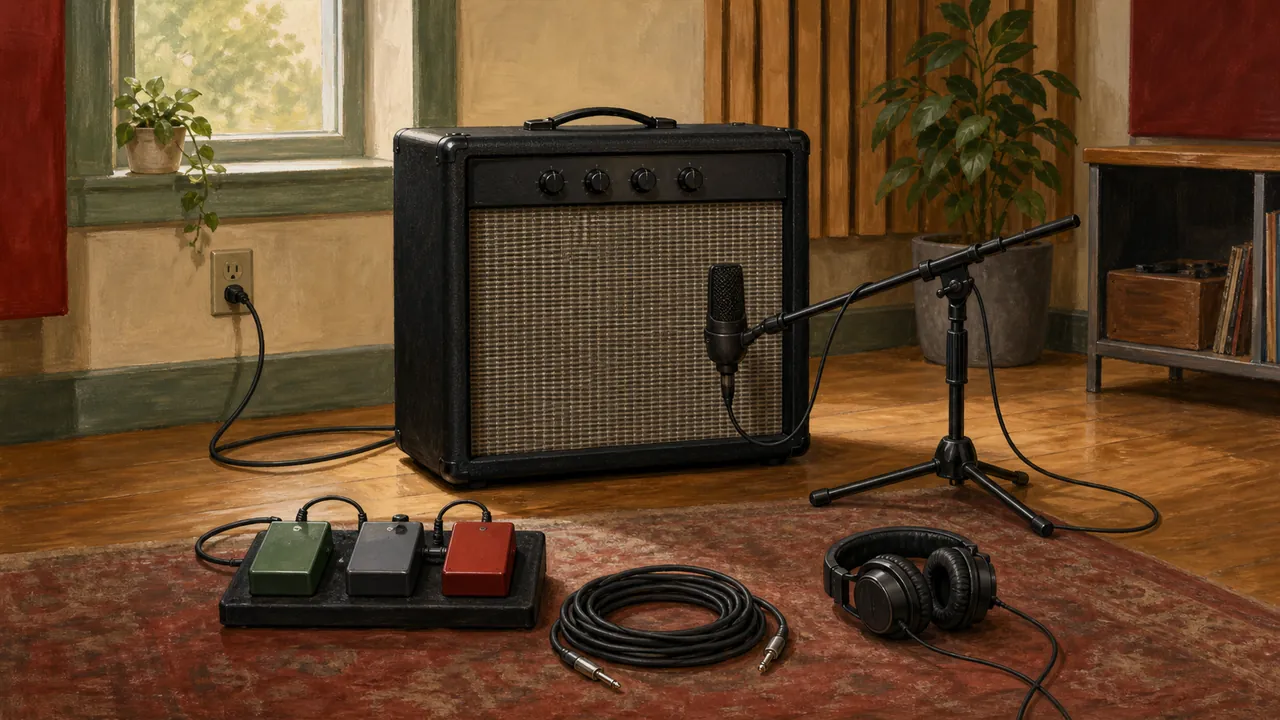
Five current combos, five different jobs
Best Guitar Amps for Practice, Rehearsal and Gigs
Fender Mustang LT25 is the straightforward first practice amp. Positive Grid Spark 2 is the app-and-looper desktop system. Boss Katana-50 Gen 3 covers the widest practice-to-rehearsal range. Marshall DSL40CR is the valve choice for players prepared for weight and maintenance. Fender Tone Master Deluxe Reverb supplies a familiar stage layout, low carry weight and an XLR direct path.
We checked exact manufacturer pages, manuals, Sweetwater and Thomann on . We did not play, record, gig, measure loudness or long-term test these amps. Sound, feel, noise and usable clean headroom require an audition with your guitar and pedals.
Read the signal path
Translate the controls before choosing a sound
Combo amplifier
An amplifier chassis and speaker mounted in one cabinet.
It is simpler to carry and connect than a separate head and cabinet, but the included speaker remains part of every sound and weight decision.
Audition the exact combo rather than assuming a head or larger model sounds identical.
“Combo” describes packaging, not whether the circuit is tube, analog solid-state or digital.
Tube amplifier
An amp that uses vacuum tubes in its signal path; DSL40CR also uses EL34 power tubes.
Tubes can change response as levels rise and are replaceable wear parts that create heat, weight and service needs.
Price replacement, bias service and safe transport before committing.
Lowering a tube amp from 40 to 20 watts does not make it a silent bedroom amp.
Modeling amplifier
A digital system that recreates amplifier, cabinet and effect behavior in software.
It can store many sounds and add USB or app editing, but firmware, drivers and preset management become part of ownership.
Build and recall the sounds you need using the controls and software you will actually use.
A long model list does not prove that one preferred sound responds correctly to your guitar.
Preamp and power amp
The preamp shapes and raises the guitar signal; the power amp drives the speaker.
Gain changes in the preamp and volume changes in the power stage can feel and sound different.
Test clean, edge-of-breakup and driven settings at the three real listening levels.
Turning down a master control does not preserve every aspect of a loud power-stage sound.
Speaker size
The nominal diameter of the built-in driver, such as 8, 12 or two 4-inch speakers.
Diameter, cabinet and driver design influence dispersion, low-frequency behavior and feel together.
Compare the exact amp in the room instead of treating 12 inches as an automatic quality grade.
Speaker diameter alone does not establish loudness, bass response or suitability for a band.
Power attenuation
A control that reduces the available output-power range, such as Katana's 0.5/half/max selector or Tone Master's stepped selector.
It can make the volume control easier to use in a small room while preserving the amp's intended operating workflow.
Test the lowest setting after dialing the sound, then listen for hiss and volume-control range.
Attenuation does not silence the physical speaker or provide headphone listening unless a headphone output is also present.
Effects loop
A send-and-return connection placed after the preamp and before the power amp.
Delay, reverb or a multi-effects unit can remain after preamp distortion rather than feeding its input.
Connect the intended pedals, check levels and confirm whether switching preserves the loop.
USB, auxiliary input and a footswitch jack are not substitutes for a serial effects loop.
Cabinet-simulated direct output
An output processed to resemble a miked speaker cabinet for a mixer, recorder or interface.
Tone Master's balanced XLR can feed front of house without relying on a microphone position.
Record the exact simulation and verify ground-lift, level and stage-monitor plan.
A direct output is not automatically a headphone output, and USB audio is not automatically a stage-ready balanced feed.
Selection boundary
One winner would hide the real decision
We required a current exact model, primary technical evidence and ordinary specialist-retailer availability. US listings came from Sweetwater; European stock and listing engagement came from Thomann. Rating counts show that buyers interact with an exact listing, not that an amp sounds good, stays reliable or suits your hands.
Katana-50 MkII and Spark 40 were removed because newer generations now occupy their lanes. The current Fender '65 Deluxe Reverb Reissue remains a valid tube platform, but it overlaps the Deluxe control-and-speaker lane at greater weight and ownership burden. It needs a personal comparison against Tone Master, not a paper verdict.
Match the room, controls and exit path
| Amp | Core format | Quiet-use path | Recording / stage path | Main refusal |
|---|---|---|---|---|
| Fender Mustang LT25 | 25 W digital, 1 x 8 in | Headphones, master volume | USB recording | No line out or effects loop |
| Positive Grid Spark 2 | 50 W stereo, 2 x 4 in full-range | Headphones, optional battery | USB audio, stereo line outs | App/account dependency; not a conventional 1x12 |
| Boss Katana-50 Gen 3 | 50 W modeling, 1 x 12 in | Headphones/recording out; 0.5 W mode | USB-C, phones/recording out | No serial loop or conventional line out |
| Marshall DSL40CR | 40/20 W valve, 1 x 12 in | Master volumes; no headphones | Effects loop, emulated out, external speakers | 22.9 kg, heat and tube service |
| Fender Tone Master Deluxe Reverb | Digital recreation of 22 W Deluxe architecture, 1 x 12 in | Stepped power down to 0.2 W; no headphones | Balanced XLR cabinet simulation | One core amp family; no effects loop |
Choose the limitation you can live with
First self-contained practice amp
Fender Mustang LT25
Choose Mustang LT25 when a new player needs an inexpensive current combo with approachable onboard presets, a headphone jack and USB recording, without making a phone app the main control surface.
Useful edge: the 12.75-pound wood combo is compact, and its panel provides a familiar gain, three-band EQ, volume and master workflow alongside preset editing.
Hard limit: its 8-inch speaker and practice-focused connections leave no conventional line output or effects loop. Foot control is limited compared with larger systems.
Avoid if: the purchase must cover a loud drummer, a loop-based pedalboard or balanced stage output.
Closest alternative: Katana-50 Gen 3 for a 12-inch speaker, power selector and broader rehearsal range.
Verify: the favorite clean and driven presets, headphone hiss, USB compatibility and whether the intended footswitch action is supported.
Found a changed specification or source? Report a correction.
App-guided practice and looping
Positive Grid Spark 2
Choose Spark 2 when practice tracks, onboard looping, app editing, USB audio, stereo line outputs and optional battery operation matter more than a traditional guitar-speaker format.
Useful edge: two 4-inch full-range speakers fit a stereo practice system into a 5.5 kg desktop enclosure, while physical controls preserve basic use away from the app.
Hard limit: advanced features bring phone, account, firmware and backup dependencies. Small full-range drivers are not a paper substitute for auditioning a 1x12 at rehearsal level.
Avoid if: you want a simple offline amp, conventional pedalboard platform or proven unassisted band volume.
Closest alternative: Mustang LT25 for simpler practice; Katana-50 Gen 3 for a conventional 12-inch combo.
Verify: current OS/app support, account registration, looper foot-control needs, line-output level and backup before factory reset.
Broadest one-box practice to rehearsal lane
Boss Katana-50 Gen 3
Choose Katana-50 Gen 3 when one current 1x12 modeling combo must cover quiet 0.5-watt practice, rehearsals, onboard effects, four tone memories and USB recording.
Useful edge: its physical panel works without software, while Boss Tone Studio exposes deeper editing. Strong Sweetwater and Thomann visibility makes exact-model support and comparison easier.
Hard limit: the base 50 has no serial effects loop or conventional line output, four memories constrain set-list switching, and Bluetooth requires an optional adapter.
Avoid if: time-based pedals must sit after modeled preamp distortion, or the show needs many footswitchable scenes.
Closest alternative: DSL40CR for a loop and valve topology; Tone Master Deluxe for balanced XLR direct output.
Verify: GA-FC/footswitch compatibility for this exact base model, USB driver workflow, recording-out behavior and clean headroom beside the drummer.
Valve rock rehearsal and club combo
Marshall DSL40CR
Choose DSL40CR when an actual EL34 valve power section, four gain modes, two master volumes, effects loop and external-speaker support justify a 50-pound carry and periodic service.
Useful edge: the 40/20-watt 1x12 has a Celestion V-Type speaker and explicit, serviceable tube topology. Its dual masters help set two performance levels.
Hard limit: it has no headphone output; 20 watts remains substantial; power-tube replacement requires correct bias. Heat, glass components and freight complicate ownership.
Avoid if: silent practice, light transport or maintenance-free consistency is essential.
Closest alternative: Katana-50 Gen 3 for lower weight and quiet practice; Tone Master Deluxe for a lighter stage combo.
Verify: clean headroom, channel/master switching, loop levels, bias service access, ventilation and the regional valve-versus-amplifier warranty term.
Lightweight traditional stage and direct platform
Fender Tone Master Deluxe Reverb
Choose Tone Master Deluxe when the Deluxe Reverb control layout, 23-pound carry, stepped output power and balanced XLR cabinet simulation matter more than multiple amp models or tube circuitry.
Useful edge: the solid-pine combo pairs a Jensen N-12K 12-inch speaker with rear-panel output power selection, mute and two cabinet-simulation choices for direct work.
Hard limit: it centers on one amp architecture, has no headphone output or effects loop, and costs considerably more than broad modeling combos.
Avoid if: the set needs high-gain models, post-preamp pedal routing, headphones or many stored scenes.
Closest alternative: Katana-50 Gen 3 for range and memories; audition the current '65 Deluxe Reverb Reissue if tube response outweighs carry and direct-output needs.
Verify: XLR simulation into the actual PA/interface, stage-monitor arrangement, low-power feel and reverb/tremolo footswitch inclusion.
Run the same song at three real volumes
Bring your guitar, cable and every always-on or gain pedal. Save one clean, one edge-of-breakup and one driven sound, then play the same verse and lead passage in each context.
- Living-room level: set the volume low enough for the planned hour. Check control range, hiss, headphone behavior where offered and whether the preferred sound collapses when quiet.
- Band level: stand where you rehearse and play beside the drummer. Listen for clean headroom, harshness, low-end masking and whether controls can be reached between songs.
- Stage/direct level: feed the actual microphone, line, XLR or USB path. Confirm who controls level, what the player monitors and whether muting the speaker changes the feed.
Write one failure sentence for each amp. “The clean sound breaks up before the chorus” is useful evidence; “50 watts should be enough” is not.
Draw the switching map before buying the footswitch
List changes: write every sound change in one set: clean/drive, boost, delay, tap tempo, loop start, tuner, reverb and volume. Four stored sounds do not cover eight independent actions.
Trace pedals: mark each pedal before the input or in the effects loop. If the amp has no loop, test delay and reverb into the driven preamp instead of assuming the result.
Prove control: verify the exact foot controller, cable and model compatibility in the manual. Similar sockets and family names can support different functions.
Prove the recording path from speaker to headphones
| Path | What to test | What it does not prove |
|---|---|---|
| Microphone | Position, room spill, stand, cable and preamp gain | Silent recording or repeatable placement |
| Balanced XLR / line | Cabinet simulation, ground lift, level and speaker-mute behavior | That the player can hear without a monitor |
| USB audio | Driver, supported OS, sample settings, monitoring and round-trip latency | A balanced feed for a stage snake |
| Headphones | Connector, volume range, noise and cabinet processing | That the amp's speaker is silent in every mode |
Carry, construction and support boundaries
A company address is not a factory. Exact manufacturing origin was disclosed for DSL40CR but not the other four models. Boss and Positive Grid also lacked a sufficiently clear universal warranty duration, so seller and regional service terms need confirmation.
| Amp | Size and weight | Construction and origin | Brand record | Warranty/support |
|---|---|---|---|---|
| Fender Mustang LT25 | 14.5 x 8.25 x 12.75 in / 368 x 210 x 324 mm; 12.75 lb / 5.7 kg. | Wood enclosure, textured vinyl and 8-inch Fender Special Design speaker. Exact manufacturing origin not disclosed. | Fender, Scottsdale, Arizona, USA; amplifier history dates to 1946; known for electric guitars and amplifiers. | Global two-year limited amplifier warranty; regional, seller and product-literature limits apply. |
| Positive Grid Spark 2 | 14.76 x 7.09 x 8.43 in / 375 x 180 x 214 mm; 12.125 lb / 5.5 kg. | Desktop enclosure, grille cloth and two 4-inch full-range speakers; exact cabinet material not stated. Exact manufacturing origin not disclosed. | Positive Grid, California, USA; established 2013; known for guitar software and Spark practice amps. | A universal exact-model hardware term was not independently established; confirm registration, region and authorized-seller coverage. |
| Boss Katana-50 Gen 3 | 18-9/16 x 9-3/8 x 15-11/16 in / 470 x 238 x 398 mm; 25 lb 10 oz / 11.6 kg. | Semi-open combo with custom 12-inch speaker; exact cabinet material not stated. Exact manufacturing origin not disclosed. | Boss, Hamamatsu, Japan; established 1973 under Roland; known for guitar effects and amplifiers. | Exact current regional duration was not established; confirm authorized seller, registration and Boss service route. |
| Marshall DSL40CR | 24.4 x 9.9 x 19.3 in / 620 x 252 x 490 mm; 50 lb / 22.9 kg. | Wood combo, 12-inch Celestion V-Type, four ECC83 and two EL34 tubes. Designed and engineered in the UK; made in Vietnam. | Marshall, Milton Keynes, England; established 1962; known for valve guitar amplifiers and cabinets. | US: one year for the amp with possible two-year registration extension; valves and fuses 90 days. Other regions differ. |
| Fender Tone Master Deluxe Reverb | 24.1 x 9.28 x 17 in / 612 x 236 x 432 mm; manufacturer 23 lb / 10.4 kg (one regional retailer lists 11.3 kg). | Solid-pine cabinet, textured vinyl and Jensen N-12K neodymium 12-inch speaker. Exact manufacturing origin not disclosed. | Fender, Scottsdale, Arizona, USA; amplifier history dates to 1946; known for electric guitars and amplifiers. | Global two-year limited amplifier warranty; regional, seller and product-literature limits apply. |
Questions to answer inside the return window
- Does the preferred clean sound remain clean beside the actual drummer?
- Can every required set-list change be made with the supported foot controller?
- Do the pedals sound right before the input, and is an effects loop required?
- Can headphones, USB, XLR or line output perform the exact recording and monitoring job?
- Who services the amp locally, and who pays freight for a 50-pound return?
- Will app, firmware, account registration or software redemption affect return eligibility?
Sources checked for exact models, stock and support
Manufacturer pages and manuals control specifications. Retail listings provide dated stock, price and listing-engagement evidence only.
Prices, stock, firmware, app support and warranty terms can change. Confirm the exact model, region and return terms before purchase.