Price and stock checked
Best headphones under $100 by room and cable
Buy the room behavior first. Closed cups suit microphones and shared spaces; the semi-open option belongs in a quiet room where leakage is acceptable. Then reject any cable that fights the desk.
We checked exact manufacturer documents, new US pricing at Sweetwater, EU orderability at Thomann, impedance, published sensitivity, cable layout, service parts and written warranty. We did not listen to, measure or wear these headphones. Fit, clamp, tonal balance and real microphone bleed still need a return-window test.
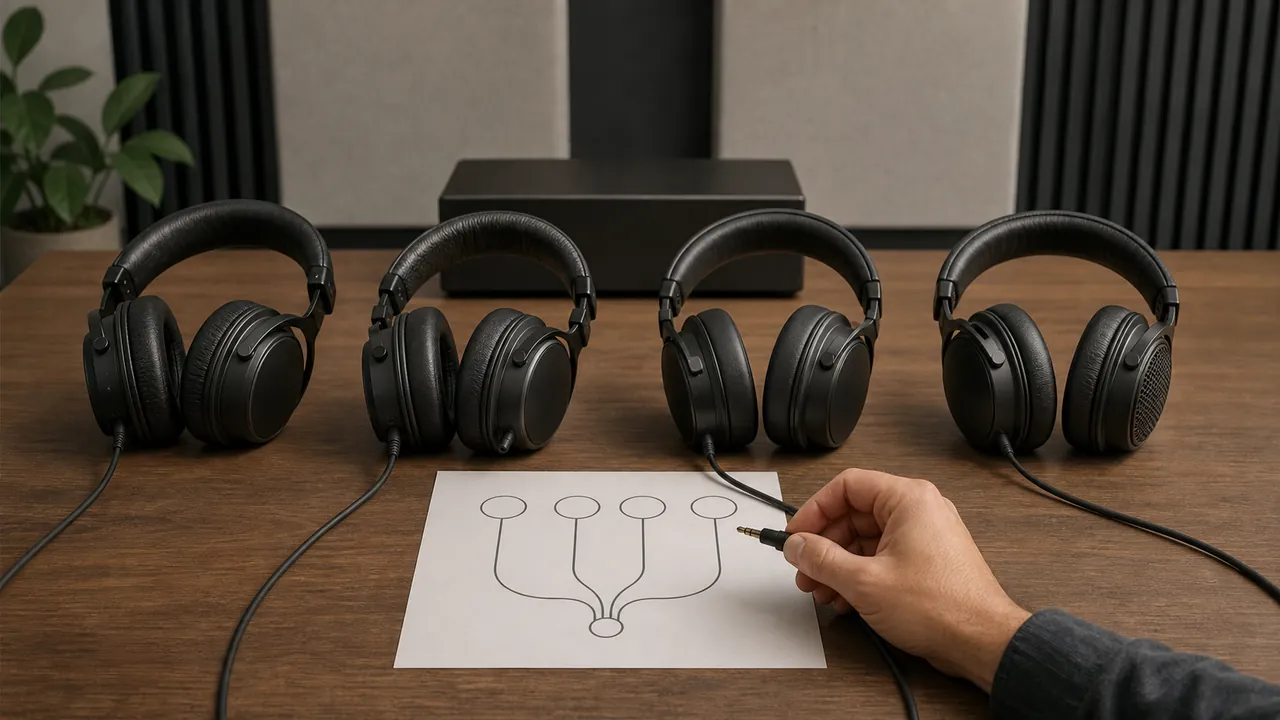
The shortlist changes when the door closes
| Exact model | Useful lane | Cup / load | Cable reality | Reject when |
|---|---|---|---|---|
| HD 280 PRO | Tracking, broadcast, live desk | Closed / 64 ohms | Fixed coil, 1.3-3 m | Clamp or cable weight distracts |
| ATH-M30x | Foldable home-studio work | Closed / 47 ohms | Fixed straight, 3 m | You need a short replaceable lead |
| K240 Studio | Quiet-room second reference | Semi-open / 55 ohms | Detachable mini-XLR, 3 m | A live microphone or sleeper shares the room |
| PreSonus HD9 | Budget closed monitor | Closed / 40 ohms | Fixed straight, 3 m | You travel and need proven dimensions |
Not on the list: Sony MDR-7506 was $113 new and Shure SRH440A $109 at the US anchor. Both were orderable; neither met this route's ceiling. An open-box price is not the same buying proposition.
Read the cup, load and lead without folklore
Closed-back
A solid outer cup restricts the open path behind the driver. That usually reduces outward and inward leakage compared with open designs. Test beside the actual microphone or person. Closed does not mean soundproof, noise-canceling or guaranteed private.
Open and semi-open
Vents let more air and sound move through the cup; semi-open sits between a sealed cup and a fully open grille. The room becomes part of the listening situation. Use it only where leakage in both directions is acceptable. “More open” is a design trade, not automatic accuracy.
Impedance
Electrical opposition, stated in ohms. It helps describe the load seen by the headphone output. Try the exact interface, keyboard, laptop or phone. Higher ohms do not mean higher quality, and ohms alone do not predict volume.
Sensitivity
A published relationship between electrical input and sound-pressure output. It works with impedance and source power to affect achievable level. Compare only figures using the same unit and method, then verify with the source. dB per volt and dB per milliwatt are not interchangeable ranking numbers.
Circumaural
The pad is intended to sit around the ear. Pad opening and head shape still determine whether it actually clears your ear. Check for pad contact after twenty minutes, including with glasses. “Over-ear” is not a standardized comfort promise.
Fixed versus detachable cable
A fixed lead is wired into the cup; a detachable one unplugs. Cable damage and desk routing become different ownership problems. Trace the full route before buying and price the exact replacement connector. A detachable proprietary cable is not automatically easy to replace locally.
Monitoring and mixing
Monitoring means hearing a source while recording or operating it; mixing means balancing recorded elements. Tracking prioritizes leakage control and cue clarity, while mix decisions need translation checks. Use speakers and other known playback systems before finalizing a mix. A “studio” label does not make one headphone sufficient for every production decision.
Four lanes, four honest compromises
Closed tracking workhorse
Sennheiser HD 280 PRO
The 64-ohm closed design, folding frame, replaceable pads and long coiled lead make the most coherent package for a fixed recording or live desk.
Advantage: 412 Sweetwater reviews and current Thomann presence establish unusually broad activity.
Meaningful drawback: the fixed coil can tug against clothing or a light interface, and fit pressure is personal.
Avoid if: your source sits in a pocket or you need a field-replaceable cable.
Alternative: ATH-M30x when a straight folding layout matters more.
What we could verify: exact configuration, stock, physical facts and warranty; sound and fit remain untested.
Fold-and-store choice
Audio-Technica ATH-M30x
At $79 with 85 Sweetwater reviews and 360 Thomann ratings, the M30x has clear cross-market evidence and a folding frame.
Advantage: swiveling cups and a light published weight simplify fixed-desk storage.
Meaningful drawback: the three-metre straight lead is permanently attached.
Avoid if: cable replacement is part of your ownership plan.
Alternative: HD 280 PRO when a coiled desk lead and replaceable pads fit better.
What we could verify: exact model, stock, dimensions context and current activity; comfort and tone remain untested.
The deliberate leak
AKG K240 Studio
The 55-ohm semi-open design, replaceable pads and detachable mini-XLR lead create a quiet-room contrast to a closed pair.
Advantage: the cable and pads have explicit replacement paths.
Meaningful drawback: cue sound can reach a microphone, and room sound reaches you.
Avoid if: privacy, isolation or one-pair tracking duty is essential.
Alternative: HD 280 PRO for closed tracking.
What we could verify: exact current SKU, physical facts and US/EU orderability; leakage and translation remain unmeasured.
Budget swivel-cup lane
PreSonus HD9
The HD9 stays below the ceiling in both markets and its cups rotate 180 degrees for a distinct desk workflow.
Advantage: current price leaves the most budget headroom.
Meaningful drawback: the three-metre cable is fixed, and current maker material does not publish travel dimensions or weight.
Avoid if: you need a compact packing plan proved before purchase.
Alternative: ATH-M30x for a stronger activity record and folding frame.
What we could verify: exact model, load, cup movement, stock and written warranty; ownership detail is thinner.
What a sub-$100 specification cannot settle
None of these figures predicts whether the pads seal around your glasses, whether clamp distracts you, or whether a tonal emphasis changes a mix decision. Closed cups can still leak into a microphone. The semi-open K240 can still feel wrong in a quiet room. A return-window rehearsal is part of the purchase, not an optional afterthought.
Issue a room-and-cable passport before checkout
A headphone passes only when all four stamps fit the real job. This is a rejection tool, not a sound score.
- Room stamp: name who or what shares the room. If a live microphone or sleeping person matters, strike the K240.
- Route stamp: run string from the left earcup position to the source, including chair movement. A three-metre fixed lead needs a storage path; the HD 280 coil needs a snag-free arc.
- Source stamp: play a familiar uncompressed track from the exact output. Check useful adjustment range, hiss and channel balance at low settings. Do not infer the result from ohms alone.
- Return stamp: confirm hygiene restrictions, restocking terms and who pays return freight before breaking seals.
Rehearse the click that should not be on the take
Put the actual microphone at the normal distance and angle. Record ten seconds of the loudest cue passage with no performance, first at the intended cue level and then one small step lower. Listen to the recording on speakers, not through the candidate headphone. Repeat with glasses if they alter the pad seal.
This does not produce a universal leakage number. It answers the narrower purchase question: is this pair workable with this microphone, cue, head and room?
Keep a translation notebook, not a flattering playlist
Choose three familiar references: one vocal with sharp consonants, one bass line whose pitch you know, and one dense passage. Write only what changes when you move among the candidate, your speakers and a familiar everyday playback system. The useful purchase is not the pair that makes every track impressive; it is the pair whose recurring biases you can recognize. This notebook is especially important if the K240 becomes a second view rather than the only monitor.
Ownership facts worth checking later
| Product | Size and weight | Construction | Manufacturing origin | Brand | Warranty/support |
|---|---|---|---|---|---|
| Sennheiser HD 280 PRO | 285 g without cable; 245 x 187 x 84 mm. | Folding polycarbonate structure, replaceable pads, fixed coiled cable. | Not disclosed for the exact current unit. | Sennheiser; Wedemark, Germany; established 1945; professional microphones and headphones. | Manufacturer states two years; local terms differ. |
| Audio-Technica ATH-M30x | About 220 g without cable; the maker does not state complete external dimensions. | 40 mm drivers, folding frame, swiveling cups, fixed lead. | Not disclosed for the exact current unit. | Audio-Technica; Tokyo; established 1962; cartridges, microphones and headphones. | Regional limited warranty; confirm exact local term. |
| AKG K240 Studio | 240 g; 110 x 190 x 200 mm. | Semi-open frame, self-adjusting headband, replaceable pads, mini-XLR cable. | Not verified; Austrian brand address is not factory evidence. | AKG; established Vienna 1947; studio microphones and headphones; Harman-owned. | Regional pro material states two years; verify local handling. |
| PreSonus HD9 | The current manufacturer page does not state these fields; verify before travel. | 45 mm drivers, closed cups rotating 180 degrees, fixed lead. | Not disclosed for the exact current unit. | PreSonus; Baton Rouge; established 1995; interfaces, mixers, monitors and software. | Two-year limited non-transferable warranty linked; exclusions apply. |
How the ceiling and evidence were handled
Buyer lanes came before products. Sweetwater supplied the dollar-price checkpoint and visible US orderability; Thomann supplied EU stock and activity signals. Manufacturer pages controlled specifications and support claims. Review counts, category ranks and cross-retailer stocking helped show that a model is actively bought and supported, but none was treated as proof of comfort, accuracy, durability or sound quality.
The guide excludes wireless features, microphones and active noise cancellation because those add battery, codec, latency and software-support decisions that cannot be compared fairly against these wired studio lanes. Prices can move. Recheck a new unit's checkout price and exact suffix.
Six checks for the first working session
- Confirm exact model and included adapter.
- Trace the cable through normal chair and instrument movement.
- Use the exact source and note usable control range.
- Repeat the bleed rehearsal with glasses.
- Check pad contact after a normal session.
- Confirm replacement part numbers and written return terms.
Evidence behind the four headphone lanes
- Sennheiser HD 280 PRO
- HD 280 PRO specification
- Sweetwater HD 280 PRO
- Thomann HD 280 PRO
- Audio-Technica ATH-M30x
- Sweetwater ATH-M30x
- Thomann ATH-M30x
- Audio-Technica warranty
- AKG K240 Studio
- K240 Studio specification
- Sweetwater K240 Studio
- Thomann K240 Studio
- AKG warranty record
- PreSonus HD9
- Sweetwater HD9
- Thomann HD9
- Shure price exclusion
- Sony price exclusion
Spotted a changed price, suffix or specification? Contact Consordini with the exact model and source.
No affiliate links are enabled. The sole image is AI-generated and is not product or test evidence.