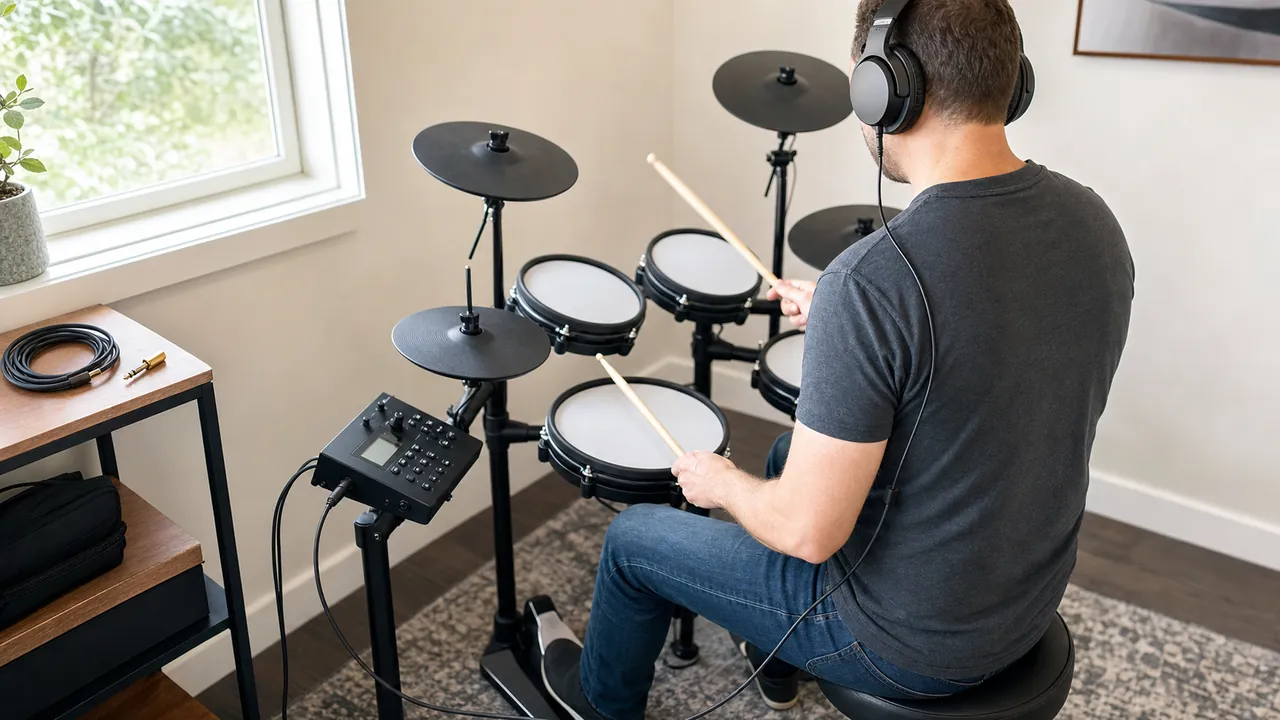
Best headphones for electronic drums by cable and isolation need
Start at the module socket and the drummer's cable path. A compatible wired connection and a useful acoustic seal matter before any unverified sound preference.
We checked current maker specifications, manuals, warranty pages and specialist-retailer stock. We did not listen through these headphones or assess fit. The player still needs to test seal, clamp, eyeglass interaction, module volume range and cable clearance at the actual kit.
For: home e-kit players, parents assembling a practice setup, and drummers who need pad-strike isolation without relying on Bluetooth.
Avoid if: you have not identified the module's stereo headphone socket. Verify before buying: 3.5 mm or 6.35 mm output, TRS stereo connection, enough clean volume from that module, and a cable route that never crosses sticks, knees, pedals or the throne.
Signal-chain words a proxy buyer must get right
3.5 mm stereo plug
The small headphone plug used on many devices and some drum modules.
It must reach a stereo headphone output, not an unrelated trigger or auxiliary socket.
Read the module label/manual and look for “phones” or a headphone symbol.
Physical fit alone does not prove the socket carries headphone audio.
6.35 mm stereo plug
The larger quarter-inch headphone connection common on music gear.
Several shortlisted headphones use a 3.5 mm plug with a supplied 6.35 mm adapter.
Seat a screw-on adapter fully and avoid stacking loose adapters.
Quarter-inch can also be mono; the headphone path normally needs a stereo TRS plug.
TRS
Tip-ring-sleeve: three conductive sections carrying left, right and common return for ordinary stereo headphones.
A mismatched mono or headset wiring scheme can produce missing or odd channel behavior.
Use the supplied stereo cable/adapter and the module's documented phones output.
More rings are not automatically better; a four-pole phone headset plug can complicate adapters.
Closed-back
Solid outer earcups rather than open perforated cups.
Closed cups usually reduce some acoustic pad noise and limit headphone spill.
Check the seal around hair, glasses and ears while playing.
Closed-back is not a measured isolation rating.
Passive isolation
Physical reduction from cups, pads and seal, without electronic noise cancellation.
Less pad clack reaching the ear can reduce the temptation to turn the module up.
Compare with the module muted first, then set a moderate listening level.
A catalog dB figure depends on frequency and test method; it is not a universal fit result.
Impedance
An electrical load stated in ohms.
The module and headphone combination affects available level; higher ohms do not mean higher quality.
Check the module manual and buy from a seller with a return path if output capability is unclear.
Frequency response and impedance do not predict how loud a specific module will drive the headphones.
Attached cable
A lead permanently wired into the earcup.
It cannot be swapped quickly if the plug or cable is damaged.
Use strain relief and confirm the length reaches without pulling.
An attached lead is not automatically stronger than a detachable one.
Detachable cable
A lead that unplugs at the headphone as well as the module.
Length can be changed and a damaged lead may be replaceable, but the earcup connector may be proprietary.
Confirm the exact replacement part, not merely “a 3.5 mm cable.”
Detachable does not guarantee universal cable compatibility.
Trace the cable from earcup to module
Do this at the assembled kit with the throne set to playing height. The useful length is the route around the body and stands, not the straight-line distance.
Find the stereo phones output in the module manual. Record 3.5 or 6.35 mm.
Use the maker-supplied stereo adapter where possible. Avoid an unstable tower of converters.
Turn to the hi-hat, ride and floor-tom positions. The lead must stay outside stick and knee travel.
Route behind the shoulder or throne side, leaving enough movement without a loop near pedals.
No-JavaScript result: if the route needs more than the supplied lead, use a suitable stereo extension with strain relief and test both channels before practice. Do not substitute Bluetooth for module monitoring unless the module and headphones document a low-latency path; ordinary Bluetooth delay can disturb timing.
Four current ways to solve the monitoring job
The dB, impedance and cable fields are factual. “Sounds good for drums” remains a player test because this project did not audition the products.
| Model | Connection | Isolation evidence | Cable / parts | Best lane |
|---|---|---|---|---|
| Alesis DRP100 | 3.5 mm TRS; 6.35 mm adapter | Closed over-ear; no numeric maker attenuation | Attached 1.8 m cable; replacement pads not documented | Budget drum-specific start |
| Vic Firth SIH3 | 3.5 mm stereo; 6.35 mm adapter | Maker states 25 dB outside-noise reduction | Cable length and detachability not stated on checked maker page | Stronger passive-reduction brief |
| Roland VMH-D1 | 3.5 mm cable; 6.35 mm adapter | Closed over-ear; seal claim without numeric attenuation | Detachable 3 m and 1.5 m cables; cable restraint | Purpose-built e-drum routing |
| Audio-Technica ATH-M50x Black | 3.5 mm cables; screw-on 6.35 mm adapter | Closed over-ear; no numeric maker attenuation used | Three detachable cable lengths; replacement accessories documented | One headphone for kit and studio |
Choose by the failure you want to avoid
Low-cost electronic-drum monitoring with both plug sizes in the box
Alesis DRP100
Alesis specifies a closed over-ear design, 32-ohm load, attached 1.8 m lead, 3.5 mm stereo plug and 6.35 mm adapter. Sweetwater showed it in stock. It is the direct budget route when that fixed cable reaches safely.
Avoid if: 1.8 m creates tension at the throne or you want user-swappable cables.
Alternative: Roland VMH-D1 for two detachable lengths and a supplied cable restraint.
Support: official product/support pages plus current Sweetwater stock and five-review popularity signal.
Documented passive reduction when pad clack dominates
Vic Firth SIH3
Vic Firth states 25 dB of outside-noise reduction and supplies 3.5 mm stereo plus a 6.35 mm adapter. Thomann's drummer-headphone category showed 37 ratings and Sweetwater showed the current SIH3 in stock.
Avoid if: the pads do not seal around glasses/hair, or the seller cannot confirm cable reach and replacement options.
Alternative: VMH-D1 when routing and detachable leads matter more than a numeric passive-reduction brief.
Support: maker specification and current Thomann/Sweetwater market signals; missing ownership fields stay explicit.
Purpose-built e-drum cable management
Roland VMH-D1
Roland includes 3 m and 1.5 m detachable cables, a quarter-inch adapter and a restraint intended to route the lead away from limbs. Its 32-ohm specification and current multi-retailer stock make it the clearest complete e-kit package.
Avoid if: the earcups or headband fail a seated 20-minute fit trial, or no seller in your region stocks the exact replacement lead.
Alternative: ATH-M50x if three supplied cables and broad studio use matter more than kit-specific routing accessories.
Support: current Roland specification, Sweetwater in-stock state with eight reviews, and Thomann's 35-rating listing.
Shared electronic-drum and recording use with cable choice
Audio-Technica ATH-M50x Black
The exact wired black ATH-M50x has 38-ohm impedance, three detachable leads (1.2 m straight, 3 m straight and 1.2-3 m coiled), a 6.35 mm adapter and documented replacement accessories. That flexibility is useful across a compact kit and desk.
Avoid if: pad noise still intrudes at a moderate module setting or the proprietary locking cable socket complicates local replacements.
Alternative: SIH3 for a documented attenuation brief, or VMH-D1 for drum-specific cable restraint.
Support: official technical sheet plus immediate Thomann/Sweetwater orderability and 1,906/276 retailer review signals.
Isolation is a seal test, not a volume contest
Mute the module and play the pads for thirty seconds. If glasses, hair or ear shape open a gap, a strong catalog claim may not translate to the head. Then restore the module at a modest setting. Turning up to bury pad noise defeats the reason for seeking isolation.
These are monitoring tools, not hearing-protection guarantees. A numeric reduction on one model is not a safe-listening certificate, and active noise cancellation is not required for this wired task. Persistent ringing, pain or hearing concern belongs with a qualified hearing professional, not a product guide.
Run the silent-kit connection rehearsal
Before the return window closes, power the module down, route the cable, sit, rotate through every pad and pedal position, and stand up once. Nothing should tug the earcup, pull the module, cross the kick/hi-hat path or catch under a throne leg. Then power up at minimum volume, test left and right channels, and raise level gradually.
Record the exact adapter used, the cable length, the module's normal volume position and whether the seal changes with glasses. This small rehearsal catches connector and movement failures that a desk audition misses.
Headphone build, origin and support record
Unknown fields are useful warnings, not invitations to infer from a brand address.
| Product | Size / weight | Construction | Manufacturing origin | Brand | Warranty |
|---|---|---|---|---|---|
| Alesis DRP100 | Over-ear; item weight and dimensions not disclosed on checked maker page | Closed dynamic, 40 mm drivers, silicone headband, attached 1.8 m cable | Not verified for this exact model; check label | Alesis, Cumberland, Rhode Island; founded 1984; electronic instruments and recording gear | Current US duration not clearly stated on public product page; request written terms before purchase; Sweetwater lists its dealer coverage |
| Vic Firth SIH3 | Over-ear; exact weight and dimensions not disclosed on checked maker page | Padded headband/cups, 50 mm dynamic drivers, 3.5 mm plug and 6.35 mm adapter | Not verified for exact SIH3; brand location is not origin proof | Vic Firth Company, part of Zildjian in Massachusetts; founded 1963; drumsticks and percussion accessories | No current model-specific written duration found in checked public sources; request terms from authorized seller |
| Roland VMH-D1 | 150 x 85 x 200 mm; 285 g ±5 g | Closed over-ear, 50 mm dual-diaphragm drivers, two detachable cables, restraint and hanger | Not disclosed for this exact model; Roland/V-MODA development locations are not manufacturing evidence | Roland, Hamamatsu, Japan; established 1972; electronic musical instruments | Roland warranty varies by region; US limited warranty page must be checked against product category and proof-of-purchase terms |
| Audio-Technica ATH-M50x Black | Over-ear folding design; 285 g without cable (official sheet; Thomann lists 287 g) | Closed dynamic, 45 mm drivers, swiveling cups, three detachable locking cables | Not verified for the exact current black variant; inspect product label | Audio-Technica, Tokyo, Japan; established 1962; microphones, headphones and audio equipment | Two-year limited end-user warranty shown on current US product family pages; confirm region, seller authorization and exact model coverage |
Why the connector came before the headphones
We started with Thomann's drummer-headphone category and Sweetwater's US electronic-drum/headphone listings, then required current maker specifications for every recommendation. Alesis, Roland and Vic Firth serve drum-specific lanes; ATH-M50x earns the shared-use lane through exact cable and replacement evidence. Popularity signals established current market relevance, not listening quality.
Roland RH-300V was excluded after Roland's current regional page marked it discontinued. Open-back models, Bluetooth-only paths and high-impedance variants with uncertain module drive were also excluded. No recommendation uses frequency range as a sound-quality score.
Before the first practice session
- Open the drum-module manual and identify the phones output and size.
- Confirm the plug and adapter are stereo TRS and seat fully.
- Route slack away from pedal, knee and stick travel.
- Check both channels at minimum volume before raising the level.
- Test passive seal with the module muted; compare with and without glasses.
- Price the exact replacement cable and pads where the design allows replacement.
Module, cable and product sources
- Alesis DRP100 specifications
- Alesis module headphone-output guidance
- Sweetwater DRP100 stock
- Vic Firth SIH3 specifications
- Sweetwater current SIH3 listing
- Thomann drummer-headphone category
- Roland VMH-D1 specifications
- Sweetwater VMH-D1 stock
- Thomann VMH-D1 listing
- Audio-Technica M-series technical file
- Thomann ATH-M50x stock and ratings
- Sweetwater ATH-M50x stock and ratings
- Audio-Technica US warranties
- Roland company history
- Audio-Technica company history
- Roland RH-300V discontinued status
Availability, warranty and included accessories can change by region. Recheck the exact model before ordering. Found an error? Contact Consordini.