Researched
Best open-back headphones by sound, room and source
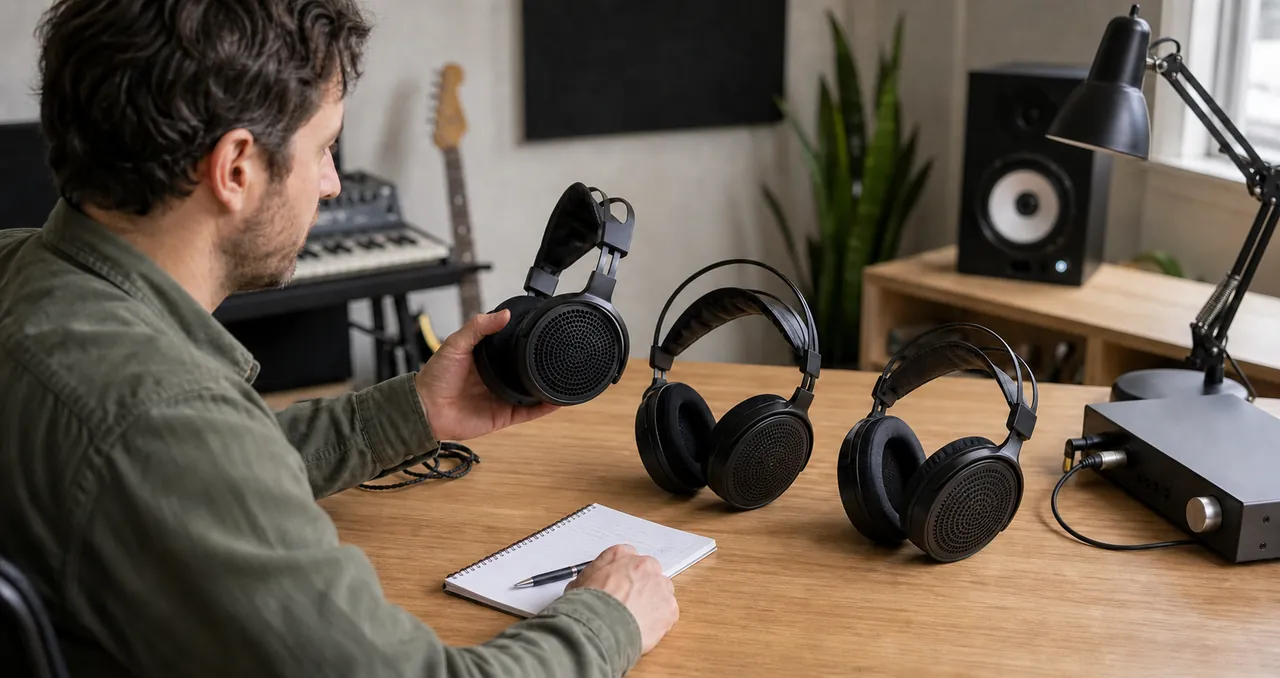
First decide whether the room can tolerate sound traveling through the earcups. Then ask whether measured tonal behavior and the intended source fit your work.
We checked current maker specifications and stock at Sweetwater and Thomann, then read independent measurements and technical reviews for each model. We did not listen to or wear these headphones. Measurements describe a limited number of headphone samples on test fixtures; they cannot guarantee the sound or fit on your head.
Begin with room, response and source
Independent measurements do not have one common sample basis. The HD 560S evidence covers five second-hand current-revision units. The HD 490 PRO, HD 600, DT 900 PRO X and ATH-R70xa sources do not publish physical sample cardinality. A supplied review product, a purchased review product, two pad sets or repeated fixture positions do not prove how many physical headphones were tested. Use every result as evidence about the documented test, not a promise about the delivered pair or your fit.
| Model | Best fit | Impedance | Weight without cable | What was measured, and what was not | Fast rejection test |
|---|---|---|---|---|---|
| HD 560S | Lower-cost, neutral-leaning home listening | 120 ohms | Manufacturer 280 g; Thomann 240 g | Five second-hand post-2022 units measured broadly neutral, with most variation above 4 kHz | Vocal or cymbal balance stays too forward after reseating |
| HD 490 PRO | Modern studio workflow with two pad baselines | 130 ohms | 260 g | SoundGuys, RTINGS and DIY Audio Heaven cover the exact model and both pad sets; none publishes physical sample count | Pad choice, glasses fit or source changes decisions |
| HD 600 | Traditional, mid-focused reference | 300 ohms | Manufacturer 260 g; Thomann 253 g (309 g with cable) | A 2019-version test was relatively neutral and slightly mid-forward, but HeadphoneCheck does not publish its sample count; an older marbled-finish test with unpublished count only corroborates it | Low bass or source output fails the translation check |
| DT 900 PRO X | 48-ohm studio comparison | 48 ohms | 345 g | SoundStage's GRAS procedure found flat response below 1 kHz, extra 2-8 kHz energy and a high-output-impedance shift; sample count not published | Upper-frequency energy redirects decisions |
| ATH-R70xa | Low-weight, high-impedance reference | 470 ohms | 199 g | A purchased review sample measured balanced overall with uneven 4-9 kHz response; physical count was not published | Reseating changes balance or source lacks headroom |
Decode open-back specifications
Open-back
Ear cups allow air and sound to pass through their rear structure. Room noise enters and playback leaks outward. Test at the actual seat with another person or microphone nearby. Open does not automatically mean wider or more accurate.
Sound leakage
Playback audible outside the earcups. It can enter a live microphone or disturb a shared room. Before opening, confirm the seller permits the planned home check; then run a low-volume room test within those rules. Leakage is not active noise canceling in reverse.
Impedance
Electrical opposition, stated here in ohms. It is one part of the source-load relationship. Check the interface or amplifier's headphone-output guidance. Higher impedance does not mean higher quality.
Sensitivity
Output level for a stated electrical input. It helps explain why equal impedance can require different volume settings. Compare only figures using the same units and test headroom. Impedance alone does not predict loudness.
Dynamic driver
A diaphragm moved by a voice coil in a magnetic field. All five recommendations use dynamic drivers. Choose by whole headphone and use case, not driver prestige. Driver type does not provide a sound-quality rank.
Detachable cable
A lead that disconnects from one or both earcups. Damage need not retire the whole headphone. Check connector type and replacement availability. Detachable does not mean every third-party cable fits.
Reference headphone
A model intended to provide repeatable information for attentive listening. It can be one comparison point in a studio or home system. Check work on speakers and another known playback system. No headphone guarantees mix translation by itself.
Choose the constraint you can verify
Sennheiser HD 560S
DIY Audio Heaven measured five second-hand units of the current post-2022, 1.8 m-cable revision as broadly neutral and extended. Most variation appeared above 4 kHz, so audition the delivered pair rather than treating those used samples as a factory-new production survey.
Advantage: the measurements cover the current revision, while 120-ohm loading, replaceable pads and stock in both regions make ownership practical.
Tradeoff: upper-frequency balance varied among the five measured units, their prior use and pad history are not a controlled new-product baseline, and published weight differs: Sennheiser lists 280 g while Thomann lists 240 g.
Avoid if: familiar vocals or cymbals remain too forward after three cup reseats, your source lacks useful level control, or leakage fails.
Compare with: DT 900 PRO X for a 48-ohm option with a separately measured upper-frequency profile.
What the measurements cannot tell you: all five current-revision units were second-hand. Their spread is useful, but it cannot isolate factory variation from wear, pad age or previous use; the earlier-revision RTINGS result is corroboration only.
Sennheiser HD 490 PRO
SoundGuys used and measured the exact model with both supplied pad sets for a week; RTINGS publishes current Test Bench 2.3 results; DIY Audio Heaven measures both pads and compares the HD 490 PRO directly with HD 600, DT 900 PRO X and post-2023 HD 560S. None publishes physical sample cardinality, but together they make this the strongest current studio-workflow evidence in the shortlist.
Advantage: two documented pad baselines, 130-ohm loading, a detachable mini-XLR cable that can enter either cup, washable pads and current stock at both regional anchors. It was cheaper than HD 600 in the US during this review and only EUR 24 more in Germany.
Tradeoff: the Producing and Mixing pads change the tonal baseline, SoundGuys found pad removal required more force than expected, and no source proves production consistency or long-term clasp durability.
Avoid if: you want one fixed baseline, glasses or reseating change low-bass decisions, or you will not label and compare both pad sets on the intended source.
Compare with: HD 600 only when you deliberately want its traditional mid-focused presentation; compare with DT 900 PRO X when 48-ohm loading and a simpler one-pad baseline matter more.
What the evidence cannot tell you: a maker-supplied review product, a unit label, repeated positions and two pad sets do not reveal physical sample count. The findings cannot predict your fit, delivered-pair variation or long-term pad-clasp wear.
Sennheiser HD 600
HeadphoneCheck's identified 2019-version test characterized the balance as relatively neutral and slightly mid-forward. RTINGS measured the older marbled-finish generation and reported bass roll-off and strong response consistency, useful corroboration but not proof that every current unit is identical. Neither source publishes physical sample count.
Advantage: a long-running, replaceable-cable design with a 2019-version technical review and deep regional owner history for buyers who specifically know they want this presentation.
Tradeoff: low-bass level and 300-ohm source headroom need a direct comparison. Published weight also conflicts: Sennheiser says 260 g without cable; Thomann says 253 g without and 309 g with cable.
Avoid if: a familiar low-bass decision fails to match known speakers, or the intended interface runs near maximum at normal level.
Compare with: HD 490 PRO first for a modern studio workflow with stronger exact-model evidence, two pad baselines and lower checked US price; HD 650 is the serious adjacent 300-ohm audition.
What the measurements cannot tell you: HeadphoneCheck does not publish how many 2019-version units its assessment represents. RTINGS also does not publish physical sample count for its older marbled-finish test, which cannot stand in for every current pair.
Beyerdynamic DT 900 PRO X
SoundStage measured the DT 900 PRO X with a documented GRAS ear-and-cheek fixture, analyzers and amplifier procedure. The measured response was broadly flat below 1 kHz, had more 2-8 kHz energy than the cited target, and changed tonally with a high-output-impedance source. The source does not publish physical sample count, so your intended source and response to the upper frequencies need a direct check.
Advantage: 48-ohm loading, two cable lengths and named replacement systems support repeatable studio use on suitable low-output-impedance gear.
Tradeoff: 345 g is 146 g heavier than ATH-R70xa, and the measured upper-frequency energy will not suit every listener.
Avoid if: vocal presence or cymbals redirect your decisions against known speakers, or the intended amplifier has high output impedance.
Compare with: DT 990 PRO X before paying more. It keeps the 48-ohm, detachable mini-XLR proposition for USD 229.99/EUR 199 on the checked pages, but its exact-model test found substantially elevated treble and stronger output-resistance sensitivity. Choose DT 900 PRO X only when its more even source-owned measurement profile and second supplied cable matter more than that saving.
What the measurements cannot tell you: SoundStage does not publish how many physical DT 900 PRO X headphones the results represent. The documented GRAS fixture enables repeatable tests, but it does not reveal sample count, establish production consistency or predict your ear response and fit.
Audio-Technica ATH-R70xa
Unheard Lab averaged multiple GRAS positions for a purchased ATH-R70xa review sample and found good overall tonal balance with uneven response from 4-9 kHz. The documented procedure supports a trial, while unpublished physical count and the reviewer fit concern keep the recommendation narrow.
Advantage: 199 g without cable is the lowest published weight here, with independent measurements and current stock in both regions.
Tradeoff: 470 ohms requires a check on your source, physical sample count was not published, and fit cannot be inferred from weight.
Avoid if: three cup reseats change vocal or cymbal balance, the headband moves during normal head motion, or the source lacks headroom.
Compare with: ATH-R50x first unless the last 11 g is decisive. It was USD/EUR 169 on the checked pages, weighs about 210 g and is much easier to drive; its exact-model measurement reported a strong 6-10 kHz peak, while the R70xa source reported a less settled 4-9 kHz region. The R70xa lane is for the buyer who verifies that its 199 g chassis and measured overall balance justify the price and 470-ohm source burden.
What the measurements cannot tell you: purchased status and repeated fixture positions do not reveal physical sample count; upper-frequency perception, fit and source adequacy still require a personal check only when the exact seller's rules allow it.
Where open-back is the wrong tool
These headphones do not isolate a commuter from traffic or a performer from a loud room. Playback can spill into a nearby vocal or acoustic-instrument microphone, while room noise can mask quiet details. For tracking beside open microphones, travel, office privacy or shared nighttime listening, start with an appropriate closed-back design instead.
Clear the room, then choose between models
Begin with a leakage walk
Play familiar material at a moderate level while another person listens from the nearest occupied seat.
Do the doorway leakage walk
At a moderate repeatable level, have a second person move from the desk to the nearest occupied seat and doorway. Record where words or rhythm become recognizable. That map is more useful than the word “open.”
Make a source headroom card
For each laptop, interface or amp, write connector, normal knob position and whether quiet masters still leave adjustment room. Do not infer this from impedance alone; use the exact source and headphone pair.
Use a three-system translation triangle
Keep one familiar speaker pair and one everyday playback device beside the candidate headphone. Note only decisions that survive all three. The headphone becomes a reference point, not a claim of automatic translation.
Run a four-pass audition passport
Confirm permission before opening. Sweetwater generally uses about 30 days for new products, but requires return authorization, received condition, accessories and packaging, may deduct outbound shipping and may apply item exceptions. Thomann says headphones can be tested at home under its 30-day program, while its formal terms still require original packaging, all accessories and no signs of use and retain hygiene and country conditions. Confirm the exact seller, country, item, opening and wear allowance, refund form, return shipping and packaging rules before using the headphones. Do not borrow these terms for another seller.
- Source: use the exact laptop, interface or amp. Record normal knob position and whether quiet material leaves control room.
- Fit: record the headband setting, pad opening against your ear, seal around glasses, clamp hot spots and movement after 20 minutes. Published weight and unspecified external dimensions cannot answer these questions.
- Sound: level-match a vocal, low-bass passage and cymbal-heavy passage. Reseat three times, then compare the same decisions on known speakers.
- Value and support: write the current checkout price, included cables, replacement-pad availability, confirmed return remedy and cost, and the warranty that applies to your seller and country. A cheaper pair that fails fit or needs another amplifier is not the lower-cost choice.
| Compare | Favor the first when | Favor the second when | Decision that must survive the audition |
|---|---|---|---|
| HD 560S vs DT 900 PRO X | Lower purchase cost and evidence across five second-hand current-revision units matter most | 48-ohm loading, two supplied cable lengths and named spares matter most | Which upper-frequency balance changes fewer vocal and cymbal decisions on your source? |
| HD 490 PRO vs HD 600 | You want the stronger current exact-model record, two pad baselines and a modern detachable-cable workflow | You deliberately want the traditional mid-focused presentation and accept the 300-ohm source check | Which choice produces stable bass, vocal and cymbal decisions without pad or source surprises? |
| HD 490 PRO vs DT 900 PRO X | Two pad baselines and 260 g published weight help the workflow | 48-ohm loading, one baseline and named Beyerdynamic spares matter more | Does either upper-frequency presentation redirect decisions against known speakers? |
| HD 560S vs HD 600 | You want lower impedance and current-revision measurements | You want the established mid-focused reference and deeper retailer-owner history | Does the HD 600's low bass and required knob position justify its price on your system? |
| HD 600 vs ATH-R70xa | You value mature regional owner history and a 300-ohm reference | The 199 g published weight and multi-position review earn a closer fit trial; physical count was not published | Which pair stays put, leaves source headroom and produces more stable low-bass decisions? |
| DT 900 PRO X vs ATH-R70xa | Lower impedance and replaceable studio hardware outweigh extra head weight | Low published weight outweighs the need to verify a 470-ohm source | After reseating, which upper-frequency presentation agrees better with known speakers? |
Check fit, construction and support before paying
| Product | Size and weight | Construction | Manufacturing origin | Brand | Written support |
|---|---|---|---|---|---|
| Sennheiser HD 560S | Over-ear; 280 g maker / 240 g Thomann; 120 ohms | Dynamic open cups, velour pads, detachable 1.8 m cable | Exact current SKU origin not disclosed by manufacturer; inspect label | Sennheiser; Germany; founded 1945 | US consumer-audio manufacturer policy: 24 months for the initial end user buying from an authorized seller; Sonova handles service, inbound shipping is buyer-paid, and ear cushions or headphone padding, cable clips, misuse and unauthorized repair are excluded. Transfer is not promised. German Thomann purchases have separate 36-month, consumer-only, non-assignable seller coverage for material or manufacturing defects. |
| Sennheiser HD 490 PRO | Over-ear; 260 g; 130 ohms | Dynamic open cups; washable Producing and Mixing pads; detachable mini-XLR cable can connect to either cup | Exact current SKU origin not published in the checked maker specification; inspect label | Sennheiser; Germany; founded 1945 | Sennheiser professional-product warranty: 24 months for a new product bought from an authorized retailer; Sennheiser's professional repair portal handles claims. Ear cushions or headphone padding and cable clips are excluded, but the policy does not exclude cables generally. Liability is limited to purchase value and excludes financial loss, downtime, rental gear, travel costs and lost profit. German Thomann purchases have separate 36-month seller coverage. |
| Sennheiser HD 600 | Over-ear; maker 260 g / Thomann 253 g without cable and 309 g with cable; 300 ohms | Dynamic open cups, velour pads, detachable two-sided cable | Assembled in Ireland; verify exact unit label | Sennheiser; Germany; founded 1945 | US consumer-audio manufacturer policy: 24 months for the initial end user buying from an authorized seller; Sonova handles service, inbound shipping is buyer-paid, and ear cushions or headphone padding, cable clips, misuse and unauthorized repair are excluded. Transfer is not promised. German Thomann purchases have separate 36-month, consumer-only, non-assignable seller coverage for material or manufacturing defects. |
| Beyerdynamic DT 900 PRO X | Over-ear; 345 g; 48 ohms | STELLAR.45 dynamic driver, velour pads, mini-XLR cables | Made in Germany | Beyerdynamic; Heilbronn; founded 1924 | US Sweetwater seller coverage is 24 months for the original buyer, non-transferable, handled by Sweetwater, with both-way shipping buyer-paid; wear, abuse and consumables are excluded. Sweetwater also disclaims lost work, studio time, wages and related ancillary losses. German Thomann purchases have separate 36-month, consumer-only, non-assignable seller coverage for material or manufacturing defects, with free repair or replacement as the stated guarantee remedy. |
| Audio-Technica ATH-R70xa | Over-ear; 199 g; 470 ohms | 45 mm dynamic driver, metal/carbon frame, detachable 3 m cable | Handcrafted in Machida, Japan | Audio-Technica; Tokyo; founded 1962 | US manufacturer: two years for the end user of select products bought from an authorized US dealer; A.T.U.S. or an authorized center handles service, delivery is prepaid by the buyer, and wear, abuse, shipping damage, misuse and unauthorized repair are excluded. To the extent state law permits, the policy disclaims consequential, incidental, direct and special damages. German Thomann purchases have separate 36-month, consumer-only, non-assignable seller coverage for material or manufacturing defects, with free repair or replacement as the stated guarantee remedy. |
What headphone measurements can and cannot predict
Controlled measurements are useful for comparing broad tonal balance and checking whether an amplifier's output impedance changes the result. They cannot duplicate your ears, show whether the cups sit comfortably on your head, or prove that a headphone will help your work translate. Treat the graphs as a starting point, then use only the checks that your exact seller permits on your own source.
The amount of testing differs by model. The HD 560S comparison covers five second-hand post-2022 units, so wear and pad history may contribute to the spread. SoundGuys, RTINGS and DIY Audio Heaven cover the exact HD 490 PRO and both supplied pad sets, but none publishes physical sample cardinality. HeadphoneCheck and the older marbled-finish RTINGS review do not publish physical HD 600 sample counts. SoundStage publishes its DT 900 PRO X fixture and procedure but not physical count. Unheard Lab says its ATH-R70xa review sample was purchased and reports several fixture positions, but neither fact establishes cardinality.
Current stock and owner-review counts help show that a model is still supported and widely considered. They do not establish tonal accuracy, comfort or durability, which is why every recommendation includes a listening, fit or source check.
Why the shortlist changed
The HD 490 PRO moved into the shortlist after fresh research found three exact-model sources that the previous audit missed. It was USD 429 versus HD 600 at USD 499.95 at Sweetwater, and EUR 339 versus EUR 315 at Thomann, so the earlier blanket claim that it cost more was also wrong. The HD 600 remains only as a narrow traditional mid-focused reference; its 300-ohm rating is a source constraint, not a quality advantage.
The current DT 990 PRO X, legacy DT 990 PRO and HD 650 were also challenged rather than dismissed. DT 990 PRO X shares the winning Beyerdynamic's 48-ohm driver platform and detachable mini-XLR cable at a lower checked price, but its exact-model source found a much sharper treble presentation and stronger source-output-resistance effect; it is the better bargain only for a buyer who wants that revealing check or will use corrective EQ. The legacy DT 990 PRO remains cheaper and far more reviewed but adds a fixed cable and 250-ohm source burden. HD 650 remains a serious adjacent 300-ohm audition, while the current K712 PRO replaces unavailable-US K702 in the two-region studio challenge.
Six checks within the seller's confirmed rules
- Test leakage from the nearest occupied seat and any live microphone position.
- Use the exact intended interface, laptop or amplifier; confirm comfortable level with control remaining.
- Level-match the candidate, known speakers and an everyday playback device; compare familiar vocal, low-bass and cymbal passages.
- Reseat the cups three times. Reject the pair if tonal decisions shift with position or fail to translate.
- Wear the pair through one normal session and record clamp, pad contact, heat and movement without treating weight as a comfort guarantee.
- Before opening, confirm the exact seller, country, item, wear, hygiene, condition, packaging, refund and shipping rules; then follow only the test those rules permit.
Sources to recheck before ordering
Checked July 20, 2026. Stock, prices, ratings and support terms can change. Independent measurements describe tested samples and fixtures, not guaranteed personal results.
- Sennheiser HD 560S
- Sweetwater HD 560S
- Thomann Germany HD 560S
- Sweetwater HD 600
- Thomann Germany HD 600
- Sennheiser HD 600 manual
- Beyerdynamic DT 900 PRO X
- Sweetwater DT 900 PRO X
- Thomann Germany DT 900 PRO X
- Audio-Technica ATH-R70xa
- Sweetwater ATH-R70xa
- Thomann Germany ATH-R70xa
- ATH-R70xa manual
- Audio-Technica US two-year warranty
- Sennheiser HD 600 official page
- Sweetwater HD 560S owner reviews
- Sweetwater HD 600 owner reviews
- Sweetwater DT 900 PRO X owner reviews
- Sweetwater ATH-R70xa owner reviews
- DIY Audio Heaven HD 560S measurements
- HeadphoneCheck HD 600 technical review
- SoundStage DT 900 PRO X measurements
- Unheard Lab ATH-R70xa measurements
- RTINGS response-consistency method
- RTINGS HD 560S measurements
- RTINGS HD 600 measurements
- Sennheiser US warranty details
- Sweetwater two-year coverage terms
- Thomann Germany three-year warranty terms
- Sweetwater HD 490 PRO
- Sweetwater HD 490 PRO owner reviews
- Thomann Germany HD 490 PRO
- Sennheiser company history
- Beyerdynamic company history
- Audio-Technica official history document
- Sennheiser HD 490 PRO specification
- SoundGuys HD 490 PRO review and measurements
- RTINGS HD 490 PRO measurements
- DIY Audio Heaven HD 490 PRO measurements
- Sweetwater DT 990 PRO
- Thomann Germany DT 990 PRO
- RTINGS DT 990 PRO measurements
- Sweetwater HD 650
- Thomann Germany HD 650
- RTINGS HD 650 measurements
- Sweetwater returns and exchanges
- Thomann Germany money-back terms
- Thomann headphone home-test guidance
- Thomann Germany AKG K702
- Sweetwater AKG K702 availability record
- Sennheiser professional warranty terms
- Sennheiser HD 490 PRO service catalog
- Beyerdynamic DT 990 PRO X
- Sweetwater DT 990 PRO X
- Thomann Germany DT 990 PRO X
- DIY Audio Heaven DT 990 PRO X measurements
- Sweetwater AKG K712 PRO
- Thomann Germany AKG K712 PRO
- RTINGS AKG K712 PRO test
- DIY Audio Heaven ATH-R50x measurements