Four system roles, not a power podium
Best Headphone Amps for Analog Desks, Digital Sources, and Portable USB
Choose JDS Labs Atom Amp 2 when you already have an analog line source, iFi ZEN CAN 3 when analog input and gain flexibility matter, FiiO K7 for a desktop DAC/amp with several digital inputs, or iFi hip-dac 3 for a battery-powered USB chain.
We checked maker specifications, manuals, support terms, and exact-model store pages on . We did not listen to or bench-test these amplifiers. Noise with your headphones, channel balance at your listening level, heat, battery runtime, and sound preference still require a careful trial.
- Start here: write down the source output and headphone plug before comparing amplifier power.
- Avoid if: your current source already reaches a comfortable level cleanly and gives enough volume-control range.
- Verify before buying: input format, output plug, power supply, gain steps, return policy, and regional warranty.
- Jump to the system-role comparison.
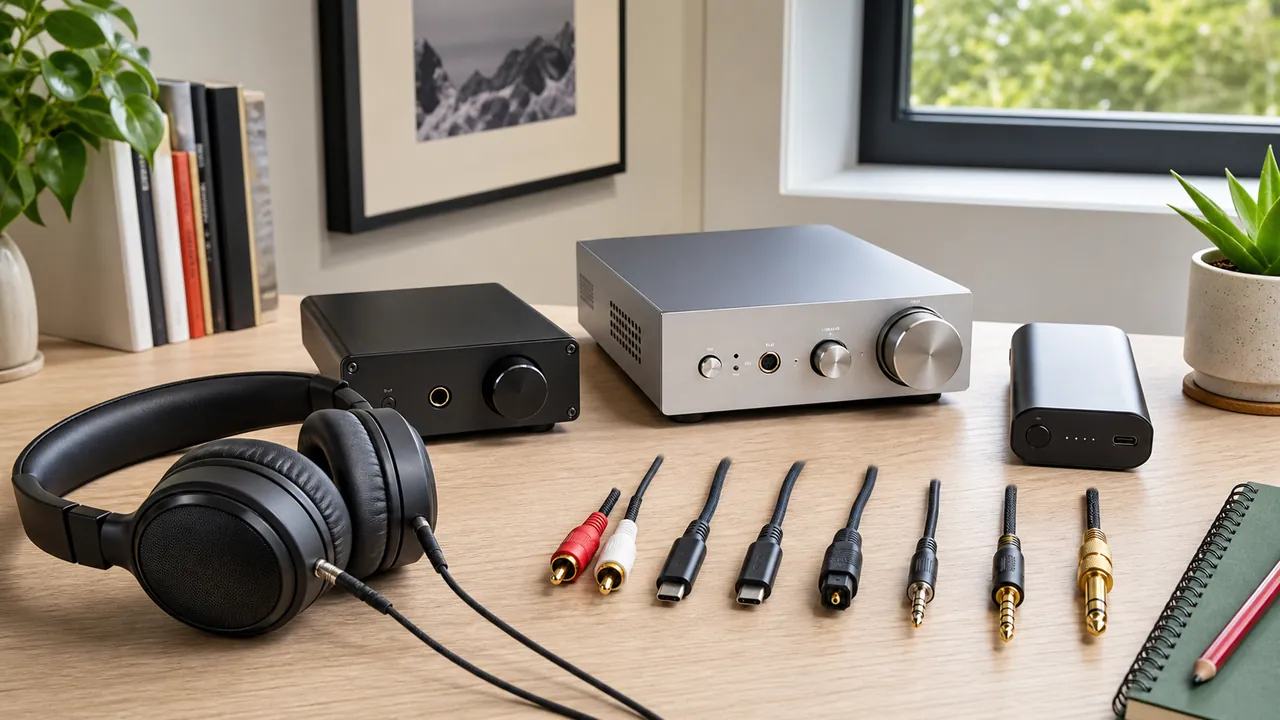
Translate amplifier language into connection decisions
Headphone amplifier
A headphone amplifier raises an analog signal to a level suitable for headphones and provides volume control.
It cannot accept a digital stream unless a DAC is also built in.
Check whether the product is amp-only or a DAC/amp before checking power.
An amplifier does not automatically improve every already-adequate source.
DAC
A digital-to-analog converter turns USB, optical, or coaxial digital audio into an analog signal.
An analog-only amp needs a DAC or another analog line source ahead of it.
Choose the digital input your actual computer, console, streamer, or television provides.
A USB charging socket is not necessarily a USB audio input.
Line output
A line output sends an analog signal intended for another audio component rather than headphones.
It is the normal feed for a separate analog headphone amp.
Confirm whether the source output is fixed or volume-controlled before connecting.
A headphone jack used near maximum is not always equivalent to a documented line output.
Preamp output
A preamp output is a volume-controlled analog feed for powered speakers or another amplifier stage.
It can let one front knob control both headphone and speaker listening workflows.
Check whether plugging in headphones mutes or changes the preamp output.
A preamp output does not directly power passive speakers.
Balanced connection
In this category, balanced may describe internal circuitry, analog inputs, line outputs, or a separate headphone return path.
The same word can refer to different parts of the signal chain.
Match the exact connector and approved wiring at both ends.
A 4.4 mm or XLR plug alone does not prove better audible performance.
Impedance
Headphone impedance is the opposition the headphones present to an audio signal, measured in ohms.
It helps define the electrical load, but it does not determine required loudness by itself.
Read impedance together with sensitivity and the maker's load-specific output figures.
High impedance does not automatically mean difficult, and low impedance does not automatically mean easy.
Sensitivity
Sensitivity describes how much sound a headphone produces from a stated electrical input.
Two headphones with the same impedance can need different gain and volume positions.
Use the headphone maker's sensitivity unit and test conservatively on low gain.
Impedance alone cannot predict the required amplifier setting.
Gain
Gain is the ratio by which the amplifier increases the incoming signal voltage.
Too much gain can compress useful volume-knob travel and make level changes abrupt.
Begin with low gain and raise it only when the clean source signal cannot reach the needed level.
High gain is not a quality mode or an upgrade switch.
How the shortlist keeps unlike systems separate
The candidate pool began with current dedicated and integrated headphone amplifiers documented by their makers and visible through a manufacturer-direct shop or major specialist. An exact model had to answer a distinct source-and-use sentence, publish enough connector and physical information to prevent an obvious mismatch, and remain orderable in the research run. JDS Labs showed 194 direct reviews and regional power selections. iFi marked ZEN CAN 3 as a direct-store best seller, although it had only one direct review and Sweetwater had none. B&H showed K7 in stock with four reviews and hip-dac 3 in stock with five; Thomann's exact hip-dac 3 page was in stock and ranked 72nd in its headphone-amplifier category.
Those uneven counts are popularity and availability signals, not evidence of audio quality. Maximum power did not decide the order either: makers publish output into different loads and sometimes at different distortion thresholds, so the numbers are useful only when matched to a specific headphone requirement. We left Topping A70 Pro out because it repeats the higher-feature analog desktop lane at a higher spend. Tiny cable-style dongles were excluded because they remove the physical volume-control workflow used here, and Bluetooth-only products answer a different source question.
Match the box to the signal that reaches it
This comparison begins at the source. Output figures are included only with their published load conditions; they are not a sound-quality ranking.
| Model | System role | Inputs | Headphone outputs | Main catch |
|---|---|---|---|---|
| JDS Labs Atom Amp 2 | Analog desktop amp and preamp | RCA, 3.5 mm analog | 6.35 mm, 4.4 mm | No DAC or digital input |
| iFi ZEN CAN 3 | Flexible analog desktop amp | RCA, 3.5 mm, 4.4 mm analog | 6.35 mm, 4.4 mm | No DAC; extra modes may be unnecessary |
| FiiO K7 | Integrated desktop DAC/amp | USB, optical, coaxial, RCA analog | 6.35 mm, 4.4 mm | Larger, more complex control hub |
| iFi hip-dac 3 | Battery USB DAC/amp | USB-C audio; separate charging | 3.5 mm, 4.4 mm | No analog, optical, or coaxial input |
Choose the system boundary you can explain
Simple analog amplification for an existing source
JDS Labs Atom Amp 2
Atom Amp 2 fits the reader who already owns a DAC, audio interface, streamer, or other source with a documented analog line output. Its two selectable inputs, low/high gain, two front headphone sockets, and RCA preamp output cover a focused desk without paying again for digital conversion.
- Manufacturer showed the exact model in stock with four regional power selections and 194 direct reviews
- 145 x 131 mm desk footprint and published 0.7-ohm output impedance
Tradeoff: there is no USB, optical, or coaxial input. The 4.4 mm jack is a convenience single-ended output on this model, not a reason to replace a working headphone cable.
Avoid if: the source has only digital output or you want one box to perform conversion and amplification.
Closest alternative: FiiO K7 when the missing part of the chain is a DAC as well as an amp.
Check before ordering: inputs, outputs, gain, dimensions, weight, performance conditions, stock, and the two-year transferable warranty are manufacturer-documented; listening behavior with a particular headphone remains untested.
Analog desk with several source levels and plugs
iFi ZEN CAN 3
ZEN CAN 3 earns the flexible analog lane with RCA, 3.5 mm, and 4.4 mm inputs plus four gain settings from 0 to 18 dB. It suits a desk where analog sources and headphone sensitivity vary, while 6.35 mm and 4.4 mm front outputs reduce routine adapter changes.
- Four gain positions provide more level-matching choices than a two-step control
- Official store and Sweetwater showed the exact product in stock
Tradeoff: it remains analog-only. XBass, XSpace, movie, and game modes add controls that a buyer seeking a minimal straight-through amp may never use. Its current review history is thin, so the direct-store best-seller badge is not a substitute for a home trial.
Avoid if: you need USB, optical, or coaxial input in the same chassis.
Closest alternative: Atom Amp 2 for a simpler, less expensive analog-only desk with fewer gain and input choices.
Check before ordering: the maker page, manual, and technical document agree on connectivity, gain, size, weight, load-specific output, and warranty framework; sound-mode preference is not asserted.
One desktop hub for computers and digital sources
FiiO K7
K7 combines USB, optical, coaxial, and RCA line input with DAC, headphone, line-out, and preamp roles. That makes it the cleanest fit here for a desk that switches between a computer and another digital source without adding a separate converter.
- Input and output selectors keep source choice and speaker/headphone role on the front panel
- B&H showed the exact unit in stock; low/high gain and two headphone sockets are documented
Tradeoff: its approximately 120 x 168 x 55 mm, 610 g enclosure and external power system are desk-bound. The weight is retailer-published, not maker-confirmed. Published 2 W into 32 ohms is measured at 1% distortion and should not be compared casually with differently stated figures.
Avoid if: you already own a DAC you intend to keep, or the amplifier needs to travel in a pocket.
Closest alternative: Atom Amp 2 when all required sources already provide analog line output.
Check before ordering: FiiO's launch specifications, comparison page, FAQ, and dealer notice establish the system role; B&H supplies the current order control and 610 g retail weight. A maker-published unit weight was not found in the cited materials.
Battery-powered USB listening with a real volume knob
iFi hip-dac 3
hip-dac 3 is the portable lane because it accepts USB-C audio, has separate USB-C charging, provides 3.5 mm and 4.4 mm outputs, and keeps a physical volume control in a 135 g battery-powered enclosure. iEMatch attenuation gives sensitive earphones a dedicated starting option.
- 102 x 70 x 14 mm body and maker claim of up to 12 hours per charge
- Exact model was in stock at iFi direct, B&H, and Thomann during research
Tradeoff: USB is the only audio input. Battery runtime depends on load, volume, file, and settings, and a phone-plus-box cable stack is less tidy than a small dongle. One current direct reviewer also reported that the knob can turn in a pocket and runtime fell short of the headline claim; that is an anecdotal warning, not a measured result.
Avoid if: you need optical, coaxial, analog line input, Bluetooth, or a fixed speaker-control desk hub.
Closest alternative: FiiO K7 when portability can be traded for more inputs and a permanent desktop role.
Check before ordering: official product and manual sources support dimensions, weight, battery, inputs, outputs, power conditions, and support; B&H and Thomann supply current exact-model availability evidence.
Fill in a source-to-plug passport before checkout
Write one value in every cell. A blank cell is a support question, not a reason to buy an adapter at random.
1. Source exit
USB-C, USB-A, optical, coaxial, RCA line, or 3.5 mm line. Record whether it carries digital or analog audio.
2. Amp entry
Match the same signal type. USB-to-RCA needs conversion; a passive cable cannot turn digital audio into analog.
3. Headphone plug
Record 3.5, 4.4, 6.35 mm, or XLR and the headphone maker's approved cable wiring.
4. Power and place
Measure chassis, cable projection, power brick access, and whether battery charging can happen during use.
Use a low-gain first-connection rehearsal
Stop playback, turn the amp to minimum, and connect the source and headphones according to both manuals.
Choose the correct input and low gain or attenuation before starting audio.
Start a familiar quiet passage and increase volume gradually to a conservative level.
Note usable knob range, hiss during silence, left/right balance, heat, and whether high gain is actually needed.
Do not hot-swap connectors when a maker warns against it, and do not treat high gain as a listening preset. If the first comfortable level arrives with almost no knob travel, lower source level only according to the product instructions or choose a lower-gain path. Protect your hearing and follow the headphone and amplifier makers' safety guidance.
What the specifications cannot answer at your chair
Power into 32 or 300 ohms is a boundary condition, not a prediction of preferred sound. Headphone sensitivity, the source's line level, gain setting, music dynamics, and desired headroom all matter. Noise can also be inaudible with one full-size headphone and obvious with a sensitive in-ear monitor. A published low output impedance is useful evidence, but it does not replace listening at the actual low-volume positions you use.
Connector count has similar limits. Balanced outputs can provide a different electrical path or more output on a particular design, but the plug does not certify audibility. Compare the approved stock cable first. Then check whether the unit remembers settings, mutes pre-outs when headphones are inserted, produces an acceptable amount of heat, and switches sources without confusing labels. Return terms are part of the decision because these observations are system-specific.
Exact-model size, construction, origin, and support
| Product | Size and weight | Construction | Manufacturing origin | Brand | Warranty/support |
|---|---|---|---|---|---|
| JDS Labs Atom Amp 2 | 145 x 131 x 34 mm including knob; 454 g. | Aluminum chassis and metal knob; external 16/17 VAC adapter; RCA preamp output. | Exact unit origin not established by the cited page; inspect the physical label. | JDS Labs, established in 2007 and based in Collinsville, Illinois, focuses on personal-audio electronics. | Two-year transferable warranty stated on the official product page. |
| iFi ZEN CAN 3 | 158 x 117 x 35 mm; 495 g. | Metal desktop enclosure; analog circuitry; external 5 V/2.5 A supply. | Exact current unit origin not verified; inspect its label rather than inferring from brand location. | iFi audio, founded in 2012 and based in Southport, UK, develops DACs, amps, and audio accessories. | Typically one year in US/UK and two years in EU, subject to regional law and authorized-sale terms. |
| FiiO K7 | About 120 x 168 x 55 mm; B&H publishes 610 g, while a current maker weight was not located. | Metal desktop enclosure; external DC supply; integrated DAC, preamp, line, and headphone stages. | Exact retail-unit origin not verified; company location is not unit-level proof. | FiiO was established in Guangzhou in 2007 and makes portable and desktop personal-audio electronics. | FiiO states one year of free maintenance; local sales-agent terms control the specific service route. |
| iFi hip-dac 3 | 102 x 70 x 14 mm; 135 g. | Aluminum portable enclosure; 2200 mAh lithium-polymer battery; separate audio and charging USB-C ports. | Exact current unit origin not verified; check the physical label. | iFi audio, founded in 2012 and based in Southport, UK, specializes in personal-audio signal products. | Typically one year in US/UK and two years in EU, subject to regional terms; manual states 12 months typical. |
Ask support these exact questions
- Does my source provide a fixed line output, a variable preamp output, or digital audio only?
- Is the listed power adapter correct for my mains region, and is it included?
- Does inserting headphones mute the line or preamp output on this exact firmware/model?
- Is my headphone cable approved for this 4.4 mm output, or should I use the supplied 3.5/6.35 mm path?
- What written manufacturer warranty applies through this authorized seller in my country?
- Can I return the opened unit after a low-level home compatibility check?
Manufacturer documents and store checks
Maker sources control technical identity. Retail pages provide point-in-time ordering evidence only; stock and review counts do not establish audio quality.
- JDS Labs Atom Amp 2 product page
- Atom Amp 2 instructions
- JDS Labs Atom 2 introduction
- JDS Labs company page
- iFi ZEN CAN 3 product page
- ZEN CAN 3 manual
- ZEN CAN 3 technical document
- iFi warranty policy
- FiiO K7 launch specifications
- FiiO K7 FAQ and support
- FiiO K7 comparison specifications
- FiiO warranty terms
- B&H FiiO K7 listing
- iFi hip-dac 3 product page
- iFi hip-dac 3 manual
- B&H iFi hip-dac 3 listing
- Thomann iFi hip-dac 3 listing
- FiiO K7 dealer notice
- Sweetwater iFi ZEN CAN 3 listing