Recording desk guide
Best Studio Monitors by Connection and Desk Size
The useful shortlist starts with the sockets you own, the space two cabinets occupy, and what actually arrives in the box.
We checked exact current manufacturer specifications, manuals, US and German specialist-store pages, seller policies, and limited independent tests. We did not hear or measure these monitors. Tonal balance, imaging, self-noise, pair matching, output in your room, and long-term reliability still need a return-safe, level-matched audition.
Researched for US and continental-European buyers.
Bottom line: ADAM D3V is the compact direct-USB linked pair; Yamaha HS5 is the shallow XLR/TRS choice; ADAM T5V fits an XLR or RCA source; Kali LP-6 V2 earns the larger nearfield lane with XLR, TRS, RCA, eight placement presets, and a stated 0.5-2.5 m listening range.
Avoid buying yet if: you cannot place two speakers symmetrically, identify left and right outputs, or tell whether the listing price is for one monitor or a pair.
Verify before paying: write the connector at each end of both audio cables, the quantity in the listing, and the cabinet depth plus cable bend. “Balanced monitor” does not make an RCA or headphone cable balanced.
Signal-chain language that changes the purchase
A monitor can be excellent and still be wrong for the sockets, distance, and space you have. These terms let a musician or gift buyer check the whole chain.
Active monitor
A speaker with amplification built into its cabinet or powered primary unit.
It needs mains power as well as an audio signal; most full-size models are sold singly.
Count power outlets, audio cables, and speakers in the listing.
“Powered” does not mean wireless or USB-equipped.
Balanced connection
An analog cable path designed to reject interference, usually XLR or three-conductor TRS.
It is the normal interface-to-monitor path when both devices provide balanced sockets.
Read the output label on the interface and input label on each monitor; buy the cable by both ends.
A TRS-shaped socket may serve another function, and RCA remains unbalanced.
Nearfield
Listening close enough that the direct sound is a major part of what reaches you.
Desk depth and speaker spacing set the useful geometry.
Measure speaker-to-ear and speaker-to-speaker distances before ordering stands.
Nearfield does not cancel room reflections or poor placement.
Frequency response tolerance
The decibel boundary attached to a quoted frequency span, such as -6 dB or ±3 dB.
Two “45 Hz” claims are not directly comparable when the tolerances differ.
Keep the tolerance with the number in every comparison.
The lowest printed frequency is not a promise of equal-level bass.
Boundary EQ
Preset filters intended to adjust the monitor for desk or wall placement.
It gives a documented starting point when the ideal free-space position is impossible.
Use the manual's closest placement diagram, then audition familiar material.
It is not full room correction and cannot fix asymmetry or severe reflections.
Sold each / sold as a pair
The package may contain one independently powered speaker or a linked stereo system.
It changes the real order quantity, cable count, controls, and total cost.
Confirm package contents in writing; HS5, T5V, and LP-6 V2 listings are commonly per monitor, while D3V is a linked pair.
A product photo showing two speakers does not prove two are in the box.
Four lanes, then a current-market challenge
We defined four practical systems first: a compact direct-to-computer pair, a shallow conventional monitor with XLR and TRS, a 5-inch model that also accepts consumer RCA, and a larger 6.5-inch nearfield with all three common analog sockets and detailed placement presets. Every winner then needed an exact current product or manual, explicit package quantity, cabinet measurements, a direct Sweetwater US page, a direct Thomann Germany page, and a support path.
We restarted discovery from Thomann's separate daily-sales and availability ranking rather than treating the old shortlist as the market. At the final check, Yamaha HS5 ranked 1st, ADAM T5V 3rd, ADAM D3V Black 8th, and Kali LP-6 2nd Wave 9th; JBL 305P MkII ranked 5th and remains a serious alternative. Sweetwater's exact pages showed 28 D3V, 73 HS5, 43 T5V, and 53 LP-6 V2 reviews. Rank and review volume establish current buyer attention, not accuracy or suitability.
Each lane challenged the other three winners and JBL's current 305P MkII. We kept a winner only when its connection, package, depth, listening-distance guidance, or placement controls changed the buying decision. That is why this guide does not declare one monitor “best sounding” from specifications or popularity.
Connection table: start at the source, not the speaker
Every path below is exact to the current model. Use the “package” column before multiplying cables or stands.
| Model | Exact audio inputs | Package | Cabinet / listening clue | Buyer meaning |
|---|---|---|---|---|
| ADAM D3V | USB-C digital; two balanced 1/4-inch TRS analog inputs on primary | Linked stereo pair | 115 x 200 x 150 mm each; 240 mm high on stand | Simplest direct computer path; USB-C cannot route a subwoofer. |
| Yamaha HS5 | One balanced XLR and one balanced 1/4-inch TRS per monitor | Single monitor | 170 x 285 x 222 mm; 54 Hz at -10 dB | Clean fit for interfaces with two balanced line outputs. |
| ADAM T5V | One balanced XLR and one unbalanced RCA per monitor | Single monitor | 179 x 298 x 297 mm; 45 Hz at -6 dB | Useful when you need pro XLR or a separate consumer RCA path. |
| Kali LP-6 V2 | One balanced XLR, one balanced TRS, one unbalanced RCA per monitor | Single monitor | 222 x 359 x 260 mm; 47 Hz at ±3 dB; 0.5-2.5 m | Most analog flexibility here, but one input at a time and a larger footprint. |
Four setups, and where each stops making sense
For a compact computer desk
ADAM Audio D3V
D3V is the only linked pair here and the only model with direct class-compliant USB-C audio. The primary speaker also accepts two balanced TRS analog feeds and drives the secondary through the included 2 m connection cable. Both checked retailer pages identify the black configuration as one pair.
- Pair, stands, inter-speaker cable, and USB cables included
- Front volume and headphone control
- 3.5-inch woofer system
- USB-C path cannot insert a conventional subwoofer
Avoid if: you need wide speaker spacing beyond the supplied link cable or a normal analog subwoofer loop while using USB.
Alternative: HS5 plus an interface or monitor controller gives two independent cabinets and conventional balanced routing.
Official sources establish the package and signal path. Sound On Sound reviewed an exact D3V pair, but the physical sample count is unpublished and the checked review is not a substitute for independent anechoic data or a test in your room.
Found a changed specification or source? Report a correction.
For a conventional balanced interface chain
Yamaha HS5
Each HS5 provides balanced XLR and balanced TRS input, a compact 222 mm cabinet depth, and simple room-control/high-trim switches. That makes the cable path easy to audit when an interface already supplies left and right balanced outputs. The selected black listings are sold one monitor at a time.
- XLR or TRS balanced input
- First in the checked daily-sales/availability rank
- No RCA or USB input
- 54 Hz figure is at -10 dB, so do not compare it directly with -3 dB or -6 dB limits
Avoid if: your source has only USB or consumer RCA and you do not plan to add an interface or controller.
Alternative: D3V accepts USB-C; T5V accepts RCA; JBL 305P MkII deserves a same-room audition if price matters more than the HS5's shallow cabinet.
Sonarworks measured HS5 systems in five studios, useful evidence that rooms alter the result. The number of physical monitor units and all configurations were not fully published, so those measurements do not establish pair matching or your room response.
For XLR now and RCA when needed
ADAM Audio T5V
T5V pairs a balanced XLR input with an unbalanced RCA input, rather than offering TRS. Its published 45 Hz-25 kHz range carries a -6 dB tolerance, and the rear shelf controls are simpler than Kali's placement matrix. Both selected listings are black single monitors.
- Exact XLR and RCA paths
- ADAM warranty can reach five years after qualifying registration
- 297 mm cabinet depth before cable clearance
- No TRS or digital input
Avoid if: your interface has TRS outputs and you do not want TRS-to-XLR cables, or the rear port and cable bend crowd the wall.
Alternative: HS5 accepts TRS directly; LP-6 V2 accepts all three analog connector types.
An independent Sound & Recording lab review measured the exact T5V, but the physical sample count is unpublished and the copy is hosted by ADAM. Treat it as limited corroboration, not proof of pair consistency, preferred tonality, or room fit.
For a larger nearfield and detailed boundary presets
Kali Audio LP-6 V2
The 2nd Wave LP-6 accepts balanced XLR, balanced TRS, or unbalanced RCA and documents eight placement presets. Its manual sets a 0.5-2.5 m recommended listening distance and a 47 Hz-21 kHz ±3 dB range. Sweetwater calls the exact black single “V2”; Thomann calls it “2nd Wave,” matching the generation language in Kali's manual.
- Widest analog input choice here
- Desk and wall placement matrix in the exact-generation manual
- Largest cabinet in this shortlist
- Only one input should be connected at a time
Avoid if: the 222 x 359 x 260 mm cabinets force a cramped or asymmetric desk, or you need instant source switching.
Alternative: D3V is a much smaller linked desktop system; HS5 is shallower; JBL 305P MkII is a serious cheaper balanced-path audition if RCA and Kali's placement matrix do not matter.
Erin's Audio Corner measured an exact LP-6 V2 by Klippel NFS with XLR input, level at 0 dB, and free-field switches. Kali loaned the review product and the physical sample count is unpublished; one laboratory setup cannot establish unit variation, idle noise for every sample, or response in your room.
What the performance evidence can actually answer
Anechoic-style measurements can show the tested monitor's on-axis response, off-axis radiation, distortion, and compression under a stated setup. They cannot tell you how two retail units match, whether your sample hisses at your sitting distance, how reflections at your desk change the balance, or which presentation helps you work. The evidence here therefore checks plausibility and limits; it does not rank “sound quality.”
| Model | Exact tested configuration | Useful result | Transfer limit |
|---|---|---|---|
| D3V | Exact linked pair in a Sound On Sound hands-on review | Corroborates physical controls, connection workflow, and placement-switch operation | No adopted independent anechoic dataset; physical sample count not published |
| HS5 | HS5 systems measured by Sonarworks in five different studios | Shows why the room and calibration context cannot be ignored | Five rooms are explicit; physical-unit count, pair matching, and every setup detail are not |
| T5V | Exact T5V measured by Sound & Recording | Provides independent lab response, directivity, and distortion context | Physical sample count is unpublished; manufacturer hosts the review copy |
| LP-6 V2 | Klippel NFS; XLR input; 0 dB level; free-field switches; exact 2nd Wave model | Documents directivity, compression, distortion, and a sample of boundary settings | Manufacturer-loaned product; physical sample count unpublished; your room and unit may differ |
The practical consequence is simple: choose by verifiable fit, then audition. Use the same interface, the same cables, the same stands, a matched playback level, and the same familiar references. A result from a different level, distance, room, or placement is a clue, not a verdict.
Write a signal-chain passport before checkout
The mistake this prevents: buying “balanced cables” without checking the socket at either end, or ordering one cable for two independently powered monitors.
Output L/R: ___
End B: ___
Quantity: ___
Each or pair: ___
Headphones from: ___
Valid examples include TRS-to-XLR from an interface to two T5Vs, two TRS-to-TRS cables to two HS5s, or one USB-C cable to the D3V primary. Do not infer a path from connector shape alone.
Rehearse the room before auditioning the speakers
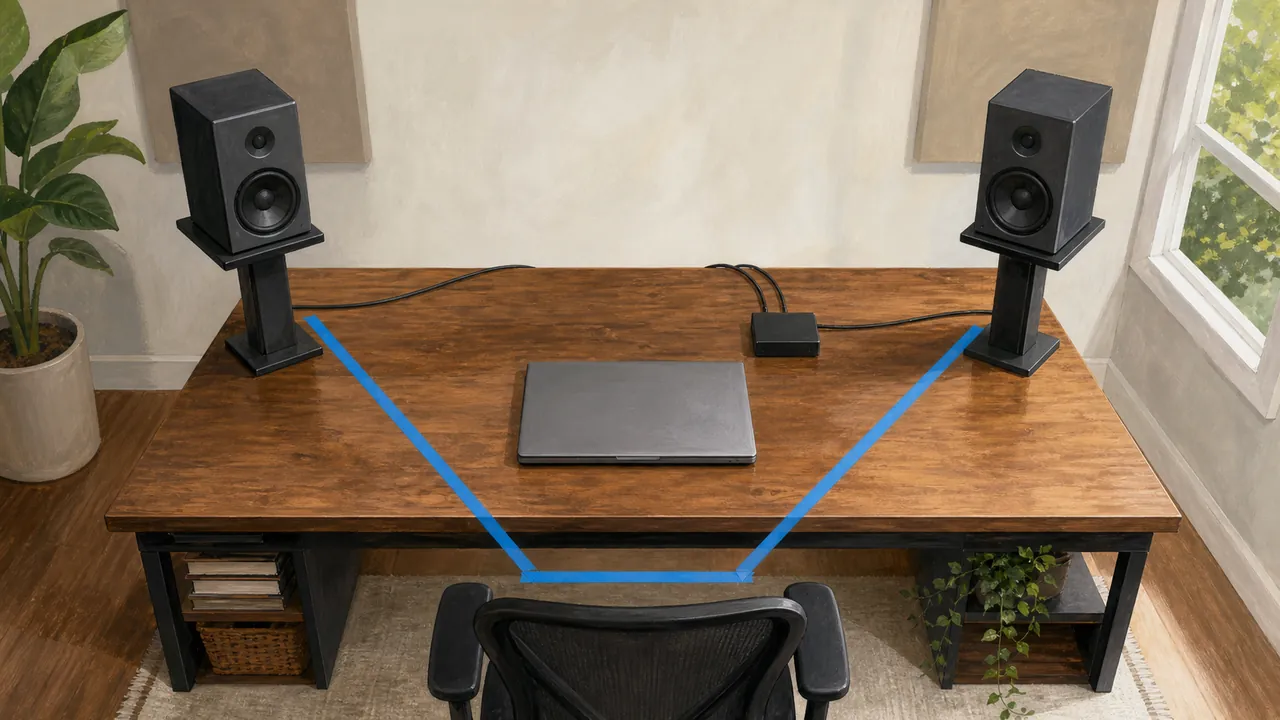
The taped triangle
The mistake this prevents: discovering after delivery that two cabinets cannot sit symmetrically at the intended distance.
- Mark the chair centre and both proposed tweeter centres with removable tape.
- Measure speaker-to-speaker and each speaker-to-ear distance; begin with a roughly equal triangle, then follow the model manual.
- Build cardboard footprints from the published width and depth. Include cable bend room behind rear sockets.
- Check that screens, doors, and instruments do not force one speaker closer.
The three-position reference pass
The mistake this prevents: choosing from one flattering stereo clip at one chair position.
At the shop, level-match as closely as the setup allows and play a familiar, legally obtained reference. Listen seated at centre, lean one head-width left/right, then switch to mono. Record only concrete observations: vocal position, whether a bass note disappears or swells, and how fast the image changes off-centre. This is a comparison prompt, not a claim about any model here.
Dimensions, build, brand, origin, and support
Exact-model manufacturing country was not disclosed in the checked official materials. Brand location is shown separately and is not used as a substitute.
| Product | Size / weight | Construction | Manufacturing origin | Brand | Warranty |
|---|---|---|---|---|---|
| ADAM Audio D3V | Each: 115 x 200 x 150 mm; 240 mm high on stand; linked pair 3.58 kg | PC-ABS cabinet; two passive radiators per channel; 3.5-inch aluminium woofer; 1.5-inch D-ART tweeter | Not disclosed for this exact model; Berlin brand location is not manufacturing evidence. | ADAM Audio; founded in Berlin in 1999; professional active loudspeakers and folded-diaphragm tweeters | ADAM: 2 years, extendable to 5 after qualifying registration with receipt. Start with the reseller; cross-border transport may cost the claimant. Registered used-product transfer is conditional. |
| Yamaha HS5 | 170 x 285 x 222 mm; 5.3 kg each | MDF bass-reflex cabinet; 5-inch cone woofer; 1-inch dome tweeter; bi-amplified | Not disclosed on checked exact-model official pages; inspect the rear label on delivered stock. | Yamaha Corporation; established 1887; Hamamatsu, Japan; musical instruments and professional and consumer audio | US/Canada: 3 years for professional loudspeakers, original authorized-dealer buyer, non-transferable; buyer prepays shipment and Yamaha may repair or replace. German order: qualifying Thomann consumer has a separate 3-year seller warranty. Yamaha's EEA page does not state an HS5-specific duration. |
| ADAM Audio T5V | 179 x 298 x 297 mm; 5.7 kg each | 5-inch polypropylene woofer; U-ART folded-diaphragm tweeter; rear-ported powered cabinet | Not disclosed for this exact model; ask the dealer or inspect the delivered label. | ADAM Audio; founded in Berlin in 1999; professional active loudspeakers and folded-diaphragm tweeters | ADAM: 2 years, extendable to 5 after qualifying registration with receipt; reseller handles first contact and exclusions include misuse, modification, unauthorized repair, accident, and altered serial number. Thomann separately offers qualifying consumers 3 years. |
| Kali Audio LP-6 V2 | 222 x 359 x 260 mm; 7.05 kg each in Kali's manual | Vinyl-wrapped MDF; front port; 6.5-inch paper woofer; 1-inch textile dome; bi-amplified | Not disclosed in the exact manual; “designed and engineered in California” is not manufacture. | Kali Audio; started January 2018; Burbank, California design headquarters; professional audio products | Selected US order: Sweetwater states 2-year coverage for nearly every product, non-transferable, buyer pays both-way service shipping; confirm exact-item eligibility. German order: qualifying Thomann consumer has 3-year seller coverage. Kali's published 1-year promise is expressly for KaliAudio.com purchases. |
Plan the audition around the seller, not the calendar
A return window is not permission for a month of studio use. Before ordering, confirm the exact seller, country or market, allowed condition and wear, packaging requirement, return shipping cost, deductions, and remedy for the exact monitor. Keep screenshots of the policy and product page with the order record.
Sweetwater US: its new-product policy says a fair amount of time from shipping, usually 30 days, for refund, in-house credit, or exchange. You need a return authorization. The item should come back in received condition with accessories, documentation, original box and intact UPC; preserve a double box when supplied. The buyer normally arranges tracked return, and original free outbound shipping is deducted from the refund. A qualifying failure within 30 days has a different US replacement-shipping rule. Confirm monitor eligibility and audition allowance before deliberate use.
Thomann Germany and continental Europe: the seller describes 30 days after complete receipt, combining statutory withdrawal with its extension. For the extension it requests original packaging, accessories and no signs of use; handling beyond shop-like examination can reduce the refund. Germany return postage is stated as free through the prescribed process. Thomann's FAQ and formal terms differ on foreign return-cost wording, so a buyer outside Germany should obtain the destination-specific rule in writing before checkout. Custom goods, activation-dependent products and several consumable or hygiene categories are excluded.
For a return-safe first check, inspect both cabinets and serial labels before discarding anything; verify left and right output at low level; test only the intended input; listen for channel mismatch or idle noise from the real chair; and stop if a fault appears. Do not register an item, mark packaging, mount it permanently, or run an extended “trial” until the seller confirms that action preserves the remedy you want.
Before the return window starts ticking
- Confirm quantity in the box and whether controls live on each speaker or the primary.
- Power down before connecting. Begin with monitor gains low and follow the manual's startup order.
- Use the placement preset as a documented starting point, not as proof the room is corrected.
- Audition at a sensible matched level with familiar material; louder is not a fairer comparison.
- Keep packaging until both channels, every intended input, standby behaviour, and control are checked.
Sources
Official specifications, exact specialist-store listings, seller policies, and independent evidence were rechecked on July 20, 2026. Stock, rank, price, review counts, returns, and support terms are refresh-sensitive.
- ADAM Audio D3V exact specifications and package
- ADAM D3V USB-C and balanced-input explainer
- ADAM D3V subwoofer-routing support
- Yamaha HS5 official specifications
- ADAM Audio T5V official specifications
- Kali LP-6 2nd Wave manual
- Sweetwater US D3V black pair
- Thomann Germany D3V black pair
- Sweetwater US Yamaha HS5 black single
- Thomann Germany Yamaha HS5 black single
- Sweetwater US ADAM T5V black single
- Thomann Germany ADAM T5V black single
- Sweetwater US Kali LP-6 V2 black single
- Thomann Germany Kali LP-6 2nd Wave black single
- Thomann daily active-nearfield sales and availability rank
- ADAM Audio warranty terms
- Yamaha current US/Canada professional-audio warranty
- Yamaha Europe warranty and service path
- Kali direct-store warranty and return policy
- Sweetwater two-year seller coverage terms
- Thomann German return and three-year seller-warranty terms
- Sweetwater returns and exchanges
- Thomann 30-day money-back FAQ
- Erin's Audio Corner exact LP-6 V2 measurements
- Sonarworks HS5 measurements in five studios
- Sound & Recording T5V lab review
- Sound On Sound D3V hands-on review