Home-studio buying guide
Best Condenser Microphones for Home Recording
Start with the recording chain, not a price ladder. The AT2020 is the uncomplicated low-cost XLR choice; the RØDE NT1 5th Generation removes the audio-interface requirement over USB; the LCT 440 PURE supplies the useful vocal accessories; and the Neumann TLM 102 is the compact premium option.
We compared current manufacturer specifications, manuals, warranty terms and retailer listings. We did not record with these microphones, so descriptions of tone from marketing or customer reviews do not become our claims. Audition a microphone with your own voice, instrument and room before an expensive purchase.
Avoid all four if the room is lively and untreated, the source is mostly amplified live performance, or you need rejection more than detail; a dynamic microphone may be the more controllable first purchase.
Verify first: XLR models need a compatible interface or preamp with 48 V phantom power. The NT1's USB mode has specific operating-system, driver and DAW boundaries.
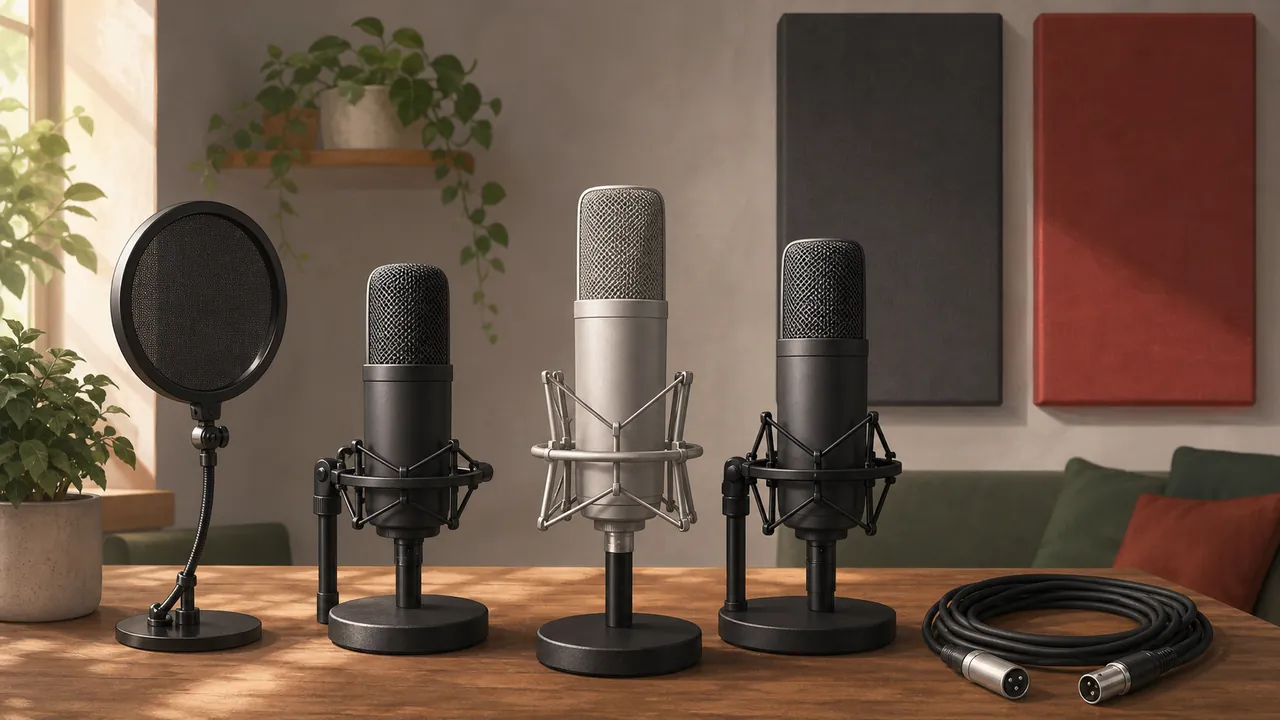
Choose the signal path before the microphone
No interface yet
Choose the RØDE NT1 5th Generation if direct USB matters. Its XLR socket leaves an upgrade path, but USB does not include a headphone jack for direct monitoring.
Existing XLR interface, tight budget
The Audio-Technica AT2020 keeps the purchase simple. Budget for an XLR cable, stand and pop filter because the basic package is sparse.
Vocal setup without accessory hunting
The Lewitt LCT 440 PURE includes a shock mount, magnetic pop filter, windscreen and bag. It remains cardioid-only.
Small premium microphone
The Neumann TLM 102 is physically compact and made in Germany. The standard microphone listing does not include Neumann's EA 4 shock mount.
Read the spec sheet without buying a number
Condenser microphone
Meaning: an active microphone capsule that needs power.
Why it matters: these models can reveal room reflections and handling noise as readily as the intended source.
Check: decide whether the room and stand are ready before upgrading the capsule.
Do not assume: “more detail” means a better recording in every room.
48 V phantom power
Meaning: power sent through an XLR cable by an interface or preamp.
Why it matters: all four need it in analog XLR use.
Check: look for a 48 V or P48 control on the exact input.
Do not assume: an XLR socket automatically supplies phantom power.
Cardioid pattern
Meaning: strongest pickup from the front, reduced pickup from the rear.
Why it matters: mic direction and reflective walls change what reaches the track.
Check: identify the front mark in the manual and aim the rear toward the main unwanted sound.
Do not assume: cardioid makes a room silent.
Self-noise
Meaning: electronic noise generated by the microphone, stated in dB-A.
Why it matters: it can matter on quiet sources in a genuinely quiet space.
Check: compare only measurements made to the same standard.
Do not assume: the lowest number fixes computer fans, traffic or room hiss.
Maximum SPL
Meaning: a maker-specified sound-pressure level at a stated distortion threshold.
Why it matters: close loud sources can exceed a capsule's clean range.
Check: preserve distance and monitor levels when trying loud sources.
Do not assume: a larger number proves better sound or safe listening.
32-bit float over USB
Meaning: a digital recording format supported by the NT1 5th Generation's USB path.
Why it matters: compatible software can preserve a wider level range for later adjustment.
Check: confirm the exact operating system, RØDE driver and DAW workflow first.
Do not assume: it prevents capsule overload, bad placement or audible monitoring distortion.
Current shortlist at a glance
Use connection and included kit to remove mismatches first. Specifications are manufacturer-published, not our measurements.
| Model | Best lane | Connection | Included setup | Main catch |
|---|---|---|---|---|
| Audio-Technica AT2020 | Low-cost XLR start | XLR; 48 V | Stand mount, adapter, pouch | No shock mount, cable or pop filter |
| RØDE NT1 5th Generation | USB now, XLR later | USB-C or XLR | Shock mount, pop filter, XLR and USB cables | No built-in headphone output; software boundaries |
| Lewitt LCT 440 PURE | Ready-to-mount vocal kit | XLR; 48 V | Shock mount, pop filter, windscreen, bag | Cardioid only; no pad or low-cut switch |
| Neumann TLM 102 | Compact premium lane | XLR; 48 V | Stand mount in standard listing | Shock mount costs extra; cardioid only |
The one-minute rejection test
- Pause in the recording position. If you clearly hear fan, traffic, hard-wall echo or household noise, solve or accept that limit before paying for lower self-noise.
- Trace the cable. For XLR, confirm one available mic input, 48 V, an XLR cable and monitoring. For NT1 USB, confirm computer power, supported software and where headphones will connect.
- Count the missing hardware. Add stand, shock mount, pop filter and cable costs. A lower microphone price can produce the larger working-kit bill.
- Name the second source. If stereo room, piano or ensemble recording is the real goal, one cardioid microphone may be the wrong system even when it is a good microphone.
Recommendations by recording constraint
Audio-Technica AT2020
Choose it when an existing interface already supplies 48 V and the goal is a current, widely stocked cardioid condenser without paying for digital features.
- Sweetwater showed it in stock with 109 reviews.
- Compact 345 g metal body.
Drawback: the basic package leaves cable, pop filter and shock-mount decisions to you.
Avoid if: you do not own an XLR interface or need switchable patterns.
Alternative: NT1 5th Generation for direct USB.
What to verify: exact package contents vary by bundle; check the AT2020, not AT2020USB-X or AT2020USB-XP.
RØDE NT1 5th Generation
It is the clearest route here for someone who needs one microphone to work directly with a computer now and an XLR interface later.
- Both connections plus shock mount, pop filter and cables.
- Thomann and Sweetwater showed current stock; Sweetwater's black version had 30 reviews.
Drawback: USB monitoring and 32-bit float depend on the computer/DAW path, and the microphone has no headphone output.
Avoid if: you need simultaneous USB and XLR output or phone/tablet support without checking power.
Alternative: LCT 440 PURE when XLR-only simplicity is preferable.
What to verify: RØDE's current compatibility instructions for your operating system and DAW.
Lewitt LCT 440 PURE
The included shock mount and magnetic pop filter make it the most coherent XLR vocal package here without moving into multi-pattern controls.
- Thomann showed in-stock status and 341 customer ratings.
- Manufacturer includes the mounting and pop-control pieces most vocal buyers need.
Drawback: no USB, pad, low-cut switch or alternate polar pattern.
Avoid if: you need omni or figure-8 recording techniques.
Alternative: AT2020 for a cheaper XLR start; a verified multi-pattern microphone for pattern work.
What to verify: interface phantom power and whether the supplied mount fits your stand thread.
Neumann TLM 102
Its 116 mm length and 210 g weight make the premium lane physically compact, while Neumann explicitly states manufacture in Germany.
- Thomann showed 201 ratings and in-stock status; Sweetwater showed 40 reviews.
- Smallest and lightest microphone in this shortlist.
Drawback: the standard package is expensive and the dedicated shock mount is separate.
Avoid if: the budget prevents a personal audition or the room remains the dominant problem.
Alternative: LCT 440 PURE for the included vocal hardware.
What to verify: standard versus Studio Set contents and dealer warranty in your country.
Product details for due diligence
Dimensions describe the microphone body, not the stand or working clearance. Warranty coverage depends on registration, territory and exclusions.
| Product | Size and weight | Construction | Manufacturing origin | Brand | Warranty/support |
|---|---|---|---|---|---|
| Audio-Technica AT2020 | 162 mm long × 52 mm maximum body diameter; 345 g | Metal body; fixed-charge back-plate condenser; pivoting stand mount | Not disclosed by the manufacturer for this exact current model | Audio-Technica, Tokyo, Japan; established 1962; audio transducers and headphones | US limited warranty is two years; territory and misuse exclusions apply |
| RØDE NT1 5th Generation | 189 mm × 52 mm diameter; 308 g | Machined aluminium body; internally shock-mounted HF6 capsule | Designed and made in Sydney, Australia, per RØDE | RØDE, Sydney, Australia; brand launched in the early 1990s by Freedman Electronics | 10-year extended warranty listed for the microphone; registration and terms apply; accessories one year |
| Lewitt LCT 440 PURE | 138 × 52 × 36 mm; 310 g | Zinc die-cast enclosure; 1-inch gold-sputtered Mylar diaphragm | Not verified for this exact model; LEWITT states its headquarters in Vienna | LEWITT, Vienna, Austria; founded 2009; studio and live microphones | Manufacturer product page displays a two-year guarantee; local consumer rights and terms may differ |
| Neumann TLM 102 | 116 mm long × 52 mm diameter; approximately 210 g | Large-diaphragm capsule, transformerless electronics and integrated pop screen | Designed and manufactured in Germany, per Neumann | Georg Neumann GmbH, Berlin, Germany; founded 1928; studio microphones and monitoring | Manufacturer warranty period was not clearly published on the product page; verify regional dealer terms before buying |
Take this A/B card to the shop
Bring a dry 20-second passage containing quiet words, louder notes and several plosives such as p and b. Ask for two microphones through the same preamp, at matched monitored level, from the same marked position. Record the room silent for five seconds, then the passage at 15 cm and 30 cm. Do not EQ either take. Listen for which recording needs less corrective work in your room and voice; do not ask the salesperson to declare a universal winner.
How we chose these condenser microphones
We defined four buyer lanes before selecting models. We began with Sweetwater in the US and Thomann for Europe, then checked current official pages, manuals and warranty information. A model needed exact identity, current orderability, a visible popularity signal and a decision-specific advantage. Retailer ratings show that a product has an observable owner base; they do not prove sound quality.
We excluded USB-only variants, discontinued generations, tube microphones and multi-pattern models whose extra controls did not fit these four lanes. AKG C414 XLS remains a credible multi-pattern alternative, but it solves a broader and much more expensive studio decision than this compact home-recording shortlist.
Before you place the order
- Check the exact suffix and package; similarly named USB and bundle versions are different products.
- Confirm return terms permit a careful audition without damage or hygiene conflict.
- Budget for stand stability, cable, pop control and a monitoring path.
- Reopen the manufacturer's compatibility and warranty pages; software and regional terms can change.
Sources
Primary specifications come from manufacturers; current stock and popularity signals come from specialist retailers. Retrieved 18 July 2026.
- Audio-Technica AT2020 specification sheet
- Sweetwater AT2020 listing and 109 reviews
- RØDE NT1 5th Generation product page
- RØDE warranty-duration table
- Thomann NT1 5th Generation listing
- Sweetwater NT1 5th Generation reviews
- LEWITT LCT 440 PURE specifications and guarantee
- LEWITT LCT 440 PURE online guide
- Thomann LCT 440 PURE listing and 341 ratings
- Neumann TLM 102 specifications
- Thomann TLM 102 listing and 201 ratings
- Sweetwater TLM 102 listing and 40 reviews
Found something that needs correcting? Contact the Consordini editorial team.