USB microphones · researched
Best USB Microphones for Room Fit, Device Connection and Monitoring
Start with the complete signal path, not a sample-rate number. Shure MV7+ is the close-address USB/XLR route; RODE NT-USB+ is the supplied pop-filter condenser kit; Sennheiser Profile puts gain and monitor controls on the body; Audio-Technica AT2040USB combines a close hypercardioid pattern with a physical low-cut.
We checked current manufacturer pages, exact-model manuals, Sweetwater and continental-European Thomann offers, seller returns and written support. We did not record, listen to or measure these microphones. Sound, room pickup, self-noise and ease still need a controlled recording on your device.
Choose from the signal path
Choose the lane whose connector, controls and mount already fit. Then keep the box clean and run one matched raw recording before the seller's return conditions are breached.
- Start with MV7+ when XLR later is a real plan and a stand is already budgeted.
- Start with NT-USB+ when a cardioid condenser, pop filter and small tripod should arrive together.
- Start with Profile when physical gain, mix, volume and mute matter more than an app.
- Start with AT2040USB when close speech, hypercardioid orientation and a physical low-cut fit the brief.
Avoid buying any of them if one distant microphone must capture several people. Use one close microphone per person or choose a system designed for that job.
Verify before paying: both cable ends, host support, mobile power, headphone plug, mount thread, arm load and the exact seller's return costs.
Compare the four signal paths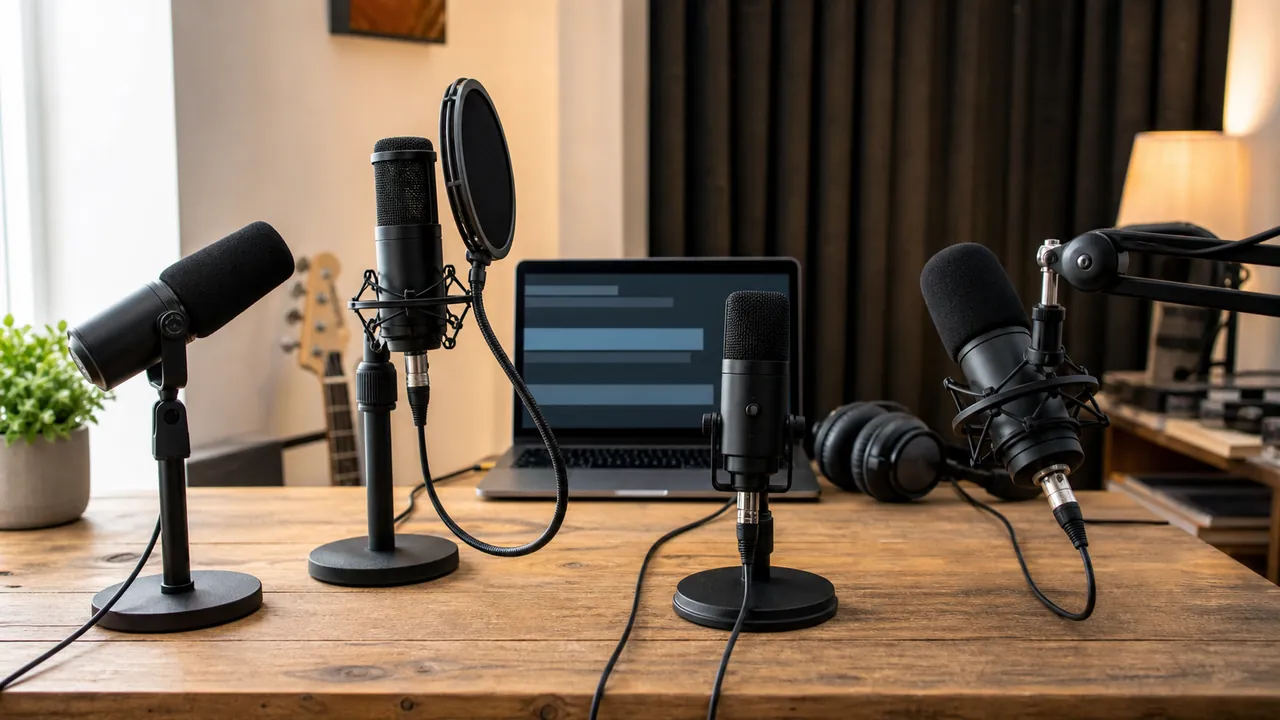
Choose the path
What connects, what you can hear, and what must hold it
The table deliberately avoids sound adjectives. A pickup pattern describes direction-dependent sensitivity, while the recommended working distance is a rehearsal starting point rather than a measured advantage.
| Model and lane | Pattern | Connections and monitoring | Controls | Mount and package | Host check |
|---|---|---|---|---|---|
| Shure MV7+ USB now, XLR later | Dynamic cardioid | USB-C, passive XLR, 3.5 mm headphones; direct mic monitoring with app routing | Touch mute/level; gain, mix and DSP in MOTIV Mix | 5/8-inch yoke; cable; no desk stand in selected base offer | Windows/macOS and selected mobile paths; verify exact OS, device and power |
| RODE NT-USB+ Condenser desk kit | Condenser cardioid | USB-C, 3.5 mm headphones; physical mic/computer mix | Headphone level and monitor mix; optional app DSP | Ring mount, pop filter, desktop tripod and USB-C cable | Computer/mobile support; Lightning iOS needs a separately sold certified cable |
| Sennheiser Profile 700065 Controls on the body | Condenser cardioid | USB-C, 3.5 mm headphones; physical mic/computer mix | Gain, mix, headphone volume and mute | Self-locking tilt joint, round table stand, 1.2 m USB-C cable | Published Windows 10+, macOS 10.15+, Android 9+ and iPadOS 14+ |
| Audio-Technica AT2040USB Close USB with low-cut | Dynamic hypercardioid | USB-C, 3.5 mm headphones; physical direct-monitor mix | Low-cut, touch mute, mix and headphone volume | Threaded clamp; internal shock mount; no desk stand; about 600 g | Standard computer USB audio path; verify exact host, power and cable package |
Current retailer ratings helped challenge the shortlist; they are not sales counts, listening tests or evidence that one microphone sounds better.
Read the signal chain
Microphone language that changes the order
Dynamic microphone
A capsule type commonly used close to the source in this shortlist.
Close placement can raise the wanted voice relative to sound arriving from farther away.
Plan a 5-10 cm starting distance, use the windscreen, and confirm the mount can hold that position.
“Dynamic” does not mean silent room, low self-noise or automatic rejection.
Condenser microphone
An active capsule type used here in the NT-USB+ and Profile.
Its useful placement for a voice or instrument may also make room reflections, keyboard position and desk height part of the result.
Begin 15-25 cm away with a pop filter for vocals, then record the actual source and room.
Condenser does not guarantee more detail, lower noise or better music recordings.
Cardioid and hypercardioid
Pickup patterns that change sensitivity as sound moves around the microphone.
They tell you where the front is and where a noise source may be less prominent.
Use the maker's orientation drawing; record the fan at front, side and rear without changing gain.
Neither pattern creates a universal dead zone. Hypercardioid can retain a rear lobe.
Direct monitoring and monitor mix
Direct monitoring sends the microphone to its headphone jack before a computer round trip; the mix balances that feed with computer playback.
A delayed voice can distract a singer or speaker, while too little playback makes timing difficult.
Connect headphones to the microphone, set a low volume, then bring in computer playback with the mix control.
Effects returning from recording software can still have latency even when the direct voice does not.
Gain, level and clipping
Gain sets input amplification; level is the resulting signal; clipping is overload that cannot be repaired by lowering playback later.
Distance and gain interact: moving closer changes both wanted sound and room balance.
Set position first, then leave headroom for the loudest phrase instead of aiming at the top of the meter.
More gain is not more detail; it also raises every sound the capsule receives.
USB-C
A connector shape used for digital audio and bus power on these microphones.
The microphone must connect to a host that supports USB audio and supplies enough power, using a cable wired for data.
Write the microphone end, device end, operating system and any adapter in one line before ordering.
Matching USB-C sockets do not prove that the device, cable, app and power path work together.
XLR and an audio interface
XLR carries the microphone's analog signal to a mixer or interface; the interface converts it for the computer.
It permits a modular system and more inputs later, but adds an interface, cable, gain control and monitoring path.
For MV7+, price an XLR cable and interface only if that migration is likely; USB works without them.
XLR is not a sound-quality guarantee, and the AT2040USB/Profile/NT-USB+ do not gain XLR through an adapter.
DSP and raw recording
Digital signal processing includes auto level, denoise, filtering, EQ, compression and effects inside the mic or companion app.
It can change the comparison more than the hardware choice.
Save one take with optional processing off, then a second with the settings you would actually use.
A polished preset demo is not a test of the capsule alone.
Mount thread and arm payload
The thread joins microphone/yoke to stand; payload is the total weight the arm can hold in position.
A stand can fit the thread yet sag once microphone, shock mount, adapter, cable and pop filter are added.
Confirm 3/8- or 5/8-inch path, add every accessory weight and check clamp depth under the desk.
A “universal” arm does not prove thread, clamp or payload fit.
How these made the page
Four lanes, one evidence limit
Every included microphone had to be a current fixed exact offer at Sweetwater and Thomann Germany, provide direct headphone monitoring, document its pickup pattern and controls, and solve a distinct connection or mounting problem. We restarted discovery from current retailer categories and challenged each lane against PodMic USB, MV6, AT2020USB-X, Profile Streaming Set, MV7i and the other winners.
The missing evidence is equally important: the available pages do not create a fair, comparable sound or noise test. Manufacturer adjectives, review totals and frequency ranges cannot answer which voice, instrument or room will work best. Recommendations stop at verifiable hardware and compatibility. The buyer's controlled recording carries the performance decision.
Recommendations by constraint
Where each microphone earns its place
Close-address USB now, XLR later
Shure MV7+
Choose it when one close voice is the job and the future system may use an interface or mixer. It is the only recommendation here with both a digital USB-C output and a passive XLR output.
- 3.5 mm monitoring and a 5/8-inch yoke are built in.
- Touch mute/level is on the microphone; deeper gain, mix and DSP controls live in MOTIV Mix.
- Fixed black offers were orderable in both checked markets.
Tradeoff: the selected base offers do not include a desk stand. The useful software layer also creates an app/firmware dependency.
Avoid if: you need physical gain and monitor-mix knobs on the microphone, or a complete stand-in-box setup.
Closest alternatives: RODE PodMic USB for another hybrid path; Profile for on-body controls; MV7i only if its second input is genuinely needed.
Connection, controls and current offers are well documented. Sound and room behavior are not tested.
Verify: exact device support, stand/arm payload, supplied cable ends and whether the selected black base offer still excludes a stand.
Cardioid condenser with the vocal desk pieces
RODE NT-USB+
Choose it when a condenser is appropriate to the source/room rehearsal and you want the microphone, detachable pop filter, ring mount and small desktop tripod in the standard package.
- Physical headphone level and microphone/computer mix controls.
- RODE documents computer, phone and tablet paths and states the exact product is made in Sydney.
- Current specialist offers and the largest exact Thomann rating count among these four.
Tradeoff: it is USB-only. The short tripod may leave a singer too far away or place the capsule beside a keyboard and reflective desk.
Avoid if: the 30-second room fingerprint is dominated by nearby fan, keyboard or reflections and closer dynamic placement is more practical.
Closest alternatives: AT2020USB-X as a cheaper current condenser; MV7+ or PodMic USB when XLR migration matters.
Package, controls, compatibility and origin are well documented. No tone or self-noise advantage is claimed.
Verify: mobile cable/power. RODE says Lightning iOS needs a separately sold certified cable.
App-independent control at the desk
Sennheiser Profile USB Microphone 700065
Choose the standard table-stand package when gain, microphone/computer mix, headphone volume and mute should all remain available as physical controls without opening companion software.
- Self-locking tilt joint and round stand are included.
- Published host floors cover Windows, macOS, Android and iPadOS.
- Exact standard offers were in stock in both checked markets.
Tradeoff: it is USB-only and has no supplied external pop filter. A table stand may place the mic too far from the source unless the desk allows it to move close.
Avoid if: XLR later or a boom arm now is part of the brief.
Closest alternatives: NT-USB+ for the supplied pop filter; AT2020USB-X as the closest current lower-priced condenser; Profile Streaming Set after US stock returns if its arm package fits.
Exact model, controls and host requirements are well documented. Manufacturing origin remains unpublished.
Verify: that the selected offer is the standard 700065 table-stand package rather than the separate Streaming Set or a promotion bundle.
Close hypercardioid USB with a physical low-cut
Audio-Technica AT2040USB
Choose it when close spoken-word placement, a hypercardioid orientation rehearsal, internal shock mount and a physical low-cut switch match the desk. Those facts distinguish the lane; they do not prove lower noise.
- Physical low-cut, mute, monitor-mix and headphone-volume controls.
- Multistage windscreen and internal shock mount are built in.
- Exact-model documents state Taiwan origin.
Tradeoff: it is USB-only, about 600 g before accessories and includes a clamp rather than a desk stand. Hypercardioid also makes rear-lobe orientation worth rehearsing.
Avoid if: the arm cannot hold the complete load, you need XLR, or you cannot work close to the capsule.
Closest alternatives: Shure MV6 for a cheaper stand-in-box dynamic; PodMic USB or MV7+ for XLR migration.
Controls, pattern, construction and origin are documented. Current seller popularity is narrower than the other lanes, and no noise claim is made.
Verify: cable package. Thomann lists a 2 m USB-C-to-A cable plus USB-C adapter; do not assume the US box is identical.
Before a cart is opened
Write a device, room and signal passport
This one-page note prevents the common purchase where the microphone is correct but the system is not. Use published facts for the hardware and your own observations for the room.
Device line
Host: exact computer/phone/tablet · OS: version · recording app: name · port: USB-C or USB-A · power: direct or powered adapter.
Room line
Source distance: planned centimetres · fan/keyboard/window: direction from mic front · reflective desk: yes/no · one person: yes/no.
Signal line
Mic output: USB only or USB/XLR · headphones: 3.5 mm plug · monitor control: body or app · processing: raw plus intended preset.
Package line
Cable ends/length: write both · stand pieces: included/missing · thread: 3/8 or 5/8 inch · complete load: mic, yoke, adapter, filter and cable.
Reject the order when any blank is filled with “probably.” Connector shape, a family name and a seller item number are not compatibility or regional-SKU proof.
Desk and mount fit
Rehearse the mouth-to-port path with string
- Place a cardboard tube at the planned capsule position: 5-10 cm for the close dynamic starting point or 15-25 cm behind a pop-filter mark for the condenser starting point.
- Run string from that point through the stand/yoke route to the device port. Add enough slack for tilt and arm movement without pulling the USB socket.
- Measure desk clamp depth and obstruction below the top. Add microphone, yoke/clip, thread adapter, pop filter and cable to the arm payload.
- Sit or perform for five minutes. Reject a position that blocks the screen, forces the neck forward or puts the microphone beside the keyboard.
Return-safe connection test
Make one raw take before choosing a preset
Preserve the remedy
Keep every bag, cable, document and box unmarked. Do not register bundled software, remove permanent films or tighten a clamp until it leaves a mark. Ask the seller in writing when the intended check may exceed careful indoor inspection.
Prove the connection
Use the exact host and app from the passport. Record ten seconds, play it back through the microphone's headphone jack and confirm mute, monitor mix and volume behave as expected.
Hold the variables
Record the same phrase or musical passage, distance, orientation and peak target. Disable optional auto level, denoise, EQ, compression and reverb. Do not compare two takes at different playback loudness.
Map the room
Record silence, the source, then the same source with the fan/keyboard at front, side and rear. This tests the actual desk; the pattern label alone cannot supply the answer.
Add the real processing
Save a second take with only the processing you would use. Keep the raw file so a polished preset is not mistaken for a hardware advantage.
Stop on a practical failure
Return or exchange within the permitted window when the host drops the microphone, monitoring route is wrong, stand will not hold position, controls are inaccessible or the room result fails your recording brief.
Seller rules beside the test
A return clock is not blanket permission to use the microphone
Sweetwater, United States
The current new-product policy says a fair time from shipment, usually 30 days, after obtaining a return authorization. Remedy can be refund, in-house credit or exchange. The product must return in received condition with every accessory, document and packaging piece; UPC stays intact and an originally double-boxed item should be double-boxed again.
Original free outbound shipping can be deducted. Promotion redemption can create a restocking fee. Confirm return-label cost and permission before any mounting or registration that changes condition.
Thomann, Germany and continental EU
Thomann combines the 14-day statutory withdrawal with a later 16-day extension. The extended period calls for original packaging, all accessories/cables/documents and no signs of use. Refund, account credit or exchange can be selected through the return request.
Germany return cost treatment differs from returns from abroad; value loss or use compensation can apply, and bundle components can be repriced. Confirm the buyer's country and keep the test to a clean indoor inspection.
What the shortlist cannot settle
Convenience moves complexity; it does not remove it
USB removes a separate interface from the first setup, but the operating system, firmware, cable data path, bus power and monitor routing become part of the microphone. XLR makes a system modular, but adds an interface, cable, gain stage and another place to route headphones.
A dynamic microphone used close may improve wanted-source level relative to distant room sound because of placement. A condenser may be the more workable geometry for a sung or acoustic source. Those are test prompts, not promises. Walk away from any product whose real recording fails, regardless of ratings or brand history.
Body, build, origin and written support
Ownership facts for the exact shortlist
Manufacturing origin is shown only when an exact-product source states it. Brand headquarters and establishment dates are background, not proof of where a microphone was made or how it performs.
| Product | Size and weight | Construction | Manufacturing origin | Brand | Warranty and support |
|---|---|---|---|---|---|
| Shure MV7+ | 573.5 g; Thomann lists 164 × 207 × 90 mm in yoke | Die-cast aluminium housing, dynamic capsule, foam windscreen and yoke | Not disclosed for the exact MV7+ on checked maker pages; inspect the delivered label | Shure · Niles, Illinois · founded 1925 · microphones, monitoring and professional audio | Shure US describes repair for covered products under two-year terms. Original receipt/registration and region apply; exact MV7+ eligibility, transfer and exclusions were not published on the checked landing pages. Sweetwater protection is separate seller coverage. |
| RODE NT-USB+ | 184 × 62 × 50 mm; 540 g microphone | Metal body, condenser capsule, detachable pop filter, ring mount and tripod | RODE states the exact product is designed and made in Sydney, Australia | RODE · Sydney · parent roots 1967, RODE born 1990 · microphones and creator-recording hardware | One-year base from an authorized dealer; NT-USB+ extends to two years after original-purchaser registration. Regional service, proof and exclusions apply. Remaining registration can transfer through RODE's documented account/support process. |
| Sennheiser Profile USB 700065 | 50 mm diameter × 152 mm; 350 g microphone; 60 g stand | Metal housing, pre-polarized cardioid condenser, self-locking tilt joint and table stand | Not disclosed for exact 700065 on checked maker pages; Wedemark is brand base, not origin proof | Sennheiser · Wedemark, Germany · founded 1945 · professional microphones, wireless and headphones | Current professional-audio terms state 24 months for the customer buying new from an authorized retailer. Regional service and exclusions apply. Transferability and consequential-damage wording were not visible in the retrieved summary. |
| Audio-Technica AT2040USB | 145.3 × 52 mm; maker says about 600 g, while Thomann's technical field says 615 g | Metal body, dynamic capsule, internal shock mount and multistage windscreen | Taiwan, stated in exact-model manufacturer datasheet and quick start | Audio-Technica · Machida, Tokyo · founded 1962 · microphones, headphones, wireless, mixers and turntables | Exact current US manufacturer duration was not recovered. Sweetwater advertises two-year seller coverage for eligible items; Thomann advertises three-year seller warranty for its qualifying order. Confirm exact-item eligibility, handler, transfer, exclusions and shipping costs. |
US and European listings
Same family name does not prove the same regional box
All four regional relationships remain unresolved because no checked manufacturer source ties both retailer listings to one exact manufacturer configuration. Sweetwater item IDs and Thomann article numbers are seller catalog identifiers. They do not become manufacturer SKUs because the text resembles a model name.
Check cable ends and length, color, stand or yoke, filter, adapters, software entitlement, firmware path, power expectation and every promotion at checkout. Profile's EU lesson promotion is time-limited; MV7+ bundles and white versions are separate offers; RODE mobile cables can be extra; AT2040USB has an explicit EU cable description that cannot be borrowed for the US box.
Reader-checkable evidence
Sources used for the decision
Shure MV7+
RODE NT-USB+
Sennheiser Profile
- Sennheiser Profile USB 700065 product page
- Sennheiser Profile specification sheet
- Sweetwater standard Profile offer
- Thomann Germany standard Profile offer
- Thomann Sennheiser USB category/popularity page
- Sennheiser current professional-audio warranty terms
- Sennheiser history
- Sennheiser Wedemark head office
Audio-Technica AT2040USB
- Audio-Technica AT2040USB datasheet
- Audio-Technica AT2040USB user manual
- Audio-Technica AT2040USB quick start and origin mark
- Sweetwater fixed AT2040USB offer
- Thomann Germany fixed AT2040 USB offer
- Thomann Audio-Technica USB category/popularity page
- Audio-Technica US warranty locator
- Audio-Technica official company information
A specification, offer or policy changed? Report a correction to Consordini.