Current brass-instrument buying guide
Best Trombones by Player, Ensemble, and Register
The useful question is not “Which trombone wins?” It is which bore, bell, valve layout, reach, and service path fit the part you actually play.
Researched · exact models and order paths checked
We compared current manufacturer specifications and specialist-retailer listings. We did not play, weigh, measure, assemble, lubricate, service, or transport these instruments. Tone, slide alignment, valve noise, intonation tendencies, mouthpiece match, case fit, and individual ergonomics were not hands-on tested.
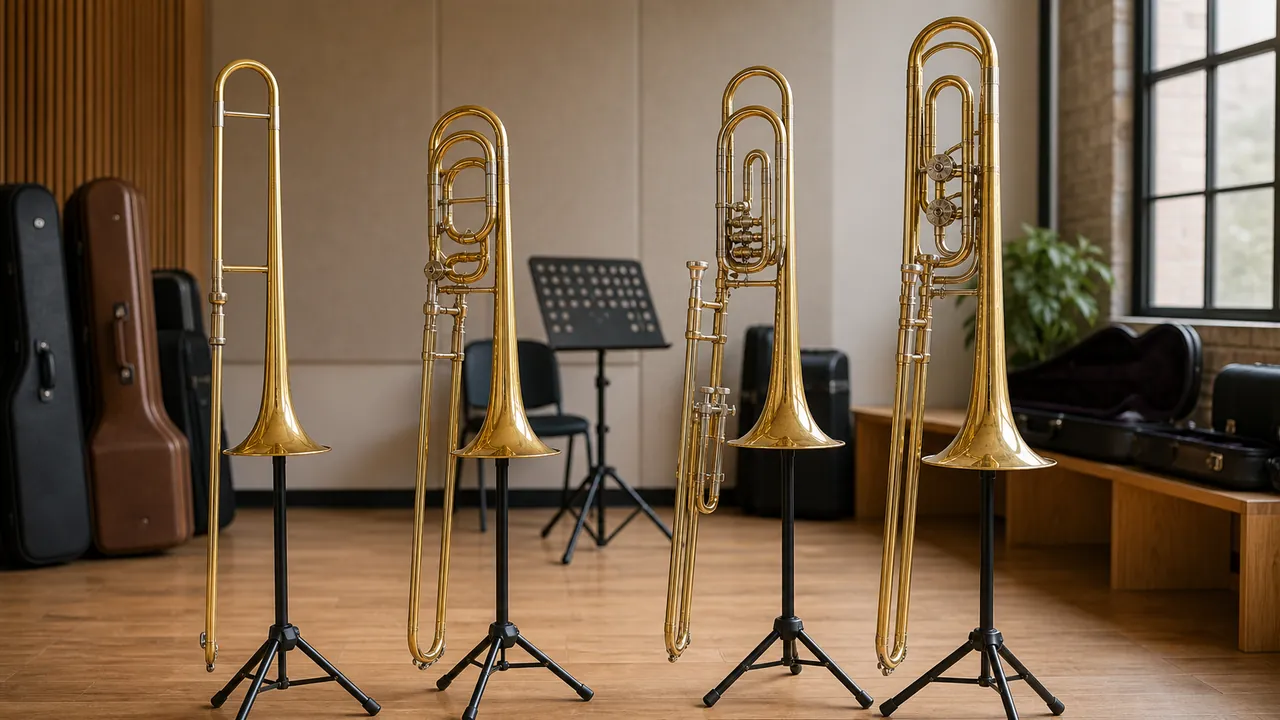
- Confirm the assigned part and mouthpiece shank.
- Test seventh-position reach and balance.
- Ask who will align and service the slide locally.
- Price case, tax, delivery, and return shipping.
Avoid blind upgrades: a larger bore and more valves add capability, resistance, weight, and maintenance—not automatic improvement.
Translate brass specifications into playing fit
Bore
Meaning: the inside diameter of the main cylindrical tubing.
Why it matters: it changes airflow, resistance, response, and typical ensemble use.
Action: match small, medium, or large bore to the player and section.
Do not assume: larger means better or louder.
Dual bore
Meaning: the two slide tubes have different diameters.
Why it matters: it can blend compact response with a broader air path.
Action: verify both numbers, as on the King 2B’s 0.481/0.491-inch slide.
Do not confuse it with: a double-valve bass trombone.
Bell diameter
Meaning: the width across the bell opening.
Why it matters: it accompanies the instrument’s bore and intended voice.
Action: compare diameter and material together.
Do not assume: the largest bell projects best in every room.
F-attachment
Meaning: a thumb-operated valve adds tubing and lowers a Bb tenor to F.
Why it matters: it gives alternate positions and extends the useful low register.
Action: buy it when the repertoire and player can use it.
Do not confuse it with: the two independent/dependent valves on a bass trombone.
Open wrap
Meaning: F-attachment tubing uses broader bends outside the main bell section.
Why it matters: it changes packaging, airflow path, and case compatibility.
Action: confirm the exact 42BO variant and included case.
Do not treat it as: proof of better tone.
Mouthpiece shank
Meaning: the receiver size the mouthpiece stem must fit.
Why it matters: small- and large-shank mouthpieces are not interchangeable.
Action: budget the correct mouthpiece rather than forcing an old one.
Do not confuse it with: cup diameter or rim width.
Slide alignment
Meaning: both inner and outer slide tubes track straight and parallel.
Why it matters: a dent or twist can make a premium slide slow.
Action: inspect movement dry only as a technician directs, then test correctly lubricated.
Do not mistake: fresh grease or oil for proof of alignment.
Match the trombone to the player and regional model
Each model needed a current exact specialist-retailer path, reliable exact-model specifications, a distinct player lane, and realistic US availability. Thomann also has current exact European paths for the Yamaha YSL-354 E, King 2102 Legend 2B, and Bach 42BO; the King was orderable with a 14–18-week estimate rather than immediate stock. The lacquer Yamaha is labelled YSL-354C by Sweetwater and YSL-354 E by Thomann, so confirm the regional suffix, included accessories, and seller terms. We excluded marketplace-only instruments, unresolved model identities, and used horns because condition can dominate model-level advice.
Match the architecture to the chair
| Model | Best lane | Bore / bell | Valve layout | Main compromise |
|---|---|---|---|---|
| Yamaha YSL-354 | First serious student tenor | 0.500 in; 8 in yellow-brass bell | Straight Bb tenor | No F-attachment; teacher must confirm reach |
| King 2B Legend | Jazz lead and commercial small-bore work | 0.481/0.491 in dual bore; 7 3/8 in yellow-brass bell | Straight Bb tenor | Specialized, expensive, and less forgiving outside its lane |
| Bach 42BO | Large-bore orchestral/concert tenor | 0.547 in; 8 1/2 in one-piece yellow-brass bell | Open-wrap F-attachment | Heavier and costlier than a straight student horn |
| Yamaha YBL-620G | Advancing or professional bass chair | 0.563 in; 9 1/2 in gold-brass bell | Bb/F/Eb and Bb/F/D configurations; D slide included | Wrong purchase for ordinary tenor parts |
Four recommendations with hard boundaries
Yamaha YSL-354
Choose it when a school director wants a durable, conventional straight Bb tenor with an 8-inch bell and manageable 0.500-inch bore.
Useful advantage: simple layout, included SL-48S mouthpiece and case, detachable balance weight, and broad US/EU dealer presence. Thomann showed 20 verified-buyer ratings and a number-nine sales rank in tenor trombones on the research date.
Real drawback: no trigger alternatives for long positions; smaller players still need an in-person reach check.
Avoid if: the assigned repertoire requires an F-attachment or the player cannot reach seventh position safely.
Closest alternative: rent a teacher-approved student trombone for one term before buying.
Evidence limit: exact dimensions and materials are manufacturer-published; regional retailers use YSL-354C and YSL-354 E labels, and dated stock or ratings are not a condition inspection.
King 2B Legend
Choose it for a player who specifically wants the compact 2B architecture: dual 0.481/0.491-inch bore, small shank, and 7 3/8-inch bell.
Useful advantage: a purpose-built small-bore design with current specialist-store paths in both regions and a long-running model identity; Thomann ranked the exact 2102 Legend 2B seventh among tenor trombones on the research date.
Real drawback: professional price, no F-attachment, and a narrower use case than a large-bore section tenor. Thomann quoted 14–18 weeks rather than immediate dispatch.
Avoid if: the main job is symphonic second/third trombone or low-register trigger work.
Closest alternative: keep a well-serviced student straight tenor until the jazz lane is certain.
Evidence limit: specifications and orderability are exact-model specialist-retailer data; neither listing proves the condition of the delivered instrument.
Bach 42BO Stradivarius
Choose it when an advanced teacher or section calls for the familiar 0.547-inch large-bore, 8 1/2-inch bell, and open-wrap F-attachment layout.
Useful advantage: precise role, large-shank ecosystem, current US specialist listing, and an exact Thomann European page.
Real drawback: high cost, extra front-end weight, rotor maintenance, and exact-suffix confusion across 42 variants.
Avoid if: you have not auditioned the exact horn or only need a light straight tenor.
Closest alternative: compare a dealer-prepared large-bore F-attachment trombone in person with your teacher.
Evidence limit: listing confirms architecture, not the individual instrument’s slide, rotor, or intonation.
Yamaha YBL-620G
Choose it only for a player assigned to bass trombone who needs the 0.563-inch bore, 9 1/2-inch bell, two-valve pitch options, and included D slide.
Useful advantage: unusually detailed first-party specifications and an active exact Sweetwater order page.
Real drawback: substantial price and complexity; public specifications call weight only “standard,” not an exact mass.
Avoid if: you are shopping for an ordinary tenor chair, beginner band, or a known light carry.
Closest alternative: rent or borrow the program’s bass trombone until valve layout and mouthpiece are settled.
Evidence limit: no hands-on valve, slide, balance, or case evaluation; EU stock was not verified as broadly as US stock.
Run a ten-minute teacher and reach check
- Bring the exact music and identify tenor or bass chair before touching a model.
- With neutral posture, reach first through seventh position without twisting the shoulder or losing the mouthpiece seal.
- Hold playing position for five minutes and note left-hand pressure from the bell/valve section.
- Confirm every valve, water key, brace, mouthpiece receiver, and case latch on the exact instrument.
- Have a brass technician or teacher assess slide alignment and rotor action; do not infer condition from shine.
Inspect the delivered instrument before the return window closes
Identity
Match model suffix, finish, bell material, valve wrap, serial documentation, mouthpiece, and case against the invoice.
Mechanics
Under teacher or technician guidance, check slide travel, stocking wear, valve linkage, water keys, braces, and visible dents.
Service
Record the retailer return deadline, warranty route, nearest authorized repairer, and who pays insured return freight.
Exact physical and ownership details
| Model | Size / weight | Materials | Manufacturing origin | Brand / support | Warranty path |
|---|---|---|---|---|---|
| Yamaha YSL-354 | 8 in (204.4 mm) bell; Yamaha gives no exact instrument mass on the checked page. | Yellow-brass bell and outer slide; nickel-silver inner slide; gold lacquer exact US recommendation. | Not disclosed on checked current product pages; verify the exact serial/instrument. | Yamaha; SL-48S mouthpiece and case listed. | Sweetwater advertised two-year retailer coverage; Thomann advertised three years. Exact terms, territory, and return freight still depend on seller. |
| King 2B Legend | 7 3/8 in bell; checked listing gives no exact instrument mass or overall dimensions. | Yellow-brass bell; nickel-silver outer slide; clear lacquer exact listing. | Sweetwater identifies current professional King production as USA; confirm exact delivered label/serial. | King / Conn Selmer; small-shank mouthpiece and case listed. | Sweetwater advertised two-year retailer coverage; Thomann advertised three years. Conn Selmer service requires an authorized seller and proof of original purchase. |
| Bach 42BO Stradivarius | 8 1/2 in bell; checked exact pages give no exact mass or overall length. | One-piece hand-hammered yellow-brass bell; nickel-silver outer slide; lacquer; open-wrap rotor section. | Exact listing identifies USA production; verify delivered instrument and serial documentation. | Vincent Bach / Conn Selmer; C1867 case and large-shank mouthpiece listed. | Sweetwater advertised two-year retailer coverage; Thomann advertised three years. Confirm dealer preparation, territory, and return deadline. |
| Yamaha YBL-620G | 9 1/2 in bell; Yamaha lists weight only as “standard,” with no exact mass. | Gold-brass one-piece hand-hammered bell; yellow-brass body; chrome-plated nickel-silver inner and nickel-silver outer slide. | Not disclosed on checked current Yamaha specification page; verify the exact instrument. | Yamaha; large-shank 58 mouthpiece, case, and D slide listed. | Sweetwater advertised two-year retailer coverage. Yamaha warranty and authorized service remain regional; verify the territory before import. |
Region and delivery can outweigh a price difference
Sweetwater supplied current US order evidence for all four lanes. Thomann supplied clear exact European pages for the Yamaha YSL-354 E and Bach 42BO in stock, plus the King 2102 Legend 2B with a 14–18-week estimate. YBL-620G European orderability was not established to the same confidence. Brass instruments are vulnerable to shipping damage and costly insured returns, so compare dealer setup, return freight, tax/VAT, warranty territory, and local technician access—not just the headline price. Stock and prices are dated snapshots and should be rechecked at checkout.
Sources
- Yamaha YSL-354 overview
- Yamaha YSL-354 specifications
- Sweetwater YSL-354C exact listing
- Thomann YSL-354 E European path
- Sweetwater King 2B exact listing
- Thomann King 2102 Legend 2B European path
- Sweetwater Bach 42BO exact listing
- Thomann Bach 42BO European path
- Yamaha YBL-620G overview
- Yamaha YBL-620G specifications
- Sweetwater YBL-620G exact listing
Specifications, stock, price, included accessories, finish, warranty, and returns can change. Match the exact model suffix and checkout terms.
Found something that needs correcting? Contact the Consordini editorial team.