Source-to-console matching
Best DI Direct Boxes by Impedance, Channels and Connectors
Start with what is producing the signal. Our picks separate low-cost passive mono, pickup loading, stereo instruments, consumer connectors and the one speaker-output path we can explain from an exact manual.
We checked manuals, exact US and continental-European offers, dated prices, seller returns and support on . We did not record, measure or listen to these boxes. Most lanes therefore rest on connection facts and a line check you perform; one independent RNDI review is clearly attributed and does not transfer to the other products.
Never connect an amplifier output because a box merely has a pad. A DI is not a load box. This guide teaches speaker mode only for the RNDI, from its exact manual, while the amplifier's required speaker or suitable load stays connected.
Match your source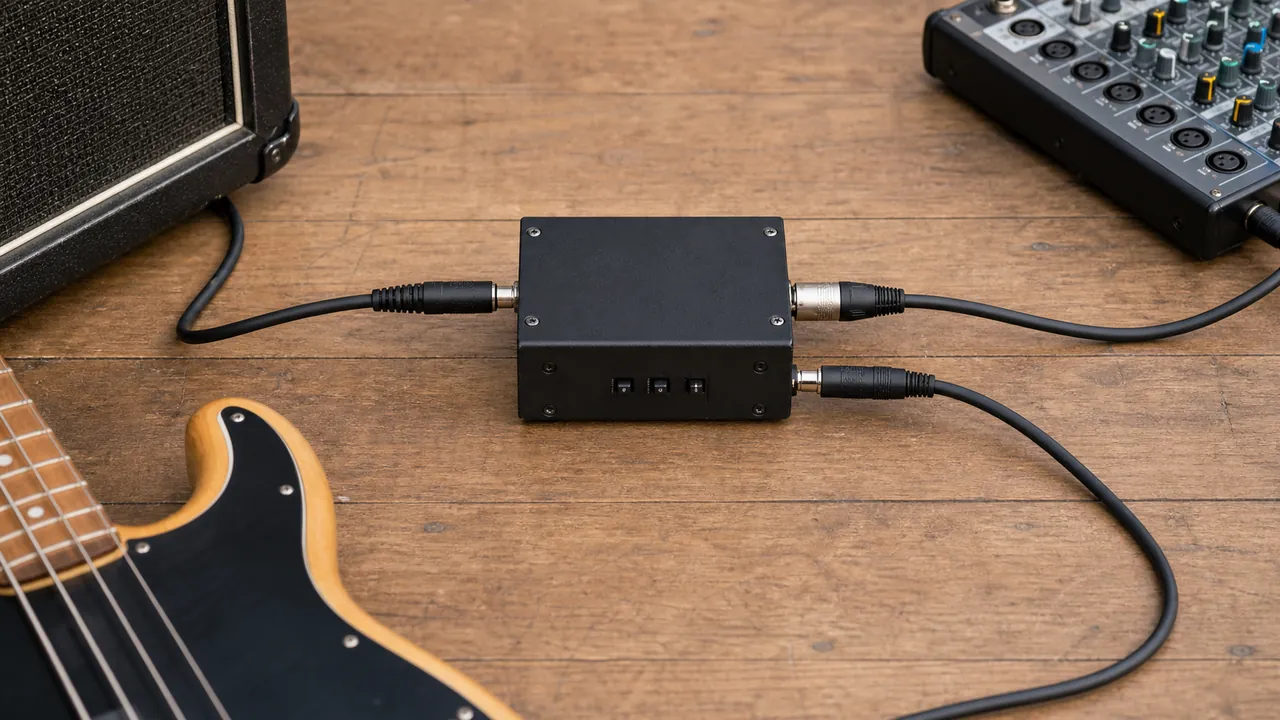
PAN 01 for low-cost buffered mono; JDI for premium passive headroom; DI 10A for budget active power backup; PZ-DI for passive pickup loading.
ProD2 for stereo quarter-inch sources; ProAV2 for 3.5 mm/RCA; RNDI only when its instrument or exact speaker mode earns the cost.
Read the signal path before the product name
A direct box usually changes an unbalanced source into a balanced, microphone-level output for a mixer or interface. These terms decide whether the path fits.
Active source
Meaning: the instrument, pedalboard or device has a powered output stage. Why it matters: it can usually drive a lower-impedance passive DI more comfortably than a bare pickup. Check: identify the exact output and expected level. “Active bass” and “bass after a powered pedal” are different paths.
Passive pickup
Meaning: the pickup itself feeds the cable without a powered buffer. Why it matters: too low a DI input impedance can change level and frequency balance. Check: magnetic or piezo, and whether an onboard preamp is switched into the output. A pickup installed in an amplified instrument is not automatically active.
Input impedance
Meaning: the electrical load the DI presents to the source. Why it matters: a passive piezo often needs a much higher value than a line output. Check: use the pickup or instrument maker's guidance. The biggest number is not automatically the best sound for every source.
Active DI
Meaning: the DI contains powered electronics. Why it matters: it may offer higher input impedance or more controls. Check: confirm phantom, battery or adapter power before soundcheck. “Active” describes circuitry, not a guaranteed quality level.
Passive DI
Meaning: the audio path uses a transformer and needs no operating power. Why it matters: it is simple and can isolate source from console. Check: input impedance, maximum level and channel count. No-power operation does not mean every passive pickup is a good match.
Pad
Meaning: a switch that reduces level before the next stage. Why it matters: it can prevent overload from a hot source. Check: start disengaged unless the manual says otherwise and use it only when level demands it. A pad alone never proves speaker-output safety.
Thru or link
Meaning: a parallel output that continues the source toward another destination. Why it matters: that destination can change the load seen by a passive pickup. Check: name the amplifier, monitor or other destination and cable. “Thru” is not a spare balanced output.
Ground lift
Meaning: the exact DI disconnects its documented audio shield path, usually at XLR pin 1. Why it matters: it may break one audio ground loop. Check: use only the DI switch as its manual directs. Never remove or defeat mains protective earth.
Balanced mic output
Meaning: the DI's XLR output is intended for a microphone input. Why it matters: console gain and phantom behavior depend on that destination. Check: reserve the exact mic channel before buying. A balanced XLR connector does not automatically mean line level.
Stereo versus dual mono
Meaning: two channels may carry left/right stereo or two unrelated mono sources. Why it matters: either case needs two DI paths, two XLR cables and usually two console channels. Check: decide whether stereo must remain stereo and reserve both destinations. Never short two outputs together with an improvised cable.
Write one source-to-console passport
Fill this in before comparing brands. If one blank remains, the purchase decision is not ready.
Exact instrument/device and output socket: passive magnetic, passive piezo, buffered pedal, keyboard line out, 3.5 mm laptop output or amplifier speaker output.
Connector, input impedance, maximum level, pad setting and one or two channels.
Passive, 48 V phantom, 9 V battery, or more than one supported option. Name who checks it.
Amplifier, monitor, second device or “unused.” Include any load the source or amplifier must still see.
One or two XLR cables to named mixer/interface mic inputs, with conservative gain at first connection.
Stop for clipping, missing low end, hum that survives a known-good cable, unstable power, heat, damage or an undocumented adapter.
Use popularity as a market check, not a quality verdict
Sweetwater and Thomann category pages supplied the current market reset. We challenged 22 exact models, including ProDI, J48, Pro48, BSS AR-133, Countryman Type 85S, Whirlwind IMP 2, Klark DI 20P, Palmer PAN 04, Radial JDI Stereo, Walrus Canvas Stereo and USB-specific boxes. Review counts and bestseller placement showed active products with real market exposure. They did not prove sound quality.
The final lanes use electrical and connection facts that can be traced to exact manuals. Manufacturer frequency, distortion and phase numbers were not turned into a cross-brand ranking because fixtures and methods differ or are not fully published. The RNDI has an attributed independent exact-model use report; the review does not publish physical sample count, serial/revision or every signal-path detail, so its observations stay narrow.
Prices below were visible on July 21, 2026. A European offer means a continental-European Thomann storefront, not the US-facing `thomannmusic.com`. Stock and price can change before payment.
Compare the source, power, channels and complete path
| DI | Best-matched job | Input and power | Channels/connectors | US / EU snapshot | Hard stop |
|---|---|---|---|---|---|
| Palmer PAN 01 | Buffered or line-level mono on a lower budget | 68 kOhm maker figure; passive; -30 dB pad | 1 x quarter-inch in/thru; 1 x XLR out | $79.99 / EUR 48, EU inbound 1-2 weeks | Do not make 68 kOhm the default for an unbuffered passive pickup. |
| Radial JDI | Hot or buffered mono needing premium passive headroom | 140 kOhm; passive; +21 dBu at 20 Hz maker limit | 1 x quarter-inch in/thru; 1 x XLR | $259.99 / EUR 279 | Price buys documented construction/headroom, not guaranteed better sound. |
| Klark Teknik DI 10A | Budget active mono with backup power | >250 kOhm; 48 V or 9 V battery; 0/-20/-40 dB | XLR/TRS input; thru; 1 x XLR out | $54.90 / EUR 49 | Not the high-impedance piezo choice; maintain and test the battery. |
| Radial PZ-DI | Passive piezo or magnetic pickup | 10 MOhm / 1 MOhm / 220 kOhm; 48 V | 1 x quarter-inch in/link; 1 x XLR | $299.99 / EUR 309 | Identify pickup/preamp type before selecting the load. |
| Radial ProD2 | Stereo keyboard, sampler or drum machine | Passive; per-channel -15 dB pad | 2 x quarter-inch in/thru; 2 x XLR | $209.99 / EUR 229 | Budget two mic inputs and two XLR cables. |
| Radial ProAV2 | Stereo laptop, phone or media player | 140 kOhm; passive | 3.5 mm, RCA or quarter-inch stereo in; 2 x XLR | $229.99 / EUR 249 | Analog only: it is not a USB audio converter or mono summer. |
| RNDI | High-impedance mono instrument; exact manual-led speaker mode | 2.2 MOhm instrument input; 48 V | 1 x quarter-inch in/thru; 1 x XLR | $399 / EUR 389 | Not a load box; speaker mode keeps the amplifier's required load connected. |
Complete-path cost: add one suitable source cable and one XLR per channel. Stereo adds a second XLR and mixer channel. DI 10A backup needs a fresh 9 V battery. A USB-only computer may need a USB DI or interface rather than the analog ProAV2.
Choose the box that completes your actual cable path
Palmer PAN 01
Choose it for a buffered pedal, active instrument or line-level mono source when a basic passive transformer path, pad, lift and thru are the whole job.
No power and the lowest initial price among the final mono boxes.
Palmer publishes 68 kOhm, while B&H says 60 kOhm; neither is a good general starting load for a bare passive pickup.
Avoid if: the source is passive piezo/magnetic without a suitable buffer, or stereo.
Alternative: PZ-DI for pickup loading; JDI for more published passive headroom.
Verify: source is buffered/line-level, -30 dB pad start state, exact seller stock and complete cable cost.
Radial JDI
Choose it when a hot or buffered mono source needs a no-power path with a published +21 dBu maximum at 20 Hz, merge option and exact manual support.
High published passive input limit, robust construction record and transferable three-year warranty.
One expensive channel and a 140 kOhm input that can still load an unbuffered pickup.
Avoid if: you are buying for passive piezo, need stereo, or cannot explain why the extra cost matters.
Alternative: PAN 01 for lower cost; ProD2 for two channels.
Verify: input level, pad/merge start state and the exact mic destination. This guide does not teach its speaker mode.
Klark Teknik DI 10A
Choose it when cost matters and the handoff benefits from 48 V phantom with automatic 9 V battery fallback.
Two supported power routes, three pad positions and current stock in both markets.
Battery condition becomes an ownership task, and manufacturer warranty details are less complete.
Avoid if: you need a documented 1-10 MOhm pickup load or want a passive box.
Alternative: PZ-DI for passive pickup matching; Pro48 if stronger Radial documentation matters more than battery fallback.
Verify: both power paths, battery age, pad state and seller-specific warranty before the event.
Radial PZ-DI
Choose it when the source is a passive piezo or magnetic pickup and the load must be selected deliberately rather than inherited from a generic DI.
10 MOhm, 1 MOhm and 220 kOhm positions plus high-pass, low-pass and polarity tools.
It is costly, phantom-only and the extra switches demand a written starting state.
Avoid if: the instrument already has a suitable active buffer or the console cannot guarantee 48 V.
Alternative: StageBug SB-4 for a simpler 5 MOhm piezo route; DI 10A for lower-cost active utility.
Verify: pickup type, instrument maker guidance, load position, filter positions, link destination and phantom.
Radial ProD2
Choose it for a keyboard, sampler or drum machine whose left and right outputs must remain separate through two balanced mic-level paths.
Two independent passive channels with per-channel pad, lift and thru in one enclosure.
The box does not create spare mixer inputs: you still need two XLR cables and two channels.
Avoid if: the source is truly mono, uses 3.5 mm/RCA, or must be summed without a proper mixer.
Alternative: Klark DI 20P for lower-cost stereo; JDI Stereo for a premium step-up.
Verify: stereo versus dual mono, source output level, two pads and the console pan/channel plan.
Radial ProAV2
Choose it when a laptop, phone or media player provides analog 3.5 mm or RCA stereo and you want two isolated XLR outputs without an adapter chain.
3.5 mm, RCA and quarter-inch inputs cover common analog sources while preserving two output channels.
It is expensive for passive conversion and cannot accept USB audio by itself.
Avoid if: the device is USB-only, Bluetooth is required, or the mixer has only one free channel.
Alternative: Klark DI AV 22P for lower cost; Radial USB-Pro when digital USB input is the real requirement.
Verify: analog output exists, cable connector matches, device volume start point and two mic inputs are reserved.
Rupert Neve Designs RNDI
Choose it when the 2.2 MOhm instrument input and published headroom fit the source, or when its exact speaker mode is a planned, manual-led job rather than an experiment.
Clear exact-model manual, current cross-market support and an attributed independent review covering bass, acoustic and live use.
Highest mono price here, phantom required, and speaker mode increases the consequence of a setup mistake.
Avoid if: you need stereo, no-power operation, or cannot keep the amplifier's required load connected.
Alternative: PZ-DI for selectable pickup loading; JDI for a passive mono path.
Verify: exact RNDI model, 48 V, instrument/speaker switch, amplifier manual, real load and every connection before power-up.
Found a changed specification, price or source? Report a correction.
Budget the cables and mixer channels, not only the box
Mono path
One suitable source cable, one DI and one XLR to one mic input. Add a fresh 9 V battery only when DI 10A backup is part of the plan.
Stereo path
Two source channels, one stereo/two mono DIs, two XLR cables and two mixer channels. Decide panning and monitor routing before arrival.
Consumer or computer path
Confirm analog 3.5 mm/RCA first. A USB-only device needs conversion; do not buy an adapter chain and hope it becomes audio isolation.
Run a two-minute matched-level line check
- Protect the return first. Borrow, rent or use a store audition where possible. For a return-preserving home check, read the exact seller/country policy, keep every part and packaging, and stay clean, dry and indoors.
- Mute before connecting. Set DI switches to the written start state, use known-good cables, confirm one or two console mic channels, then apply phantom only if the exact DI requires it.
- Record one repeatable phrase. Play the same passage through the candidate and an available reference path. Match console output level before judging noise, low-end loss or clipping; louder is not automatically better.
- Add the real thru destination. Connect the amplifier or monitor named in the passport and repeat. A passive pickup may react to the combined load.
- Reject a bad contract. Stop if a connector is hot, damaged or intermittent, phantom is unstable, the source clips despite correct pad/gain, or the path needs an undocumented adapter.
The independent RNDI review used an exact RNDI with several sources, but it does not publish the physical unit count, serial/revision or every path detail. Its observations cannot predict your pickup, cables, preamp, console or another model. Your matched-level check remains decisive.
Unlock speaker-output use only after five answers
This section applies only to the exact RNDI. It does not authorize a speaker connection to PAN 01, JDI, DI 10A, PZ-DI, ProD2, ProAV2 or another revision.
The front says RNDI, not RNDI-M or RNDI-S, and the current RNDI manual is open.
The manual's maximum is 1000 W or 92 V RMS. Treat it as a ceiling, not a target or blanket permission.
The amplifier's required speaker or suitable load remains connected exactly as the amplifier and RNDI manuals require.
RNDI is in Speaker mode, XLR goes to a muted mic input, 48 V is confirmed, and power-up order follows the equipment manuals.
Do not proceed if the load, power rating, connector, amplifier topology or manual diagram is uncertain. Ask a qualified technician; do not improvise.
The RNDI is not a load box, attenuator or speaker load. It samples a path while the amplifier still sees its required load.
Keep a home check inside the seller's return rules
Sweetwater, United States
Usually 30 days, but confirm the order deadline. Get return authorization, keep received condition, accessories, documents, UPC and original/double packaging. Free outbound shipping may be deducted, and other exclusions or fees can apply.
Thomann, continental Europe
Its Netherlands policy states 30 days, no signs of use, original packaging and every part/accessory. Contact Thomann first and follow its EU freight instructions. Do not turn this into permission for stage use.
B&H, United States
Thirty days from delivery, new condition, original unaltered box and all contents. Customer return shipping and nonrefundable shipping can apply; noncompliance may cause refusal or a restocking adjustment.
A return window is not a free trial. Keep the check clean and indoor, do not label the box with tape, and preserve every bag, manual and cable. Confirm item-specific exclusions before opening.
Check size, construction, origin and support before payment
| Product | Size/weight | Construction | Manufacturing origin | Brand | Warranty/support |
|---|---|---|---|---|---|
| Palmer PAN 01 | 110 x 73 x 42 mm; 0.34 kg. | Passive transformer-balanced steel enclosure; pad, lift and thru. | Not disclosed by manufacturer for exact PAN 01. | Palmer; Neu-Anspach, Germany; established 1980; stage/studio signal tools. | Five years stated. Eligibility, transfer, remedy and claim costs are not fully published on the checked exact page; start with seller and keep proof. |
| Radial JDI | Approx. 89 x 140 x 51 mm; 1.0 kg. | Jensen transformer; welded 14-gauge steel; pads, merge and lift. | Made in Canada, per current exact-model materials. | Radial Engineering; British Columbia, Canada; founded 1991; audio interfacing. | Three-year transferable limited warranty with invoice and authorization. Owner pays shipment to Radial; workmanship coverage and damage/loss exclusions apply. |
| Klark Teknik DI 10A | 118 x 64 x 112 mm; 0.56 kg. | Active circuit, Midas transformer, aluminum enclosure and rubber corners. | Not disclosed by manufacturer for exact DI 10A. | Klark Teknik; established 1974; professional live-sound processing. | US Sweetwater offer includes two-year retailer coverage; EU Thomann offer includes three-year retailer warranty. Manufacturer duration and transfer terms not verified. |
| Radial PZ-DI | 84 x 127 x 48 mm; 0.73 kg. | Active circuit in 14-gauge steel; selectable load, filters, pad, polarity and lift. | Made in Canada, per current exact-model materials. | Radial Engineering; British Columbia, Canada; founded 1991; audio interfacing. | Three-year transferable limited warranty with invoice and authorization; owner pays shipment to Radial. |
| Radial ProD2 | 127 x 84.1 x 45.5 mm; 0.54 kg. | Two passive transformer channels in 14-gauge steel. | Made in Canada, per current exact-model materials. | Radial Engineering; British Columbia, Canada; founded 1991; audio interfacing. | Three-year transferable limited warranty with invoice and authorization; owner pays shipment to Radial. |
| Radial ProAV2 | 83 x 127 x 48 mm; 0.82 kg. | Dual passive Eclipse transformers in 14-gauge steel; analog 3.5 mm, RCA and quarter-inch inputs. | Made in Canada, per current exact-model materials. | Radial Engineering; British Columbia, Canada; founded 1991; audio interfacing. | Three-year transferable limited warranty with invoice and authorization; owner pays shipment to Radial. |
| Rupert Neve Designs RNDI | 159 x 102 x 45 mm; 0.45 kg. | Steel chassis, class-A discrete FET input and custom output transformer. | Not verified for exact RNDI from checked manufacturer page/manual. | Rupert Neve Designs; Wimberley, Texas; founded 2005; analog audio equipment. | Three years for original end user with proof. RND handles authorized claims; misuse, modification and improper installation are excluded. |
Let your own line check settle sound and system fit
A transformer, active circuit or higher price is not a universal sound grade. Source impedance, level, cable, thru load, preamp input, gain and listening level interact. Even a careful independent review of one exact model cannot settle your complete system.
The guide therefore makes narrower promises. It can tell you whether the box has one or two channels, which connectors and power it requires, the maker's published input/load boundaries, current commerce and support terms, and where a setup becomes unsafe. Borrowing or a policy-compliant matched-level check still decides whether the path sounds and behaves correctly for you.
Open the manuals, offers, policies and independent review
- Palmer PAN 01 specifications and warranty
- B&H PAN 01 US offer
- Thomann NL PAN 01 offer
- Radial JDI product
- Radial JDI manual
- Sweetwater JDI offer
- Thomann NL JDI offer
- Klark Teknik DI 10A guide
- Sweetwater DI 10A offer and coverage
- Thomann NL DI 10A offer and coverage
- Radial PZ-DI product
- Radial PZ-DI manual
- Sweetwater PZ-DI offer
- Thomann NL PZ-DI offer
- Radial ProD2 product
- Radial ProD2 manual
- Sweetwater ProD2 offer
- Thomann NL ProD2 offer
- Radial ProAV2 product
- Radial ProAV2 specifications and warranty
- Sweetwater ProAV2 offer
- Thomann ProAV2 offer
- RNDI product
- RNDI manual and warranty
- Sweetwater RNDI offer
- Thomann NL RNDI offer
- MusicTech independent RNDI review
- Radial transferable warranty
- Rupert Neve Designs support
- Sweetwater popular direct boxes
- Thomann NL DI-box category
- Sweetwater return policy
- Thomann NL return policy
- B&H return policy
- Radial company
- Klark Teknik history
- Palmer company
- Rupert Neve Designs company