Choose the contact points before the electronics
Best electric cello choices by support and signal path
A familiar left hand does not guarantee a familiar playing position. Decide how the instrument meets your chest and knees, then build the headphone or amplified signal path.
Researched . These are current four-string, fretless, full-size instruments with documented US and European buying evidence.
We checked manufacturer specifications, manuals, support pages, Sweetwater, Thomann and string specialists. We did not play, hear, set up, weigh or measure these cellos. Bow response, comfort, residual room sound, amplified tone and the delivered setup must be tested during the return window.
Avoid this shortlist if: the player needs a fractional size, a normal acoustic cello for unamplified ensemble use, or a five-string range.
Verify before buying: the player accepts the exact support system, the bow is included or budgeted, and the output connects to the intended headphones, interface, preamp or amplifier.
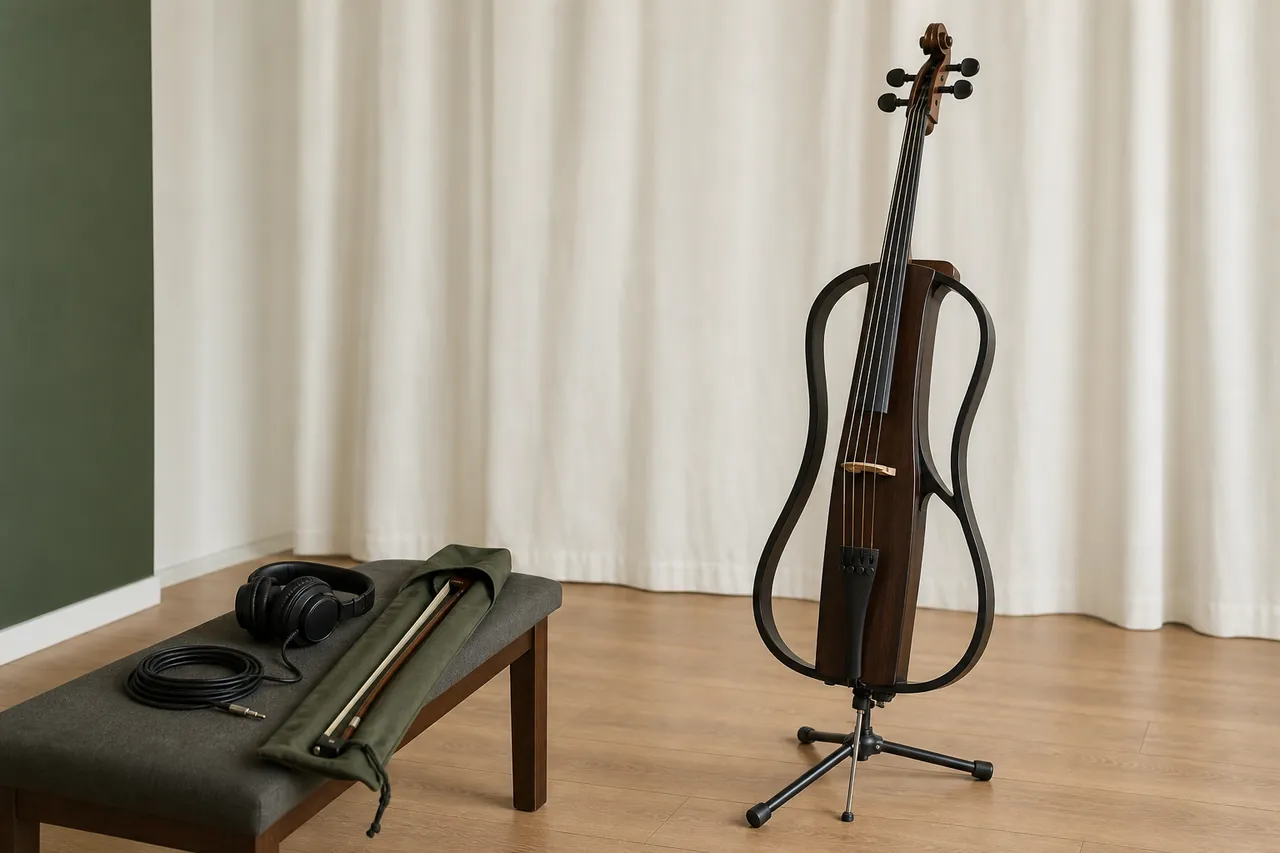
The frame is part of the instrument
Compare posture, output and the missing parts
| Exact model | Primary support | Electronics | Direct headphones? | Instrument weight | Complete-rig catch |
|---|---|---|---|---|---|
| Yamaha SVC300F | Full frame, chest support, endpin | Piezo, SRT blend, EQ, tuner, aux-in, two reverbs | Yes | 3.4 kg | Bow, batteries and AC adapter are separate |
| Yamaha SVC300C | Folding knee supports, chest/arm support, endpin | Piezo, SRT blend, EQ, tuner, aux-in, two reverbs | Yes | 3.6 kg | Support geometry, regional SKU and power supply |
| NS Design WAV4c | Included tripod; optional endpin/strap systems | Passive high-impedance Polar pickup | No | 2.0 kg | Headphone practice needs another powered device |
| NS Design NXT4a | Included tripod; optional supports | Capacitor-powered active or passive output | No | 1.9 kg on model page; 2.5 kg on maker comparison | Weight conflict, charger and output mode need checking |
The NS instrument weights exclude the included 2 kg tripod. Yamaha publishes the SVC300 weights without saying they include batteries or the removable chest support. NS Design also publishes conflicting NXT4a instrument weights: 1.9 kg on the model page and 2.5 kg on its series comparison. These are not like-for-like packed weights; ask the seller to confirm the current unit, then total the case, stand, bow, cable and power items.
Translate the specification sheet into a rig
What the specification sheet means in the chair
Piezo pickup
A sensor that turns bridge vibration into an electrical signal.
It lets the cello feed headphones or amplification, but the sound still depends on setup and the next device.
Check output type, input impedance and gain on the intended amp or interface.
A piezo label does not guarantee acoustic-cello tone.
Passive high-impedance output
The pickup sends an unpowered signal that prefers an input designed for instrument or piezo sources.
A mismatched low-impedance input can change level and tonal balance.
Confirm the amp, preamp or interface input in writing; budget a suitable preamp if needed.
Passive means no battery in the cello, not that headphones can plug in directly.
Active output
An onboard circuit buffers the signal for easier connection to common audio equipment.
NXT4a can switch between active and passive paths.
Test both modes at matched listening level and note which cable/input each device expects.
Active does not mean the cello contains a speaker.
SRT Powered processing
Yamaha's digital processing adds a modeled body-resonance response to the pickup signal; it does not sample or amplify an acoustic sound box.
The SVC300F and SVC300C provide sound type, blend, treble, bass and reverb controls, so one factory setting is not the whole signal path.
Reset the controls, compare settings at matched volume through the buyer's headphones and amp, and keep notes for each use.
The SRT name is not proof that either model sounds exactly like the player's acoustic cello.
Arco / pizzicato switch
A pickup setting that changes sensitivity for bowed versus plucked vibration.
NS instruments expose this choice because each technique moves the bridge differently.
Use both techniques through the real rig before keeping the instrument.
It is not an automatic playing-style detector or an effects preset.
Scale length
The vibrating string length from nut to bridge; these models are around 69 to 69.5 cm.
It helps preserve familiar left-hand spacing, but it says nothing about chest, knee or thumb landmarks.
Have the player check first, fourth and thumb positions with a teacher where appropriate.
A 4/4 label does not make every support geometry identical.
Tripod support
A floor-standing frame that holds an NS cello independently of the player's knees.
It supports seated or standing use, but removes several normal acoustic-body reference points.
Rehearse chair height, stand footprint, instrument angle and bow clearance.
The included stand is not the same experience as an optional endpin support with knee and chest contact.
Residual acoustic sound
The sound audible in the room before headphones or an amplifier reproduce the pickup signal.
An electric cello is quieter than an acoustic cello, not silent to nearby people.
Ask the seller about returns, then test in the actual practice room at the intended hour.
Headphones do not mute the strings and bridge.
Availability and playing position
How support and signal path split the field
Where each cello was orderable
Each exact model needed a current maker record plus current US and European buying evidence. Sweetwater and Thomann showed both SVC300 models in stock. Johnson String and Thomann showed WAV4c in stock; Fiddlershop and Thomann did the same for the NXT4a. Retailer sales ranks, purchase-share displays and ratings show market presence only, never objective quality.
What changes in the playing position
We separated familiar body contact, folding travel support, passive stage entry and dual-output performance. That prevents a beautifully documented pickup from hiding a playing position the cellist dislikes.
Match the cello to the session
Recommendations by posture and signal path
Familiar acoustic-style body contact
Yamaha SVC300F
Choose the SVC300F when direct headphone practice and familiar body reference points outweigh minimum packed size. Its molded-plywood full frame, removable chest support and endpin surround a spruce/maple body; aux-in, tuner, SRT blend, EQ and reverb keep practice and basic tone shaping onboard.
- Advantage
- The most acoustic-cello-like outline here, with direct phones, line out, aux-in and the newest Yamaha control set.
- Drawback
- It is the bulkiest shape in the shortlist and still makes audible string/bridge sound in the room.
- Avoid if
- You need the narrowest case, standing tripod performance, passive electronics or a lower price.
- Closest alternative
- SVC300C keeps the same documented SVC300 control set in a folding-support format.
- Before checkout
- Confirm SVC300F, finish, 4/4, soft case and chest support, plus the separately sold bow, batteries, regional adapter and warranty.
Folding Yamaha practice and travel format
Yamaha SVC300C
The SVC300C is the current Yamaha lane for a slimmer packed form. Folding beech knee supports plus removable chest and arm supports provide a structured seated position without the SVC300F's full frame, while retaining headphone, line, aux-in, tuner, SRT blend, EQ and reverb controls.
- Advantage
- Integrated headphone-practice path, current SVC300 electronics and folding supports in one documented system.
- Drawback
- Less body-like contact than SVC300F, and the 3.6 kg maker figure still omits packed-case context.
- Avoid if
- You want the lightest instrument, passive electronics, included tripod, or acoustic-body landmarks.
- Closest alternative
- NXT4a for lower published instrument mass and flexible active/passive stage output, subject to the maker's weight conflict.
- Before checkout
- Confirm SVC300C finish/SKU, supplied supports and soft case, plus the separately sold bow, batteries, regional adapter and service access.
Lower-cost passive stage and effects rig
NS Design WAV4c
WAV4c is the straightforward entry to NS Design's compact format: a 2 kg four-string instrument, included folding tripod and battery-free passive Polar pickup with arco/pizzicato selection. It suits a buyer willing to design the input and support system around the cello.
- Advantage
- Lowest current price lane here, compact body, no battery, and current US/EU specialist stock.
- Drawback
- The high-impedance passive output and tripod posture can add a preamp or optional endpin support to the real cost.
- Avoid if
- You need direct headphones, onboard reverb/aux-in, or familiar chest and knee contact out of the box.
- Closest alternative
- NXT4a retains the NS format and adds active/passive output.
- Before checkout
- Confirm WAV4c rather than WAV5c, four-string CGDA tuning, exact finish/fingerboard, stand/bag and intended input impedance.
Active/passive performance and recording rig
NS Design NXT4a
NXT4a earns the flexible-rig lane with switchable active/passive output, volume/tone controls and the Polar pickup's arco/pizzicato setting. The maker says a 60-second charge powers the capacitor-based active circuit for up to 16 hours; passive mode remains available. We did not verify that runtime.
- Advantage
- Dual output modes, adjustable setup and current in-stock specialist paths in both markets.
- Drawback
- No direct headphone circuit, the included tripod changes normal cello contact points, and maker pages disagree on instrument weight.
- Avoid if
- You want a self-contained practice instrument, acoustic-style body reference or no charging routine.
- Closest alternative
- SVC300C for built-in headphone practice; WAV4c for simpler passive electronics.
- Before checkout
- Confirm exact NXT4a-CO finish, fretless four-string configuration, current weight, charger/bag contents, output mode, support choice and regional warranty.
Rehearse the geometry without guessing
Map every contact point before ordering
Sit on the real chair with the usual shoes. Use a broom handle or straight cardboard strip for the neck and a box at the listed instrument height. This cannot prove playability; it can expose a support plan that does not fit the player or room.
Chair height________
Endpin / tripod position________
Chest contactpresent / absent
Knee contactpresent / absent
Fourth-position landmark________
Bow clearance each side________
Stand footprint clearyes / no
Teacher approves geometryyes / not checked
Reject the plan if the support collides with the chair, the tripod occupies a walkway, the player must clamp the neck, or the bow cannot clear furniture. For an NS model, price the optional endpin support before assuming the included tripod will feel natural.
The cello is only the first box
Write one signal-chain passport per use
Cello output/mode: ________ Cable: ________ Next input and impedance: ________
Headphone or speaker volume controlled by: ________ Power/charge source: ________
Recording/interface path: ________ Safe cable route: ________ Return-window test date: ________
For SVC300F/C, separate the headphone and line-output jobs and verify the regional power adapter. For WAV4c, name the high-impedance input or preamp. For NXT4a, write active or passive beside every destination. Never connect an output to phantom power unless both device manuals explicitly support the arrangement.
Do not spend the return window admiring the finish
The first-hour handoff with a teacher or technician
Identity and structure
Match model suffix, string count, finish, bridge orientation, supports, case, tools, charger/cables and manual. Photograph shipping damage before setup. Do not force a bridge, endpin or support that resists its documented motion.
Playing landmarks
At modest bow pressure, check open strings, first and fourth positions, shifts and every string crossing. Ask the player whether missing bouts or chest contact changes left-hand security.
Two signal tests
Use the same phrase through headphones where supported and the intended amp/interface. Check noise, clipping, cable movement and arco/pizzicato response without turning a first impression into a universal sound claim.
Room reality
Close the door and have another household member listen from the sensitive room. Residual acoustic sound may still be too loud for the planned hour.
Size, materials, origin and support
The instrument behind each support system
Weights use each source's stated context, including the unresolved NXT4a conflict. Brand location is not manufacturing origin; Yamaha's exact assembly country remains unverified.
| Product | Size / weight | Construction | Manufacturing origin | Brand | Warranty / support |
|---|---|---|---|---|---|
| Yamaha SVC300F | 1266 x 430 x 243 mm without chest support; maker lists 3.4 kg without fuller weighing context | Spruce/maple body, maple neck, molded-plywood frame, ebony fingerboard, Aubert maple bridge | Not disclosed by Yamaha for this exact model; verify unit label | Yamaha, founded 1887 in Hamamatsu; broad musical-instrument and audio maker | Verify Yamaha purchase-country limited warranty and authorized seller; retailer coverage is separate |
| Yamaha SVC300C | 1251 x 438 x 243 mm without chest support; maker lists 3.6 kg without fuller weighing context | Spruce/maple body, maple neck, beech folding supports, ebony fingerboard, Aubert bridge | Not disclosed by Yamaha for this exact model; verify unit label | Yamaha, founded 1887 in Hamamatsu; broad musical-instrument and audio maker | Verify regional Yamaha term, SKU and service path before importing |
| NS Design WAV4c | 942 x 139 x 94 mm; 2.0 kg instrument; included tripod about 2 kg | Solid maple body/neck, flame-maple face, Coform or rosewood fingerboard, adjustable maple bridge | India, stated by NS Design for current WAV cello series | NS Design, founded 1990 by Ned Steinberger; Maine-based electric bowed-instrument specialist | Maker-direct terms and dealer coverage vary; obtain the exact written regional term |
| NS Design NXT4a | 942 x 139 x 94 mm; model page says 1.9 kg but maker comparison says 2.5 kg; included tripod about 2 kg | Solid maple body/neck, Richlite fingerboard, adjustable maple bridge, capacitor active circuit | Czech Republic, stated by NS Design for NXT4a cello series | NS Design, founded 1990 by Ned Steinberger; Maine-based electric bowed-instrument specialist | Confirm dealer authorization and exact written term; retailer coverage is seller-specific |
Where an electric cello does not solve the job
When an electric cello is the wrong answer
It does not replace an acoustic ensemble instrument
Without amplification, these are quiet practice objects, not conventional orchestral cellos. A school or ensemble should approve the use case before purchase.
Travel size is a full-rig claim
Tripod, endpin support, bow, case, cables, preamp and charger can erase an attractive instrument-only weight. Airlines also control cabin acceptance; no model here is promised as carry-on compliant.
Setup still belongs to bowed-instrument work
Bridge alignment, string height, nut, fingerboard relief and bow choice affect playability. Buy from a seller with a credible setup/return process or budget an inspection by a qualified string technician.
Headphones do not protect hearing automatically
Begin at low level, control peaks in the signal chain and take breaks. The available output is not a target setting.
Use the return window on the delivered cello
What to check before the box is discarded
Identity
Match model suffix, string count, voltage, case and accessories to the paid invoice.
Structure
Inspect bridge, strings, tuners, endpin, supports, finish and case without forcing adjustments.
Posture
Repeat the contact rehearsal seated and, if relevant, standing with teacher input.
Signal
Test every documented output/mode with the intended cable and destination at conservative level.
Noise
Check residual room sound, hum, handling noise and cable movement in the real room.
Service
Register if required and store serial, receipt, written warranty and return deadline together.
Specifications and stock checked July 19, 2026
Sources for specifications and availability
Found a changed model, specification or support term? Send Consordini the exact product, country and source link.