Current US and continental-European offers checked
Best electric violin choices for stage signal, five-string range, and headphones
Start with the output and the job. These four exact configurations survived 22 lane comparisons across 18 exact models because each solves a different rig or playing problem, not because one specification proves better tone. No hands-on test was performed.
See the four lanesChoose the job before the instrument
An electric violin can be a passive stage source, an active/passive instrument, or part of a headphone-practice system. Those are different purchases. None of the four current finalists drives headphones by itself, so quiet practice requires a compatible receiver with a headphone output.
The shortlist deliberately narrows performance claims. We found manufacturer documentation, current exact offers, and some owner or specialist observations, but no controlled current comparison of the exact four finalists with a published physical sample count. Tone, balance, bow response, setup, and fit remain buyer-test questions.
Signal words that prevent the wrong order
Passive output
The pickup sends signal without an onboard powered preamp. The receiving input determines level and loading. Check the first device's input impedance and gain range. Passive does not mean direct headphone listening.
High-impedance input
An input that places a light electrical load on a passive pickup. NS specifies at least 1 megaohm for WAV and passive NXTa use, with 3-10 megaohms preferred for WAV. Read the input specification, not just the connector shape. A quarter-inch socket is not proof of compatible loading.
DI or preamp
A device that can load, boost, balance, or route the violin signal for the next input. It can be the missing link between a passive bridge pickup and mixer, interface, or amp. Match its input to the pickup and its output to the next device. A passive DI is not automatically a piezo preamp.
Headphone output
A powered output intended to drive headphones. None of the four finalists supplies one directly. Budget a compatible headphone-capable receiver when absent. Line out and instrument out are not interchangeable with headphones.
Active/passive dual mode
The NXT5a can run its onboard active circuit after charging or bypass it as a passive instrument. Active mode tolerates a broader set of inputs; passive mode still needs high impedance. Rehearse both modes and pack the charger. Battery-free charging does not remove every power-planning task.
Five-string C
A lower C string extends below the usual violin G. It also changes string spacing and bowing lanes. Test repeated C-G and G-D crossings before paying for range. More strings are not automatically better for four-string repertoire.
Control box
A separate powered part of the YSV104 system with instrument, auxiliary, and headphone connections. The intended practice path depends on it and its cable. Keep the supplied box and cables with the instrument. It is not a generic replacement for every stage preamp.
Complete rig
The violin plus every required bow, support, case, cable, power source, preamp, monitoring device, and speaker or headphones. Instrument-only prices hide different missing parts. Compare the checklist line by line before comparing totals. Accessories shown in a retailer image are not necessarily included.
Compare the complete rig, not the violin alone
| Exact configuration | US offer | Continental-EU offer | Included | Still needed |
|---|---|---|---|---|
| Yamaha YEV104 Black | $881.99 instrument; $1,358.95 complete standalone headphone rig | EUR849 instrument; EUR1,261.50 complete standalone rig | Instrument only | Bow, case, shoulder rest, cable, Scarlett Solo, wall adapter, C-to-C cable, headphones |
| Yamaha YEV105PRO Natural/Black | $1,694.99 instrument; $2,171.95 complete standalone headphone rig | EUR1,589 instrument; EUR2,001.50 complete standalone rig | Instrument only | Same list, plus a five-string setup check |
| NS Design WAV4 Transparent Red | $1,099 instrument; $1,501.98 complete standalone headphone rig | EUR1,049 instrument; EUR1,380.50 complete standalone rig | Case, shoulder rest, chin rest, tool kit | Bow, cable, Scarlett Solo, wall adapter, C-to-C cable, headphones |
| NS Design NXT5a Sunburst | $2,329 instrument; $2,731.98 complete standalone headphone rig | EUR2,290, incoming in 1-2 weeks; EUR2,621.50 complete standalone rig | Case, XL rest, chin rest, tool kit, charger | Bow, cable, Scarlett Solo, wall adapter, C-to-C cable, headphones |
Each total buys the missing playing parts and a complete standalone monitoring path. US baskets add an Eastman bow, Pro Co cable, Scarlett Solo, $19 USB-C wall adapter, $19 C-to-C data/power cable, and $59 ATH-M20x headphones; Yamaha also needs the $59.99 Protec case and $13.99 Everest rest. EU baskets use the Gewa bow, Cordial cable, Solo, EUR25 wall adapter, EUR25 C-to-C cable, and EUR56 ATH-M20x headphones; Yamaha also needs the Roth & Junius case and Kun rest. EU headphones are incoming in 2-5 days. The Solo's box has only a C-to-A cable; standalone listening needs wall power and Direct Monitor. A compatible buyer-owned powered computer/USB host can replace the wall adapter and C-to-C cable, reducing the example by $38 or EUR50. Tax, shipping, setup, and substitutions are excluded.
The shortlist by playing job
Passive four-string stage lane
Yamaha YEV104 Black
Choose it when familiar four-string range, conventional 4/4 shoulder-rest compatibility, passive simplicity, and the lower current complete-rig price are the actual brief.
Why it survives: the exact Black/TBL offers are $881.99 and EUR849, versus $1,553.99 and EUR1,449 for YEV104PRO. Thomann shows rank 5 and 45 ratings for this exact item.
Tradeoff: no bow, case, rest, cable, interface, power source, or headphone path is supplied.
Avoid if: quiet headphone practice is the job, or your first input cannot handle a passive bridge pickup.
Challenge it with: WAV4 if adjustable NS support and an included case matter more. YEV104PRO is a hardware step-up, but no controlled evidence found here justifies its $672 / EUR600 instrument premium.
Evidence limit: identity, offer, contents, and architecture are documented; no claim is made that it sounds, fits, or arrives set up like the PRO.
Current cross-market passive five-string lane
Yamaha YEV105PRO Natural/Black
Choose it only when a real arrangement uses low C and you need an ordinary exact Yamaha order path in both anchor markets now.
Why it survives: both exact PRO offers are ordinarily orderable; its lane is cross-market availability, not a proven performance premium.
Tradeoff: the older YEV105 is $959.99 in US backorder and EUR964 immediately available in Europe, versus $1,694.99 / EUR1,589 for the PRO. The older model has EU rank 24 and 14 ratings; PRO is rank 47 with one rating.
Avoid if: you are buying in Europe and the older YEV105 meets the brief, or clean four-string crossings matter more than occasional low notes.
Challenge it with: the older YEV105 first in Europe, WAV5 for adjustable geometry, or YEV104 Black if the C string fails rehearsal.
Evidence limit: exact offers and construction are documented; no current controlled evidence proves that PRO hardware earns the premium. Confirm its fingerboard and output socket in writing.
Adjustable passive value lane
NS Design WAV4 Transparent Red
Choose it when the NS support system, reversible reference bout, adjustable bridge, included case, and passive simplicity matter more than conventional body geometry.
Why it survives: it is the least expensive current NS finalist in both anchor markets and includes the custom support hardware and case.
Tradeoff: its passive Polar pickup asks for at least 1 megaohm, with 3-10 megaohms preferred; ordinary low-impedance mixer inputs are not the same thing.
Avoid if: you need familiar shoulder-rest geometry or direct headphones.
Challenge it with: YEV104 Black using your existing rest, and WAV5 only if low C earns its changed lanes.
Evidence limit: official signal and fit boundaries are useful; older owner reports inform the fitting test but cannot prove current-unit tone or setup.
Battery-free active/passive five-string lane
NS Design NXT5a Sunburst
Choose it when five-string range, NS geometry, and a rechargeable active output that can fall back to passive operation are worth the step-up cost.
Why it survives: NS states a 60-second charge supplies up to 16 hours of active use, while passive mode remains available; case, XL rest, and charger are included.
Tradeoff: passive mode still needs a high-impedance input, and Sweetwater lists Richlite where current NS comparison material and Thomann list ebony.
Avoid if: a four-string passive rig already does the job, or an unresolved fingerboard-material conflict is unacceptable.
Challenge it with: Yamaha YEV105PRO for simpler passive stage wiring, or NXT4a if low C is unnecessary.
Evidence limit: power modes and offer state are documented; verify the delivered fingerboard material in writing before the return clock starts.
A current offer or specification changed? Report a correction.
What the shortlist does not prove
No source here proves a universal best sound, best setup, best feedback resistance, or best fit. Manufacturer documents establish design boundaries. Retailer ratings establish market presence, not quality. The older exact-model playing accounts we found do not publish enough current-unit cardinality or controlled chain detail to transfer their tone judgments to a new order. That is why every lane ends with a rejectable buyer test.
Build the signal-chain passport
The six-line receiver passport
- Exact instrument output and power mode.
- Cable and connector at both ends.
- First input type and published impedance.
- Gain, DI, preamp, or control box.
- Monitoring output, amp, speaker, or headphones.
- Fallback when power or a proprietary cable fails.
The fifth-string rehearsal
Use the same passage on four and five strings: repeated C-G and G-D crossings, a slow double-stop, and the lowest note the arrangement actually needs. Reject low C if it adds avoidable adjacent-string contact without earning a musical job.
The support trace
On paper, mark jaw, collarbone, rest, and left-hand contact on the current violin. Bring the exact rest where policy permits. With open strings only, reject a candidate that needs the left hand to stop it rotating. Do not alter bridge, strings, or hardware during a return-preserving inspection.
Run one passage through every candidate
- Preserve the remedy first. Read the seller policy before fitting or connecting anything. Keep all packaging and supplied parts.
- Match the chain. Use the same bow, passage, monitoring endpoint, and sensible matched listening level. Change only the documented preamp/loading required by each design.
- Check physical control. Open strings, shifts, adjacent crossings, and a slow double-stop expose rotation and bow-lane problems without pretending to measure tone.
- Check electrical boundaries. Listen for overload, weak loading, hum, unexpected gain jumps, and headphone-routing gaps.
- Write a rejection. “Needs an unplanned preamp,” “low C adds collisions,” or “support rotates” is more useful than a vague favorite.
Check fit without spending the return
SHAR, US
Thirty days is not unrestricted home use. A full refund depends on like-new condition and original packaging. Keep the check to basic inspection: use beyond that may be depreciated. The buyer pays return shipping; signs of use can trigger a 30% restocking fee, and instruments used beyond basic inspection can lose up to 50% of value. Confirm the current terms before ordering.
| Seller and market | Clock and remedy | Inspection boundary | Costs and traps |
|---|---|---|---|
| Sweetwater, US | Usually 30 days from shipping; return authorization required | Received condition with accessories, documents, and packaging; treat a violin comparison as shop-equivalent inspection | Buyer generally bears return shipping; promotional outbound shipping may be deducted; special-order or modified goods can be excluded |
| SHAR, US | 30 days; full refund depends on like-new condition | Original packaging; basic inspection only. Instrument use beyond that can be depreciated | Buyer return shipping; signs of use can trigger 30% restocking, and instruments beyond basic inspection can lose up to 50% |
| Thomann Germany / continental Europe | 30-day money-back statement, alongside statutory rights | Original packaging and accessories, no avoidable signs of use; examination should stay comparable to a shop check | Germany return handling is not a Europe-wide promise; outside Germany use the applicable localized policy. Diminished value may be charged |
Do not rehearse on stage, change strings, alter the bridge, mount adhesive hardware, or assume “30 days” means unrestricted home use. Ask the seller in writing when the intended check exceeds ordinary inspection.
Physical, brand, and support facts
Yamaha warranty route
US manufacturer coverage: eligible new Yamaha electric violins bought from an authorized US dealer by or for the original owner have five-year limited coverage. Yamaha chooses repair or replacement; repairs may use qualifying new or refurbished parts, and a replacement may be reconditioned. The owner pays initial claim shipping; Yamaha pays covered return shipping within the US. Liability is limited to Yamaha's chosen repair or replacement. The policy excludes incidental or consequential loss, inconvenience, loss of use, damage to other equipment or items, and performance interruption or resulting consequences; state law may limit those exclusions. Europe seller coverage: Thomann's three-year seller warranty and mandatory local rights are separate and do not enlarge Yamaha's US policy.
| Product | Size and weight | Materials | Manufacturing origin | Assembly or setup path | Brand | Warranty route |
|---|---|---|---|---|---|---|
| Yamaha YEV104 Black | 592 x 204 x 111 mm; about 550 g | Spruce, mahogany, and maple body; maple neck; walnut frame; ebony fingerboard and chin rest; passive piezo pickup. No decision-critical current materials conflict was found for Black/TBL. | Exact model manufacturing or assembly country is not published in the checked maker and exact retailer material. | Instrument-only offer: add bow, case, 4/4 rest, and cable. Ask the seller or a violin technician to confirm delivered bridge/pickup setup before alteration; no factory assembly country is inferred. | Base: Hamamatsu, Japan. Established: 1887. Known for: musical instruments and professional audio. | Classification: manufacturer warranty. Duration/market/channel: five years for an eligible new US authorized-dealer purchase by or for the original owner; not transferable. Thomann's three-year seller coverage and local rights are separate. Handler: start with an authorized Yamaha dealer and obtain service or return authorization. Remedy/cost: Yamaha may repair or replace at its option; qualifying new/refurbished repair parts and a reconditioned replacement are possible. The owner pays initial shipping; Yamaha pays covered US return shipping. Limits: liability is repair or replacement at Yamaha's option. Incidental/consequential loss, inconvenience, loss of use, other-equipment damage, and performance interruption or consequences are excluded, subject to state law. Wear, misuse, unauthorized work, shipment damage, environmental damage, strings, pegs, bow hair, and tail adjuster are among the exclusions. |
| Yamaha YEV105PRO Natural/Black | 607 x 204 x 120 mm; about 550 g | Yamaha manual does not publish fingerboard material; Thomann lists maple while Sweetwater lists composite. Yamaha manual says passive 6.3 mm output; Thomann prints 3.6 mm. Confirm both in writing; neither conflict is resolved here. | Exact model manufacturing or assembly country is not published in the checked maker and exact retailer material. | Instrument-only offer: add bow, case, 4/4 rest, and cable. Confirm delivered fingerboard, output socket, bridge/pickup setup, and five-string spacing before alteration. | Base: Hamamatsu, Japan. Established: 1887. Known for: musical instruments and professional audio. | Classification: manufacturer warranty. Duration/market/channel: five years for an eligible new US authorized-dealer purchase by or for the original owner; not transferable. Thomann's three-year seller coverage and local rights are separate. Handler: start with an authorized Yamaha dealer and obtain service or return authorization. Remedy/cost: Yamaha may repair or replace at its option; qualifying new/refurbished repair parts and a reconditioned replacement are possible. The owner pays initial shipping; Yamaha pays covered US return shipping. Limits: liability is repair or replacement at Yamaha's option. Incidental/consequential loss, inconvenience, loss of use, other-equipment damage, and performance interruption or consequences are excluded, subject to state law. Wear, misuse, unauthorized work, shipment damage, environmental damage, strings, pegs, bow hair, and tail adjuster are among the exclusions. |
| NS Design WAV4 Transparent Red | 540 x 110 x 65 mm; 330 mm scale; about 670 g | Maple body and neck, ebony fingerboard, adjustable maple bridge, passive Polar pickup. | NS Design states this model is crafted in India. | Case, shoulder rest, chin rest, and tool kit are included; add bow and cable. Follow maker fitting/bridge instructions and preserve the seller's return condition before adjustment. | Base: ships from Nobleboro, Maine, USA. Established: 1990. Known for: Ned Steinberger's ergonomic electric bowed instruments. | Classification: manufacturer warranty. Duration: NS terms state two years for WAV; Sweetwater two-year and Thomann three-year seller coverages are separate. Market: maker, seller, and mandatory local rights depend on channel. Buyer: eligible owner with proof; transfer status is not published. Eligible channel: confirm the dealer's claim-handling path before purchase. Service handler: start with seller or NS support for authorization. Transferability: not stated. Exclusions: strings, batteries, listed wear, finish wear, unauthorized modification, and non-defect damage. Costs/remedy limits: obtain shipping instructions. NS may repair or replace a defective instrument or part; returned warranty instruments are repaired/returned or refunded at NS's option. NS states no liability beyond actual repair to playable condition within its specifications, calls this its sole express or implied warranty, and notes varying state rights. |
| NS Design NXT5a Sunburst | 540 x 110 x 65 mm; 330 mm scale; about 610 g | Maple body and neck; current NS comparison and Thomann list ebony fingerboard, while Sweetwater lists Richlite. Confirm the delivered unit in writing. | NS Design states this model is crafted in the Czech Republic. | Case, XL shoulder rest, chin rest, tool kit, and charger are included; add bow and cable. Confirm fingerboard, support fit, bridge setup, and both output modes before alteration. | Base: ships from Nobleboro, Maine, USA. Established: 1990. Known for: Ned Steinberger's ergonomic electric bowed instruments. | Classification: manufacturer warranty. Duration: NS terms state three years for NXT; Sweetwater two-year and Thomann three-year seller coverages are separate. Market: maker, seller, and mandatory local rights depend on channel. Buyer: eligible owner with proof; transfer status is not published. Eligible channel: confirm authorized dealer handling before purchase. Service handler: seller or NS support for authorization. Transferability: not stated. Exclusions: strings, batteries, listed wear, finish wear, unauthorized modification, misuse, and non-defect damage. Costs/remedy limits: confirm freight and regional service path. NS may repair or replace a defective instrument or part; returned warranty instruments are repaired/returned or refunded at NS's option. NS states no liability beyond actual repair to playable condition within its specifications, calls this its sole express or implied warranty, and notes varying state rights. |
Which alternatives still deserve a comparison?
The challenge record contains 22 lane comparisons spanning 18 distinct exact models: Yamaha YEV104, YEV105, YSV104, SV250, and SV255; NS WAV5, NXT4a, CR4, and CR5; GEWA Novita 3.0 four- and five-string; Wood Stingray SVX4, SVX5, and Viper PRO Midnight Black 5-string; Glasser AEX4 and AEX5; Harley Benton Stage Four; and Thomann Europe Electric Violin. Its tables keep dated price, offer-state, popularity, accessory, and complete-rig evidence separate.
YSV104 availability and warranty watch: SHAR's exact Black SKU YSV104BLK is $1,105.99 but backordered; placing an order reserves a place in line rather than creating an ordinary in-stock path. The product page promises a one-year, non-transferable SHAR warranty for workmanship or material defects and excludes wear and misuse. SHAR's general purchase terms instead put new products under the manufacturer's limited warranty, disclaim an automatic separate SHAR warranty, cap liability at the amount paid, and exclude consequential, special, or indirect damages subject to law. Treat that as an unresolved product-specific exception: obtain the eligible SKU, handler, remedy, costs, exclusions, and controlling terms in writing before relying on it.
Older YEV models: YEV104 Black wins the four-string lane because it is currently $672 / EUR600 less than YEV104PRO and no controlled evidence proves a performance return on that premium. For five strings, the older YEV105 is the European value preference at EUR964 and immediate stock; its $959.99 US offer is backordered with an expected July 27, 2026 arrival, so YEV105PRO remains only the ordinary two-market path.
Yamaha SV250/SV255: credible active professional alternatives, but at higher cost; SV255 lacked a clean normal US path in this pass.
Wood and GEWA: attractive specialized designs, but checked exact paths were made-to-order, unavailable, or regionally unresolved.
Glasser AEX: acoustic-electric rather than the solid-body task used for this shortlist.
Low-cost Thomann models: real EU offers, but no strong exact US path and insufficient current evidence for a cross-region launch recommendation.
Use these five checks to narrow the field
A finalist needed an exact enabled order path in the US and continental Europe, a distinct buyer job, adequate manufacturer documentation for signal and contents, a support path that could be described without invention, and a buyer test capable of rejecting it. Ordinary in-stock/orderable offers were preferred. NXT5a is the explicit qualified exception: Thomann accepts an order against labeled incoming stock in one to two weeks, so its EU offer is incoming-stock, not ordinary in-stock. Popularity was used only to challenge whether the pool was broad and current. Products were skipped when exact orderability, regional identity, category fit, or support evidence stayed too thin.
Close the case only after these five checks
- Exact model, finish, string count, and orderability class match the evidence: ordinary, incoming stock, backorder, or unavailable. NXT5a's European path is incoming stock in one to two weeks, not ordinary in-stock.
- Every missing bow, case, support, cable, input, USB host or wall-power path, and monitoring part has a price and owner.
- The open-string support trace is stable without left-hand clamping.
- The same passage works through the intended first input and, where needed, the passive fallback.
- Return and warranty channels, SHAR's product-page/general-terms warranty conflict, YEV105PRO's Thomann-maple versus Sweetwater-composite fingerboard conflict (the Yamaha manual is silent) and 6.3-versus-3.6 mm socket conflict, and NXT5a's ebony-versus-Richlite conflict are answered in writing.
Sources and update trail
Direct offer pages are snapshots. Recheck exact finish, stock, tax, package contents, seller authorization, and policy before payment.
- Yamaha YEV104/105 and PRO manual
- Sweetwater Yamaha YEV104 Black selected offer
- Thomann DE Yamaha YEV104 TBL selected offer
- Thomann YEV104 item sales-rank signal
- Sweetwater YEV104PRO challenger offer
- Thomann DE YEV104PRO challenger offer
- Thomann DE Yamaha electric-violin category
- Sweetwater YEV105PRO Natural/Black
- Thomann DE YEV105PRO Natural/Black
- Thomann YEV105PRO item sales-rank signal
- Sweetwater older YEV105 Black challenger
- Thomann DE older YEV105 TBL challenger
- Thomann older YEV105 item sales-rank signal
- Yamaha YSV104 specifications
- Yamaha YSV104 manual
- SHAR Yamaha Silent Violin exact family page
- SHAR general purchase and warranty terms
- Thomann DE YSV104 Black
- Electric Violin Shop Yamaha system guide
- NS Design violin comparison and specifications
- Sweetwater NS WAV4 Transparent Red
- Thomann DE NS WAV4 Transparent Red
- Thomann WAV4 item sales-rank signal
- Thomann DE NS electric-violin category
- Sweetwater NS NXT5a Sunburst
- Thomann DE NS NXT5a Sunburst
- Thomann NXT5a item sales-rank signal
- Thomann DE NS Design brand page
- NS Design WAV violin owner manual
- NS Design NXTa violin/viola owner manual
- NS Design warranty terms
- Yamaha US strings warranty
- Yamaha US strings warranty index
- Yamaha US authorized-channel warranty notice
- Sweetwater returns and exchanges
- Sweetwater two-year seller warranty
- SHAR returns and exchanges
- Thomann DE money-back policy
- Thomann DE seller warranty
- Thomann DE terms
- Violin String Review WAV/NXT comparison
- The Violinist Blog WAV4 owner review
- Sweetwater WAV4 owner reviews
- Sweetwater Eastman BL301 Cadenza violin bow
- Sweetwater Protec MX044 violin case
- Sweetwater Everest EZ shoulder rest
- Sweetwater Pro Co EG-10 instrument cable
- Sweetwater Focusrite Scarlett Solo 4th Gen
- Thomann DE Gewa Carbon Violin Bow 4/4 Wood
- Thomann DE Roth & Junius Concert-02 case
- Thomann DE Kun 300 Original shoulder rest
- Thomann DE Cordial CCI 3 PP cable
- Thomann DE Focusrite Scarlett Solo 4th Gen
- Focusrite Scarlett Solo official specifications and box contents
- Focusrite Scarlett Solo standalone and Direct Monitor guide
- Focusrite USB-C-to-USB-C compatibility note
- Apple US 20W USB-C wall adapter
- Apple US USB-C-to-USB-C cable
- Apple DE 20W USB-C wall adapter
- Apple DE USB-C-to-USB-C cable
- Sweetwater Audio-Technica ATH-M20x headphones
- Thomann DE Audio-Technica ATH-M20x headphones
- Yamaha company history
- NS Design history
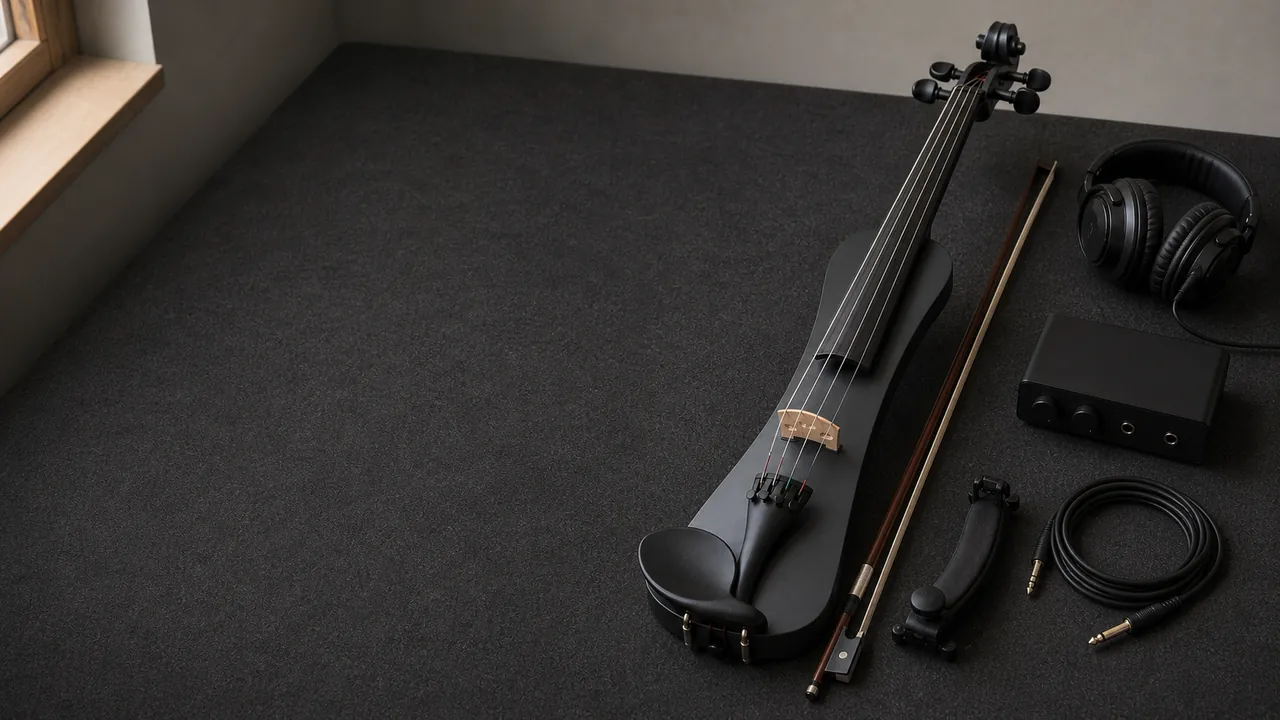
AI-generated selection scene; it does not show a tested or recommended product. The hero is an original unbranded illustration, not a finalist, product photograph, or record of hands-on testing.