Electronic drums · researched
Best Electronic Drum Amps and Monitor Speakers
Bottom line: choose the cable path and floor position before the headline power figure. The Roland PM-100 is the most straightforward seated-practice choice; the Alesis Strike Amp 8 MK2 is easier to carry; the PM-200 adds dedicated direct outputs; and the Strike Amp 12 MK2 is the larger-driver comparison.
We checked current manufacturer specifications, manuals, warranty paths, and live specialist-store listings. We did not hear, measure, or use these speakers. Room response, usable volume, noise, and tonal balance still need your own trial.
Start here: front controls for the throne, lower carry weight for stairs, or an XLR output for an onward feed.
Avoid: buying one speaker while expecting a stereo field, or assuming a module-to-speaker cable is in the box.
Verify before checkout: your module's output sockets, the required cable, local voltage version, seller warranty, and whether controls remain reachable in the intended position.
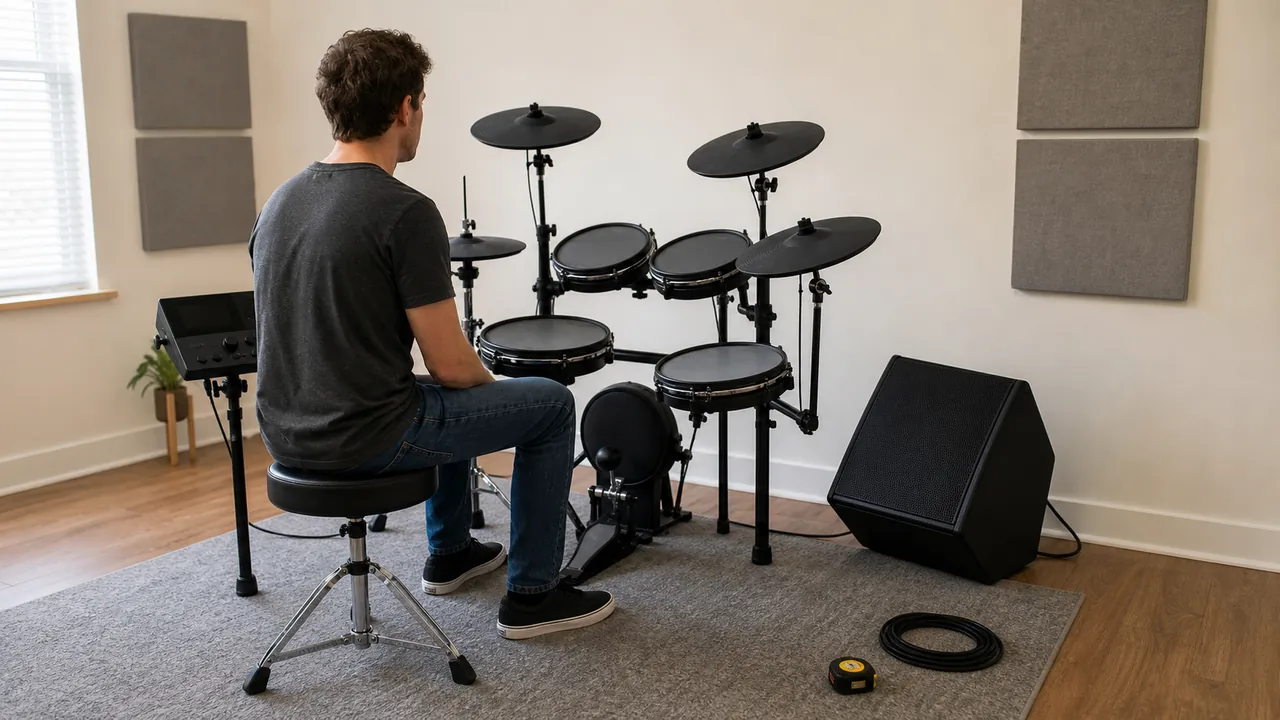
AI-generated editorial image; it does not show a tested product.
Read the rear panel before the marketing panel
The terms that decide whether the monitor fits
A drum monitor is a powered speaker placed close enough for the player to hear the module. The important vocabulary is less about status and more about whether the module, cable, cabinet, room, and onward sound system can connect cleanly.
Powered monitor
Plain meaning: the amplifier is built into the speaker cabinet.
Why it matters: an electronic-drum module sends a line-level signal; it cannot drive a passive speaker by itself.
Check: confirm the cabinet has AC power and a line input.
Common mistake: assuming any stage wedge is ready to connect.
Mono and stereo
Plain meaning: mono uses one audio channel; stereo uses separate left and right channels.
Why it matters: one cabinet reproduces one physical source even if its input accepts a stereo plug.
Check: read the module manual for its L/Mono and R outputs, then decide whether one or two speakers are intended.
Common mistake: treating a stereo-labelled socket on one cabinet as a two-speaker listening field.
Example: a single cable from L/Mono to one combo input is the simplest one-speaker path.
XLR/TRS combo input
Plain meaning: one socket accepts an XLR plug or a 1/4-inch TRS/TS plug.
Why it matters: it gives more cable options than a fixed 1/4-inch input.
Check: match the module output and speaker input; do not choose a cable from shape alone.
Common mistake: assuming every 1/4-inch cable is wired the same way.
Direct or link output
Plain meaning: an output that sends the monitor's signal onward to another speaker, recorder, or mixer.
Why it matters: it can simplify a personal-monitor-plus-PA path.
Check: confirm whether the output carries one input, a mix, mono, or stereo, and whether the venue wants a feed directly from the module instead.
Common mistake: treating a link socket as a complete mixing desk.
Frequency response and frequency range
Plain meaning: both describe the frequencies a maker says the speaker reproduces, but the tolerance matters. A -10 dB range reaches farther into quieter edges than a +/-3 dB response.
Why it matters: the Alesis models publish both conventions; Roland does not publish a range for these models.
Check: compare like with like and audition kick, tom, snare, cymbal, and backing-track material at your real position.
Common mistake: reading the lowest number as proof of stronger or better bass.
Rated, continuous, and peak power
Plain meaning: these are different ways of describing amplifier output, often under different test conditions.
Why it matters: Roland's rated watts and Alesis's large headline figures are not a clean league table.
Check: use power only alongside driver size, published SPL/range, room, return path, and an audition.
Common mistake: declaring the largest number the loudest or best-sounding product.
High-pass filter (HPF)
Plain meaning: a switch that reduces frequencies below a stated point; both Alesis MK2 models provide a 100 Hz HPF.
Why it matters: it can help a system hand low frequencies elsewhere, but it also removes much of the kick's low content from that cabinet.
Check: begin with it off for a standalone drum monitor and follow the venue's system plan when a subwoofer or full PA is involved.
Common mistake: assuming an HPF is a general clarity or quality switch.
How we chose these
Current models, distinct jobs, traceable limits
We mapped the current drum-monitor categories at Thomann in Europe and Sweetwater in the United States, then verified exact models against Roland and Alesis pages and manuals. Every recommendation was orderable on July 18, 2026 and had a visible retailer signal such as cross-store stocking, customer-rating volume, or category sales rank.
We excluded passive boxes, studio-monitor pairs, generic PA speakers, keyboard amps, and the delayed Roland PM-03. We also excluded models whose only persuasive evidence was an old roundup or marketplace listing. Popularity helped form the candidate pool; it did not decide the winner.
The shortlist at a glance
Compare by routing, placement, and weight
The power columns retain each maker's wording and should not be compared as one standardized test. The most useful first comparison is whether you need front controls, an onward output, Bluetooth, or a cabinet you can carry without resenting it.
| Model | Best fit | Driver / published range | Routing | Weight | Main caution |
|---|---|---|---|---|---|
| Roland PM-100 | Seated home practice | 10 in + 2 in; range not stated | Two stereo input sections; no direct out | 13.5 kg | Heavier than the Alesis 8; no onward XLR |
| Roland PM-200 | Seated monitor plus onward feed | 12 in + horn; range not stated | Two input sections; two XLR direct outs | 21 kg | Largest carry burden here |
| Alesis Strike Amp 8 MK2 | Portable, flexible placement | 8 in + 1 in; 52 Hz-20 kHz (-10 dB) | Two combo inputs; XLR link; Bluetooth | 9.5 kg | Rear controls; smaller-driver low-range comparison |
| Alesis Strike Amp 12 MK2 | Larger-driver rehearsal monitor | 12 in + 1 in; 44 Hz-20 kHz (-10 dB) | Two combo inputs; XLR link; Bluetooth | 15.7 kg | Rear controls and taller cabinet |
Recommendations by buyer lane
Start with the constraint you cannot change
Best for seated home practice
Roland PM-100
Why it fits: the angled cabinet, front-facing controls, dedicated V-Drums input, separate line-input level, and two-band EQ make it easy to operate from beside the throne.
Useful strengths: current exact-model documentation, 10-inch woofer, simple source mixing, and strong cross-retailer evidence: 34 Sweetwater reviews and 94 Thomann ratings.
Tradeoff: 13.5 kg is substantial for a compact cabinet, and there is no XLR direct or link output.
Skip it if: the monitor must feed a second cabinet or mixer, or it will travel up stairs every week.
Also compare: Strike Amp 8 MK2 for lower weight and a link output.
Check before keeping: audition the exact setup, confirm the required module cable, and verify that the regional warranty matches the seller's promise.
Best for carrying and flexible placement
Alesis Strike Amp 8 MK2
Why it fits: at 9.5 kg it is the lightest shortlist model, while retaining two balanced combo inputs, XLR link output, Bluetooth, upright/wedge use, and a pole socket.
Useful strengths: compact footprint, separate input levels, published response/range, 100 Hz HPF, and current stocking at both specialist anchors.
Tradeoff: its controls are on the rear, and the 52 Hz -10 dB lower limit is a screening figure rather than proof of how a kick will feel in your room.
Skip it if: you want controls facing the throne or need the larger-driver comparison before buying.
Also compare: PM-100 for front controls or Strike Amp 12 MK2 for the 12-inch path.
Check the paperwork: current specifications, contents, and US/EU listings are clear; the universal Alesis warranty term and exact manufacturing origin are not.
Best when the monitor must pass signal onward
Roland PM-200
Why it fits: it keeps the seated-angle, front mixer, and two source sections, then adds two XLR direct outputs with mono/stereo switching.
Useful strengths: 12-inch woofer, 180 W rated output, documented direct-routing controls, Thomann's category rank 10, and current transatlantic specialist presence.
Tradeoff: 21 kg and a 458 x 469 mm floor footprint make this a deliberate furniture-and-transport decision.
Skip it if: you do not need direct outputs or one-person carrying is a regular part of the job.
Also compare: Strike Amp 12 MK2, which is 5.3 kg lighter and uses a single XLR link path.
Confirm before lifting: rehearse the carry route and audition the cabinet; Roland publishes neither a frequency range nor the exact-model manufacturing origin.
Best larger-driver comparison
Alesis Strike Amp 12 MK2
Why it fits: its 12-inch low-frequency driver, published 44 Hz -10 dB lower limit, dual combo inputs, Bluetooth, XLR link, and multi-position cabinet create the clearest rehearsal-oriented A/B against the smaller Strike.
Useful strengths: lower published range boundary than the 8-inch model, 15.7 kg weight, 132 dB manufacturer peak SPL, and current in-stock Sweetwater evidence.
Tradeoff: it is taller and heavier than the 8, rear controls need space, and its 2500 W headline is not a standardized comparison with Roland's rated figures.
Skip it if: the room, carrying route, or reachable-control position favors a smaller cabinet.
Also compare: PM-200 for front controls and dedicated mono/stereo direct outputs.
Check the exact listing: specifications, contents, and orderability are current; origin, enclosure material, and a universal manufacturer warranty term remain undisclosed.
Due diligence after the shortlist
Physical facts, brand context, and support
These fields help with floorspace, transport, and service. Brand headquarters are not manufacturing-origin evidence, and a longer warranty is not proof of better sound.
| Product | Size and weight | Construction | Manufacturing origin | Brand | Warranty/support |
|---|---|---|---|---|---|
| Roland PM-100 | 388 W x 407 D x 354 H mm; 13.5 kg | 10 in woofer, 2 in tweeter, rugged angled cabinet; exact cabinet material not disclosed | Not disclosed by Roland for this exact model | Roland; established 1972; Hamamatsu, Japan; electronic musical instruments including V-Drums | US two-year limited category coverage for qualifying purchases; terms and region apply |
| Alesis Strike Amp 8 MK2 | 256 W x 245 D x 436 H mm; 9.5 kg | 8 in LF and 1 in HF drivers; exact enclosure material not disclosed | Not disclosed by Alesis for this exact model | Alesis; established 1980; known for electronic drums, studio products, controllers and monitoring | No universal term stated on the checked page; US/Canada via Alesis support, other regions via seller; verify in writing |
| Roland PM-200 | 458 W x 469 D x 420 H mm; 21.0 kg | 12 in woofer, horn tweeter, rugged angled cabinet; exact cabinet material not disclosed | Not disclosed by Roland for this exact model | Roland; established 1972; Hamamatsu, Japan; electronic musical instruments including V-Drums | US two-year limited category coverage for qualifying purchases; terms and region apply |
| Alesis Strike Amp 12 MK2 | 351 W x 354 D x 607 H mm; 15.7 kg | 12 in LF and 1 in HF drivers; exact enclosure material not disclosed | Not disclosed by Alesis for this exact model | Alesis; established 1980; known for electronic drums, studio products, controllers and monitoring | No universal manufacturer term stated; Sweetwater states two-year US retailer coverage; verify seller and region |
What the specification table cannot settle
One cabinet can solve the wrong problem very neatly
Front controls versus flexible placement
The Roland pair put the mixer where a seated player can reach it. The Alesis pair can work as wedges, upright speakers, or pole-mounted cabinets, but rear-panel access needs clearance. Draw the room before treating either approach as superior.
Large driver versus carry route
The 12-inch models are the sensible low-range audition lane, not automatic winners. The Strike 12 weighs 15.7 kg and the PM-200 21 kg. Lift a similarly weighted object from the intended shelf and walk the real stair route before ordering.
One speaker versus the full room
A personal monitor aims at the drummer. It may not distribute sound evenly to a band or audience. For a venue, ask whether the module should feed the main mixer directly while the cabinet handles only personal monitoring.
A five-minute pre-purchase map
Complete the signal passport before choosing a cabinet
Write one answer in every row. If any box is blank, the purchase is not ready. This prevents the common surprise of owning a powered speaker but lacking the cable, output mode, reachable controls, or onward route needed to use it.
Prevent a placement mistake before delivery
Build the cabinet from cardboard for ten minutes
Tape the published width, depth, and height on a box, then place it exactly where the monitor will live. Sit at the kit. Can you reach the controls without leaning through a rack? Does the handle clear the wall? Can the power and audio cables leave without crossing a pedal path? Now carry the box along the real route while holding an object close to the published weight.
This rehearsal cannot predict sound. It can reject a cabinet that blocks a module, steals pedal space, points past the player, or turns every rehearsal into an awkward lift.
At the shop or during the return window
Use one repeatable audition, not a loud first impression
- Set the module and monitor to conservative starting levels, then check for obvious hum or clipping indicators.
- Play the same kick, tom, snare, hi-hat, ride, and backing-track passage from the throne position.
- Repeat at the quietest useful practice level. Listen for whether details remain understandable; record this as your preference, not a universal fact.
- Move the cabinet only to positions that fit the room map. Rear walls, corners, floors, and seating distance can change what you hear.
- Test every input, the direct/link output if needed, Bluetooth if it matters, and the exact cable route you will keep.
- Before the return window closes, confirm the serial record, seller warranty, packaging, and service contact for your region.
What we checked
Manufacturer, manual, support, and retailer sources
Specifications come from makers and manuals. Store pages support current orderability and observable stocking signals, not sound-quality claims. No affiliate links are used in this review package.
- Roland PM-100 product page
- Roland PM-200 product page
- Roland PM-100/PM-200 owner manual
- Roland US warranty information
- Alesis Strike Amp 8 MK2 product page
- Alesis Strike Amp 12 MK2 product page
- Alesis regional repair and warranty-service path
- Thomann PM-200 listing and sales-rank signal
- Thomann Strike Amp 8 MK2 listing
- Sweetwater PM-100 listing
- Sweetwater Strike Amp 12 MK2 listing
Models and stock change. If you spot an error, send Consordini a correction.
Last model and orderability check: July 18, 2026. Recheck stock, regional voltage, warranty, and bundle contents before paying.