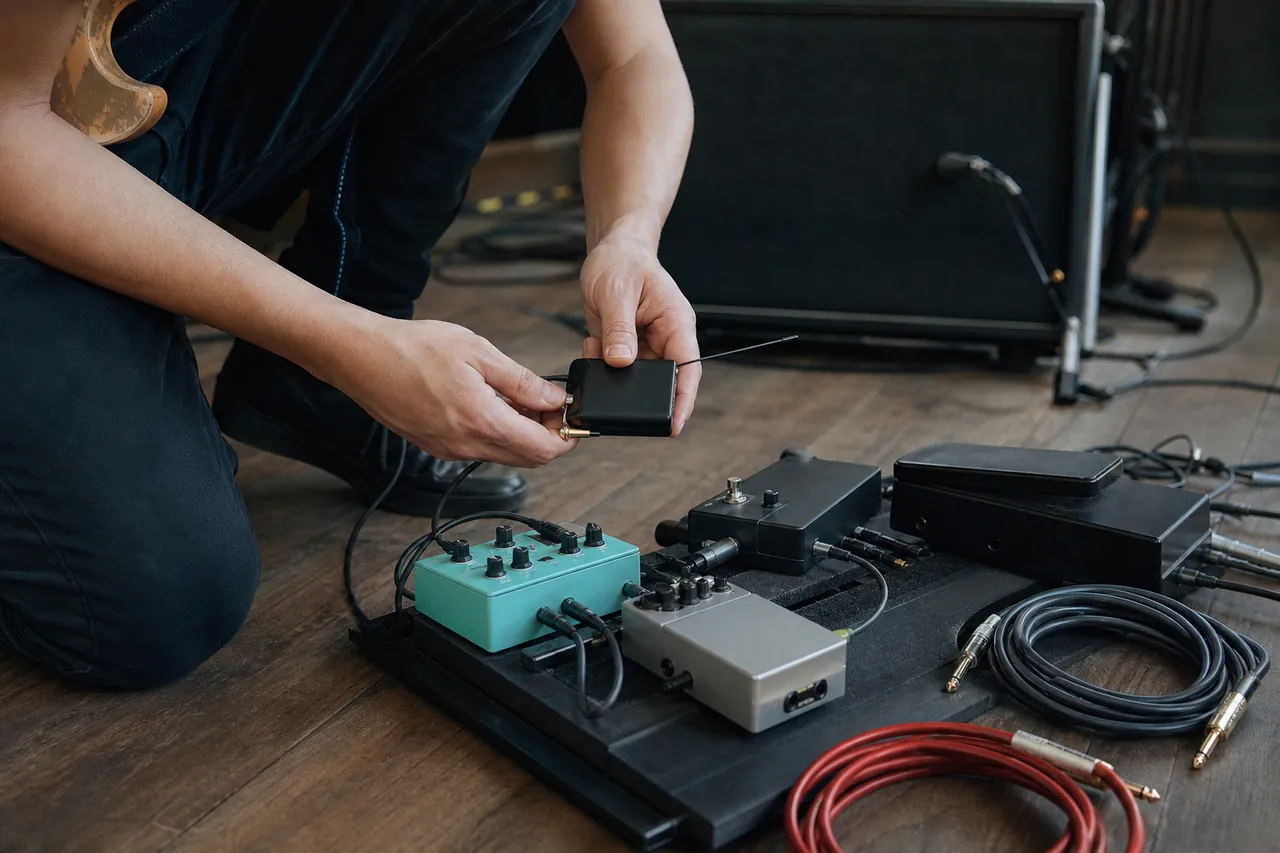
AI-generated illustration of a generic setup; it is not a test or a pictured recommendation.
Build the radio plan before soundcheck
Best wireless guitar systems
Choose by country, connector and whole-band channel count. A range number cannot tell you what the venue's radio traffic will do.
We checked current manufacturer pages, manuals, support documents, regulatory context and specialist-retailer stock on . We did not measure latency, range, sound or connection stability. Published figures use maker conditions; your exact instrument, venue and country still need checks.
Start here: Boss WL-20 for a compact passive-pickup rig; Line 6 G10SII for a docked pedalboard; Shure GLXD16+ for bodypack placement and dual-band planning; Sennheiser XSW-D for a cabled transmitter and XLR receiver output.
Avoid wireless today: when nobody can identify every radio system at the venue, charge the transmitter, or keep a tested cable ready.
Verify before paying: exact regional suffix, instrument jack/electronics, receiver output, simultaneous links and replacement-battery policy.
A licence-exempt band used by these systems and by Wi-Fi/Bluetooth devices.
It enables broad regional availability but creates shared-spectrum competition.
Inventory routers, wireless mixers and every stage link; separate receivers from USB 3 gear.
Licence-exempt does not mean interference-free.
5.8 GHz
A higher shared band used by the GLXD16+ alongside 2.4 GHz in supported variants.
Another band can give the system more coordination options.
Confirm the exact regional variant and locally permitted operation.
Higher frequency is not automatically more reliable or longer range.
Line of sight
The transmitter and receiver have a relatively unobstructed path.
Maker range figures normally depend on favorable placement.
Put the receiver above crowded metalwork and walk the real performance route at soundcheck.
A stated distance is not a wall-filled venue guarantee.
Latency
Time added while audio is converted, transmitted and reconstructed.
It combines with digital pedals, modelers and monitoring delay.
Add published stages on paper, then let the player test the complete rig.
A single maker number is not the whole monitoring path.
Compatible channels
Radio channels a system can select, not always the number of links that can coexist.
Band traffic and coordination reduce practical counts.
Use the maker's simultaneous-system method for the exact product family.
“14 channels” does not promise fourteen guitars in every room.
Bodypack
A belt or strap-mounted transmitter joined to the instrument by a short cable.
It avoids hanging a rigid radio directly from the guitar jack.
Confirm cable wiring, connector lock and a secure mounting point.
Any microphone bodypack is not automatically an instrument set.
Active electronics
Onboard preamps or pickups powered by a battery, often switched through jack contacts.
Some plug-in transmitter wiring or geometry can interact with the switching circuit.
Check maker compatibility and test power-up/mute behavior on the exact instrument.
A 1/4-inch plug shape alone does not prove electrical compatibility.
Sealed rechargeable battery
An internal cell that must be charged rather than swapped for a fresh AA pack.
A missed charge can remove the transmitter from service.
Write charging time, runtime, spare transmitter and cable fallback into the call sheet.
Maximum runtime is not a reason to schedule a set to the final minute.
Compare the operating plan
Four systems, four different failure points
Published specifications and the buyer meaning
Exact system
Band / transmitter
Stated latency and range
Power
Channel planning
Stop condition
Boss WL-20
2.4 GHz; direct plug pair
2.3 ms; 15 m line of sight
TX about 12 h; RX about 7 h
14 compatible channels; real coexistence varies
Jack/active circuit not proven compatible
Line 6 Relay G10SII
2.4 GHz; docked G10TII
<2.9 ms; up to 40 m line of sight
TX up to 7 h; powered receiver
Automatic selection; plan other 2.4 GHz devices
USB 3/Wi-Fi congestion or no charge fallback
Shure GLXD16+
2.4/5.8 GHz; WA305 bodypack
Mode-dependent; up to 60 m context
SB904 up to 12 h stated
Up to 8 typical retailer summary; managed expansion needs exact architecture
Wrong country variant or uncoordinated band
Sennheiser XSW-D Pedalboard
2.4 GHz; plug TX with extension/belt clip
<4 ms; 75 m optimal conditions
TX up to 5 h; powered receiver
Up to 5 systems stated
Five-hour schedule lacks charge/cable reserve
The specification is not the venue
Build the operating envelope in four passes
Match the sold variant to the countries
Begin with the exact model suffix on the invoice and receiver label. Ask the authorized seller to confirm that it is intended for the purchase country and every country where it will be used. A page that says 2.4 GHz or dual band is not enough: equipment authorization, allowed sub-bands and transmitted power attach to the particular device and market. Do not assume a cheaper imported version is equivalent.
European and ETSI material explains harmonized licence-exempt spectrum, but national administrations implement rules and manufacturers certify variants. For touring outside the seller's market, take the exact model and frequency information to the relevant regulator or a qualified coordinator. This guide cannot issue authorization.
Count links, not performers
Write one row for every transmitter: guitars, vocals, talkback, in-ear monitors, camera links, wireless mixer control and venue Wi-Fi. Some carry audio and others data, but they can still share or influence the same environment. A compatible-channels figure describes one system's selection scheme; it is not permission to add that number to another brand's headline.
For several links, stay inside a maker's documented coordination method or hire someone who can plan mixed inventory. Keep receivers away from noisy digital equipment as manuals direct. Name who pairs or scans first and who may change settings after line check.
Prove the instrument connection
For a direct plug transmitter, inspect jack direction, recess, nearby knobs, tremolo arm, strap and stand. Test active electronics and mute behavior with a charged unit. For a bodypack, verify that the supplied cable is the instrument cable named by the maker, secure the pack from impact, and add strain relief that does not tug the jack.
At the receiver, decide whether output goes to the first pedal, amplifier, modeler or console. XLR availability does not establish level or routing suitability. Set gain against the normal cable so an emergency swap is not a surprise.
Budget battery margin
Use maker runtime only as a ceiling under stated conditions. Deduct rehearsal, line check, standby and delays, then set a charge time with generous reserve. Sealed cells age and cannot be rescued with fresh AAs. A replaceable-battery system helps only if a charged compatible spare is actually in the case.
Label charging cables and supplies. Before doors, confirm transmitter indicator, receiver power, cable fallback and wired gain. After the show, dock or charge according to the manual instead of leaving responsibility to whoever packs last.
Choose the failure mode you can manage
Recommendations by instrument and stage job
Compact passive-instrument rig
Boss WL-20
The WL-20 removes the bodypack cable and automatically pairs in a small receiver/transmitter set. Its cable-tone mode is intended for high-impedance passive pickups, which makes this the narrowest lane rather than a universal plug-in recommendation.
Advantage: minimal hardware and no receiver box on the floor.
Drawback: both lithium batteries are non-user-replaceable, and Boss explicitly documents 2.4 GHz congestion as a possible cause of conflict.
Avoid if: an active circuit, recessed jack, side angle or strap movement has not passed the exact fit/power test.
Alternative: Shure's cabled bodypack separates radio placement from the jack.
Verify: use WL-20 rather than WL-20L only when the pickup/electronics brief matches Boss's distinction.
Dock-and-charge pedalboard
Line 6 Relay G10SII
The G10SII receiver is a charging dock as well as a pedalboard output hub, with 1/4-inch and XLR outputs. That makes daily transmitter handling visible: dock after use, check firmware, then carry a cable.
Advantage: docked charging and two output formats suit a fixed board.
Drawback: the G10TII's sealed battery is stated for up to seven hours, and Line 6 warns nearby USB 3 equipment can reduce 2.4 GHz performance.
Avoid if: the receiver will sit beside USB 3 drives/hubs or the instrument jack has not passed the plug test.
Alternative: Sennheiser supplies an extension cable and belt clip.
Verify: exact G10TII bundle, current firmware and receiver power supply; do not accept an older G10T substitution.
Bodypack and coordinated multi-system stage
Shure GLXD16+
The GLXD16+ combines the WA305 instrument cable, metal bodypack and pedal tuner receiver with operation across 2.4 and 5.8 GHz in the relevant variant. Its channel documentation is the best fit here when the technician is coordinating several links.
Advantage: bodypack placement, replaceable SB904 battery ecosystem and dual-band coordination.
Drawback: it costs more, occupies more board space and makes the country-variant check non-negotiable.
Avoid if: a touring buyer cannot document the exact regional suffix and legal use countries.
Alternative: Sennheiser is simpler when one cabled transmitter and XLR output are enough.
Verify: channel count for the exact mode and whether a Frequency Manager is part of the planned architecture.
Cabled transmitter placement and XLR out
Sennheiser XSW-D Pedalboard Set
The supplied extension cable and belt clip let the 1/4-inch transmitter move off a vulnerable guitar jack, while the pedal receiver offers both jack and XLR outputs. That solves a physical problem the smallest plug sets leave to the buyer.
Advantage: flexible transmitter placement and useful receiver outputs.
Drawback: the stated transmitter runtime is only up to five hours, and all operation remains in shared 2.4 GHz spectrum.
Avoid if: the schedule cannot include a mid-day charge and wired reserve.
Alternative: choose Shure for dual-band/multi-system planning or Boss for a smaller passive rig.
Verify: supplied power adapter, cable strain relief, five-system ceiling and the actual venue walk.
Total wireless linksguitar ___ vocal ___ IEM ___ mixer ___
Routers / USB 3 nearby______
Charge and spare plan______
Tested cable fallback______
Stop: any suffix, country, connector, system count or fallback line is blank. This tool screens the purchase; it cannot certify spectrum or predict a venue.
Make a cardboard transmitter
Rehearse the jack before ordering
Cut a card to the transmitter's listed length and depth. Hold it at the guitar jack, then put the instrument on its strap, sit, stand, use the tremolo arm and place it on its normal stand. Check whether the card hits the body, strap, floor, case edge or player's leg. For a bodypack, rehearse the short cable route and clip position instead. This catches geometry only; electrical compatibility still comes from the maker and an exact-instrument test.
One page for the whole band
Write the RF and power call sheet
List every guitar link, vocal wireless, in-ear monitor, wireless mixer/router and nearby USB 3 computer device. Assign one person to power receivers, pair/scan in venue conditions, walk each performance route, watch battery indicators and switch to a cable at the first repeatable fault. Record the wired input level before the show so fallback does not become a gain surprise. A successful rehearsal is venue evidence for that day, not a promise for the next room.
Questions for the seller and venue
Use names and numbers, not “it should work”
Send the seller: “Please confirm the full model and regional suffix, authorized countries of use, included transmitter and instrument cable, battery replacement route, and warranty country.” Send the venue: “How many 2.4 GHz, 5 GHz and other wireless audio links will be active; where are routers and receiver racks; who coordinates them; and when can we perform a full-stage walk?” Bring the answers with the system.
At handoff, label transmitter, receiver, charger and cable as one set. Record firmware where the maker provides updates. If a hired technician changes the plan, note the final assignment before the show begins. This small record prevents the next operator from pairing a transmitter to the wrong receiver, borrowing a charger with the wrong output, or rebuilding a channel layout from memory.
Due diligence
Physical, brand, origin and support facts
Exact sets checked July 18, 2026
Product
Size / weight
Construction
Origin
Brand
Support
Boss WL-20
Each 87 x 25 x 38 mm; about 60 g each
Plug-in TX/RX; exact housing material not stated
Not disclosed for this exact set
Boss is a Roland brand; Roland based in Hamamatsu, established 1972
Receiver approx. 127 x 102 x 51 mm; verify current manual mass
Metal stompbox receiver; plug-in G10TII
Not disclosed for this exact set
Line 6, founded 1996 in California; Yamaha group guitar-technology brand
Regional Line 6/Yamaha terms vary; register and retain proof
Shure GLXD16+
Receiver 95 x 48 x 138 mm; bodypack 67 x 29 x 115 mm; about 1.2 kg set
Metal bodypack; pedal-format receiver; WA305 cable
Not disclosed for this exact set
Shure, founded 1925 and based near Chicago; professional microphones/wireless
Verify regional limited warranty and SB904 battery terms
Sennheiser XSW-D Pedalboard Set
Receiver 130 x 82 x 51 mm / about 890 g; TX 122 x 24 x 28 mm / about 77 g
Pedal receiver; cabled plug TX and belt clip; materials not stated
Not disclosed for this exact set
Sennheiser, founded 1945 and based in Wedemark, Germany; audio/wireless systems
Two years stated on product page; regional terms apply
No universal winner
Range is the last filter, not the first
Every listed range assumes favorable placement, and each system shares spectrum with other devices. Buy the legal variant and compatible connector, coordinate the band's full channel plan, create battery margin and retain a cable. Only then does the published distance help decide whether the product is even plausible for the stage.
How we selected these systems
We began with current Thomann guitar-wireless inventory and cross-checked US specialist listings, then used maker manuals/support for bands, connectors, power and system counts. Stock/rank/review signals established current market presence; they never became stability or sound evidence.
Soundcheck rejection rules
Reject a system that cannot be tied to the correct country variant.
Reject a plug transmitter that strains, switches off or obstructs the exact instrument.
Reject a stage plan whose simultaneous count comes only from adding channel labels.
Reject a battery schedule without reserve and a level-matched cable.
At any repeatable dropout, move/coordinate once; then use the cable rather than promising the next scan will fix it.