Cajon buying guide
Best cajon percussion boxes for acoustic and hybrid playing
Choose the mechanism and sitting geometry before the decorative faceplate.
We checked current maker specifications, manuals, support terms, and live retailer order pages. We did not play, record, sit on, or measure these cajons. Sound, surface feel, rattle control, trigger response, and comfort still need a same-room trial.
Researched for acoustic players, drummers, teachers, and bandmates buying a shared box.
Avoid: do not pay for the EC-10 if you will not manage batteries, threshold, levels, and an output path. Verify: sit at the published height and test the exact instrument during the return window.
Go to the mechanism comparison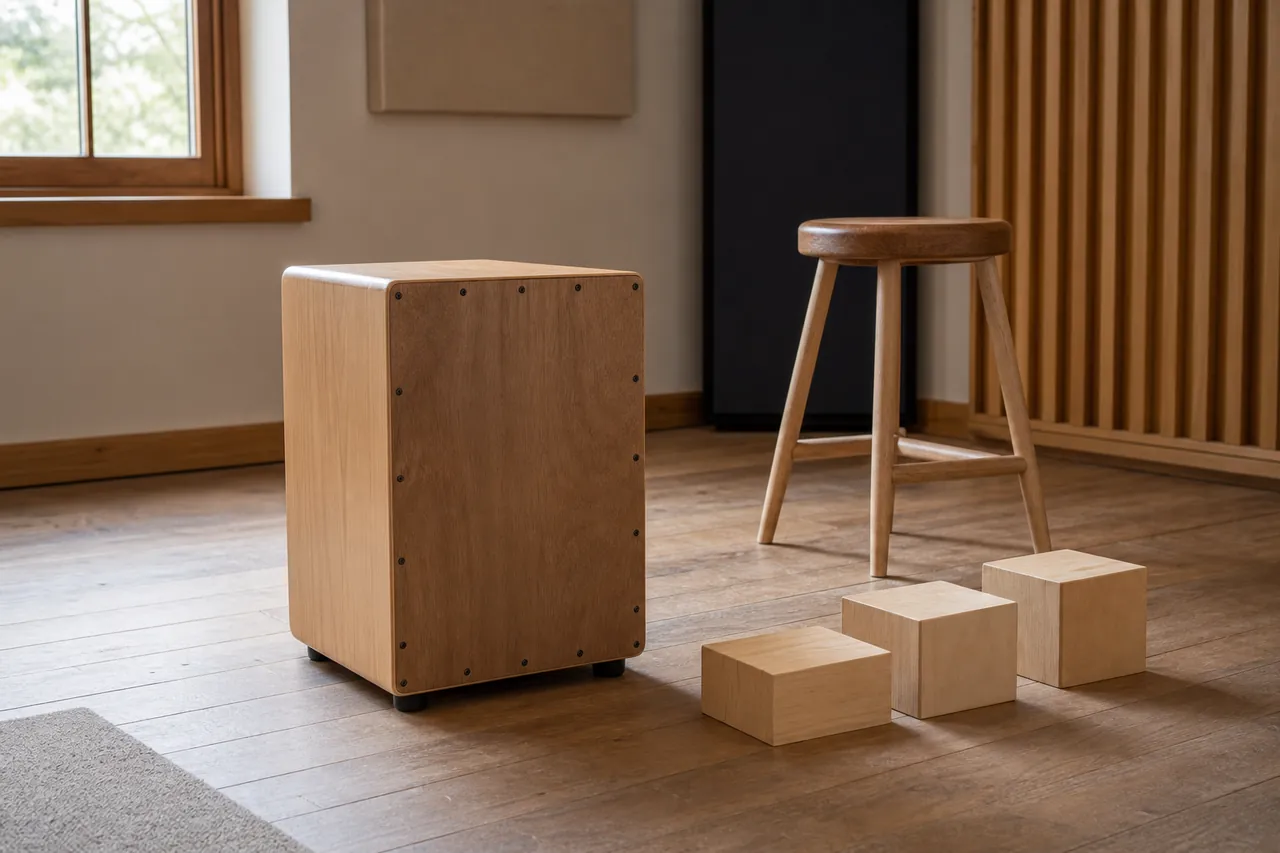
Read the box correctly
The words that change what your hands can control
Playing face or tapa
The thin front panel you strike.
Its construction and attachment affect response, but a wood name alone does not predict the exact instrument's sound.
Inspect the edges, screws, and flatness; play soft and hard strokes across both corners.
A decorative veneer is not proof of better tone or durability.
String cajon
Internal strings touch the playing face to add a snare-like buzz.
Tension can change response and unwanted ringing.
Ask which fastener changes tension and make one small, reversible adjustment only with the maker's tool.
“Adjustable” does not mean every buzz can be fixed without setup skill.
Snare wires
Drum-like wire sets contact the face inside the box.
Fixed wires keep setup simple but do not let you remove the snare character.
Play a center bass stroke and listen for wire spill after the stroke ends.
More wire is not automatically more articulate.
Removable snare traverse
A rail carrying snare strands that can be taken out, as on the CP404.
It changes the instrument from snare-present to a more open acoustic mode.
Have the seller demonstrate removal and refitting before the return period ends.
Removal is different from fine tension control while playing.
Clap corner
The upper face corner where a sharper slap sound is produced; some models let the corner gap be adjusted.
The response changes how easily quiet accents separate from bass strokes.
Test both corners at the volume you actually play.
A loud showroom slap does not prove useful control at rehearsal volume.
Bass port
The opening that lets air move from the box and offers a microphone position.
Wall distance, floor, and microphone placement can change the result.
Audition in the intended room and keep the rear port clear.
A large port is not a measured guarantee of deeper bass.
Electronic layer
A triggered sample added to the acoustic stroke.
It can add percussion colors but introduces power, threshold, level, and routing work.
Test soft and off-center hits, then confirm output level into the actual amp or PA.
An onboard speaker does not automatically cover a venue or replace sound check.
Shortlist
Match the mechanism to the job
Use the final column as the audition assignment. Specifications identify the mechanism; they do not establish sound or comfort.
| Model | Mechanism | Published height | Current signal | Test before paying |
|---|---|---|---|---|
| Meinl HCAJ1NT | Fixed strings; tension and corners adjustable | 18 in retailer listing | Both anchors; 114 Thomann ratings | String spill after center bass stroke |
| Schlagwerk CP404 Nature | Removable 40-strand traverse | 50 cm / 19.7 in | Maker stock; 330 Thomann ratings | Difference with traverse in and out |
| Pearl PBC-121B | Two fixed snare-wire sets | 19.25 in | Sweetwater stock; 19 reviews | Whether fixed wire spill suits quiet playing |
| Roland EC-10 | Acoustic box plus 30 electronic kits | 495 mm / 19.5 in | Both anchors; 22 Thomann ratings | Trigger threshold and PA level |
Recommendations
Four different answers, not a tone ranking
01
Meinl HCAJ1NT: learn what string adjustment changes
Best fit: a first full-size cajon for a player willing to make small setup adjustments.
The current model combines fixed internal strings with adjustable tension and top corners, and it has an active order path at both retailer anchors.
Advantage: it teaches the relationship between string tension, corner response, and unwanted ring without adding electronics.
Drawback: published exact weight and manufacturing origin were not found, and adjustment is another variable to learn.
Avoid if: you want to remove the snare character entirely.
Closest alternative: CP404 Nature for a removable traverse.
What is solid: current identity, materials, mechanism, stock, and two-year Meinl warranty. Sound and feel remain untested.
02
Schlagwerk CP404 Nature: switch between two acoustic behaviors
Best fit: an acoustic player who wants the snare traverse present for one arrangement and removed for another.
The CP404 publishes a removable 40-strand system, made-in-Germany origin, and current maker-shop stock.
Advantage: removal makes a larger mechanism change than a decorative face or minor corner adjustment.
Drawback: its 50 cm seat is the tallest here and the maker does not publish item weight.
Avoid if: you need electronic percussion colors or instant footswitch changes.
Closest alternative: HCAJ1NT when string tension adjustment is enough.
What is solid: exact construction, dimensions, origin, orderability, and retailer activity. No listening claim is made.
03
Pearl PBC-121B: leave the mechanism alone and play
Best fit: a lesson room or casual acoustic setup where fixed wires are preferable to a tuning routine.
The maker specifies two fixed snare sets, a current exact identity, and a compact 11.75-inch square footprint.
Advantage: fewer mechanism decisions between unpacking and the first rehearsal.
Drawback: the snare system cannot be removed, and the current warranty page excludes the playing surface.
Avoid if: wire spill during quiet bass strokes fails your trial.
Closest alternative: CP404 Nature for removable snare hardware.
What is solid: current dimensions, construction, stock, and review activity. Exact origin, weight, and warranty duration remain unverified.
04
Roland EC-10: add layers only when the set needs them
Best fit: a performer who needs triggered percussion colors from one seat and can manage power and level checks.
The EC-10 retains acoustic operation while adding 30 kits, separate head/edge triggers, a speaker, and an output.
Advantage: it covers a genuinely different hybrid lane, with current stock at both anchors.
Drawback: 6 kg weight, batteries or adapter, threshold, trigger balance, and PA routing make it the most complex option.
Avoid if: the job is simply to support one acoustic guitar at rehearsal volume.
Closest alternative: CP404 Nature plus a suitable microphone when only amplification is needed.
What is solid: official specifications, manual behavior, and cross-market stock. Trigger feel and venue output were not tested.
Before ordering
Rehearse the seat, not an imaginary sound
Stack firm books or use a stable stool at the published height. This is a screening exercise, not an ergonomic guarantee.
- Sit with both feet where they would be while playing. Record whether the heels stay planted and whether you must reach down to the upper corners.
- Mime center and corner strokes for two minutes without striking the support. Note shoulder lifting, twisting, or sliding forward.
- Compare 18 inches with 19.25 and 19.7 inches. A small height difference can still matter to one player's leg length and technique.
- Take those observations to a teacher or shop. Do not convert discomfort into a diagnosis or buy through persistent pain.
At the shop or during returns
Use three strokes to expose the wrong box
Center bass
Play one soft and one normal center stroke. Record lingering wire buzz, room boom, and whether the note disappears under the guitar.
Corner response
Alternate left and right corners at the same effort. Record missed accents, harsh edge noise, and whether one corner responds differently.
Soft-to-loud line
Repeat an eight-beat pattern from conversation level to rehearsal level. Record the point where the mechanism becomes clear or unruly.
Use the same room, floor, player, pattern, and distance for every box. Write observable events rather than “warm,” “professional,” or “premium.”
Due diligence
Size, build, origin, company, and written support
These facts help with transport and service. They do not score sound quality.
| Product | Size and weight | Construction | Manufacturing origin | Brand | Warranty/support |
|---|---|---|---|---|---|
| Meinl HCAJ1NT | About 11.75 x 11.75 x 18 in; the maker does not state item weight. | Siam oak face/body; internal steel strings; adjustable corners. | Not verified for this exact model; brand base is not proof. | Meinl, Gutenstetten, Germany; established 1951; percussion and cymbals. | Two years for original authorized-dealer purchaser; exclusions apply. |
| Schlagwerk CP404 Nature | 30 x 30 x 50 cm; the maker does not state item weight. | Beech face, eight-ply birch body, removable 40-strand traverse. | Made in Germany on exact-model maker shop. | Schlagwerk, Gingen an der Fils, Germany; established 1982; cajons and hand percussion. | Repair during applicable legal warranty; request regional duration/transport terms. |
| Pearl PBC-121B Primero Figured Cherry | 19.25 x 11.75 x 11.75 in; the maker does not state item weight. | Figured-cherry face, MDF body, two fixed snare sets, rear port. | Not verified for this exact model; Japanese base is not proof. | Pearl, Yachiyo, Chiba; founded 1946; drums and orchestral/world percussion. | Dealer-first service; playing surface excluded; exact current duration not verified. |
| Roland EC-10 ELCajon | 295 x 298 x 495 mm; 6.0 kg. | Sapele-ply face, MDF box, sensors, 6.5-in speaker and module. | Not verified for this exact model; Japanese base is not proof. | Roland, Hamamatsu, Japan; founded 1972; electronic musical instruments. | Buy authorized and request exact regional EC-10 written terms. |
Do not stop at the box
Map the complete rig before choosing electronics
Acoustic cajon path
Box → stable floor → room audition. For amplification add an appropriate microphone, stand or mount, cable, mixer/PA input, monitor plan, and sound-check time.
EC-10 layer path
Box → six AA batteries or included adapter → threshold and head/edge balance → onboard speaker for personal use or 1/4-inch output → cable → amp/PA input → level check.
Ask the venue which input is available and who controls gain. The EC-10's onboard 3 W speaker is a feature, not a promise of room coverage.
Walk-away checks
Reject the individual instrument when the mechanism fights the music
- Persistent rattle or wire spill masks normal center strokes and does not respond to a documented adjustment.
- The top edges, screws, face, or port show damage, lifting, sharpness, or movement on arrival.
- The published height forces an unstable playing posture in the player's own rehearsal.
- The seller cannot state whether a weight is item or shipping weight, or cannot provide written regional support terms.
- EC-10 soft hits fail to trigger consistently after documented threshold adjustment on the exact unit.
How we chose these
Current identity first, then a distinct musical job
We began with Thomann's European cajon range and Sweetwater's US listings, then checked manufacturer product, manual, company, and support pages. An included model needed a current exact identity, an order path on July 18, 2026, an observable specialist-retailer activity signal, and a buyer lane that another selected box did not already cover.
Retailer ratings and reviews only showed current customer activity. They did not establish sound, build quality, comfort, or reliability. Prices were omitted because they change faster than the mechanism and fit decisions.
Before checkout
Carry five facts to the seller
- The player's preferred seat height and whether feet remain planted.
- String tension, fixed wires, removable traverse, or electronic layers.
- Acoustic-only, microphone/PA, or electronic-output plan.
- Exact model code, item weight, included tools/power supply, and return deadline.
- Written regional warranty, playing-surface exclusions, freight responsibility, and authorized-dealer status.
Sources
Current pages used for the shortlist
- Meinl HCAJ1NT product page
- Sweetwater HCAJ1NT stock
- Thomann HCAJ1NT activity
- Meinl warranty
- Schlagwerk CP404 Nature
- Schlagwerk maker-shop stock and origin
- Thomann cajon activity
- Schlagwerk support FAQ
- Pearl PBC-121B product page
- Sweetwater PBC-121B stock
- Pearl company history
- Pearl warranty
- Roland EC-10 product page
- Roland EC-10 manual
- Sweetwater EC-10 stock
- Thomann EC-10 stock and activity
- Roland warranty route
- Roland company profile
No affiliate links are used. Stock, terms, and exact shipped units can change. Found a factual problem? Send Consordini a correction.