MICROPHONE STAND GUIDE
Best Microphone Stands for Stage, Studio and Desk Use
Choose the placement first. A dependable vocal boom, a tall quick-change stand, a kick-drum stand and a desk arm solve different center-of-gravity and reach problems.
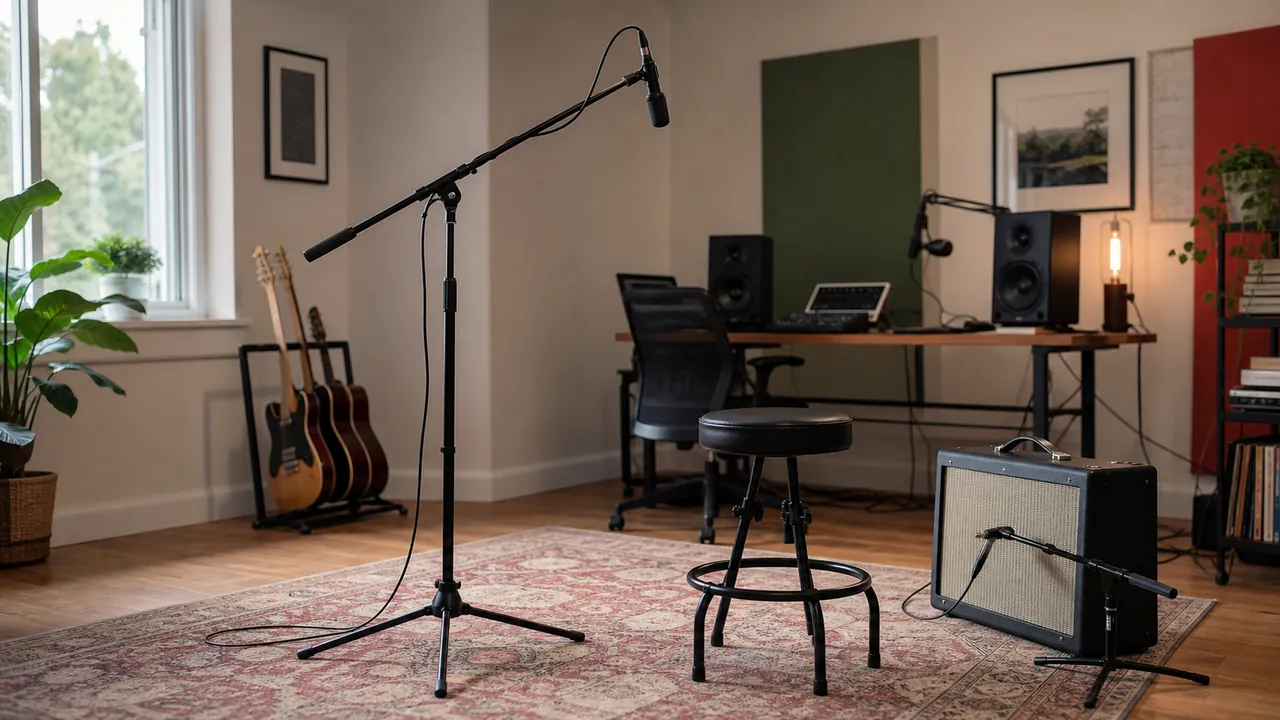
K&M 210/9 is the conventional steel tripod boom for routine vocal and instrument placement. Hercules MS533B trades telescoping boom reach for fast height changes and a 2400 mm maximum. K&M 25950 is purpose-built for low sources. Elgato Wave Mic Arm LP belongs on a compatible desk, not on a stage floor. Buy the geometry that keeps the microphone over the base, then verify every thread, clamp and accessory mass.
Stand geometry came before brand reputation
We compared current maker specifications, setup information and specialist-store orderability. We did not mount microphones, pull cables, test clamp wear or measure droop. Published dimensions establish a fit boundary; long-term joint wear, floor grip and handling noise still need an inspection during the return period.
The four recommendations occupy separate working lanes. A product was excluded when it duplicated one of those lanes without stronger current evidence, when the maker did not publish enough fit information, or when current specialist stock was weak. Thomann's large verified-buyer history and current sales positions establish durable market presence, not acoustic quality.
Before choosing, total the microphone, clip or shock mount, pop filter and any inline accessory. Mark the intended capsule position and the nearest legal base or clamp position. The stand is suitable only when both points can coexist without putting a leg in a walkway, crushing a desk edge or hanging the load beyond the stable footprint.
Match the support type to the source position
| Stand | Published geometry | Best lane | Main refusal |
|---|---|---|---|
| K&M 210/9 | 900-1605 mm high; 435-745 mm boom; 3.1 kg | General floor boom | 3/8-inch thread may need an adapter |
| Hercules MS533B | 1070-2400 mm high; 780 mm boom; 2.6 kg | Tall or fast straight/boom change | Hideaway boom is fixed-length |
| K&M 25950 | 280 mm high; 425-725 mm boom; 2.98 kg | Kick drum and amplifier | Too low for normal vocal use |
| Elgato Wave Mic Arm LP | 740 mm horizontal reach; 60 mm clamp; 2 kg load | Desk voice and streaming | Needs a suitable desk edge |
Read stability claims as measurable parts
Boom arm
A boom offsets the microphone horizontally from the upright or clamp.
More reach also moves the center of gravity away from the base.
Use only the reach needed and aim a tripod leg under the load direction.
Maximum extension is not automatically the safest working position.
Center of gravity
The combined stand and microphone load has a balance point projected toward the floor.
If that projection leaves the support footprint, the setup can tip.
Add accessories and cable pull before judging stability.
A heavy stand can still tip with a long offset load.
Thread size
Microphone clips commonly connect through 3/8-inch, 5/8-inch or 1/4-inch hardware.
Mismatched male and female threads do not become compatible through force.
Write down the stand end, clip and included adapter sizes.
“Standard” does not identify one universal thread.
Suspended load
Suspended load includes every item carried beyond a joint, not only the microphone.
A shock mount, pop filter and inline booster can materially change leverage.
Weigh or total published masses for the complete assembly.
Microphone weight alone is not the final load.
Clamp opening
Clamp opening is the maximum desk thickness the mounting jaws can span.
Edge bevels, cable trays and hollow surfaces can invalidate a nominal fit.
Inspect the underside and measure a flat load-bearing patch.
A thin desktop is not necessarily safe to clamp.
Cable strain relief
Strain relief leaves enough slack that the cable does not pull the microphone or joint.
A tight cable can create tipping force or transmit bumps into a recording.
Move the stand through its planned range before fastening cable ties.
A visually tidy cable is not automatically mechanically relaxed.
Four useful stands with clear boundaries
GENERAL FLOOR BOOM
K&M 210/9
Choose the 210/9 for a conventional steel stand that can move between standing vocals, seated instruments and moderate side-address microphone placement. Its two-piece telescoping boom separates reach from angle.
K&M publishes 900-1605 mm height, 435-745 mm boom length, 3.1 kg weight, a zinc die-cast base and foldable steel legs. Thomann lists it as its top stand seller with a long buyer history.
The 985 mm folded length and 3.1 kg weight are not ultralight, and the reviewed European variant ends in a 3/8-inch thread rather than guaranteeing every clip will fit directly.
Avoid if: the source sits near the floor, above 1605 mm without a boom angle, or at a desk with no safe floor footprint.
Alternative: MS533B for taller fast changes; 25950 for bass drum or amplifier height.
Verify: exact regional variant, thread/adapter, folded-bag length, mic assembly mass and one forward leg under the boom.
TALL AND FAST-CHANGE
Hercules MS533B
Choose the MS533B when one stand must change quickly between a straight vocal position and a boom, or when its published 2400 mm maximum solves a real overhead or tall-performer placement.
The squeeze-style EZ Clutch changes height, the boom hides in the upright for straight use, and Hercules publishes 1070-2400 mm height, 780 mm boom, 2.6 kg weight and 980 mm folded length.
The hideaway arm does not telescope like the 210/9 boom. Its quick mechanisms add proprietary parts that should be checked for lock security and replacement support.
Avoid if: independently variable boom length matters more than fast conversion, or the minimum 1070 mm upright is already too tall.
Alternative: K&M 210/9 for telescoping reach and a conventional T-bar lock.
Verify: 3/8- or 5/8-inch clip path on the exact package, EZ Clutch lock, boom clamp, cable slack and load balance.
LOW INSTRUMENT POSITION
K&M 25950
Choose the 25950 when the capsule must sit in front of a kick drum, guitar cabinet or other source near the floor. The 280 mm fixed upright avoids folding a full-height stand into an unstable shape.
Very short heavy folding legs, a zinc die-cast base and 425-725 mm telescoping boom put 2.98 kg of stand mass close to the floor. Thomann records hundreds of verified ratings and current stock.
It is a specialized tool: the upright height does not adjust, and a nearly 3 kg stand is substantial for one low microphone position.
Avoid if: the stand must also cover seated or standing vocals, drum overheads or fast height changes.
Alternative: 210/9 for broad floor-boom duty; a compact round-base desk stand for a source directly on a table.
Verify: regional 3/8- versus 5/8-inch variant, actual cabinet clearance, boom projection, leg direction and cable exit.
LOW-PROFILE DESK ARM
Elgato Wave Mic Arm LP
Choose the Wave Mic Arm LP for seated speech when a horizontal arm below the shoulder line preserves monitor sightlines and a strong, flat desk edge is available.
Elgato publishes 740 mm horizontal reach, 360-degree base/elbow rotation, a 60 mm clamp opening, 2 kg maximum load and included 3/8- and 5/8-inch adapters.
The arm needs clear space below and behind the desktop. The 2 kg ceiling includes microphone and accessories, and clamp pressure can damage an unsuitable hollow, glass or beveled desk.
Avoid if: there is no flat structural edge, the complete assembly exceeds 2 kg, or the microphone must move between stage and desk.
Alternative: a floor boom behind the desk when clamping is unsafe; MS533B when tall vertical reach matters.
Verify: desk material, flat 60 mm clamp path, cable channel fit, total suspended mass and full swing clearance.
Build a stand-load passport
Enter the complete hanging assembly, then compare the placement against the published geometry.
General floor-boom lane: map the 900-1605 mm height and 435-745 mm boom of the K&M 210/9.
Dry-run the base before connecting a microphone
- Mark the desired capsule position with tape or an empty clip.
- Open every tripod leg fully, or inspect a desk's top and underside for one flat structural clamp patch.
- Fit the correct thread adapter by hand; stop if threads bind.
- Add the actual microphone, shock mount, pop filter and inline accessories while holding the boom.
- Route the cable with a service loop at each moving joint, then sweep the complete intended range.
- Apply a light controlled nudge at the base, upright and cable. Any rocking, joint slip or cable steering is a failed setup.
Do this inside the return window and repeat it on the real stage, rug or desk. A specification cannot prove grip on a particular floor or strength of an unknown desktop.
Convenience mechanisms need a maintenance plan
Fast clutches and convertible booms reduce setup motions, but they add interfaces that must remain clean and correctly adjusted. Conventional T-bar locks are slower and easier to understand. Neither architecture guarantees service life. Inspect contact surfaces and confirm that replacement parts are actually offered for the exact model.
Maximum height and maximum boom extension should not be combined casually. A tall stand with an offset heavy microphone has more leverage and a higher consequence if disturbed. Use the shortest workable extension, keep one tripod leg under the boom, and keep feet and cable loops out of performer paths.
A desk arm can clear floor space while transferring every keyboard bump and desk knock into the same structure as the microphone. A low-profile visual line does not remove mechanical coupling. If isolation matters, test typing, monitor adjustment and chair contact with headphones before accepting the setup.
Dimensions, materials, origin and support record
| Product | Size / weight | Construction | Manufacturing origin | Brand | Warranty / support |
|---|---|---|---|---|---|
| K&M 210/9 | 900-1605 mm high; 435-745 mm boom; 3.1 kg; folded 105 x 85 x 985 mm. | Steel, foldable tripod legs, zinc die-cast base, telescoping boom, T-bar lock. | Exact unit origin not stated; K&M says components are predominantly made in-house in Germany. | König & Meyer, Wertheim, Germany; founded 1949. | Maker provides service contacts and spare-part documents; retailer terms vary. |
| Hercules MS533B | 1070-2400 mm high; 780 mm boom; 2.6 kg; folded 980 x 95 x 95 mm. | Tripod stand with EZ Clutch, single-knob boom clamp and hideaway straight/boom tube. | Country of manufacture not stated on the reviewed maker page. | Hercules Stands is a KHS Musical Instruments brand; Taiwan-based parent. | Maker support and parts channels available; Sweetwater lists two-year store coverage. |
| K&M 25950 | 280 mm high; 425-725 mm boom; 2.98 kg; folded 122 x 85 x 450 mm. | Steel, very short heavy folding legs, zinc die-cast base and telescoping boom. | Exact unit origin not stated; K&M says components are predominantly made in-house in Germany. | König & Meyer, Wertheim, Germany; professional stand specialist. | Maker publishes installation and spare-parts files; Thomann lists three-year store coverage. |
| Elgato Wave Mic Arm LP | 740 mm horizontal reach; 70/160 mm desk clearance; arm weight 1.723 kg. | Metal tension-adjustable arm, padded 60 mm desk clamp and magnetic cable channels. | Country of manufacture not stated on the reviewed maker page. | Elgato is a Corsair brand based in California, USA. | Elgato provides setup/support pages; verify regional seller and Corsair warranty terms. |
Thread, load and retailer evidence
- K&M 210/9 specifications and parts
- K&M 25950 US specifications
- Hercules MS533B specifications
- Elgato Wave Mic Arm LP specifications
- Elgato LP setup support
- Thomann K&M 210/9
- Thomann K&M 25950
- Thomann Hercules MS533B
- Sweetwater K&M 210/9 regional variant
- Sweetwater Hercules MS533B
- Sweetwater Elgato stand availability
- B&H K&M 25950 regional variant
For factual corrections, use the contact details on Consordini's contact page. Thread, finish, stock and warranty can vary by regional SKU; confirm the exact package before checkout.