Weighted digital piano buying guide
Best 88-Key Weighted Keyboards for Piano Feel, Floor Space and Connections
The useful shortlist starts with the room, bench, pedal and cables, then asks which action the player can control quietly and repeatedly.
Researched · for learners, returning pianists and compact home or rehearsal setups
We checked current maker specifications and manuals, plus orderability and visible demand at Sweetwater and Thomann. We did not play these instruments. Key return, noise, repetition, speaker character, pedal travel and app behavior still need a hands-on trial with the exact unit and planned accessories.
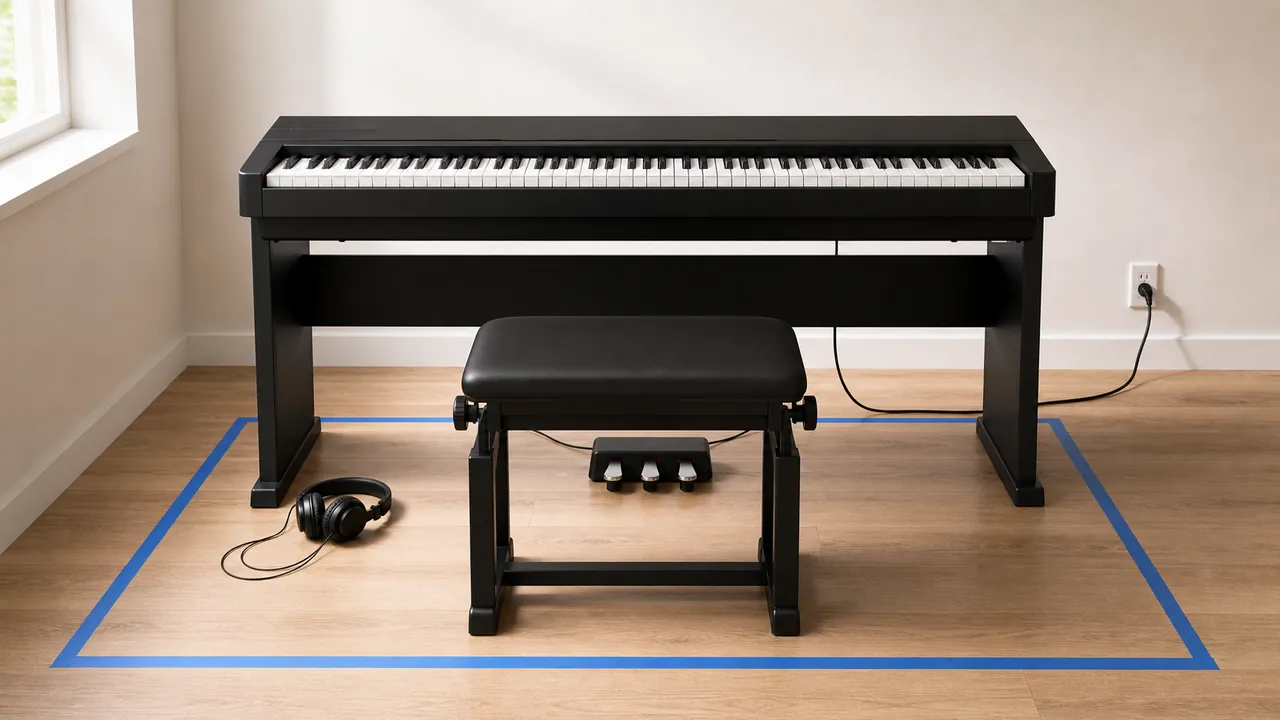
- Mark the piano, bench and cable envelope on the floor.
- Play softly with headphones, then through the speakers.
- Confirm the exact pedal and stand combination.
- Test every required wired and wireless connection.
Avoid: choosing from “weighted” in the product name without comparing action control and the complete installed footprint.
Translate weighted into a repeatable shop test
Graded hammer action
Meaning: A weighted action designed with heavier resistance toward the bass and lighter resistance toward the treble.
Why it matters: The label describes a design goal, not whether one player can shape quiet notes or repeat them evenly.
Check: Play the same soft five-note pattern in bass, middle and treble.
Do not assume: Two graded actions feel the same.
Escapement simulation
Meaning: A small tactile change near the bottom of some digital-piano key travel.
Why it matters: It can affect very soft control and personal preference.
Check: Depress keys slowly, then play normally so the feature is not judged in isolation.
Do not assume: Its presence proves a more suitable action.
Maximum polyphony
Meaning: The maximum number of internally generated notes the instrument can sustain under stated conditions.
Why it matters: Layering sounds, resonance and heavy pedal use can consume more voices than the keys being held.
Check: Use the planned piano sound and pedal-heavy passage, not a number alone.
Do not assume: Higher polyphony improves the key action.
Half-pedaling
Meaning: Continuous or stepped damper control between fully up and fully down when a compatible pedal is connected.
Why it matters: It supports more controlled sustain as repertoire advances.
Check: Verify both the piano socket and the exact pedal model.
Do not assume: The included switch pedal provides it.
Dedicated line outputs
Meaning: Left/mono and right outputs intended to feed powered speakers, a mixer or recorder.
Why it matters: They avoid tying the stage or recording feed to a headphone socket.
Check: Confirm connector size, mono behavior and whether internal speakers can remain on.
Do not assume: Every USB or headphone port replaces line outputs.
USB audio and USB MIDI
Meaning: Audio sends sound; MIDI sends performance instructions such as note, velocity and pedal data.
Why it matters: Recording the piano sound and controlling software instruments are different jobs.
Check: Match the manual, device, cable and operating system to the intended job.
Do not assume: “USB to host” always carries both audio and MIDI.
Bluetooth audio and Bluetooth MIDI
Meaning: Audio streams backing sound to the piano; MIDI connects performance data to compatible apps.
Why it matters: A model may support one, both or require an adapter, and wireless latency can matter.
Check: Pair the intended phone or tablet and run the actual lesson or music app.
Do not assume: Bluetooth sends the piano sound wirelessly to ordinary headphones.
Amplifier watts
Meaning: The rated output of the built-in amplifier channels.
Why it matters: It helps describe the onboard system but does not capture placement, voicing or room acoustics.
Check: Listen at the bench and across the actual room at the volume you will use.
Do not assume: More watts automatically sound clearer or more natural.
Put the complete piano system on paper
- Tape a 133 cm-wide line on the floor; every shortlisted chassis is close to that width.
- Mark model depth: 23.2 cm PX-S1100, 27.2 cm P-225, 28 cm ES120, or 28.4 cm FP-30X, then add the maker stand or rear cable bend.
- Add bench travel so the player can sit with forearms approximately level and stand without hitting the instrument.
- Place the sustain or triple-pedal unit where it cannot slide; confirm the cable reaches without crossing a walkway.
- Add music-rest depth and height, headphone plug clearance, power brick, USB cable and line-output plugs.
- Measure the route to storage. The bare instruments range from 11.2 kg to 14.8 kg before bag, stand, pedals and cables.
Shortlist by the constraint that cannot move
We required an exact current model at Sweetwater and Thomann, then checked dimensions and functions against maker material. The four lanes were set before selection: shallow integrated home system, stronger onboard speaker/action trial, balanced rehearsal connections, and minimum-depth battery portability. Popularity signals support orderability; they do not prove feel or reliability.
Current instruments separated by room and connection needs
| Model | Best reason to trial it | Current retail evidence | Decision risk |
|---|---|---|---|
| Yamaha P-225 | 11.5 kg body, 27.2 cm depth, USB audio and dedicated line outputs. | Sweetwater black model in stock with 14 reviews; Thomann exact model current. | The compact GHC action must be compared at soft dynamics; Bluetooth is audio, not built-in Bluetooth MIDI. |
| Roland FP-30X | PHA-4 Standard action, 2 x 11 W speakers, USB audio/MIDI and Bluetooth audio/MIDI. | Sweetwater current with 31 reviews on the black listing; Thomann in stock with 203 reviews. | At 14.8 kg it is the heaviest here, and app/button workflow should be tried without sales help. |
| Kawai ES120 | 12 kg without rest, 2 x 10 W speakers, stereo line outs and Bluetooth audio/MIDI. | Sweetwater black model current with nine reviews; Thomann exact model current. | USB is MIDI rather than USB audio; the included switch pedal is not the half-pedal upgrade. |
| Casio Privia PX-S1100 | 23.2 cm depth, 11.2 kg body, optional battery operation and included wireless adapter. | Sweetwater exact model in stock; Thomann in stock with 45 reviews. | The very shallow chassis and Smart Scaled action deserve direct repetition and leverage testing. |
Choose the compromise you can explain before checkout
Yamaha P-225
Choose the P-225 lane when the player wants a compact Yamaha setup with proper line outputs and USB audio, and can trial the newer GHC action beside the alternatives.
Useful advantage: Light 11.5 kg chassis with a complete wired recording and amplification path.
Real drawback: Bluetooth audio does not replace MIDI, and action preference cannot be inferred from Yamaha familiarity.
Avoid if: the player cannot make quiet repeated notes consistently on the exact action.
Closest alternative: Kawai ES120 for built-in Bluetooth MIDI.
What we could verify: Current exact-model US/EU listings, dimensions, 192-note polyphony, GHC action, 2 x 7 W speakers, line outputs and USB audio. Feel and mechanical noise remain hands-on checks.
Roland FP-30X
The FP-30X is the high-demand reference when PHA-4 feel and stronger onboard speakers matter more than carrying the lightest chassis.
Useful advantage: Broad connection set, 256-note polyphony and the strongest stated amplifier rating in this group.
Real drawback: It is 3.6 kg heavier than the Casio before accessories.
Avoid if: one person must routinely lift the complete piano, bag, stand and pedal kit.
Closest alternative: Kawai ES120 for a lighter body and conventional line-output layout.
What we could verify: Maker and both anchors agree on 1300 x 284 x 151 mm, 14.8 kg, PHA-4, 2 x 11 W, line outs, USB audio/MIDI and Bluetooth audio/MIDI. Key feel and interface friction remain trial items.
Kawai ES120
The ES120 fits a player who wants a relatively light piano with dedicated line outs, two headphone sizes and integrated wireless audio/MIDI, without needing USB audio.
Useful advantage: A practical connection set and 2 x 10 W speakers in a 12 kg body.
Real drawback: USB carries MIDI, not audio recording, and half-pedaling requires a compatible upgrade.
Avoid if: one-cable USB audio recording is a fixed requirement.
Closest alternative: Yamaha P-225 for USB audio in a similarly portable chassis.
What we could verify: Current exact-model listings, RHC action, 192-note polyphony, dimensions, weight, line outs, Bluetooth audio/MIDI and included F-1SP switch pedal. Action response remains personal.
Casio Privia PX-S1100
The PX-S1100 earns its lane where a 23.2 cm-deep body, 11.2 kg carry weight or operation from six AA batteries solves a real placement problem.
Useful advantage: The smallest front-to-back footprint here, with line outputs and an included wireless MIDI/audio adapter.
Real drawback: Compact packaging is not a substitute for testing control near the rear of black and white keys.
Avoid if: the player cannot repeat soft notes evenly across the full key length during a direct comparison.
Closest alternative: Yamaha P-225 for USB audio and a different compact action.
What we could verify: Current exact-model stock, 1322 x 232 x 102 mm, 11.2 kg without batteries, 192-note polyphony, 2 x 8 W, line outs and battery option. Battery life varies with use.
Dimensions, construction, company context and support
Dimensions are bare-instrument measurements unless noted. Exact-model manufacturing country and chassis/key materials were not stated in the maker sources we found; those gaps are kept explicit.
| Product | Size/weight | Materials/construction | Manufacturing origin | Brand | Warranty/support |
|---|---|---|---|---|---|
| Yamaha P-225 | 1326 x 272 x 129 mm; 11.5 kg, without optional stand and with music rest excluded from depth/height. | GHC weighted action with matte black keytops; exact chassis and key-core materials not stated. | Not verified for this exact model. | Yamaha; Hamamatsu, Japan; founded 1887; pianos, digital instruments, winds and audio. | Sweetwater advertises two-year retailer coverage; Thomann advertises three years. Confirm regional Yamaha terms and authorized service. |
| Roland FP-30X | 1300 x 284 x 151 mm with music rest removed; 14.8 kg with music rest. | PHA-4 Standard hammer action with escapement and Ivory Feel; exact chassis/key materials not stated. | Not verified for this exact model. | Roland; Hamamatsu, Japan; established 1972; electronic musical instruments, equipment and software. | Sweetwater advertises two-year retailer coverage; Thomann advertises three years. Confirm country-specific Roland service. |
| Kawai ES120 | 1305 x 280 x 150 mm and 12 kg without music rest; 350 mm depth, 340 mm height and 12.5 kg with rest. | Responsive Hammer Compact graded action with matte key surfaces; exact chassis/key-core materials not stated. | Not verified for this exact model. | Kawai; Hamamatsu, Japan; established 1927; acoustic/digital pianos and music education. | Sweetwater advertises two-year retailer coverage; Thomann advertises three years. Warranty card and terms vary by market. |
| Casio Privia PX-S1100 | 1322 x 232 x 102 mm without music stand; 11.2 kg without batteries. | Smart Scaled Hammer Action; exact chassis, key-core and key-surface materials not stated in the current specification. | Not verified for this exact model. | Casio; Tokyo, Japan; operations began 1946 and company established 1957; electronics including musical instruments. | Sweetwater advertises two-year retailer coverage; Thomann advertises three years. Confirm Casio regional registration and service terms. |
Map every signal before buying a cable
| Job | P-225 | FP-30X | ES120 | PX-S1100 |
|---|---|---|---|---|
| Record audio by USB | Yes | Yes | No; USB MIDI | Use audio recorder/line out; verify workflow |
| Feed a mixer without headphone out | Line L/L+R, R | Stereo 1/4-inch outputs | Line L/mono, R | Line L/mono, R |
| Wireless lesson-app MIDI | Requires separate solution | Built in | Built in, market-dependent | Included WU-BT10 adapter |
| Half-pedal path | Compatible upgraded pedal | Compatible DP-10 or pedal unit | F-10H/GFP-3/F-351 path | Optional SP-34 |
Bring the actual phone, tablet, headphones and cable adapters to the shop. Pairing success, driver support and app control can change with device and software updates; preserve a usable front-panel workflow for core practice.
Run a timed keybed and pedal audition
Use the same headphones and piano-style sound on every model. Spend several minutes on quiet repeated notes, scales from the backs of the keys, bass-to-treble chords and a pedal-heavy passage. Then turn headphones off and listen from the bench and across the room. Note action control, return noise, pedal travel and interface steps separately. Keep packaging until the return window closes, inspect the delivered unit for uneven keys or noises, and ask a teacher or experienced pianist to check the setup early enough to return it.
Sources and current-model checks
- Sweetwater 88-key digital pianos
- Thomann digital pianos
- Yamaha P-225 specifications
- Sweetwater Yamaha P-225
- Thomann Yamaha P-225
- Roland FP-30X specifications
- Sweetwater Roland FP-30X
- Thomann Roland FP-30X
- Kawai ES120 specifications
- Sweetwater Kawai ES120
- Thomann Kawai ES120
- Casio PX-S1100 specifications
- Sweetwater Casio PX-S1100
- Thomann Casio PX-S1100
- Yamaha corporate profile
- Kawai company outline
- Casio history
Stock, finishes, bundles, app compatibility and warranty terms change. Save the exact listing and manual revision, then confirm included pedal, power supply and regional wireless features before payment.
Found something that needs correcting? Contact the Consordini editorial team.