Compact controllers, exact 25-key boundary
Best 25-Key Mini MIDI Keyboard Controllers for Small Setups
Choose by the work you repeat, not by the software bundle. Akai MPK Mini IV pairs pads with physical wheels; Arturia MiniLab 3 adds faders and full-size MIDI out; Launchkey Mini 25 MK4 serves several DAWs; the new FLkey 2 Mini 25 is the FL Studio specialist; MicroLab Mk3 is the keys-first travel option.
We checked current manufacturer specifications, support pages, US specialist stock and Thomann listings on . We did not play, measure or latency-test these controllers. Key feel, pad response and software setup still need a shop or return-window check.
Do not buy one for sound alone. A MIDI controller normally sends instructions. It needs a computer, tablet, sound module or other instrument to make audio.
Run the connection passport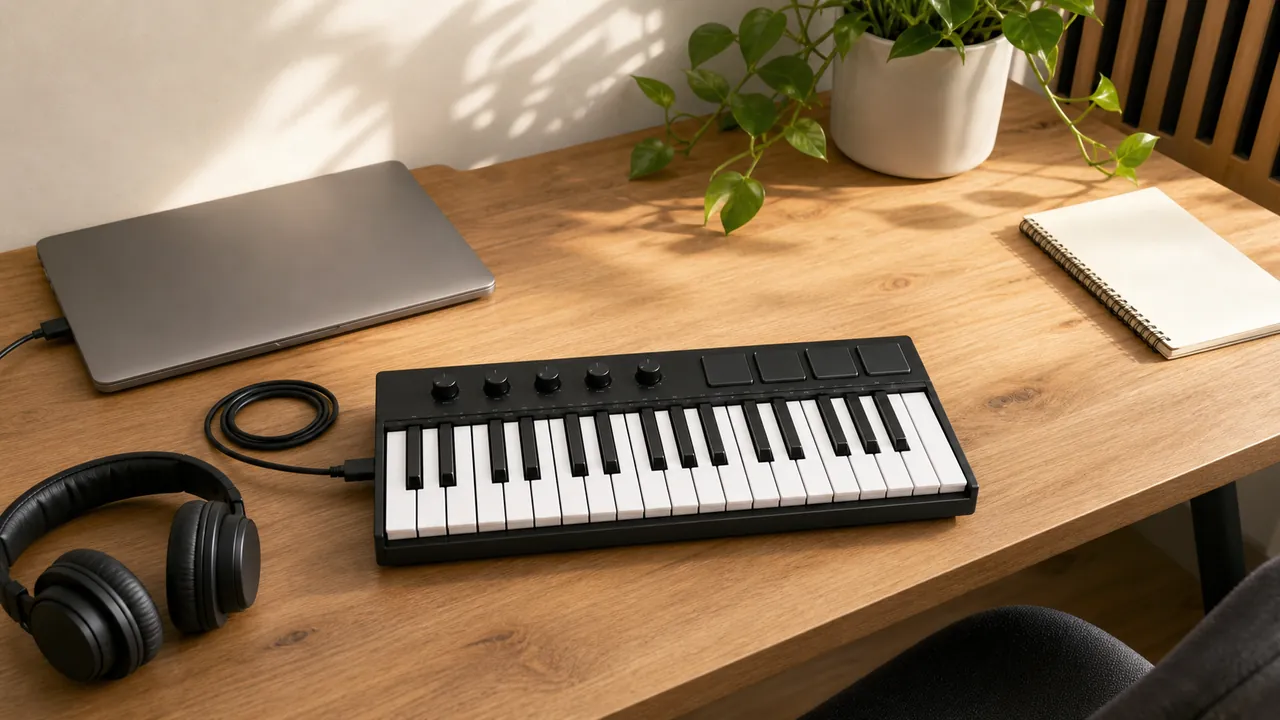
Read the control surface
What the small keyboard can and cannot do
MIDI controller
Hardware that sends note and control messages rather than producing its own instrument sound.
Your speakers stay silent unless software or another sound-making device receives those messages.
Name the sound source and audio output before ordering.
A bundled library does not live inside the keyboard; it is software to install on a compatible host.
Mini keys
Narrower, usually shorter keys used to keep a controller portable.
They save desk width but can feel cramped for two-handed parts or larger fingers.
Play repeated chords and octave jumps before the return period closes.
Velocity sensitivity changes response to force; it does not make a mini key full-size or piano-weighted.
Velocity sensitivity
The controller sends a value based on how quickly or firmly a key or pad is struck.
A receiving instrument can use that value for loudness or tone, but the result depends on the software patch and curve settings.
Try soft, medium and hard notes with the sound you will use.
It is not pressure after the initial strike; that separate function is aftertouch.
Aftertouch
A message sent by continuing to press after a note or pad has triggered.
Launchkey and FLkey 2 pads can add expression when the receiving software maps it.
Confirm the destination instrument responds to aftertouch before paying for the feature.
Pad aftertouch does not mean the keyboard keys have aftertouch.
DAW integration
Scripts or control protocols that let hardware operate tracks, transport, devices or mixer functions in recording software.
Good mapping reduces mouse work, but support varies by DAW and version.
Check the maker's current integration list against your exact software version and operating system.
Class-compliant note input does not guarantee every knob and transport button is pre-mapped.
MIDI out
A hardware connection that sends MIDI to a synthesizer, sound module or other device without routing through a computer.
MiniLab 3 and Akai use full-size five-pin DIN; Launchkey and FLkey 2 use a smaller 3.5 mm TRS jack; MicroLab Mk3 has no hardware MIDI out.
Draw the cable path and verify the correct TRS adapter standard where needed.
MIDI carries control data, not the finished audio signal.
Sustain input
A jack for a foot pedal that holds notes after keys are released; Arturia can also assign its control input to other pedal roles.
Keyboard parts can become awkward without a pedal, while beat-only users may never need one.
Check connector size, polarity behavior and whether the pedal is included. It usually is not.
A sustain button or MIDI hold function is not the same playing action as a foot pedal.
Why these five fit different desks and sessions
The pool began with current manufacturer ranges plus Sweetwater and Thomann. A board needed exactly 25 mini keys, ordinary US and EU ordering on the research date, and a visible market-presence signal such as category rank, exact-listing ratings, or cross-retailer stock. Popularity established relevance; it did not decide the recommendation.
The current-generation FLkey 2 Mini 25 earns its own lane because its FL Studio mapping changes the workflow, while Launchkey remains the stronger multi-DAW choice. MicroLab Mk3 replaces Korg microKEY2-25 in the keys-first lane: Korg is still orderable and historically popular, but its 2012 USB-B design lacks MicroLab's current USB-C and sustain path. Boards with 32/37 keys, full-size keys, or superseded generations were excluded.
Match controls to the work you repeat
| Model | Hands-on controls | Pedal / hardware MIDI | Footprint clue | Reason to refuse |
|---|---|---|---|---|
| Akai MPK Mini IV | 8 pads, 8 encoders, physical pitch/mod wheels, transport | Sustain / 5-pin DIN out | 13.68 x 7.56 in; 2.31 lb | You want 16 pads, faders or a shallower board |
| Arturia MiniLab 3 | 8 pads, 8 encoders, 4 faders, touch strips | Assignable pedal / 5-pin DIN out | 14.02 x 8.62 in; 2.20 lb | Bag depth and desk area matter most |
| Novation Launchkey Mini 25 MK4 | 16 aftertouch pads, 8 encoders, touch strips, DAW/chord tools | Sustain / 3.5 mm TRS MIDI out | 13.33 x 6.96 in; 1.72 lb | You require physical wheels or full-size DIN |
| Novation FLkey 2 Mini 25 | 16 aftertouch pads, 8 encoders, FL Studio pattern/mixer/plugin control | Sustain / 3.5 mm TRS MIDI out | 13.35 x 6.97 in; 1.81 lb | You switch DAWs often or cannot run FL Studio 21.0.3+ |
| Arturia MicroLab Mk3 | Keys, pitch/mod touch strips, chord/hold and octave controls | Sustain / no hardware MIDI out | 15.98 x 4.92 in; 1.37 lb | You need pads, knobs, transport or direct hardware MIDI |
The shortlist, with the return reason attached
Pads plus physical wheels
Akai Professional MPK Mini IV
Pick the current fourth generation when eight pads, eight endless knobs, transport and separate pitch/mod wheels form the control set you already understand.
Useful edge: USB-C, sustain and full-size five-pin MIDI out make it easier to move from laptop ideas to a hardware synth without a TRS adapter.
Hard limit: Only eight physical pads are present, and the new generation has a shorter review history than long-running predecessors.
Avoid if: clip launching or 16-pad layouts drive your sessions.
Closest alternative: Launchkey Mini 25 MK4 for 16 pads and deeper DAW scripts; MiniLab 3 for faders.
Verify: your exact DAW mapping, smart-device power and the included cable. The software bundle does not support every mobile OS even though basic class-compliant MIDI can work.
Faders and full-size hardware MIDI
Arturia MiniLab 3
Choose it when four faders, eight encoders, pads, an assignable pedal input and a proper five-pin output justify the largest desk footprint here.
Useful edge: It can browse Arturia sounds, control common DAWs through scripts/protocols and send MIDI to hardware in one compact surface.
Hard limit: At about 14 by 8.6 inches, this is the deepest shortlist member. Arturia's store and overview also expose slightly different physical values.
Avoid if: the controller must live permanently in a very shallow laptop shelf.
Closest alternative: MicroLab Mk3 for minimum depth; Akai for physical wheels in a smaller footprint.
Verify: use the 356 x 219 x 54 mm overview figure for planning, then check the seller's carton/model before ordering. Confirm the pedal mode and DAW script for your setup.
Multi-DAW navigation, clips and chords
Novation Launchkey Mini 25 MK4
Choose it when 16 pads, eight encoders, chord/scale tools and current scripts for several DAWs matter more than physical wheels.
Useful edge: Its pads support polyphonic aftertouch, and the screen gives feedback while mappings and creative modes change.
Hard limit: Pitch and modulation use touch strips; hardware MIDI leaves through a 3.5 mm jack, so the destination may require the correct adapter.
Avoid if: FL Studio is your main workspace, or you want mixer faders or a full-size DIN cable directly from the unit.
Closest alternative: FLkey 2 for an FL Studio-first setup; MiniLab 3 for faders and full-size MIDI out.
Verify: the DAW/version compatibility list, TRS MIDI wiring, tablet power and whether your intended instrument actually reads pad aftertouch.
Dedicated FL Studio control
Novation FLkey 2 Mini 25
Choose the current second generation when FL Studio's Channel Rack, patterns, mixer and plugins are the center of the session rather than one DAW among several.
Useful edge: Its 16 pads, eight endless encoders and OLED are mapped around current FL Studio jobs while sustain and 3.5 mm MIDI out preserve basic hardware options.
Hard limit: This new generation still has little retailer review history. Its workflow advantage also shrinks outside FL Studio.
Avoid if: you cannot run FL Studio 21.0.3 or later, use FL Studio Web, or regularly move projects into other DAWs.
Closest alternative: Launchkey Mini 25 MK4 for broader DAW scripts on nearly the same hardware footprint.
Verify: your FL Studio version, operating system, TRS MIDI wiring and whether the six-month software offer still applies before redeeming anything. Official support lists 0.82 kg while Novation's product page and Thomann list 0.78 kg.
Keys-first travel controller
Arturia MicroLab Mk3
Choose it when a 4.92-inch depth, 1.37-pound body, USB-C and sustain input solve the real problem, while pads and mixer controls would only occupy space.
Useful edge: It keeps pitch/mod touch strips, chord/hold controls and a pedal input in the shallowest current shortlist body.
Hard limit: There are no pads, encoders, transport buttons or hardware MIDI output; external instruments need a USB host in the path.
Avoid if: finger drumming, hands-on mixing or direct DIN/TRS control of a hardware synth belongs in the session.
Closest alternative: MiniLab 3 for Arturia browsing plus faders, pads and full-size MIDI out; Launchkey for 16 pads in a still-shallow body.
Verify: the host adapter and power path, pedal behavior and whether 15.98 inches of width fits the bag even though the board is only 4.92 inches deep.
Complete the signal path before choosing the keyboard
Write one answer in every box. A blank means the setup is not ready to order.
- Controller to host: USB-C cable, plus any adapter or powered hub.
- Host: computer, tablet or USB host that can power and recognize the controller.
- Sound source: named software instrument, DAW track or external module.
- Audio path: headphones, interface plus speakers, or the external instrument's output.
- Foot and hardware path: sustain input required? DIN cable or correctly wired TRS MIDI adapter?
Reject MicroLab when direct hardware MIDI is mandatory. Reject either Novation when you cannot confirm its TRS cable path. Reject FLkey 2 when the required FL Studio version is unavailable. Reject the purchase entirely when the sound source or audio output is still unnamed.
Rehearse the two-octave compromise on paper
Take eight bars from the part you actually want to enter. Mark its lowest and highest notes, then count every place you would need an octave button. Repeat with the left-hand bass, right-hand chord and melody entered as separate passes.
If octave switching interrupts the phrase rather than merely changing register between phrases, a 25-key board is the wrong footprint. Move to 32, 37 or more keys before comparing pads and software bundles. This test is about range, not playing talent.
Keep the first session from becoming an installer session
Before the gift is wrapped: verify the recipient has permission to install software, enough storage, the right host port and an audio output. Keep license cards and proof of purchase with the controller.
During setup: register only on the maker's current site, install the current support package, confirm simple note input first, then add the DAW script. Test every key, pad, wheel/strip, knob and pedal jack while return options remain open.
For a teacher: ask whether two octaves are enough for the first term and whether full-size keys matter more than desk space. A cheap controller that fights the lesson plan is not a saving.
Desk footprint, keybed construction and support
Brand location is not manufacturing origin. None of the checked exact-model pages named the manufacturing country, so the table leaves that fact unresolved.
| Model | Size and weight | Construction and origin | Brand record | Warranty/support |
|---|---|---|---|---|
| Akai Professional MPK Mini IV | 13.68 x 7.56 x 1.8 in; 2.31 lb / 1.05 kg | Plastic enclosure and mechanical wheels; the maker does not state the exact resin. Manufacturing origin not disclosed for this model. | Akai Professional, US-based inMusic brand; established 1984 and known for MPC instruments/controllers. | Current maker duration not verified; Sweetwater advertises its own two-year coverage. Confirm regional maker terms. |
| Arturia MiniLab 3 | 356 x 219 x 54 mm; 1 kg (overview values) | At least 50% recycled plastic stated. Exact manufacturing origin not disclosed. | Arturia, Grenoble, France; founded 1999; software instruments, synthesizers and controllers. | Five-year manufacturer warranty stated on product page; verify registration and regional scope. |
| Novation Launchkey Mini 25 MK4 | 338.5 x 176.8 x 49 mm; 0.78 kg | Plastic controller with RGB pads; the maker does not state the exact material grade. Manufacturing origin not disclosed. | Novation, UK Focusrite-group brand; founded 1992; synthesizers and MIDI/grid controllers. | Three-year manufacturer warranty stated; proof-of-purchase and regional terms apply. |
| Novation FLkey 2 Mini 25 | 339 x 177 x 49 mm; 0.82 kg official support value | Controller with 16 RGB FSR pads, eight endless encoders and touch strips; the maker does not disclose the exact enclosure material. Manufacturing origin not disclosed. | Novation, UK Focusrite-group brand; founded 1992; synthesizers and MIDI/grid controllers. | Three-year manufacturer warranty displayed on the current product page; confirm regional eligibility and proof-of-purchase terms. |
| Arturia MicroLab Mk3 | 406 x 125 x 39 mm; 0.62 kg | Compact controller with slim keys, touch strips and pedal input; exact enclosure material not disclosed. Manufacturing origin not disclosed. | Arturia, Grenoble, France; founded 1999; software instruments, synthesizers and controllers. | Current exact-model manufacturer duration not verified; Sweetwater advertises its own two-year coverage. Request regional maker terms. |
Checkout questions worth asking aloud
- Does this exact generation map transport and devices in my DAW version?
- Will my tablet or laptop power it directly, and is the needed cable in the box?
- Can I return it after installing bundled software, and what happens to redeemed licenses?
- Is my sustain pedal compatible, and does the controller auto-detect polarity?
- For external hardware, do I need full-size DIN or a particular TRS MIDI adapter?
- Who handles support in my country, and what proof or registration does the warranty require?
Sources checked for identity, connection and support
Manufacturer pages establish specifications and support boundaries. Retailer pages establish dated orderability and listing engagement only.
Specifications, bundles and support terms can change. Recheck the exact model suffix and seller terms at purchase.
Found something that needs correcting? Contact the Consordini editorial team.