MIDI controller buying guide
Best Cheap MIDI Keyboard Controllers Under $100
Choose the control surface your desk and music software can actually use: compact pads and knobs, more physical keys, or the smallest workable footprint.
Exact models, prices and order controls checked .
These are controllers, not self-contained keyboards: none of the four has a sound engine or speakers. They send MIDI to a computer or other compatible host, so sound requires software or hardware that receives those messages plus a monitoring path.
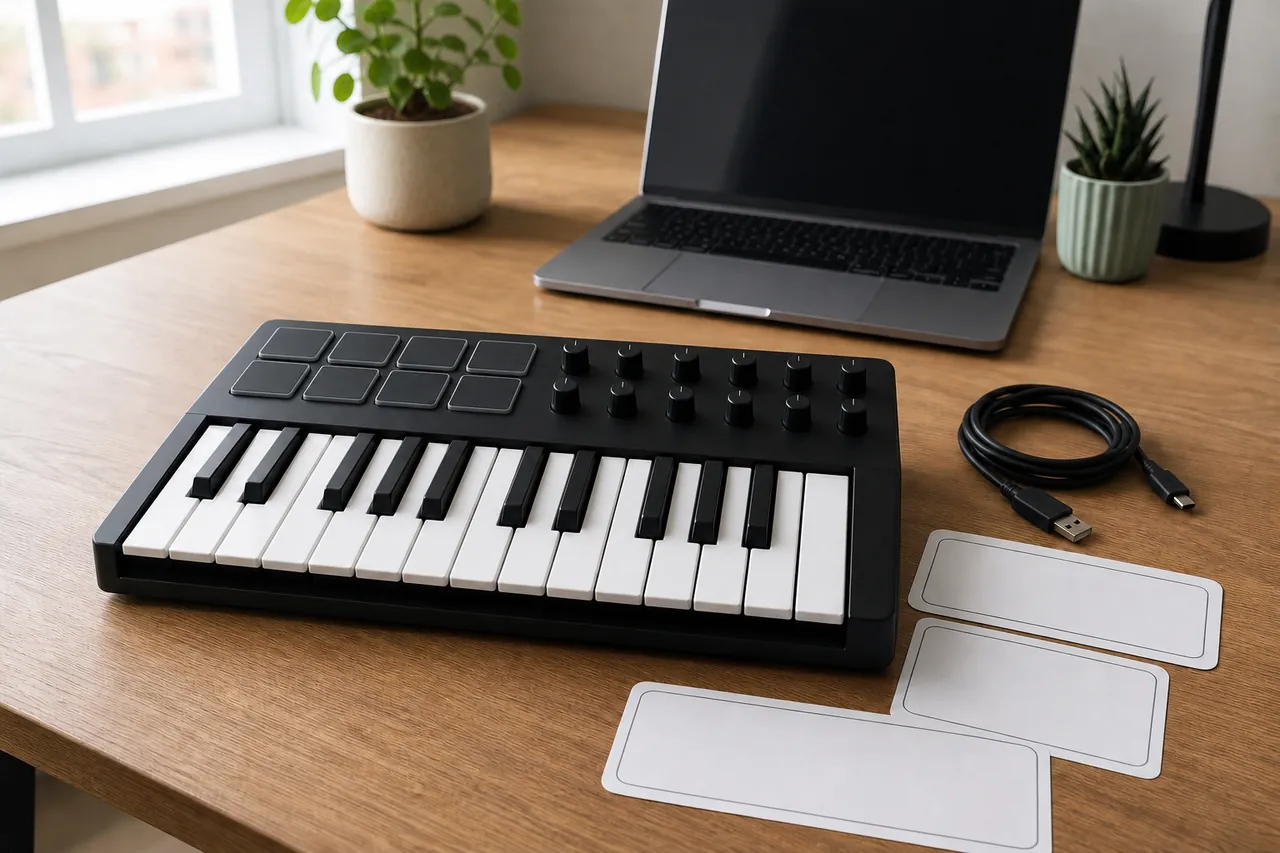
Buying language
Read the controls as a signal path
MIDI controller
Meaning: hardware that sends note and control messages to another device.
Why it matters: pressing a key does not create audio by itself.
Check: identify the host, instrument software and audio output before ordering.
Do not assume: USB power means built-in sounds or speakers.
Key count and key size
Meaning: the number and physical format of keys on the controller.
Why it matters: this shortlist runs from 25 mini keys to 49 full-size keys.
Check: decide how often octave switching is acceptable and measure the resulting width.
Do not assume: more keys also means more pads, knobs or ports.
Velocity
Meaning: MIDI data representing how quickly a key or pad is struck.
Why it matters: receiving software may map it to loudness or another parameter.
Check: verify that the destination instrument responds to velocity as intended.
Do not assume: velocity sensitivity predicts key feel or expressive performance.
Pads
Meaning: separate trigger surfaces that commonly send MIDI notes.
Why it matters: only the Akai in this shortlist has eight physical pads.
Check: count the simultaneous triggers your workflow genuinely needs.
Do not assume: a pad automatically maps to the drum sound shown in software.
Knob, encoder and CC
Meaning: a rotary control can send MIDI Continuous Controller data or mapped parameters.
Why it matters: only the MPK Mini IV supplies eight dedicated knobs here.
Check: confirm the software's mapping method and available CC assignments.
Do not assume: every plug-in maps controls automatically.
USB bus power
Meaning: the host supplies operating power through the USB connection.
Why it matters: the cable connector and host port still have to match.
Check: include any adapter or powered hub in the complete connection plan.
Do not assume: every phone, tablet or passive adapter can power the controller.
Five-pin MIDI and pedal input
Meaning: dedicated hardware connections beyond USB; a pedal input accepts a compatible foot control.
Why it matters: the Akai has both a sustain input and five-pin MIDI out, while the SE49 has a sustain input only.
Check: match the exact connector, direction and pedal specification.
Do not assume: an on-panel sustain button equals a physical pedal socket.
Selection
Four controllers with distinct reasons to exist
Every model had to be orderable below $100 in the same US specialist-store check and occupy a different buyer lane. Sweetwater showed the Akai at $99 with four reviews, the SE49 at $89.99 with 26 reviews, the M-Audio at $59 with 24 reviews, and the SE25 at $49.99 with 14 reviews. Each exact listing had an in-stock or Add to Cart state.
Cross-market specialist evidence adds context rather than a performance verdict. Thomann showed the exact MPK Mini IV at #2 in its master-keyboard category with 15 ratings. Its exact pages showed 92 ratings for the SE49, 103 for the M-Audio and 43 for the SE25; the SE25 was also in stock at €39, ranked #20 among controllers up to 25 keys, and accounted for 39% of purchases in Thomann's displayed comparison group. Popularity and availability can move; neither proves reliability, feel or low latency. Manufacturer pages or manuals support controls, connections and specifications. Manufacturing origin remains unclaimed where the exact source did not disclose it.
Shortlist
Compare physical control before bundled software
| Model | Keys | Pads / knobs | Hardware connections | Checked price |
|---|---|---|---|---|
| Akai MPK Mini IV | 25 mini | 8 / 8 | USB-C, sustain, MIDI out | $99 |
| Nektar SE49 | 49 full-size | 0 / 0; one fader | USB, sustain | $89.99 |
| M-Audio Mini 32 MK3 | 32 low-profile mini | 0 / 1 | USB Mini-B | $59 |
| Nektar SE25 | 25 mini | 0 / 0 | USB Micro-B | $49.99 |
Recommendations
Pick the lane, then accept its omission
Akai Professional MPK Mini IV
The Akai is the most complete physical control surface under this ceiling: 25 velocity-sensitive mini keys, eight pressure-and-velocity-sensitive pads, eight knobs, transport controls, pitch and modulation wheels, a sustain input and five-pin MIDI out.
USB-C and a dedicated MIDI output make it the only choice here that can address both a USB host and compatible five-pin hardware without a separate USB-MIDI interface.
It sits exactly at the $100 cap and provides only two physical octaves before using octave controls.
Avoid if: physical playing range matters more than pads or rotary controls.
Closest alternative: Nektar SE49 for 49 full-size keys.
Verified boundary: official controls, ports, 13.68-by-7.56-inch footprint, 2.31-pound weight, current seller state and current compatibility listing. Feel, latency, durability and exact factory origin are not claimed.
Nektar SE49
The SE49 trades compact controls for the broadest physical range here. Its 49 full-size velocity-sensitive keys, pitch and modulation wheels, one fader, octave buttons and sustain input suit a buyer who wants four octaves without paying for pads.
It cost less than the Akai in the checked US run and carried the strongest Sweetwater review count here after the M-Audio's combined cross-market total.
At 805 millimetres wide, it requires nearly twice the desk width of the M-Audio and has no pads or rotary encoders.
Avoid if: the desk cannot clear 805 by 197 millimetres plus the cable bend, or finger drumming and plug-in knobs are required.
Closest alternative: M-Audio Mini 32 MK3 for a shorter 32-key span.
Verified boundary: exact manual behavior, retailer dimensions and weight, two current order states and dated review signals. Key action quality and origin remain unverified.
M-Audio Keystation Mini 32 MK3
This is the middle ground for buyers who want seven more keys than a 25-key controller without allocating space to a 49-key board. It has 32 low-profile velocity-sensitive mini keys, octave and sustain buttons, pitch/modulation controls and an assignable volume knob.
Thomann lists a 418-by-105-millimetre footprint and 0.45-kilogram weight, while the current US specialist price was $59.
There are no pads, pedal socket or five-pin MIDI port, and the USB connector is Mini-B.
Avoid if: a physical sustain pedal or dedicated trigger pads are non-negotiable.
Closest alternative: Nektar SE25 for lower cost; SE49 for full-size keys and a pedal input.
Source conflict: M-Audio's inch dimensions give a 0.78-inch height and Thomann says 20 mm, but M-Audio's adjacent metric line says 198 mm. We treat that metric height as unresolved source text and report roughly 20 mm, not 198 mm.
Nektar SE25
The SE25 is the deliberately minimal choice: 25 velocity-sensitive mini keys, six assignable buttons and a 335-by-100-by-21-millimetre footprint. It was the cheapest exact model in the synchronized US check.
The manual documents octave, transpose, sustain and assignable-button functions without adding a larger control panel.
There are no pads, knobs, wheels, pedal socket or five-pin output, and two octaves may require frequent switching.
Avoid if: you need continuous hardware controls, a pedal input or two-hand physical range.
Closest alternative: M-Audio Mini 32 MK3 for seven additional keys.
Verified boundary: exact manual, current Sweetwater order state and 14-review signal, plus Thomann's exact in-stock listing at €39 with 43 ratings, category rank and comparison-group purchase share. Popularity and stock can change.
Before checkout
Trace the desk, including the cable
Paper footprint rehearsal
- Draw the stated width and depth on paper or low-tack tape.
- Add space behind the USB plug for its straight connector and bend radius.
- Place the computer, mouse and audio interface where they normally sit.
- Reach every key and control without moving another device.
- Repeat with the laptop open and any drawer pulled through its full path.
The outline tests furniture fit only. It cannot establish ergonomics, stability or compatibility.
Complete the signal path
Tradeoffs
Every saved inch removes something
The SE49 spends its width on physical key range and omits pads and rotary controls. The Akai compresses more control types into a smaller frame but stops at 25 mini keys. The M-Audio adds seven keys without the SE49's width, yet removes the pedal socket and dedicated triggers. The SE25 minimizes price and depth by relying on buttons and octave changes. None is the universal bargain: the useful saving is the feature you can remove without rebuilding the setup later.
Return-window check
Make a MIDI message receipt
Open a trusted MIDI monitor before committing mappings or installing a large software bundle. Record the exact controller, host, cable and port. Press the lowest and highest key, trigger every pad where fitted, turn each knob from end to end, and operate every assignable button or pedal input.
For each control, note whether a message arrived, its type, channel and number, and whether values changed through the expected range. This verifies message delivery and reveals duplicate or unexpected assignments. It does not measure audio latency, judge feel, or prove that a particular instrument mapping is correct. Keep the receipt with seller return dates and any support ticket.
Exact-model details
Dimensions, construction and support boundaries
| Model | Size / weight | Construction and controls | Manufacturing origin | Brand and support | Written protection |
|---|---|---|---|---|---|
| Akai MPK Mini IV | 13.68 x 7.56 x 1.8 in; 2.31 lb | Plastic enclosure; 25 mini keys, 8 pads, 8 knobs, wheels; USB-C, sustain, MIDI out | Not disclosed for the exact model. | Akai Professional; current regional repair route published. | Exact manufacturer duration not found; Sweetwater advertises separate two-year coverage subject to terms. |
| Nektar SE49 | 805 x 197 x 69 mm; 2.2 kg | Plastic enclosure; 49 full-size keys, wheels, one fader; USB and sustain input | Not disclosed for the exact model. | Nektar Technology; registration, download and support route published. | Confirm the current regional manufacturer term through Nektar support or seller. |
| M-Audio Mini 32 MK3 | 418 x 105 x about 20 mm; 1 lb / 0.45 kg. Official metric height says 198 mm, conflicting with its own 0.78 in and Thomann's 20 mm. | Plastic enclosure; 32 low-profile keys, assignable knob/buttons; USB Mini-B | Not disclosed for the exact model. | M-Audio; current support route published. | Current regional duration is not stated on the product page; confirm with support or seller. |
| Nektar SE25 | 335 x 100 x 21 mm; 0.4 kg | Plastic enclosure; 25 mini keys and six assignable buttons; USB Micro-B | Not disclosed for the exact model. | Nektar Technology; current support route published. | Confirm the regional warranty with Nektar or seller. |
Final checks
Treat software and price as dated extras
Download bundles can change independently of the hardware. Before buying for one named DAW or plug-in, check the current registration page, operating-system support, license terms and whether the software remains usable without a subscription or account. Akai's current Windows compatibility page lists the MPK Mini IV as supported, but that does not establish compatibility with every host, adapter or future update.
At checkout, retain the exact SKU, price, stock state, seller region, included cable list, warranty text and return deadline. Inspect the box and connector before discarding packaging. If a dimension, compatibility statement or warranty term affects the decision, ask the seller to confirm it in writing for the exact unit.
Research
Sources
- Akai Professional: MPK Mini IV product page
- Sweetwater: MPK Mini IV black listing
- Thomann: MIDI master keyboards category
- Akai Professional: repairs
- Sweetwater: Nektar SE49 listing
- Thomann: Nektar SE49 listing
- Nektar: SE49/61 guide
- M-Audio: Keystation Mini 32 MK3 product page
- Sweetwater: Keystation Mini 32 MK3 listing
- Thomann: Keystation Mini 32 MK3 listing
- Sweetwater: Nektar SE25 listing
- Thomann: Nektar SE25 listing
- Nektar: SE25 user guide
- Akai: Windows compatibility
- Sweetwater: warranty policy
- M-Audio support
- Nektar support
Accessed July 18, 2026. Prices, ratings, stock, software and support terms are snapshots; recheck them for your seller and region.
Found something that needs correcting? Contact the Consordini editorial team.