Controllers, not sound engines
Best MIDI Keyboard Controllers
Choose the keybed and desk footprint first, then buy only the controls and connection paths your software or hardware can use.
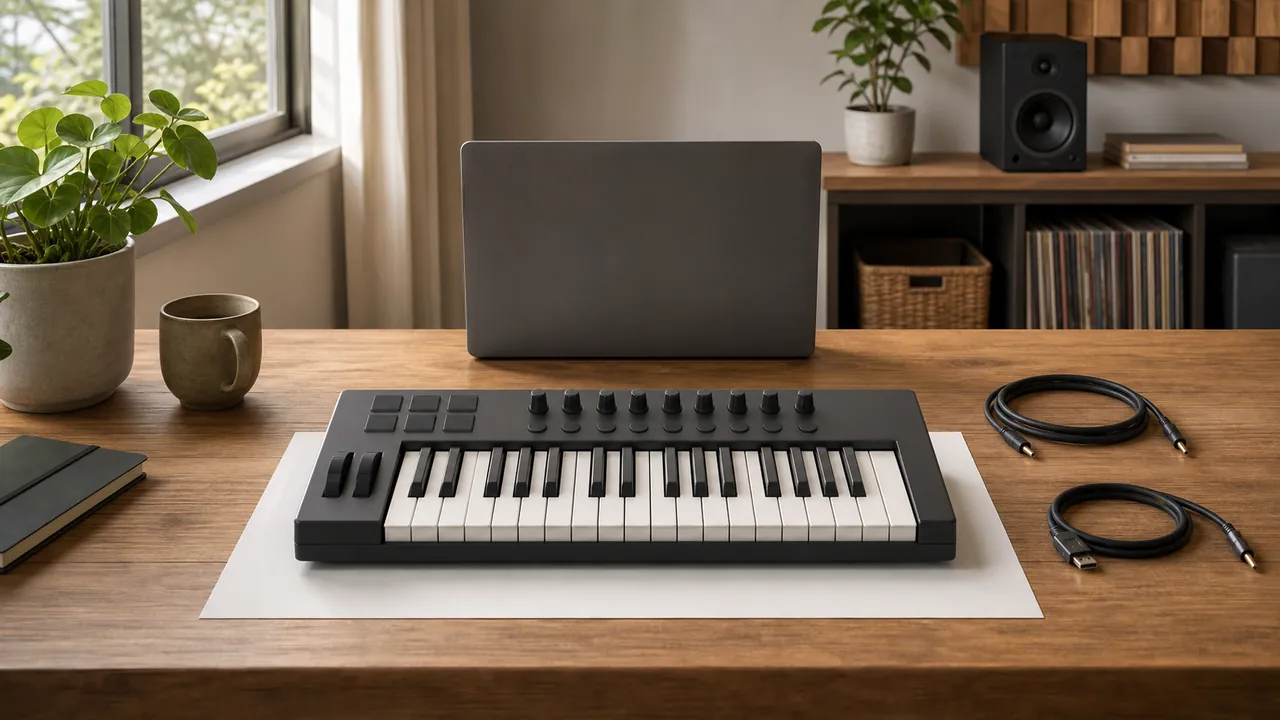
We checked current manufacturer specifications, manuals, warranty pages, and ordinary ordering at Thomann and Sweetwater. We did not test key feel, pads, scripts, latency, or bundled software. Try the exact keybed and verify the current DAW, operating-system, cable, and registration requirements before the return period closes.
Portable mini keys
Launchkey Mini 37
Compact full-size keys
Launchkey 37
Faders and 49 keys
KeyLab Essential 49
Full note range
Keystation 88
Avoid buying yet if: you cannot name what will make the sound. A MIDI controller normally sends instructions; it does not contain speakers or a general-purpose sound engine.
Verify before paying: trace controller → host or sound module → audio output, including the exact port and cable at each arrow.
Translate the product page
Controller language that changes the setup
MIDI controller
A controller sends note and control messages to software or another instrument.
It usually makes no audible sound alone, so the complete setup needs a sound source and audio output.
Name the computer, tablet, phone, module, or synth that receives its messages.
Bundled virtual instruments do not turn the unplugged controller into a self-contained keyboard.
DAW and control script
A digital audio workstation records and arranges music; a control script maps hardware buttons and knobs to that program.
Deep transport or mixer control may depend on the exact DAW version.
Open the manufacturer's current compatibility list for your OS and DAW version.
“Works with any DAW” may mean basic MIDI notes work, not that every labeled control maps automatically.
Mini, slim, and full-size keys
These labels describe physical key width/length families, not the number of notes.
Spacing changes chord comfort and accuracy while chassis width changes portability.
Play octave shapes, repeated chords, and the widest two-handed passage you use.
Thirty-seven mini keys provide the same note count as 37 full-size keys but not the same hand spacing.
Velocity and aftertouch
Velocity reports how quickly a key or pad is struck; aftertouch reports pressure after the initial press when supported.
Software can map these messages to loudness or expression, but mappings vary.
Confirm that both controller and chosen instrument respond to the message you need.
Pressure sensitivity is not proof that pads or keys feel even to a particular player.
USB MIDI and hardware MIDI out
USB normally connects to a host; 5-pin DIN or 3.5 mm TRS MIDI can connect directly to compatible hardware.
TRS MIDI has connector standards and may require the correct adapter.
Write down both socket shapes and the manufacturer's stated TRS type before ordering a cable.
A USB-shaped port does not mean the controller can act as a host for another USB device.
Synth, semi-weighted, and hammer action
These describe different key mechanisms and resistance; marketing usage is not perfectly standardized.
A pianist, beat maker, and notation user may prefer different return speed and resistance.
Try soft repeated notes, fast repetitions, and chords on the exact model.
“Semi-weighted” does not mean graded hammer action like a digital piano.
Choose by key range, desk space, and controls
We separated the purchase into four physical jobs before looking at software bundles. Each included model had to be a current exact generation, have an official specification page, and be ordinarily orderable through both Thomann and Sweetwater on the research date. Retailer review counts established that a product has a meaningful current market presence; they did not decide key feel or reliability.
We excluded self-contained keyboards because internal sounds, speakers, amplification, and piano features form a different category. We also excluded the new Arturia KeyStep 37 mk2 despite current stock: two current official Arturia pages disagree on height and weight by enough to change a desk/case decision. No recommendation should ask a buyer to solve an official physical-specification conflict after paying.
Measure before mapping knobs
Compare the physical job
All four send MIDI notes. The useful differences are how much key range stays under the hands, whether those keys fit the player, how much permanent desk space they take, and whether the control surface replaces repeated mouse work.
| Model | Keys | Footprint | Direct controls | Main catch |
|---|---|---|---|---|
| Launchkey Mini 37 MK4 | 37 mini | 477.8 x 176.8 mm | 16 pads, 8 encoders, transport, chord/scale tools | Mini key spacing and touch strips |
| Launchkey 37 MK4 | 37 full-size | 555 x 258 mm | 16 pads, 8 encoders, transport, wheels | More depth/weight without a fader bank |
| KeyLab Essential 49 mk3 | 49 full-size | 790 x 240 mm | 8 pads, 9 encoders, 9 faders, transport | Permanent-width commitment and integration setup |
| Keystation 88 MK3 | 88 full-size, semi-weighted label | 1377.7 x 216.4 mm | Basic transport, volume, wheels | Very wide; not hammer action; sparse control surface |
Choose the note count from a real passage
Twenty-five keys can be enough for bass lines, drum programming, and one-handed melodies, but this shortlist begins at 37 because the route serves buyers comparing a primary controller rather than the smallest possible input device. Thirty-seven notes allow many chord-and-melody sketches with fewer octave changes. The Mini and full-size Launchkeys prove why note count alone is incomplete: they cover the same nominal range while demanding different hand spacing, desk depth, and carrying weight.
Forty-nine keys create a more comfortable middle ground for two-handed production without taking the full width of a piano. The KeyLab earns that footprint only when its faders and encoders replace work the buyer actually repeats. If the controls remain unmapped, a broader keybed or a smaller controller may use the space better. Write down three actions you want away from the mouse. “Mixer volume on eight channels,” “record and loop without reaching,” and “filter plus envelope control” are purchase reasons; “more knobs” is not.
Eighty-eight keys solve a different problem. They let notation users, arrangers, and players reach low bass and high register without octave buttons or rearranging splits. They do not automatically supply piano mechanics. The Keystation's semi-weighted description places it between very light synth keys and a hammer-action digital piano in marketing terms, but it cannot tell a pianist how the resistance, pivot, or repetition will feel. A buyer seeking piano practice should compare digital pianos and hammer-action controllers instead of treating note count as a shortcut.
For a proxy buyer, request one representative passage or workflow from the end user. Mark the lowest and highest notes, whether both hands play together, how often pads are used, and which controls the user currently reaches for with a mouse. That single page is more useful than a bundle comparison because it turns keys and controls into observable tasks.
Recommendations by workflow
For a portable production surface with three octaves
Novation Launchkey Mini 37 MK4
Choose this when 25 notes cause constant octave switching but full-size keys make the bag or desk too large. The 37 mini-key chassis still carries 16 pads, eight endless encoders, transport controls, chord/scale modes, sustain input, USB-C, and a hardware MIDI output.
Advantage: 0.98 kg weight and 176.8 mm depth leave room for a laptop on many small tables while preserving a three-octave span.
Tradeoff: mini keys and touch pitch/modulation strips are physical compromises. DAW scripts cover named programs and versions, but other hosts may fall back to more generic control.
Avoid it if: normal octave shapes already feel crowded on mini keys or the controller will never travel.
Alternative: Launchkey 37 MK4 retains the note count with full-size keys and wheels.
Verify: play the exact mini keybed and check the current script for the exact DAW version.
For compact full-size-key playing
Novation Launchkey 37 MK4
This is the step up when key spacing matters more than maximum note range. It combines 37 full-size synth-style keys with the Launchkey pads, encoders, transport layer, display, and hardware MIDI path.
Advantage: common chord and melody work stays on full-size spacing in a chassis narrower than most 49-key controllers.
Tradeoff: it is deeper and more than twice the weight of Mini 37, yet it still lacks the nine-fader mixer layout of KeyLab Essential.
Avoid it if: you need broad two-handed range or dedicated channel faders.
Alternative: KeyLab Essential 49 for more keys and mixer controls; Mini 37 for travel.
Verify: leave room behind it for plugs and in front for wrists; test wheel and key return.
For a permanent home-studio desk with mixer control
Arturia KeyLab Essential 49 mk3
Its nine faders and nine encoders make sense when the buyer repeatedly balances channels or adjusts mapped instrument parameters and wants 49 notes available without octave buttons dominating the session.
Advantage: controls, display, pads, 5-pin MIDI out, and pedal input form a broad desk hub. Arturia and both anchor retailers list the exact mk3 generation as current.
Tradeoff: 790 mm width needs a permanent home. The strongest software integration is not universal, and bundled titles/entitlements can change.
Avoid it if: most work is note entry and the faders would remain unused, or the keyboard must be stored after every session.
Alternative: Launchkey 37 for a smaller full-size-key surface; Keystation 88 for note range over control density.
Verify: map one fader, one encoder, transport, and a pad in the actual DAW before the return deadline.
For full-range note entry with minimal surface controls
M-Audio Keystation 88 MK3
This is the lane for notation, orchestral libraries, splits, or two-handed parts that genuinely use 88 notes. It supplies full-size velocity-sensitive keys, wheels, basic transport, sustain/expression inputs, USB, and 5-pin MIDI out without surrounding the keybed with pads and faders.
Advantage: the full note range is available at once, and 20 Sweetwater reviews plus 105 Thomann ratings provide a strong observable market-presence signal.
Tradeoff: 1377.7 mm width is furniture-scale. M-Audio calls the keys semi-weighted, but this is not a graded hammer-action piano. The 6.24 kg product still needs a stable stand or deep desk.
Avoid it if: realistic acoustic-piano action is the goal, or the room cannot keep nearly 1.38 m of width continuously clear.
Alternative: KeyLab Essential 49 for a smaller desk and more DAW control.
Verify: play quiet repetitions and chords across the exact keybed; confirm stand width, pedal polarity, and power plan.
A ten-minute room test
Make the controller out of paper first
Cut or tape a paper rectangle to the published width and depth. Add 75 mm behind it as a conservative cable-bend zone unless the chosen right-angle connectors prove they need less. This is a planning allowance, not a product specification.
- Place the rectangle where the controller will actually live, not on an empty desk staged for the test.
- Open the laptop, move the mouse through the full normal range, and place the audio interface and drink outside the rectangle.
- Sit at playing height. Check wrist position, monitor sightline, and whether knobs would sit under a shelf.
- Route one mock USB cable and any MIDI/pedal leads without a tight bend or trip loop.
- For Keystation 88, repeat on the intended stand and mark room for pedals, bench, and walking clearance.
Reject the size if normal editing requires moving the controller, if plugs press against a wall, or if storage means lifting it over other equipment every session.
Complete before checkout
The six-line connection passport
Write one answer per line: sound source; host device and OS; controller port; destination port; power source; audio output. Add pedal connector/polarity and TRS MIDI adapter type when relevant. A gift buyer should hand this passport to the end user before choosing a model.
A complete example is “virtual instrument on current macOS laptop; USB-C controller to USB-C host with a data cable; USB bus power; laptop to existing audio interface and monitors.” An incomplete answer such as “Bluetooth speaker” exposes a missing audio/latency plan rather than a keyboard feature.
What the specification cannot choose
Key feel
Terms such as synth-style and semi-weighted narrow the mechanism family; they do not establish comfort, evenness, quietness, or piano realism. Try the exact unit.
Software value
A large bundle is useful only when the licenses run on the buyer's system, remain available, and fill a real gap. Treat it as refresh-sensitive, not permanent hardware value.
Latency
The controller is one part of a chain. Computer load, audio driver, buffer, virtual instrument, hub, and interface affect playing response. No shortlist position guarantees low latency.
Controller size, build and support
Origin is left unresolved where the exact-model source does not publish it. Brand base is context, not manufacture evidence.
| Product | Size/weight | Construction | Manufacturing origin | Brand | Warranty/support |
|---|---|---|---|---|---|
| Novation Launchkey Mini 37 MK4 | 477.8 x 176.8 x 49 mm; 0.98 kg | Electronic housing; 37 mini keys, pads, encoders, OLED | Not disclosed for exact model; inspect label | Novation; High Wycombe, UK; established 1992; controllers/synths | Regional limited terms; verify registration and proof |
| Novation Launchkey 37 MK4 | 555 x 258 x 77 mm; 2.18 kg | Electronic housing; full-size synth keys, pads, encoders, wheels | Not disclosed for exact model; inspect label | Novation; High Wycombe, UK; established 1992; controllers/synths | Regional limited terms; verify registration and proof |
| Arturia KeyLab Essential 49 mk3 | 790 x 240 x 70 mm; 2.76 kg | Electronic housing; 49 keys, pads, 9 encoders, 9 faders | Not disclosed for exact model; inspect label | Arturia; Meylan, France; established 1999; software/hardware instruments | Five-year program advertised with conditions; verify eligibility |
| M-Audio Keystation 88 MK3 | 1377.7 x 216.4 x 73.1 mm; 6.24 kg | Electronic housing; 88 full-size semi-weighted-labeled keys | Not disclosed for exact model; inspect label | M-Audio; inMusic, Rhode Island; established 1988; MIDI/audio tools | Regional terms vary; register and retain proof |
First-hour acceptance test
- Install only current official software and firmware; record versions.
- Play every key softly and firmly, then every pad at several strikes. Record missed or double triggers without assuming technique is the cause.
- Map transport, one encoder, one fader where present, pitch/modulation, sustain, and hardware MIDI out.
- Restart the host and confirm mappings and MIDI ports return.
- Check USB cable reach and strain with the desk in normal use.
- Keep packaging, serial, receipt, and written warranty until the setup passes.
Sources checked
Official product pages control specifications; retailer pages show dated orderability and market-presence signals.
Found a changed specification or source? Report a correction.