Casio keyboard buying guide
Best Casio Keyboards for Your Practice Plan
Decide whether you need accompaniment, more two-handed range or a weighted piano action before comparing sound lists and wireless extras.
We checked current Casio specifications and manuals plus orderability and buyer activity at Thomann and Sweetwater. We did not play these instruments. Key resistance, speaker balance, control ergonomics and headphone sound need an in-person comparison.
Researched for first-time players, returning pianists and households choosing one portable instrument.
Lessons plus rhythms: CT-S300.
Wider unweighted range: CT-S1-76.
Lowest-cost piano action: CDP-S110.
Portable piano connections: PX-S1100.
Do not buy yet if: you cannot say whether the teacher expects weighted 88-key practice. A touch-sensitive portable keyboard and a hammer-action digital piano train different physical responses.
Verify in the cart: the exact power adapter, stand, pedal and bench bundle; the return freight rule; and whether the seller's written warranty applies in your destination.
Match the keyboard class to your room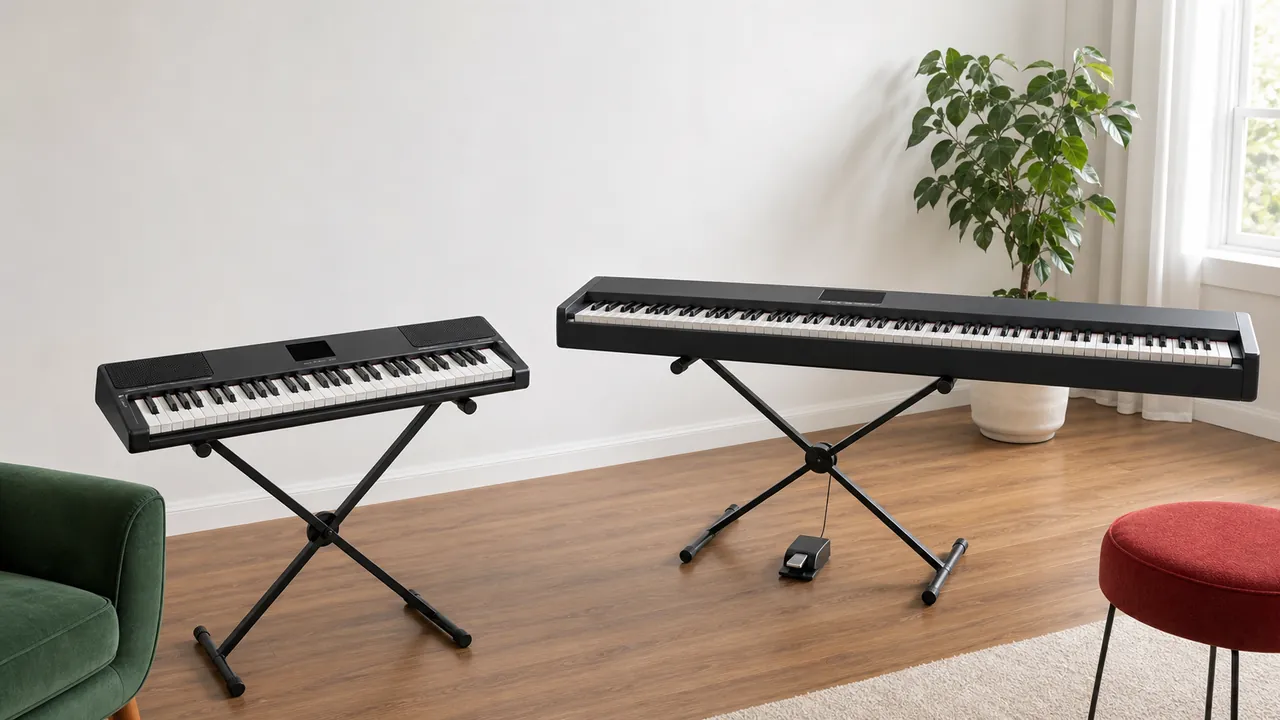
Make the first cut
Fit the action and key span before choosing a model
A keyboard can fit the tabletop and still fail the player. Enter the clear width available, then answer for the practice you actually expect during the next year. The result is a shortlist prompt, not a substitute for measuring the stand and trying the action.
Start with the CT-S300, then compare the CT-S1-76 if you can make 114 cm of width and prefer a simpler sound-first interface.
Surface: Measure the stand at playing height, not just the room wall.
Reach: Controls, music rest and headphone socket remain accessible from the bench.
Movement: The stand does not rock during firm chords or pedal use.
Storage: The instrument has a safe place when the shared room changes purpose.
Labels that change the purchase
Translate Casio's feature list into playing consequences
Open these terms as the need arises. Each one should lead to a test or a decision, not another number to collect.
Touch response
The instrument changes volume or tone according to how quickly a key is pressed.
It lets a beginner practise dynamics instead of producing the same level from every note.
Play one note very softly, moderately and firmly; reject a response that jumps abruptly or cannot stay quiet.
Touch-sensitive does not mean weighted. CT-series keys spring back like keyboard keys rather than simulating piano hammers.
Hammer action
A weighted mechanism adds resistance intended to approximate the broad behavior of an acoustic-piano action.
It is the relevant class for traditional piano technique and teacher-assigned weighted-key practice.
Compare slow scales, repeated notes and chords near the backs of the keys on both CDP and Privia candidates.
Hammer action is a category, not proof that two models feel alike or that either matches an acoustic piano.
61, 76 and 88 keys
The number describes keyboard span: five octaves for 61, a wider middle ground for 76 and the standard acoustic-piano range for 88.
Extra range reduces octave shifting and supports more piano repertoire, but increases width and carrying burden.
Bring the widest piece you expect to play and mark the full instrument width where it will live.
More keys do not make an unweighted action suitable for a piano curriculum.
Auto accompaniment
The keyboard generates rhythm and backing parts from selected styles and the chords you play.
It supports song arranging, timing practice and informal performance on the CT-S300.
Change chords in a familiar song and check whether starting, stopping and varying the pattern feels manageable.
The CT-S1-76's larger key count does not include the CT-S300's arranger workflow.
Polyphony
The maximum number of internally generated notes that can sound together, including sustained and layered voices.
Heavy sustain, layers and accompaniment can consume more voices than a dry melody.
Use the busiest intended mode and listen for held notes disappearing.
A larger polyphony figure does not prove better key feel, speakers or piano tone.
USB to host
A USB connection can send MIDI performance data to a phone, tablet or computer; capability and connector type vary.
It can support learning apps, notation and software instruments.
Confirm the required cable and adapter with the actual device, and test whether the intended app recognizes notes and pedal messages.
A USB socket does not necessarily transmit the keyboard's audio or charge a mobile device.
Line outputs
Separate left and right audio jacks provide a practical feed to mixers, interfaces or powered speakers.
The PX-S1100's line outputs avoid using a headphone jack for a regular external-sound setup.
List the receiving equipment and cables before purchase; use the left/mono jack when the destination is mono.
Bluetooth audio on this model is for receiving playback, not a low-latency wireless stage output.
Wireless MIDI and audio adapter
The WU-BT10 accessory enables supported Bluetooth MIDI and incoming audio functions; it is included with the PX-S1100 and optional for the CT-S1-76.
It can simplify app control and play-along audio when its latency and compatibility suit the task.
Check the exact included-accessory list and test the app/device combination before the return window closes.
Wireless audio is not suitable for monitoring your own playing through Bluetooth headphones because delay can be distracting.
We selected one current answer for each distinct Casio job
The shortlist starts with four non-overlapping lanes: a compact arranger for a beginner, a wider unweighted keyboard, an entry 88-key piano and a connection-ready portable piano. Casio's current catalog established that each exact model remains supported. Thomann was the European store anchor; Sweetwater supplied the US check. In-stock pages, category positions and purchase-linked review counts support current availability and buyer activity, not a claim that one instrument sounds best.
We rejected the temptation to rank every Casio by price. A CT-S300 buyer who needs rhythms is not served by a cleaner but rhythm-free CT-S1-76, while a piano student should not be steered toward either because it is lighter. Published dimensions, weight, connections and accessories came from Casio pages and manuals. Feel, tonal preference, speaker projection and interface speed remain audition questions.
Four different jobs
Compare what each Casio is designed to let you do
| Model | Keybed | Best fit | Useful connections | Main boundary |
|---|---|---|---|---|
| CT-S300 | 61 touch-sensitive, unweighted keys | First keyboard with rhythms, 400 tones and pitch bend | Micro-B USB MIDI, audio input, pedal, headphone/output | Five-octave span and no hammer action |
| CT-S1-76 | 76 touch-sensitive, unweighted keys | Two-handed range with a minimal sound-focused layout | Micro-B USB MIDI, audio input, pedal; optional wireless adapter | No arranger rhythms and no piano weight |
| CDP-S110 | 88 scaled hammer-action keys | Budget-conscious piano lessons and portable practice | USB MIDI, audio input, pedal, headphone/output | No dedicated line outputs or wireless audio |
| PX-S1100 | 88 Smart Scaled Hammer Action keys | Portable piano for external sound, recording and play-along use | Line outs, USB MIDI, two headphones, included wireless adapter | Touch-led controls and higher system cost |
Choose the lane first
Buy the least complicated instrument that meets the practice brief
Casio CT-S300
The CT-S300 is the practical starting point when the learner wants songs, beats and a broad sound palette as well as basic keyboard skills. Its 61 touch-sensitive keys preserve dynamic response, while the carry grip, 3.3 kg weight and long stated alkaline-battery runtime make shared-room storage realistic.
Useful advantage: Auto accompaniment, 400 tones, pitch-bend wheel and a simple display cover more exploratory playing than the other three.
Meaningful drawback: Its short unweighted action is not a substitute for the 88 weighted keys a piano teacher may require.
Avoid if: the main goal is acoustic-piano technique, wide classical repertoire or a permanent three-pedal setup.
Closest alternative: CT-S1-76 when wider two-handed range and cleaner controls matter more than rhythms.
Known before audition: current official support, 3.3 kg weight, 61 touch-sensitive keys, 48-note polyphony, rhythm features, 43 Thomann purchase-linked reviews and current Sweetwater stock. The key response and speakers still need ears and hands.
Casio CT-S1-76
Choose the CT-S1-76 when 61 keys feel cramped but a portable, lightly sprung action is intentional. It keeps the control surface sparse, expands the range to 76 keys and raises stated speaker power to 6.5 W per side. That combination suits pop parts, songwriting and casual two-handed practice better than an arranger-first interface.
Useful advantage: A 114 cm-wide, 5.3 kg body provides fifteen more keys than the CT-S300 without approaching the carrying weight of either piano.
Meaningful drawback: No arranger accompaniment, no hammer mechanism and only one stereo mini headphone/output connection.
Avoid if: the buyer expects built-in backing styles or needs weighted action for piano lessons.
Closest alternative: CDP-S110 when key resistance and the full piano range justify roughly doubling the instrument weight.
Known before audition: Casio's 2024 release and current pages specify 76 touch-sensitive keys, 64-note polyphony, 5.3 kg weight, MIDI recorder and optional WU-BT10 support; both anchor stores list the model. Its spring feel and minimalist controls remain personal.
Casio CDP-S110
The CDP-S110 is the disciplined value choice when the requirement is simply weighted 88-key practice in a slim, movable body. Ten tones and straightforward connections keep the emphasis on playing. At 10.5 kg it is portable in the sense that one adult can move it, but a stand, bench and pedal still determine whether daily posture is stable.
Useful advantage: Full piano span and scaled hammer action in the same 132.2 cm by 23.2 cm plan as the more expensive Privia.
Meaningful drawback: It lacks dedicated line outputs, wireless audio and the broader sound/control system of the PX-S1100.
Avoid if: regular mixer connection, wireless play-along audio or a more flexible recording setup is already in the brief.
Closest alternative: PX-S1100 when those connections will be used rather than merely admired.
Known before audition: current Casio support, 1322 x 232 x 99 mm dimensions, 10.5 kg weight, scaled hammer action and live Thomann and Sweetwater ordering. Quiet control, action noise and tone through headphones require a trial.
Casio PX-S1100
The PX-S1100 earns its premium when the piano will feed powered speakers or a mixer, play incoming phone audio through its speakers, or use the included wireless adapter for supported app work. It keeps the 23.2 cm depth of the CDP while adding two headphone sockets, separate line outputs, 18 tones and 192-note polyphony.
Useful advantage: The strongest connection set here, battery operation and 11.2 kg weight make it adaptable between home, rehearsal and small performance systems.
Meaningful drawback: Touch-led controls can be slower than dedicated buttons, and the single included switch pedal is only the start of a furniture-style setup.
Avoid if: the buyer needs only weighted home practice or dislikes changing settings through sparse touch controls.
Closest alternative: CDP-S110 for the same broad physical footprint with fewer extras and a lower system cost.
Known before audition: official dimensions, weight, included WU-BT10 and pedal, line outputs, 192-note polyphony, current cross-market stock and substantial retailer review activity. Action preference and touch-panel speed cannot be settled on paper.
A fair four-way trial
Test the player, the stand and the connections as one instrument
Do not compare a keyboard on a high display shelf with a piano at a proper bench. Ask the store to set each candidate at a comfortable playing height. Use the same headphones and the plainest piano tone before exploring extras.
- Dynamic ladder: play one five-note pattern from barely audible to firm. On the CT models, decide whether the unweighted response is intentional; on the pianos, listen for jumps and missed quiet notes.
- Range reality: play the widest intended piece without octave buttons. Mark whether 61 keys interrupt it, 76 solves it or only 88 works.
- Control recovery: select a second sound, adjust touch response, then return to the default piano setup without help. Daily friction counts.
- Stand and pedal: play repeated chords while using sustain. Reject rocking, creeping pedals, bent wrists or knees trapped under the support.
- Device rehearsal: connect the actual phone, tablet, interface or speaker workflow. Confirm cable types, app recognition and whether wireless delay is acceptable for its intended use.
Thirty-second rule: after each instrument, say what became easier and what remained awkward. “More features” is not an answer; “I can play the left-hand bass without shifting octaves” is.
Dimensions, construction, origin and written protection
Measure the instrument separately from the stand and player. Casio does not publish one manufacturing country for these exact units on the checked product pages, so inspect the rating label or carton if origin affects the purchase. Brand headquarters is not factory evidence.
| Instrument | Size and weight | Materials and construction | Manufacturing origin | Brand context | Warranty or guarantee |
|---|---|---|---|---|---|
| Casio CT-S300 | 930 x 256 x 73 mm without music rest; 3.3 kg. | Plastic portable chassis with integrated carry grip, box-style unweighted keys, two oval speakers and pitch wheel. Casio does not state the polymer type. | Casio gives no assembly country for the exact unit; verify its label or carton. | Casio Computer Co., Tokyo; established 1957; known for calculators, watches and electronic instruments. | Casio Europe states a two-year guarantee. Thomann advertises three-year retailer warranty; Sweetwater advertises two-year retailer coverage. Local terms control. |
| Casio CT-S1-76 | 1140 x 258 x 83 mm without music rest; 5.3 kg without batteries. | Plastic portable body, box-style unweighted keys, mixed-color speaker fabric and horizontal bass-reflex speaker enclosure. Exact plastics and fabric blend are not stated. | Casio gives no assembly country for the exact unit; verify its label or carton. | Casio Computer Co., Tokyo; its Casiotone name dates to the company's early electronic keyboards. | Casio Europe states a two-year guarantee; retailer extensions differ. Confirm whether accessories and commercial use receive the same term. |
| Casio CDP-S110 | 1322 x 232 x 99 mm; 10.5 kg without batteries. | Slim plastic portable cabinet, 88-key scaled hammer-action mechanism, textured key surfaces and two oval speakers. Internal action materials are not fully specified. | Not disclosed on the checked exact-model pages; inspect the product label. | Casio Computer Co., Tokyo; CDP is its entry portable digital-piano line. | Casio Europe states a two-year guarantee. Thomann and Sweetwater add their advertised retailer programs; obtain the service route in writing. |
| Casio PX-S1100 | 1322 x 232 x 102 mm; about 11.2 kg without batteries. | Slim plastic portable cabinet, Smart Scaled Hammer Action and textured key surfaces; two oval speakers. Casio describes the mechanism but not a full materials bill. | Casio gives no exact-unit assembly country; Tokyo headquarters does not establish it. | Casio Computer Co., Tokyo; Privia is its slim digital-piano family, introduced as a portable home-piano line. | Casio Europe states a two-year guarantee. Thomann advertises three years and Sweetwater two years of retailer coverage; exclusions and freight rules differ. |
Budget for the playing station, not the keyboard box
The included-accessory list is not consistent across countries or bundles. Confirm the correct AC adapter, music rest and pedal on the exact retailer page. The CT-S300 and CT-S1-76 can be played on a sturdy table for a short trial, but long sessions need a stand that places the forearms close to level and leaves the knees clear. The CDP-S110 and PX-S1100 need an especially stable support because hammer-action playing transfers more force into the stand.
A small switch pedal can move on a hard floor. Add a nonslip mat or choose a compatible heavier pedal after checking polarity and model support. A three-pedal unit and furniture stand can turn a portable piano into a more coherent home station, but they also change the price, depth and return problem. Measure the assembled option rather than assuming the piano remains 23.2 cm deep in use.
During the return window, practise at the household's quietest real volume, with headphones, and with every intended device. Check action noise in the adjacent room, USB cable routing, wireless reconnection and whether settings survive the normal power routine. Keep the packaging until keys, speakers, sockets, adapter and pedal have been checked. Cosmetic finish and hundreds of tones should not outrank stable posture or the action a teacher expects.
Specifications and availability sources
Casio pages and manuals support exact-model features. Store pages support dated stock and buyer-activity signals only. Availability, bundle contents and warranty handling can change by country.
- Casio current electronic-instrument catalog
- Casio CT-S300 specifications
- Casio CT-S300 manuals hub
- Thomann CT-S300 listing and purchase-linked reviews
- Sweetwater CT-S300 in-stock listing
- Casio CT-S1-76 release and specification table
- Casio CT-S1-76 product details
- Casio CT-S1-76 user guide
- Thomann CT-S1-76 listing
- Sweetwater CT-S1-76 listing
- Casio CDP-S110 product details
- Casio CDP-S110 specification release
- Thomann CDP-S110 listing
- Casio PX-S1100 product details
- Casio PX-S1100 user guide
- Thomann PX-S1100 listing
- Casio corporate profile
- Casio Europe guarantee FAQ
- Thomann three-year warranty terms
- Sweetwater two-year coverage terms
Found something that needs correcting? Contact the Consordini editorial team.