Yamaha keyboard buying guide
Best Yamaha Keyboards and Digital Pianos
Start with the playing job: weighted piano practice, arranger-led music making, or fast stage control.
We checked current Yamaha specifications, support pages, and exact-model ordering at major US and European music stores on . We did not play or measure these instruments. Key feel, sound, speaker projection, controls, app behavior, and carry comfort still need your own trial.
Focused first piano: P-145BT
Compact piano with better outputs: P-225
Weighted keys plus accompaniment: DGX-670
Light stage board: CK61
Avoid: choosing CK61 for conventional piano study merely because it is light. Verify: the complete stand, pedal, bench, cable, and speaker package before paying.
Choose the instrument class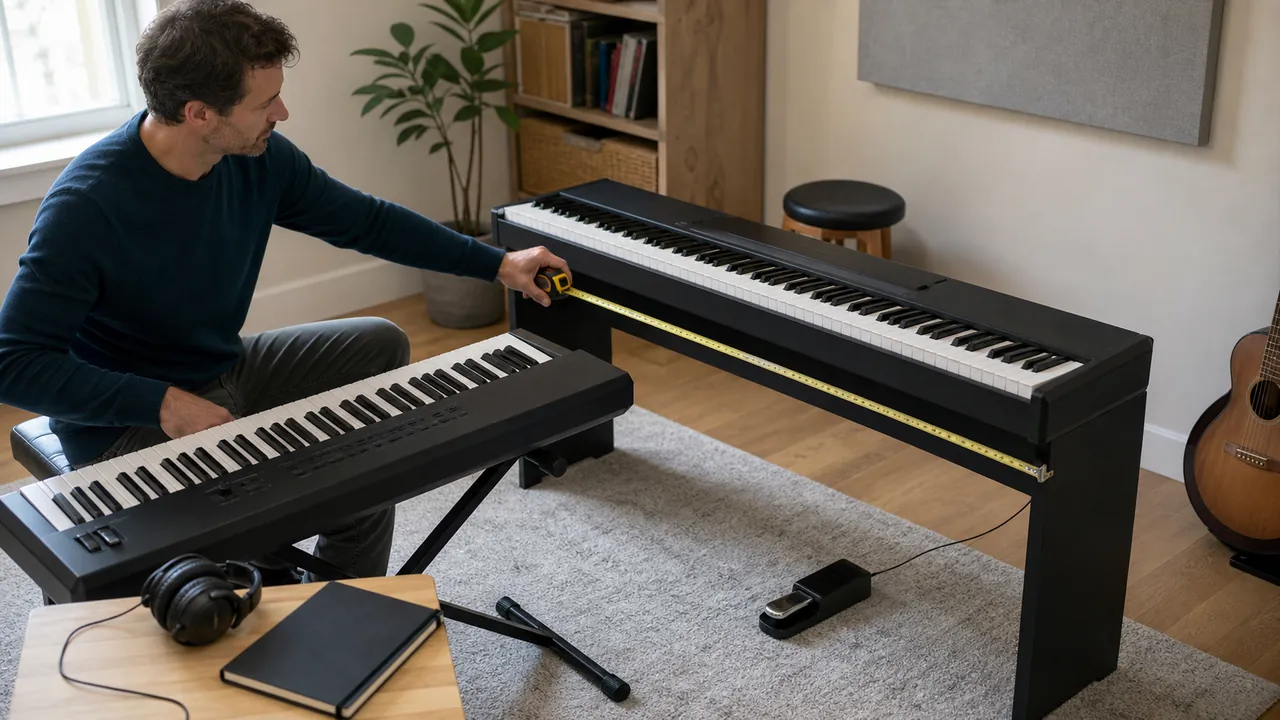
Class before model
Follow the left hand, not the feature count
Piano technique is the job
Require 88 weighted keys. Start at P-145BT; move to P-225 for split mode, stronger output flexibility, more polyphony, and three-pedal compatibility.
Styles and singing are part of practice
DGX-670 adds automatic accompaniment, a screen, microphone input, recording, and many voices. Accept its 21.4 kg body and deeper furniture footprint.
Fast sound changes happen on stage
CK61 offers drawbars, direct controls, line I/O, MIDI, speakers, and battery operation at 5.6 kg. Accept 61 synth-action keys and audition that action.
Read Yamaha's labels
Translate the keyboard language into playing consequences
Weighted hammer action
Keys use a mechanism intended to add resistance and grade the feel across the range.
It supports the physical control expected in much piano teaching.
Ask the teacher whether 88 weighted keys are required, then play repeated quiet notes and chords.
“Weighted” does not make every action feel alike or guarantee a preferred response.
Synth action
A lighter, springier action is designed for quick keyboard, organ, and synth playing.
It reduces carry weight and can suit fast live parts, but changes piano practice.
Compare the CK61 directly with the lesson instrument.
Touch sensitivity measures velocity response; it does not mean hammer action.
Graded action
The lower keys are intended to feel heavier than the upper keys.
That pattern echoes an acoustic piano, but its implementation still needs a trial.
Play the same soft-to-loud figure in the bass, middle, and treble.
A graded label is not a quality score across different mechanisms.
Polyphony
The maximum number of sound voices the instrument can generate at once.
Sustain, layered sounds, and accompaniment can consume more than one voice per key.
Rehearse dense pedal passages or layered arrangements.
Higher polyphony does not by itself improve tone or key feel.
Arranger style
An automatic backing pattern follows chords played by the musician.
It can support solo performance and songwriting but adds controls and learning.
Try changing variations, fills, and chords without stopping.
Many voices are not the same as responsive automatic accompaniment.
Split and layer
Split assigns different sounds to keyboard zones; layer plays sounds together.
These functions change teaching duets, left-hand bass, and live setups.
Map the exact two sounds and split point your music needs.
Duo mode usually duplicates pitch ranges for teacher/student use; it is not an ordinary split.
USB audio and MIDI
MIDI sends performance instructions; USB audio carries recorded sound.
A single port may support both, but cables, drivers, and device compatibility still vary.
Verify the exact phone/computer, adapter, app, and monitoring route.
Bluetooth audio is generally playback into the keyboard, not proof of low-latency wireless performance MIDI.
Half-damper pedal
A compatible pedal can report positions between fully up and fully down.
It gives finer sustain control than a simple on/off footswitch.
Check the exact pedal and stand compatibility, then test gradual releases.
A bundled sustain switch is not automatically a half-damper or three-pedal unit.
How the shortlist was built
Require a current model, two-market order path, and a distinct job
We began with Yamaha's current families, then mapped Thomann for Europe and Sweetwater for the US. Every recommendation needed official specifications, same-run exact-model orderability at both anchors, an observable retail signal, and a job not already served more cleanly.
The P-45, P-125a, and DGX-660 were removed from the current shortlist because newer models occupy their lanes. MONTAGE 8 was removed because a flagship workstation is a different purchase system. Retail ranks and review counts demonstrate market presence; they do not establish quality.
Current models at a glance
Compare action, purpose, and the ownership burden
| Model | Keys/action | Core job | Size/weight | Dated retail signal |
|---|---|---|---|---|
| P-145BT | 88 GHC weighted | Focused piano practice | 1326 x 268 mm; 11.1 kg | Thomann rank 7, 21 ratings; both anchors in stock |
| P-225 | 88 GHC weighted | Compact piano, improved outputs/pedals | 1326 x 272 mm; 11.5 kg | 74 Thomann ratings, 15 Sweetwater reviews; both in stock |
| DGX-670 | 88 GHS weighted | Piano plus arranger/accompaniment | 1397 x 445 mm; 21.4 kg | 70 Thomann ratings, 40 Sweetwater reviews; both in stock |
| CK61 | 61 FSB synth action | Portable live performance | 910 x 291 mm; 5.6 kg | 30 Sweetwater reviews; both anchors in stock |
Recommendations by playing job
Choose the constraint you already have
Yamaha P-145BT
The P-145BT is the clean starting point when lessons need 88 weighted keys and the household does not need accompaniment or live-performance controls.
Advantages: current GHC action, 11.1 kg chassis, speakers, USB audio/MIDI, Bluetooth audio, and a simple ten-voice layout.
Drawback: no split mode, a basic output path, and little room for sound-design or stage changes.
Avoid if: the player needs dedicated line outputs, split keyboard, accompaniment, or fast multi-sound control.
Alternative: P-225 for a more expandable piano setup.
Verify before buying: action preference, pedal/stand bundle, headphone connector, app-device compatibility, origin, and local warranty paperwork.
Found a changed specification or source? Report a correction.
Yamaha P-225
Choose the P-225 when the job remains piano-centered but split mode, CFX-based piano sound, 192-note polyphony, three-pedal compatibility, and separate outputs justify the step up.
Advantages: compact weighted body, 24 voices, line/headphone outputs, USB audio/MIDI, Bluetooth audio, and optional furniture stand/pedal integration.
Drawback: the action and speaker placement remain trial items, while some functions are less immediate without the app or key-command chart.
Avoid if: automatic accompaniment or direct stage sound controls are central.
Alternative: DGX-670 for arranger functions; CK61 for live control and low carry weight.
Verify before buying: action under quiet repetition, output cable path, exact pedal unit, app support, manufacturing label, and local warranty.
Yamaha DGX-670
The DGX-670 earns its lane by combining 88 weighted keys with styles, a color display, microphone input, recording, and a large sound set for self-contained music making.
Advantages: 256-note polyphony, arranger controls, score/lyrics display, USB recording, microphone path, and optional furniture stand/three-pedal setup.
Drawback: 21.4 kg and 445 mm chassis depth make delivery, furniture, and moving part of the purchase; the interface is substantially more complex.
Avoid if: accompaniment will remain unused or the board must travel frequently.
Alternative: P-225 for a focused piano; CK61 for frequent stage transport.
Verify before buying: full assembled footprint, bench/pedal package, menu workflow, microphone/output route, origin, and regional warranty.
Yamaha CK61
The CK61 is the distinct live option: 5.6 kg, physical drawbars and effect controls, three-part sound architecture, line I/O, MIDI, USB audio/MIDI, speakers, and battery operation.
Advantages: low carry weight, compact width, direct live controls, stereo inputs/outputs, two pedal connections, and onboard speakers.
Drawback: 61 synth-action keys and no arranger styles; piano, organ, and synth feel are personal and were not tested.
Avoid if: 88 weighted keys are part of the curriculum or repertoire.
Alternative: P-225 for weighted piano work.
Verify before buying: action, 61-key range, set-list workflow, battery behavior, bag dimensions, manufacturing label, and exact written warranty.
Room rehearsal
Tape the instrument with the music rest and pedal in use
- Tape the published chassis width and depth on the actual floor or desk.
- Add the proposed stand legs, music-rest depth, cable bends behind the unit, and bench travel in front.
- Place the sustain or three-pedal unit where the foot lands; confirm it cannot slide into a stand brace.
- Open the book or tablet at playing height and check sightline, knees, and access to power/headphones.
- For DGX-670, rehearse a two-person lift using a harmless object of comparable mass; do not infer carry comfort from “portable” naming.
The published chassis dimensions are the starting rectangle, not the finished room claim.
Teacher/shop card
Use one passage to expose the wrong action
Bring a passage with soft repeated notes, a sustained chord, a bass-to-treble run, and one rapid sound change from the real repertoire. Ask the teacher or player to repeat it on the lesson instrument and the candidate. Record only observable outcomes: missed quiet notes, unwanted accents, pedal transitions, reach limits, and whether a sound change interrupts the phrase. Do not reduce the result to “realistic feel.”
First rehearsal
Write the complete signal path before choosing cables
Complete this line: “Keys produce ___; headphones connect at ___; the room hears built-in speakers / ___ outputs into ___; the phone or computer sends audio/MIDI through ___; the sustain or expression pedal is ___.” If any blank depends on an adapter, app, mixer, powered speaker, or pedal not in the cart, the keyboard is not yet a complete system.
Due diligence
Physical facts, brand context, and support limits
| Product | Size / weight | Construction | Manufacturing origin | Brand | Warranty / support |
|---|---|---|---|---|---|
| Yamaha P-145BT | 1326 x 268 x 129 mm; 11.1 kg | GHC weighted action and integrated speaker cabinet; full enclosure composition not disclosed. | Not disclosed by Yamaha for this exact model. | Yamaha Corporation, Hamamatsu, Japan; founded 1887; pianos, digital instruments, and audio equipment. | US P-series limited three-year warranty for authorized-dealer purchases; verify local scope and seller. |
| Yamaha P-225 | 1326 x 272 x 129 mm; 11.5 kg | GHC weighted action and integrated speakers; full enclosure composition not disclosed. | Not disclosed by Yamaha for this exact model. | Yamaha Corporation, Hamamatsu, Japan; founded 1887; long-running acoustic and digital piano maker. | US P-series limited three-year warranty for authorized-dealer purchases; verify country and proof requirements. |
| Yamaha DGX-670 | 1397 x 445 x 151 mm; 21.4 kg | GHS weighted action, color display, and integrated speaker cabinet; full enclosure composition not disclosed. | Not disclosed by Yamaha for this exact model. | Yamaha Corporation, Hamamatsu, Japan; founded 1887; keyboard, piano, and arranger families. | US DGX600-series limited three-year warranty for authorized-dealer purchases; verify regional term. |
| Yamaha CK61 | 910 x 291 x 109 mm; 5.6 kg | FSB synth-action keys, physical drawbars, controls, and integrated speakers; full enclosure composition not disclosed. | Not disclosed by Yamaha for this exact model. | Yamaha Corporation, Hamamatsu, Japan; founded 1887; stage keyboards and music-production instruments. | Exact manufacturer duration was not verified for CK61; obtain the current written local term from an authorized seller. |
Reject the wrong setup
Five failures a model name will not prevent
- Action mismatch: touch-sensitive synth keys are not weighted piano keys.
- Footprint creep: stands, music rests, pedals, benches, plugs, and cases exceed chassis dimensions.
- Output dead end: a headphone socket, line output, and USB audio port solve different connections.
- Accessory gap: the bundled footswitch may not be the half-damper or three-pedal unit the music requires.
- Feature tax: arranger styles and deep menus are burdens when the player wants a direct piano.
Checkout questions
Ask the seller to put the exact answer in writing
- Is this exact model and finish new, in stock, and covered by Yamaha in my country?
- Which stand, pedal, power supply, music rest, and cable are included rather than pictured?
- Does the exact pedal support half-damper or three-pedal operation with this model?
- Which outputs feed my speakers or mixer, and which adapter is required for my phone/computer?
- What country of manufacture appears on the physical unit or carton, and what warranty document applies?
Primary documents and dated stock checks
Verify the parts that can change
- Yamaha current P-Series overview
- Yamaha P-145BT specifications
- Thomann P-145BT ordering page
- Sweetwater P-145BT ordering page
- Yamaha P-225 product page
- Yamaha P-225 specifications
- Thomann P-225 ordering page
- Sweetwater P-225 ordering page
- Yamaha DGX-670 specifications
- Yamaha DGX-670 product page
- Thomann DGX-670 ordering page
- Sweetwater DGX-670 ordering page
- Yamaha CK61 specifications
- Yamaha CK series FAQ
- Thomann CK61 ordering page
- Sweetwater CK61 ordering page
- Yamaha US keyboard warranty index
- Yamaha corporate profile
No affiliate links are used. Stock and warranty terms can change; repeat the exact-SKU checks at checkout. Corrections can be sent through the site's contact route once that destination is verified; no unverified link is published here.