Skip to content
Consordini
Menu

Private piano practice, checked

Best Digital Piano Keyboard Headphones

Start with Audio-Technica ATH-M20x for a long straight cable on a tighter budget, Sony MDR-7506 for folding storage, Sennheiser HD 280 Pro when its published attenuation specification is useful, or the exact 32-ohm beyerdynamic DT 770 Pro for replaceable wear parts.

We checked current maker specifications and exact-model listings at Thomann Europe and Sweetwater US. We did not play a piano through these headphones or test sound, seal, comfort, durability, or usable volume. Your exact piano output and head still decide the result.

  • Avoid: buying a different impedance variant because the name looks the same.
  • Verify: jack size, adapter, cable route and return conditions.
  • First move: measure from the piano jack to your playing position with slack.
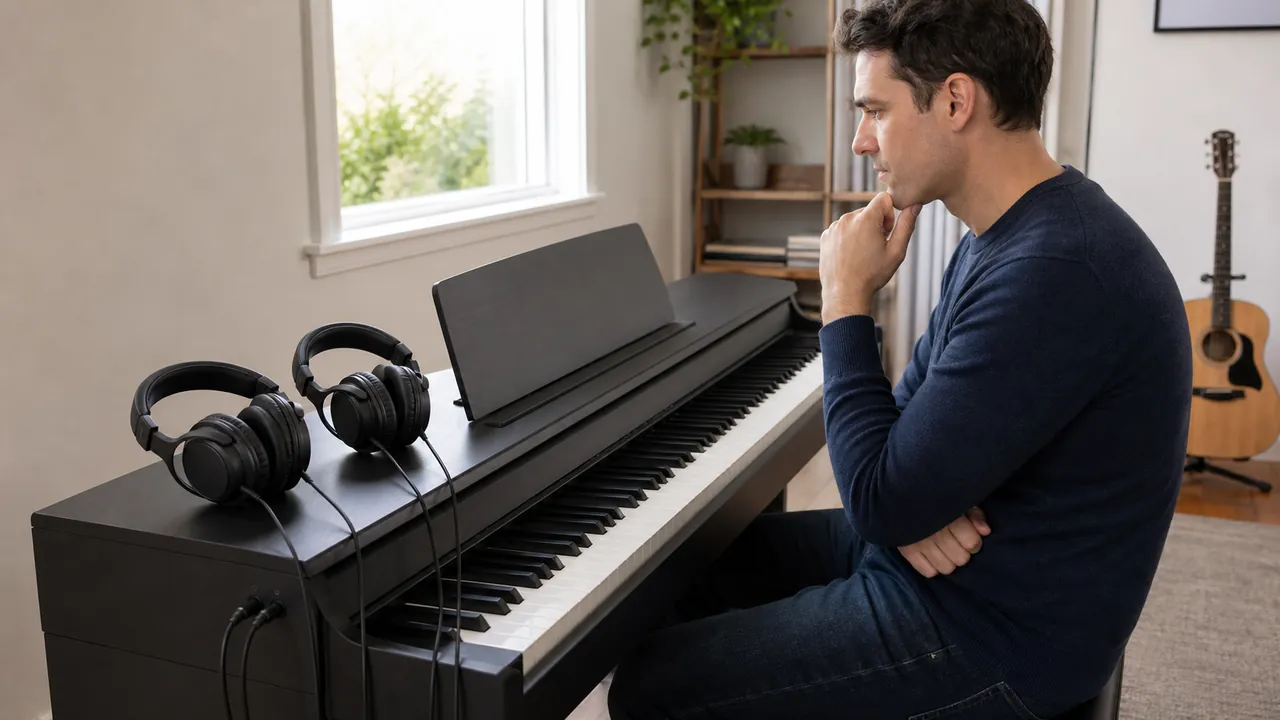
Pianist comparing two generic wired over-ear headphones beside a digital piano
AI-generated buying scene; the piano and headphones are generic and were not tested.

We chose the electrical and physical match first

Every pick had to be an exact current wired model, orderable when checked, supported by maker specifications, and backed by an observable retailer signal. Thomann and Sweetwater anchor the retailer map; their ratings and cross-stocking show an active product, not better sound. All four picks are closed-back. An open-back headphone vents the earcups and usually leaks more sound into a shared room, so that design sits outside this private-practice shortlist; closed-back still does not guarantee silence, isolation, or comfort.

Translate the headphone page into a piano setup

Impedance

The electrical load, stated in ohms, presented to the piano's headphone amplifier.

It interacts with sensitivity and output design, so equal volume-knob positions do not prove equal usable level.

Use the exact variant and test it on your piano at an ordinary setting before keeping it.

Lower ohms do not automatically mean better sound.

Sensitivity or sound-pressure level

A maker's published output figure at a stated electrical reference.

The checked pages do not all state the same reference method, so their dB numbers cannot be ranked as though they were equivalent.

Use the figure only with its stated basis, then test clean usable volume on your exact piano.

A larger published number does not prove better sound or a safe listening level.

6.3 mm and 3.5 mm plugs

The two common wired headphone connector sizes; many pianos use the larger 6.3 mm socket.

An adapter can add leverage at the jack or be missing from a used/open-box unit.

Photograph the piano jack and confirm the adapter is included.

A plug that fits does not establish electrical compatibility.

Closed-back

The outer earcups are enclosed rather than openly vented.

It usually reduces leakage compared with an open design, useful in a shared room.

Check leakage with another person at your normal volume.

Closed-back does not mean silent or guaranteed isolation.

Circumaural

The pads are intended to sit around the ears.

Ear and pad dimensions still determine whether they actually clear your ears.

Keep the pair on for a normal practice block within the return rules.

“Over-ear” is not a comfort measurement.

Fixed cable

The lead is permanently attached rather than unplugging at the earcup.

A damaged lead can require service, and excess length needs safe routing.

Check reach, chair movement and storage before purchase.

A long cable is not always more convenient.

Straight versus coiled

A straight lead lies at full length; a coiled lead expands and pulls back.

Coils reduce loose cable but can tug when the piano jack is far away.

Rehearse the route from jack to bench with the same cable style.

Advertised maximum coil length is not relaxed working reach.

Passive attenuation

Physical cups and pads reduce outside sound without active electronics.

The HD 280 Pro maker publishes up to 32 dB, but seal and frequency change the real result.

Test ordinary room noise and keep piano volume conservative.

It is not hearing protection or a guarantee across frequencies.
Compare the part that reaches the piano

Exact wired, closed-back variants checked July 18, 2026
ModelImpedancePublished sensitivity / SPL*Cable and plugWeightConcrete retail signal
ATH-M20x47 ohms96 dB/mW3 m straight; 3.5 mm + 6.3 mm adapter190 g192 Sweetwater reviews; both anchors list it
MDR-750663 ohms106 dB/mW1.2-3 m coil; 3.5/6.3 mm two-way plug230 g391 Sweetwater reviews; both anchors list it
HD 280 Pro64 ohms113 dB SPL; reference unstated1.3-3 m coil; 3.5 mm + 6.3 mm adapter285 g412 Sweetwater reviews; both anchors list it
DT 770 Pro 3232 ohms96 dB nominal SPL; reference unstated1.6 m straight; 3.5 mm + 6.35 mm adapter278 g621 Thomann ratings; in stock at Sweetwater

*Maker wording and reference basis differ; these dB figures are not an equivalent loudness ranking. Weight is without cable where stated. Review volume is an activity signal only.

Choose a lane, then make the pair pass your piano

Low-cost, long straight cable

Audio-Technica ATH-M20x

The 47-ohm ATH-M20x gives a stationary piano a 3 m straight lead, both plug sizes via adapter, and the lightest published weight here.

Useful facts: 190 g, closed-back, current at both anchors, 192 Sweetwater reviews.

Drawback: the cable is fixed and the frame does not fold.

Avoid if: 3 m of loose cable will cross a walkway or storage must be compact.

Closest alternative: MDR-7506 for folding cups and a coiled lead.

Confidence: high for identity/specs/orderability; sound and fit untested.

Folding, coiled-cable storage

Sony MDR-7506

The exact 63-ohm model folds and its 3 m coiled cable keeps some excess lead off the floor, making it the cleaner put-away lane.

Useful facts: 230 g, 3.5-to-6.3 mm adapter, current US/EU specialist listings.

Drawback: the cable is fixed; coil pull and pad feel were not tested.

Avoid if: the piano jack sits far enough away that coil tension reaches your head.

Closest alternative: HD 280 Pro for a published attenuation figure.

Confidence: high for maker facts and current identity; comfort unknown.

Published attenuation specification

Sennheiser HD 280 Pro

This is the lane for a buyer who wants a maker-published passive attenuation figure, folding/rotating cups, and replaceable pads without active electronics.

Useful facts: 64 ohms, up to 32 dB maker specification, 412 Sweetwater reviews.

Drawback: 285 g is the highest published weight here, with a fixed coiled cable.

Avoid if: low weight or a straight lead matters more than the attenuation specification.

Closest alternative: ATH-M20x for a lighter, straight-cable setup.

Confidence: high for specs/orderability; seal and isolation outcome untested.

Low-impedance, replaceable wear parts

beyerdynamic DT 770 Pro 32 Ohm

Choose the exact 32-ohm version when the piano-output use case and replaceable pads/headband parts matter more than a long lead.

Useful facts: made in Germany, 621 Thomann ratings, current Sweetwater stock.

Drawback: its fixed 1.6 m cable is the shortest here.

Avoid if: the side or rear jack cannot reach your seated position with slack.

Closest alternative: ATH-M20x for almost twice the cable length.

Confidence: high for exact variant/specs/orderability; sound and fit untested.

Run a string from the jack to your head

Use string or a spare cable, starting at the exact piano headphone socket. Route it around the music stand, bench and your playing-side shoulder. Add enough slack to look at the lowest and highest keys without tugging. A 1.6 m straight lead that works on a front-left jack can fail on a rear-right jack; a 3 m coil can still pull before its advertised maximum.

Reject the setup if:the adapter bears sideways weightthe cable crosses feet or pedalsturning your head moves the plug

Use a quiet-volume output check before keeping it

Set the piano to a familiar default voice and its ordinary speaker level first. Insert the headphones, start the headphone control low, and raise it only to a comfortable practice setting. Check soft notes, loud chords, and left/right channels. The test is whether your exact piano has clean, usable range without living near maximum, not which pair sounds “best” in a shop.

Where the numbers stop and your piano takes over

Impedance alone does not predict usable level, sensitivity figures need the same measurement basis before comparison, and frequency-response endpoints do not rank piano realism. A retailer rating does not predict your head fit. Leakage, pad seal, clamp, tonal balance, mechanical noise and long-session comfort need a return-window trial. Keep packaging clean, check whether opened headphones can be returned, and do not treat a published attenuation number as hearing protection.

Construction, origin, brand and warranty details

Due-diligence fields for exact selected variants
ProductSize and weightConstructionManufacturing originBrandWarranty
Audio-Technica ATH-M20x190 g without cable; full envelope not disclosed.Closed dynamic; 40 mm neodymium driver and CCAW coil.Not disclosed for exact model.Tokyo; established 1962; audio transducers.Regional maker/seller terms vary; verify invoice coverage.
Sony MDR-7506230 g without cable; full folded envelope not disclosed.Closed dynamic, 40 mm driver, folding frame, fixed coil.Not disclosed for exact model.Tokyo; established 1946; consumer/pro audio.Warranty card listed; exact region/term must be confirmed.
Sennheiser HD 280 Pro285 g without cable; full folded envelope not disclosed.Closed dynamic; rotating/folding cups; replaceable pads.Not disclosed for exact model.Wedemark, Germany; established 1945; pro audio.Maker page lists two years; regional scope applies.
beyerdynamic DT 770 Pro 32 Ohm278 g without cable; 317 g with cable.Closed dynamic; spring-steel band; replaceable pads/headband.Made in Germany per exact maker page.Heilbronn; established 1924; headphones/microphones.Maker and seller terms vary; Thomann lists three years.

Sources checked

  1. Audio-Technica M-series technical file
  2. Sweetwater ATH-M20x
  3. Thomann ATH-M20x
  4. Sony MDR-7506 operating instructions
  5. Sweetwater MDR-7506
  6. Thomann MDR-7506
  7. Sennheiser HD 280 Pro
  8. HD 280 Pro specification PDF
  9. Sweetwater HD 280 Pro
  10. Thomann HD 280 Pro
  11. beyerdynamic DT 770 Pro 32
  12. beyerdynamic DT 770 Pro technical sheet
  13. Thomann DT 770 Pro 32
  14. Sweetwater DT 770 Pro 32

Found something that needs correcting? Contact the Consordini editorial team.