Buy the practice station, not just the keyboard
Best Cheap Keyboard Piano
Kawai ES60 is the most complete low-cost route when line outputs matter; Roland, Yamaha and Casio make better sense for different practice rooms and connections.
We checked current manufacturer specifications and exact-model availability at Sweetwater, Guitar Center and Thomann. We did not play, hear, lift, measure or durability-test these pianos.
Researched . Prices, stock, ranks and rating counts can change.
Line outputs and wired lessons: Kawai ES60.
Established home-practice lane: Roland FP-10.
Phone audio through the speakers: Yamaha P-145BT.
Shallow or battery-capable setup: Casio CDP-S110.
Avoid: buying before the stand, bench, pedal and headphone plug are settled.
Verify: delivered price, return terms and the exact regional Bluetooth function.
The piano language hidden inside the listing
Hammer action
A mechanism adds resistance intended to resemble piano keys. It changes how force and control develop during lessons. Compare actions with the same short passage. The label does not prove acoustic-piano realism or personal preference.
Graded weighting
Lower keys are designed to feel heavier than upper keys. That mirrors the broad direction of an acoustic piano keyboard. Play quietly at both ends. Graded does not describe the exact weight or pivot length.
Touch sensitivity
The sound responds to how quickly a key is pressed. It permits soft and loud phrasing. Check the available response curves. It is different from physical key weight.
Polyphony
The stated maximum is the number of notes the sound engine can sustain at once. Pedal, layers and accompaniment can consume notes. Test the densest music you expect to play. A larger number is not proof of better piano sound.
Half-pedaling
A compatible pedal can report positions between fully up and down. It gives finer control of sustain. Check both piano and pedal compatibility. The included switch pedal may only send on and off.
Bluetooth audio
The piano receives audio from a phone or tablet. Backing tracks can use the onboard speakers. Confirm the feature exists in your sales region. It does not automatically send MIDI or headphone audio.
Bluetooth MIDI
The piano sends performance data to compatible software. It can simplify lesson-app connections. Check app and device support. MIDI contains instructions, not the piano's audible sound.
Line output
A dedicated output feeds an amplifier, recorder or mixer. It avoids sharing the headphone socket in a fixed setup. Match connector type and level to the next device. A headphone jack can sometimes feed speakers but is not the same connection.
Four low-cost pianos, four different room jobs
All four have 88 hammer-action keys, speakers, a headphone path, music rest and basic sustain pedal. Ratings establish that real store customers bought the exact model; they do not establish the best action or sound.
| Model | Depth | Connection distinction | Best lane | Main boundary |
|---|---|---|---|---|
| Kawai ES60 | 26 cm | Stereo line outputs | Lessons and small amplification | No Bluetooth |
| Roland FP-10 | 25.8 cm | Bluetooth MIDI | Focused home practice | No dedicated line outputs |
| Yamaha P-145BT | 26.8 cm | Bluetooth audio receive | Phone-backed practice | Function varies by region |
| Casio CDP-S110 | 23.2 cm | Six-AA battery option | Shallow or movable setup | One shared phones/output jack |
Why familiar names were not enough
We required a current maker record plus an order path at a large US music retailer and Thomann. In the July 17 snapshot, FP-10 had 426 Thomann ratings and a number-one stage-piano rank; ES60 had 66 ratings, a 61% exact-item purchase share and a number-one Digital Pianos rank; P-145BT had 21 ratings and 54%; CDP-S110 had 90 and 46%. These volatile store signals show market presence only. Alesis Recital Pro and Donner DEP-20 did not match the same cross-region specialist evidence, so neither displaces a stronger-supported lane.
Choose the constraint you cannot fix later
Kawai ES60 for a wired lesson or performance corner
Fit: a student using the speakers, a teacher feeding a recorder, or a small performance setup that needs proper left/right outputs.
The ES60 is the only pick here with dedicated L/Mono and R line outputs. Sweetwater lists it in stock; Thomann's July 17 snapshot shows 66 ratings, 61% exact-item share and a number-one Digital Pianos rank.
Advantage: 20 W speaker system, 192-note polyphony, one front 1/4-inch stereo headphone jack and a half-pedal upgrade path.
Drawback: there is only one headphone connection and no Bluetooth audio or MIDI; action feel and speaker quality were not tested.
Avoid if: two simultaneous wired headphone listeners or wireless phone practice are firm requirements.
Alternative: Yamaha P-145BT for Bluetooth audio.
Kawai's exact specification governs the connection count: one front headphone jack plus separate L/Mono and R line outputs. Store counts and ranks are a dated snapshot.
Roland FP-10 for a settled home-practice routine
Fit: a beginner prioritizing an established 88-key practice platform and Bluetooth MIDI for compatible learning software.
Thomann lists it in stock, first in its stage-piano sales rank and backed by 426 ratings. Roland documents the PHA-4 Standard action and 96-note polyphony.
Advantage: the largest exact-model specialist history in this set and a compact 258 mm body.
Drawback: Bluetooth is MIDI rather than backing-track audio, and external sound must share the 3.5 mm phones/output jack.
Avoid if: dedicated line outputs are part of the room plan.
Alternative: Kawai ES60 for a mixer or powered-speaker connection.
Current model and EU popularity are well supported; no claim is made about action preference.
Yamaha P-145BT for practice with phone audio
Fit: an apartment student who wants lesson or backing-track audio to play through the piano speakers without a cable.
Yamaha specifies Bluetooth audio receive plus USB MIDI/audio. Sweetwater and Thomann both show stock, while Thomann records rank seven, 21 ratings and a 54% exact-item share.
Advantage: the wireless feature answers a clear practice job rather than adding an ambiguous specification.
Drawback: Bluetooth availability varies by region, it is not Bluetooth MIDI, and the US page had only one review.
Avoid if: you need stereo line outputs or wireless MIDI.
Alternative: Roland FP-10 for Bluetooth MIDI.
Manufacturer and retailer facts align; wireless behavior must still be verified for the exact regional unit.
Casio CDP-S110 for the shallowest movable station
Fit: a shared room where the piano is stored after practice or occasionally used away from an outlet.
At 232 mm deep and about 10.5 kg, it is the smallest body here, and Casio documents operation from six AA batteries. Thomann shows 90 ratings and a 46% exact-item share.
Advantage: the physical and power advantages are measurable before purchase.
Drawback: the 3.5 mm phones/output is the only output path, and checked US and EU prices differed sharply.
Avoid if: the piano will stay connected to a mixer or powered monitors.
Alternative: Kawai ES60 for dedicated outputs.
Dimensions, power and current store support are clear; portability comfort and key feel were not tested.
A floor plan that includes the player
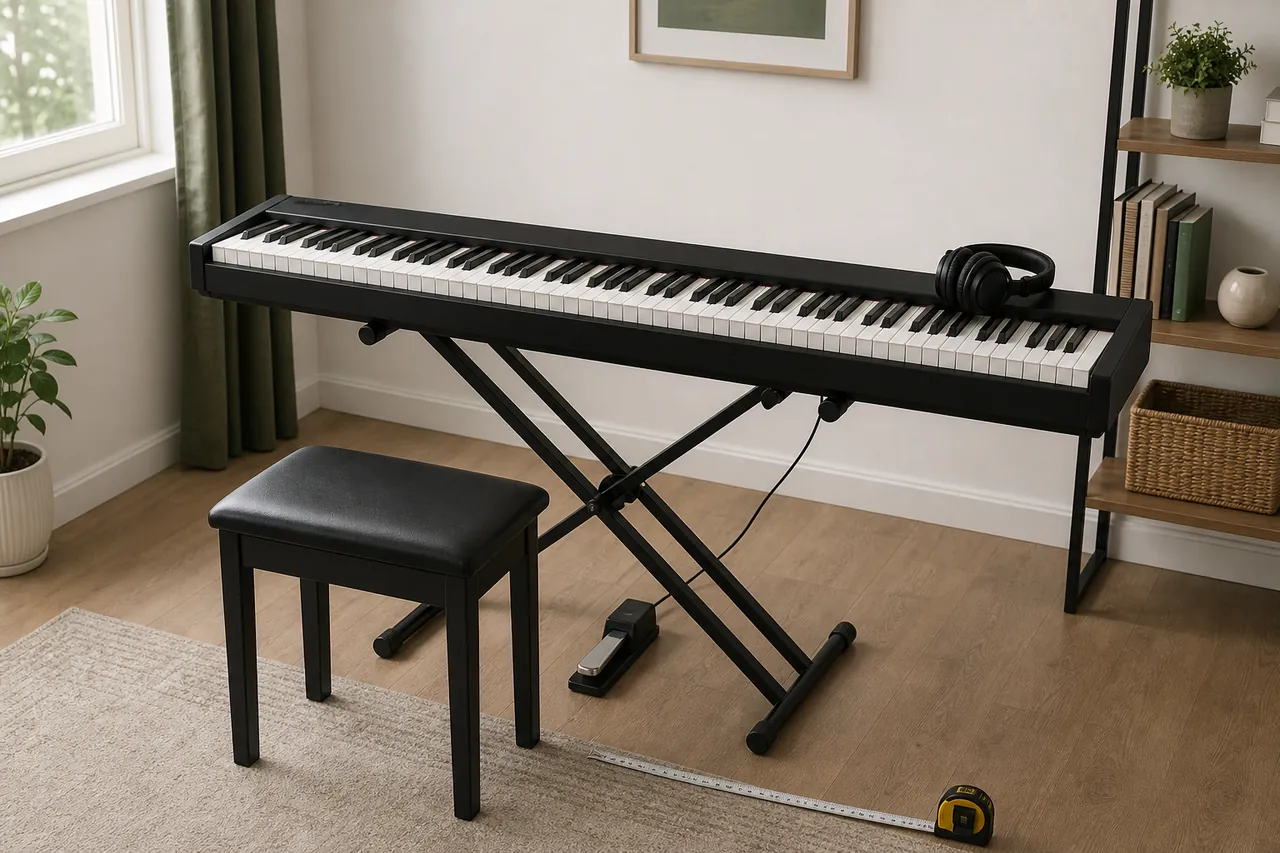
Tape the bench path before the carton arrives
A 23 cm-deep piano can still consume much more room once the stand, rest, cables and seated player are present. This rehearsal prevents a dimensional specification from becoming a false space promise.
Run a quiet-practice checkout while returns are easy
- Set the bench so forearms are near level and feet reach the pedal without leaning.
- Play the same soft scale and repeated-note passage across the keyboard; listen for unwanted mechanical or channel irregularity without assuming normal key noise is a defect.
- Connect the actual headphones with the correct adapter and check safe usable volume.
- Test the included pedal, then confirm whether a future half-pedal or three-pedal unit needs a specific stand.
- Connect the intended app, computer, mixer or speakers. Bluetooth audio and Bluetooth MIDI are different tests.
A cheap piano becomes expensive when the room is wrong
The ES60 spends its advantage on outputs; FP-10 on an established practice platform; P-145BT on incoming phone audio; CDP-S110 on depth and battery power. None includes a stable furniture stand or height-adjustable bench in the base product evidence. Price the complete station, including cable adapters and floor protection, before comparing discounts.
Body, construction, maker and support record
Checked manufacturer pages did not establish the manufacturing country of the exact delivered units. Brand headquarters are not a substitute; inspect the carton and product label if origin affects the decision.
| Product | Size and weight | Construction | Manufacturing origin | Brand | Warranty |
|---|---|---|---|---|---|
| Kawai ES60 | 129.5 x 26 x 15 cm; 11 kg, rest detached | 88-key RHL action, detachable rest, two 12 cm speakers, switch pedal and adapter | Not disclosed for exact delivered unit; inspect label. | Kawai, founded 1927 in Hamamatsu; acoustic and digital pianos. | Sweetwater lists two-year store coverage; verify regional maker terms. |
| Roland FP-10 | 128.4 x 25.8 x 14 cm; 12.6 kg, rest detached | 88-key PHA-4 Standard action, two 12 cm speakers, rest, switch pedal and adapter | Not disclosed for exact delivered unit; inspect label. | Roland, established 1972 in Japan; electronic instruments and digital pianos. | Confirm Sweetwater coverage and Roland regional registration terms. |
| Yamaha P-145BT | 132.6 x 26.8 x 12.9 cm; 11.1 kg, rest detached | 88-key GHC action, two oval speakers, rest, footswitch and adapter | Not disclosed for exact delivered unit; inspect label. | Yamaha, founded 1887 in Hamamatsu; acoustic pianos and electronic instruments. | Sweetwater lists two-year store coverage; verify Yamaha regional terms. |
| Casio CDP-S110 | 132.2 x 23.2 x 9.9 cm; about 10.5 kg without batteries | 88-key scaled hammer action, two oval speakers, AC or six-AA power, rest and pedal | Not disclosed for exact delivered unit; inspect label. | Casio, founded 1946 in Tokyo; consumer electronics and musical instruments. | Guitar Center advertises free warranty; confirm duration and Casio terms. |
Exact pages behind the shortlist
- Kawai ES60 specification
- ES60 at Sweetwater
- ES60 at Thomann
- Roland FP-10 specification
- FP-10 at Sweetwater
- FP-10 at Thomann
- Yamaha P-145BT specification
- P-145BT at Sweetwater
- P-145 B BT at Thomann
- Casio CDP-S110 manual
- CDP-S110 at Guitar Center
- CDP-S110 at Thomann
- Kawai company background
- Roland company overview
- Yamaha history
- Casio history
- Alesis exclusion check
- Donner exclusion check
Found something that needs correcting? Contact the Consordini editorial team.