Current digital pianos, not brand mythology
Best Digital Piano Keyboard Brands: A Current Buying Guide
Buy the model that fits the room and playing job. Yamaha P-225 is the compact all-rounder, Roland FP-30X the connected practice piano, Kawai ES120 the piano-first portable, and Nord Piano 6 88 the amplified stage instrument.
We checked current manufacturer specifications and manuals plus orderable US and European specialist-store listings on . We did not play, measure or sound-test these pianos. Action and speaker preference require an in-person, level-matched trial.
Do not buy a brand name without the exact model. Key actions, speakers, pedal support and outputs change within every range. A good company can still make the wrong piano for your use.
Use the 12-minute audition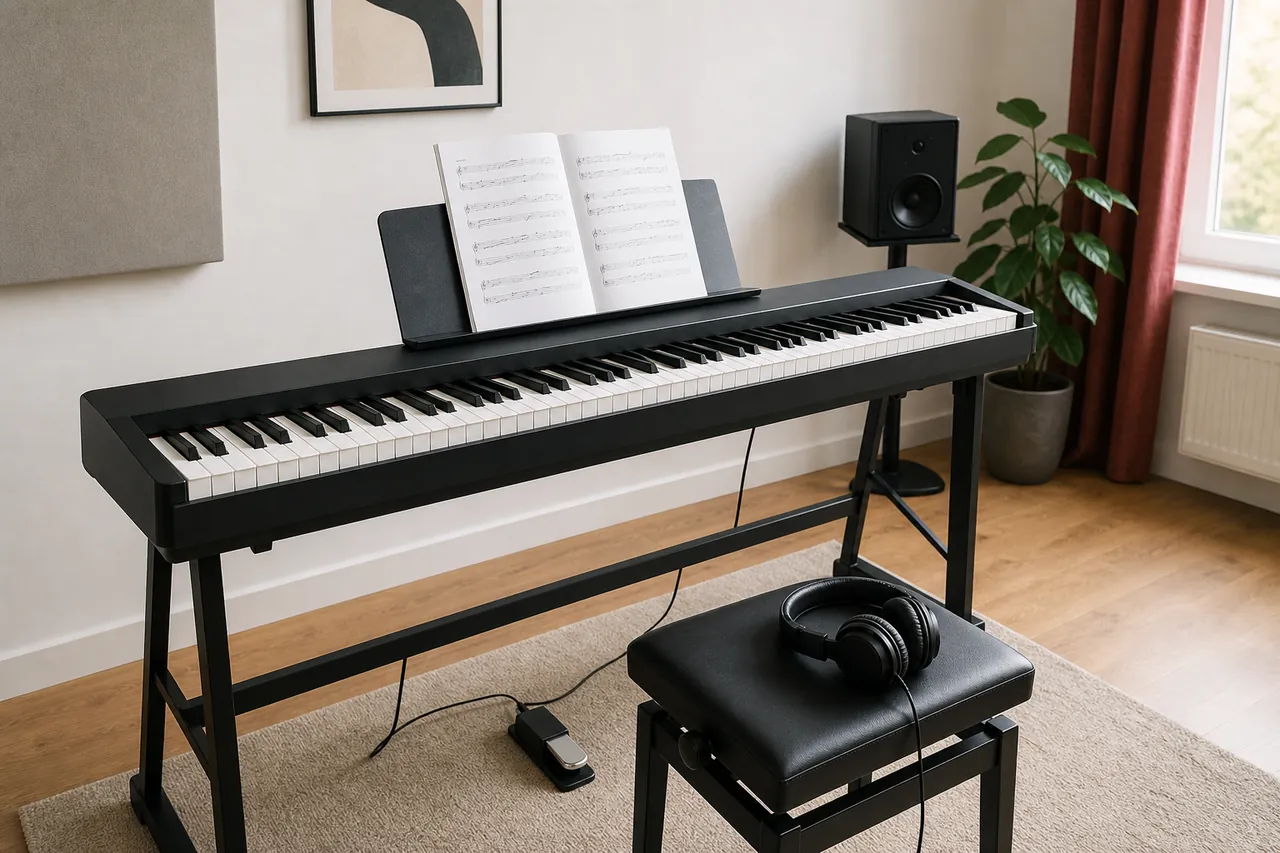
Prioritize action, headphone comfort, pedal path and a stable stand before extra sounds.
Measure the full depth with music rest, plugs and bench clearance.
Require line outputs, suitable monitoring and a carry plan; built-in speakers are not venue reinforcement.
The words that change what your hands and room receive
Graded hammer action
A weighted mechanism designed to feel heavier in the bass and lighter in the treble.
It matters more to piano technique than the number of onboard voices.
Play repeated quiet notes, scales and chords on the exact model.
“Graded” does not make different brands or actions feel identical.
Escapement simulation
A small tactile notch intended to echo part of a grand-piano action near the bottom of travel.
Some players notice it during very soft control.
Compare it slowly with headphones off so mechanism noise is also apparent.
It is not the complete escapement mechanism of an acoustic grand.
Polyphony
The maximum number of sound voices the engine can sustain at once.
Pedal resonance, layers and stereo samples may consume more than one voice per key.
Test dense pedaled passages in the sound and layer you will use.
256-note polyphony does not mean 256 physical keys or automatically better tone.
Half-pedaling
Continuous damper sensing between fully up and fully down.
It permits finer control than an included on/off switch pedal.
Confirm the compatible pedal or three-pedal unit and include it in the budget.
A sustain jack does not prove the supplied pedal supports half-pedaling.
Line outputs
Dedicated audio sockets for a mixer, interface or powered monitors.
They give a cleaner stage/studio route than borrowing the headphone socket.
Check connector size, mono use and whether internal speakers can remain active.
USB-MIDI alone carries performance data, not necessarily the piano's audio.
USB audio and USB-MIDI
USB audio transfers sound; USB-MIDI transfers notes, pedals and controls.
A model may support one without the other.
Verify the manual and the cable/adapter your computer requires.
Bluetooth Audio commonly plays music into a piano; it is not a low-latency recording promise.
Local control
A setting that connects or disconnects the keys from the internal sound engine.
Turning it off can prevent doubled notes when a DAW echoes MIDI back.
Find the setting before a computer-based lesson or recording session.
It does not mute externally arriving audio.
Stage piano
A performance-focused keyboard intended to feed external amplification.
It may omit speakers and trade furniture styling for controls and outputs.
Budget monitors, stand, case and cables with the instrument.
“Portable” can still mean more than 40 pounds before accessories.
Four representative models survived the shelf and lane check
We mapped current portable and stage-piano shelves at Sweetwater and Thomann, then returned to first-party specifications and manuals for every decision claim. Sweetwater lists the Roland FP-30X, Yamaha P-225 and Kawai ES120 in stock and names the first two among its visible popular home-piano products. Thomann's current category data shows 203 Roland FP-30X, 74 Yamaha P-225 and 74 Kawai ES-120 listing counts/signals, while individual pages expose what shoppers who viewed a model bought. Nord Piano 6 88 is currently in stock at Sweetwater and orderable in Europe, but its premium stage lane should not be compared by the same home-piano volume.
These are shelf and engagement observations, not proof of durability, tone or action quality. Casio remains a credible major brand, but adding a fifth portable did not create a clean lane beyond the three home/practice choices. Console and hybrid pianos were excluded because furniture, delivery and acoustic-action decisions require a different guide. Nord is included only as a representative performance purchase, not as advice that an expensive red keyboard is inherently better.
Compare the setup before comparing piano demos
| Model | Buyer lane | Action / sound | Speakers and outputs | Refusal point |
|---|---|---|---|---|
| Yamaha P-225 | Compact home all-rounder | 88-key GHC; CFX voice; 192-note polyphony | 7 W x 2; headphone and AUX OUT | Trial the compact action; Bluetooth MIDI needs an optional adapter |
| Roland FP-30X | Connected practice and small performance | PHA-4 Standard with escapement; 256 notes | 11 W x 2; dedicated L/Mono, R outputs | 14.8 kg is not light for frequent stairs |
| Kawai ES120 | Piano-first portable for home/teaching | RHC graded action; 192 notes | 10 W x 2; L/Mono, R outputs | Included F-1SP is on/off; budget a continuous pedal |
| Nord Piano 6 88 | Touring stage pianist and layered performance | Triple-sensor hammer action; dual piano/synth layers | No speakers; L/R line outputs | Requires amplification and weighs 19.2 kg |
Current products with a clear job and a reason to refuse
Best fit: compact home piano that occasionally travels
Yamaha P-225
The P-225 fits a small room without dropping the full 88-key graded layout. Yamaha specifies its GHC action, CFX-derived piano sound, 192-note polyphony, 24 voices and 11.5 kg weight. It can grow into the L-200 stand and LP-1 three-pedal unit, while AUX OUT sockets support external amplification.
It is the lightest home-style piano here and has strong current US/EU shelf evidence.
The compact action is exactly why an experienced pianist should trial it, not infer feel from Yamaha's acoustic reputation.
Avoid it if built-in Bluetooth MIDI or a heavier action is mandatory.
Try Roland FP-30X for connectivity and a different action; Kawai ES120 for the piano-first alternative.
Verified: current specs, manual, accessories and retailer orderability. Not verified: feel, speaker tone, reliability or country of final assembly.
Found a changed specification or source? Report a correction.
Best fit: lessons, headphones and flexible device connection
Roland FP-30X
The FP-30X combines Roland's PHA-4 Standard action with 256-note polyphony, 22 watts of total speaker power, Bluetooth audio/MIDI, USB audio/MIDI and proper quarter-inch line outputs. That connection set makes it easier to move from private practice to an interface, mixer or app without changing the piano.
Two headphone sizes and dedicated outputs reduce adapter work in lessons and performance.
At 14.8 kg with music rest, it is materially heavier than Yamaha and Kawai.
Avoid it when frequent one-person transport matters more than connectivity, or if the PHA-4 feel does not suit you.
Yamaha P-225 saves 3.3 kg; Kawai ES120 supplies another action to compare at similar scope.
Verified: current official specification/manual and strong in-stock US/EU evidence. No playing test was performed.
Best fit: piano-focused portable for home or teaching room
Kawai ES120
Kawai's ES120 offers its Responsive Hammer Compact graded action, 88-key piano sampling, 192-note polyphony, 20 watts of speakers, Bluetooth audio/MIDI and dedicated line outputs in a 12 kg chassis. Its lane is the buyer who wants to compare piano behavior before app extras and does not need stage-layer controls.
The specification balances low weight, proper outputs and optional three-pedal support.
The included switch pedal is not the half-pedal solution many developing pianists eventually want.
Avoid it if you expect the box to include a continuous damper or furniture stand.
Compare the Roland directly for connection workflow and Yamaha for the lightest carry.
Verified: manufacturer specification, brochure, current Sweetwater listing and Thomann category signal. Action preference remains unknown.
Best fit: stage pianist who needs direct layered control
Nord Piano 6 88
Nord Piano 6 belongs in a different purchase: no speakers, a 42.3-pound chassis, dedicated front-panel performance controls, dual piano and dual synth layers, independent effects and balanced-by-workflow stage connections. It includes the Nord Triple Pedal 2 and is meant to feed a PA or monitors.
Layer controls, program storage and stage-focused effects are available without building the performance around a laptop.
The real system cost includes stand, case, amplification and safe transport.
Avoid it for casual home practice when built-in speakers and furniture integration matter, or when 19.2 kg is not a realistic carry.
Choose one of the three speaker-equipped portables unless performance controls are a proven need.
Verified: current official specs, included pedal and in-stock Sweetwater evidence. We did not assess keybed feel or stage sound.
Bring the same script to every shop
A 12-minute action and speaker audition
Minutes 0-4: quiet control
Use one plain grand-piano preset. Play each key softly, then repeat one note at changing speeds. Listen for missed quiet notes and mechanical sounds. Do not add reverb to flatter the first impression.
Minutes 4-8: pedal and density
Play a familiar pedaled passage, half-pedal if supported, and dense chords. Release deliberately. Check whether the supplied pedal moves and whether the optional pedal changes the budget.
Minutes 8-12: level match
Match loudness by ear before switching pianos. Repeat through your own headphones, then speakers. Louder often seems better; a fair comparison removes that shortcut.
Make a room and connection passport
Physical fit
Record width, depth with rest and rear plugs, bench pull-back, stand footprint and the narrowest doorway. Tape the rectangle on the floor.
Signal path
Write headphones, line outputs, USB audio, USB-MIDI, Bluetooth role and required adapter. Draw the actual route to lesson device, computer or mixer.
Pedal path
Name the included pedal, continuous-damper option and compatible three-pedal unit. Include stand dependencies and regional part numbers.
Price and lift the complete rig, not the keyboard
A 12 kg keyboard can become an awkward 20 kg trip once stand, pedal, cables and case travel together. Lift the packed system before treating “portable” as solved.
Exact size, construction, origin and support details
| Product | Size / weight | Construction | Manufacturing origin | Brand context | Warranty / support |
|---|---|---|---|---|---|
| Yamaha P-225 | 1326 x 272 x 129 mm; 11.5 kg, rest detached. | GHC 88-key action; plastic portable chassis; material grade is unstated. | Country of final assembly is absent on reviewed official page/manual; check unit label. | Yamaha, Japan; broad piano and musical-instrument maker. | Regional Yamaha terms apply; confirm serial eligibility and local dealer handling before purchase. |
| Roland FP-30X | 1300 x 284 x 151 mm; 14.8 kg with music rest. | PHA-4 Standard action in portable molded chassis; exact plastics/metal mix not specified. | Not stated in reviewed global specification; inspect model label. | Roland, Japan; electronic instruments and production products. | Regional written warranty varies; Sweetwater separately advertises its own two-year coverage. |
| Kawai ES120 | 1305 x 280 x 150 mm; 12 kg, rest detached. | RHC 88-key action; portable chassis; material specification is unstated. | Official global materials reviewed do not name final-assembly country; check label. | Kawai, Japan; acoustic and digital piano maker. | A warranty card is listed in some regions; term and transferability must be confirmed locally. |
| Nord Piano 6 88 | 1282 x 349 x 121 mm; 19.2 kg. | Triple-sensor hammer keybed and performance chassis; exact material breakdown unpublished. | Nord states its instruments are handmade in Stockholm, Sweden. | Clavia/Nord, Stockholm; stage keyboards and synthesizers. | Regional distributor/dealer terms apply; verify touring-service route and registration. |
Choose the failure that belongs to your setup
A beginner's first failure is often instability rather than sound: an X-stand at the wrong height, a sliding switch pedal and a dining chair can make practice uncomfortable even when the keyboard is capable. Spend enough of the budget on a rigid stand, adjustable seat and pedal that stays put. For a student, ask the teacher whether a three-pedal unit is part of the next two years of work. Buying that path once is cleaner than discovering that a generic pedal cannot provide the continuous control expected by the lesson material.
A shared-home failure is different. Headphone sockets can sit at the front, side or rear; a rear plug can add depth and be struck against a wall. Built-in speakers also transmit vibration through a stand and floor even at moderate volume. Measure with cables connected, use a mat where appropriate, and ask another person to listen from the room below. Bluetooth headphones are not assumed here: latency can separate finger movement from sound, and the reviewed pianos primarily describe wired headphone use.
A stage failure usually appears at load-in. Confirm that the line outputs can feed the venue system, label a known-good pair of cables and decide whether you need mono operation. The Nord has no speakers, while the other three can make sound alone but are not substitutes for venue monitoring. Rehearse patch changes and pedal polarity before arrival. Carrying a premium instrument without a suitable case, cart or second person is not a professional plan.
A computer failure comes from confusing MIDI and audio. MIDI can record what notes and pedals you played while the piano's own tone remains outside the computer. USB audio can carry that tone on models that support it; otherwise use line outputs into an audio interface. Make a 30-second recording, disconnect and reconnect everything, and repeat. The successful file and cable list are better evidence than a compatibility icon on a sales page.
The final checkout question
Ask the seller to name the exact boxed accessories, return window, restocking conditions and warranty contact in writing. Photograph the model and serial labels when it arrives, keep the packaging through the return period, and test every key, socket, pedal and control before that deadline. This is also the moment to confirm that the stand and pedal part numbers match the regional model rather than a visually similar predecessor.
What this evidence cannot settle
Specifications cannot rank action feel, speaker voicing, pedal noise, long-session comfort or reliability. Retail rank can show active ordering, not satisfaction across years. Manufacturer sound names identify source technology, not whether one piano will sound better in your room. Trial the exact unit family, use matched loudness, and buy from a seller whose return and warranty route you understand.
Prices are omitted because promotions, taxes, bundles and regional accessories change quickly. Compare complete systems on the same day. A cheaper keyboard that immediately needs stand, pedal and monitors may cost more than the displayed gap; a premium stage piano is wasteful when its controls never leave a living room.
Manufacturer, manual and specialist-retailer sources
- Yamaha P-225 specifications
- Yamaha P-225 owner manual
- Roland FP-30X specifications
- Roland FP-30X manual
- Kawai ES120 specifications
- Kawai ES120 brochure
- Nord Piano 6 specifications
- Nord company and production
- Sweetwater home digital piano category
- Sweetwater Nord Piano 6 listing
- Thomann Yamaha P-225 listing
- Thomann Roland FP-30X listing
- Thomann stage-piano current offers and counts
- Sweetwater Kawai ES120 listing
- Yamaha US warranty information
- Roland US warranty information