Alto saxophone buying guide
Best Alto Saxophone Choices for Students and Advancing Players
The best first alto is the one a school accepts, a local technician will service, and you can inspect before the return window closes. Four current models cover the useful lanes from lower-cost direct purchase to a genuine intermediate step-up.
Research checked against maker and specialist-retailer pages.
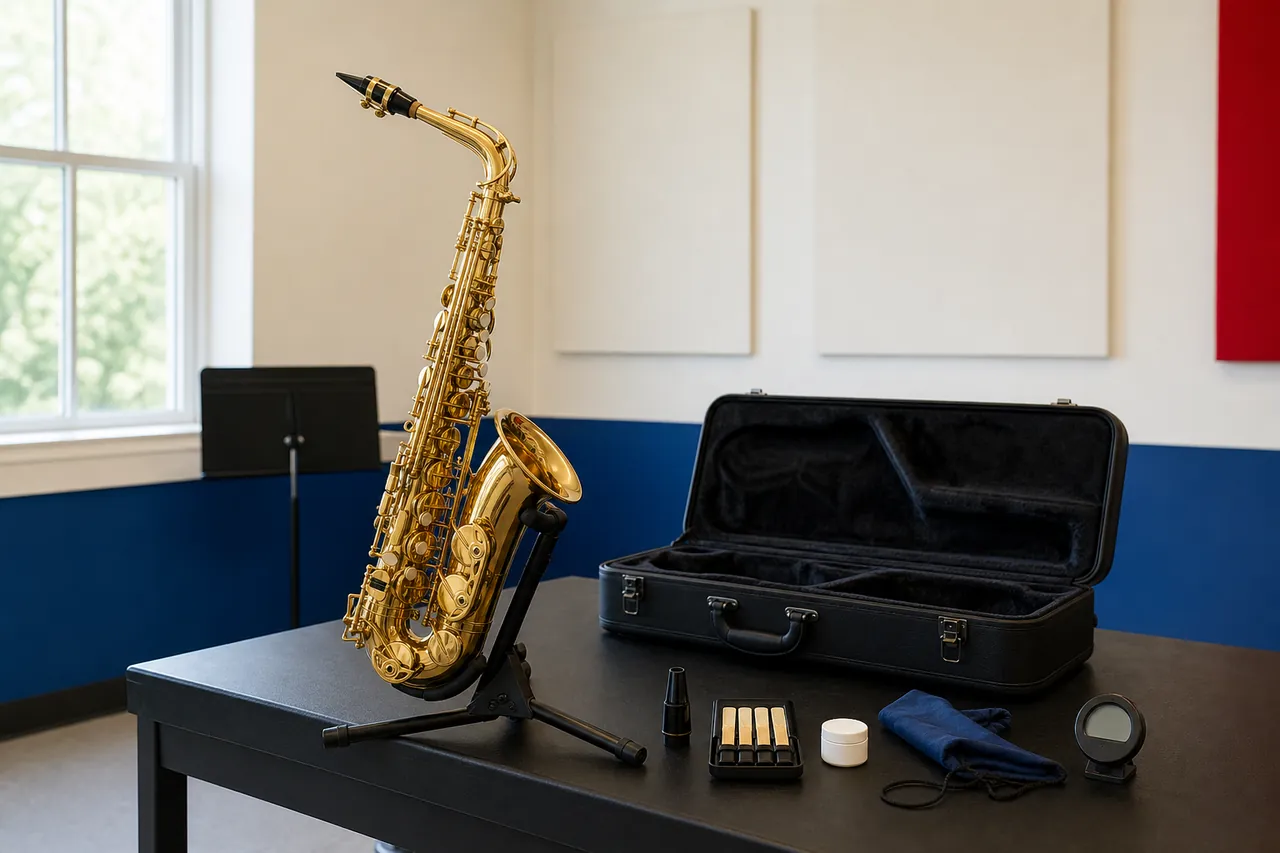
We compared current specifications, support terms, exact-model checkout, and observable retailer signals. We did not play, regulate, leak-test, tune, or inspect these instruments. Delivered condition, pad sealing, key height, intonation, and fit still need a teacher or repair-tech check.
Short answer: Yamaha YAS-280 is the strongest school-band default; Jean Paul AS-400 is the lower-cost direct option; Jupiter JAS700A offers more player-specific adjustment; Yamaha YAS-480 is the intermediate upgrade.
Understand the instrument before choosing a model
Student versus intermediate
Meaning: these are maker/retailer tiers, not standardized grades.
Why it matters: an intermediate label may mean more refined keywork or neck design, but not a guaranteed better fit.
Check: compare exact mechanisms and let the player use the same setup.
Do not assume: years played automatically determine the tier.
Regulation and setup
Meaning: a technician aligns keys, opening heights, linkages, springs, and pads so notes respond together.
Why it matters: shipping movement can change a playable factory setup.
Check: arrange an inspection during the return window.
Do not assume: new means perfectly regulated on arrival.
Leak test
Meaning: a technician checks whether closed pads seal their tone holes.
Why it matters: a small leak can make low notes or soft attacks unreliable.
Check: ask for qualified inspection, especially if low notes resist.
Do not assume: the beginner's air support explains every difficult note.
Front F and high F#
Meaning: these keys provide additional upper-register fingering options.
Why it matters: they support later technique but do little for first-week fundamentals.
Check: confirm they operate cleanly without making them the purchase reason.
Do not assume: more high-note keys make a sax easier overall.
Post-to-body construction
Meaning: key posts mount individually to the body rather than sharing long ribs.
Why it matters: it changes construction and repair approach, not automatic tone quality.
Check: ask the intended repair shop whether parts and service are practical.
Do not assume: ribbed always means professional or stronger.
Adjustable thumb rest and palm keys
Meaning: contact points can be repositioned for a player's hand.
Why it matters: adjustment can improve reach only when set deliberately.
Check: have a teacher or technician set them while observing relaxed hand position.
Do not assume: adjustability fixes every ergonomic mismatch.
Mouthpiece and reed strength
Meaning: the mouthpiece opening and reed resistance form the player's immediate interface.
Why it matters: changing either can overwhelm differences between saxophones.
Check: compare horns with one familiar mouthpiece, ligature, and fresh matched reeds.
Do not assume: the bundled mouthpiece reveals the instrument's full potential.
Return window and service path
Meaning: the days available to reject the delivered horn and the people authorized to repair it.
Why it matters: setup costs and warranty shipping can erase an apparent bargain.
Check: get dates, restocking conditions, repair contacts, and approvals in writing.
Do not assume: a manufacturer warranty pays for routine regulation.
Orderability is necessary; support decides the lane
We started with current specialist shelves, not an inherited list of familiar names. Thomann showed the YAS-280 with 258 verified-purchaser ratings and 141 reviews, the broadest exact-model popularity signal in this shortlist. Its YAS-480 page showed 52 ratings and 22 reviews. Sweetwater supplied current US checkout for YAS-480 and JAS700A, while Jean Paul's maker-direct AS-400 page displayed 486 reviews and available checkout. Those counts show commercial presence only; they cannot prove that the unit delivered seals or suits a player's hands.
Yamaha YAS-26 was excluded because its exact Sweetwater listing was backordered with a September 2026 estimate during research. Eastman EAS251 and Prelude AS111 remained credible current alternatives but overlapped the student lane without stronger evidence. Cheap legacy marketplace picks were dropped where exact identity, specialist support, or repair continuity was weak.
Match the horn to the ownership path
| Product | Best fit | Service advantage | Walk away when |
|---|---|---|---|
| Yamaha YAS-280 | School-band default | Broad specialist and authorized-dealer context | School approval or local authorized service is absent |
| Jean Paul AS-400 | Lower-cost direct buy | Maker says each woodwind is adjusted before shipping | Local shop will not service it or inspection cannot happen in time |
| Jupiter JAS700A | Adjustable student alternative | Adjustable palm keys and multiple mechanism adjustments | No technician will set and maintain those adjustments |
| Yamaha YAS-480 | Intermediate upgrade | Professional-style neck receiver and established dealer route | The player has not controlled the mouthpiece/reed comparison |
Recommendations with a hard boundary
Yamaha YAS-280
Choose the YAS-280 when school acceptance, familiar student keywork, and a broad dealer/service path matter more than finding the lowest purchase price.
Advantage: Yamaha calls it a current student model, and Thomann's exact page shows by far the strongest independent specialist-retailer rating/review signal here.
Drawback: its price can be much higher than the direct AS-400, while published features such as front F and high F# do not guarantee a better delivered setup.
Avoid if: the band director requires another approved model or no nearby technician will handle authorized service.
Closest alternative: Jupiter JAS700A when adjustable palm keys are useful and local Jupiter support is stronger.
Verify before buying: exact included accessories, seller inspection, written warranty duration, return deadline, and local service route.
Jean Paul AS-400
The AS-400 earns the budget lane because it is currently orderable direct, publishes a 5 lb instrument weight, includes a backpack case and starter kit, and discloses its China-production/Miami-adjustment path.
Advantage: the exact maker page shows 486 reviews, active checkout, a one-year instrument warranty, and technician setup before shipment.
Drawback: the review signal is maker-controlled, and a direct model may have less local shop familiarity or school acceptance than Yamaha.
Avoid if: the teacher has not cleared it, the local repair shop declines the brand, or you cannot fund a prompt independent inspection.
Closest alternative: Yamaha YAS-280 for broader specialist/dealer continuity.
Verify before buying: current return/restocking rules, the exact brass variant, included mouthpiece, and who pays shipping if warranty work is required.
Jupiter JAS700A
The JAS700A suits a student who benefits from a technician setting palm keys and other regulation points, with current exact checkout through a major instrument specialist.
Advantage: Jupiter's 700-series specification includes adjustable palm keys, thumb rest, bumper felts, stack screws, Pisoni pads, and an ABS case.
Drawback: Sweetwater's exact listing has only two reviews, and the US price can sit uncomfortably close to upgrade territory.
Avoid if: there is no Jupiter-capable repair shop nearby or nobody will set the adjustable contacts for the player's hand.
Closest alternative: Yamaha YAS-280 for the stronger exact-model popularity and dealer signal.
Verify before buying: that the cart says JAS700A, not JAS700Q; regional warranty terms; delivered regulation; and included accessories.
Yamaha YAS-480
The YAS-480 is the step-up for a developing player who can actually compare its YAS-62-style neck, neck receiver, action, and response against a regulated current instrument.
Advantage: both Thomann and Sweetwater showed current exact checkout; Yamaha publishes yellow-brass construction, front F/high F#, adjustable thumb hook, and hand engraving.
Drawback: US and European specialist prices differed dramatically, and only two Sweetwater reviews were visible despite 52 Thomann ratings.
Avoid if: the purchase is based on the intermediate label or engraving without a same-mouthpiece/reed comparison.
Closest alternative: Jupiter JAS700A when student durability and adjustable ergonomics solve the actual need.
Verify before buying: authorized-dealer status, exact written warranty, current stock, seller inspection, and whether a return trial allows your own sanitized mouthpiece.
Run a first-week intake, not a first-month repair
Record serial number, delivery condition, return deadline, restocking rules, seller setup claim, and warranty contact. Keep packing material until acceptance.
Ask a teacher or sax technician to check neck fit, octave mechanism, pad seal, linked keys, springs, cork, and obvious transit damage. Do not bend keywork yourself.
Use a familiar mouthpiece and suitable fresh reed. Check low-note response, soft attacks, chromatic transitions, octave changes, and tuning tendencies without forcing.
Separate ordinary preference from correctable regulation and from a return-worthy defect. Get any proposed repair authorization in writing before work begins.
Hold four variables still during an A/B
- One mouthpiece: use the same clean, familiar mouthpiece and ligature on every candidate, with seller permission.
- Matched reeds: rotate two fresh reeds of the same cut and strength so one unusual reed does not decide the result.
- One passage set: play low-note attacks, a slow chromatic scale, octave slurs, a mid-register articulation line, and sustained tuner/drone notes.
- One room and recorder position: keep posture, strap height, distance, and recording device fixed. Listen later without seeing the model name.
The protocol can reveal consistency and preference; it cannot diagnose leaks or prove long-term durability. Have resistance or mechanism noise assessed by a qualified technician.
Physical, construction, origin, and support facts
On a phone, scroll the table sideways. An explicit information gap is retained where the reviewed current exact-model pages did not establish a fact.
| Product | Size and weight | Construction | Manufacturing origin | Brand | Warranty/support |
|---|---|---|---|---|---|
| Yamaha YAS-280 | Thomann lists 2.40 kg; the reviewed current pages do not give full external dimensions. | Brass body/keywork, gold lacquer, front F, high F#, adjustable thumb rest, improved neck receiver and low B-C# connection. | The reviewed pages do not state an origin for the exact current YAS-280; verify the instrument label. | Yamaha; Hamamatsu, Japan; founded 1887; broad musical-instrument maker with student through professional winds. | US coverage requires an authorized US dealer. Obtain the exact saxophone term and local service route in writing. |
| Jean Paul AS-400 | Maker lists 5 lb instrument weight; it does not give full external dimensions. | Eb brass alto, blued stainless springs, high F#, adjustable thumb rest, semi-hard backpack case and starter accessories. | Made in China with final adjustment at Jean Paul's Miami headquarters, according to the maker's story. | Jean Paul; Miami, Florida; brand introduced 2012; direct student/intermediate wind instruments. | One-year manufacturer instrument warranty for original buyer; case coverage is six months and listed consumables/accessories are excluded. |
| Jupiter JAS700A | The reviewed sources do not give exact current weight or full external dimensions. | Gold-lacquered brass neck/body/mechanism, high F#, adjustable palm keys/thumb rest, Pisoni pads, ABS case and mouthpiece. | The reviewed product pages do not assign an exact JAS700A origin; Jupiter documents its Taiwan factory history. | Jupiter; owned by KHS in New Taipei City, Taiwan; brand introduced 1980; school through professional wind instruments. | Terms vary by country and distributor. Sweetwater separately lists two-year seller coverage for its exact listing. |
| Yamaha YAS-480 | The reviewed exact pages do not give current weight or full external dimensions. | Yellow-brass neck/body/keys, annealed YAS-62-style neck, front F/high F#, adjustable thumb hook, hand engraving, 4C mouthpiece and case. | The reviewed pages do not state an origin for the exact current YAS-480; verify the instrument label. | Yamaha; Hamamatsu, Japan; founded 1887; broad musical-instrument maker with student through professional winds. | US maker coverage requires an authorized dealer; Sweetwater lists separate two-year seller coverage. |
A good model can still be the wrong instrument
Delivered condition: saxophones are mechanisms with linked keys and broad pads. Transit or storage can change regulation, so judge the actual serial-numbered horn after inspection rather than treating model reputation as a seal test.
Player fit: hand size, strap position, mouthpiece, reed, and teacher expectations interact. An adjustable mechanism helps only when someone competent sets it; a more expensive neck design helps only when the player can hear and control the difference.
Sources used for this decision
- Yamaha YAS-280 overview
- Thomann YAS-280 listing
- Sweetwater YAS-280 listing
- Jean Paul AS-400 direct page
- Jean Paul warranty policy
- Jean Paul company story
- Jupiter 700-series alto specifications
- Sweetwater JAS700A listing
- Jupiter regional warranty policy
- Jupiter heritage
- Yamaha YAS-480 specifications
- Thomann YAS-480 listing
- Sweetwater YAS-480 listing
- Yamaha USA warranty policy
- Yamaha corporate profile
Stock, prices, and terms change. Confirm the exact model, school approval, return deadline, and written support route before ordering.
Found something that needs correcting? Contact the Consordini editorial team.