Tenor saxophone buying guide
Best Tenor Saxophone Choices for Student Ownership and Step-Up Trials
A tenor has to work in the chair, on the strap, through the doorway and at the repair counter before its specification list matters.
Researched · for first-time owners, returners and advancing tenor players
We checked current maker specifications/manuals, Sweetwater and Thomann stock, visible demand signals and support terms. We did not play these saxophones. Exact weight, balance, key fit, pad seal, mouthpiece match and response still need checking on the serial-numbered instrument.
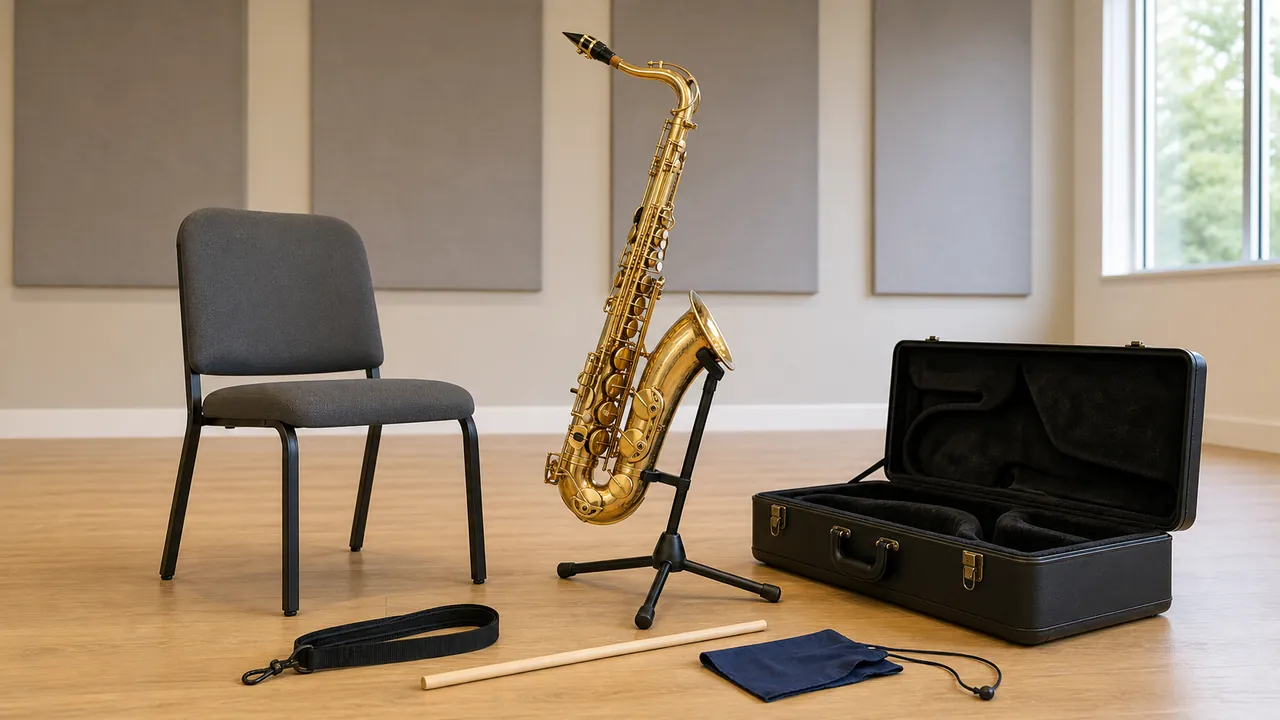
- Rehearse seated bell clearance and standing balance.
- Use one familiar mouthpiece/reed in every A/B.
- Reserve the return window for a leak test.
- Confirm exact regional model name and support.
Avoid: spending for a professional label before the player can identify a repeatable advantage.
The load path from mouthpiece to chair
Harness versus neck strap
Meaning: Two support systems that distribute instrument load differently.
Why it matters: Tenor weight and angle affect a full rehearsal, not just a shop minute.
Check: Try both seated and standing with the same sax.
Do not assume: Support cannot fix a leaking or badly adjusted horn.
Thumb hook
Meaning: The right-hand contact that helps stabilize the instrument.
Why it matters: Its position changes wrist angle and key reach.
Check: Set strap height before judging it.
Do not assume: The thumb should not carry the whole saxophone.
Bell clearance
Meaning: Space the bow and bell need beside a chair, desk and music stand.
Why it matters: Collisions can damage keys and interrupt seated playing.
Check: Rehearse entry, page turns and standing up.
Do not assume: A compact case does not prove playing clearance.
Neck receiver
Meaning: The joint where the tenor neck enters the body.
Why it matters: Fit and octave-key contact affect reliable assembly.
Check: Check smooth insertion and octave-key alignment.
Do not assume: Do not force or over-tighten the screw.
High F# key
Meaning: An auxiliary upper-register key.
Why it matters: It provides a fingering option, not general quality.
Check: Ask whether repertoire uses it.
Do not assume: More keys do not guarantee better pitch.
Post-to-body / ribbed
Meaning: Ways key posts attach directly or to plates on the body.
Why it matters: They change construction and repair context.
Check: Ask a repairer about regulation and parts, then play the horn.
Do not assume: Construction labels alone do not predict tone.
Pad resonator
Meaning: A disk mounted on many pads.
Why it matters: It is part of the pad/reflector assembly and repair specification.
Check: Confirm replacement compatibility during service.
Do not assume: Metal versus plastic is not a simple quality ranking.
Leak test
Meaning: A shop check that finds pads not sealing tone holes.
Why it matters: Leaks can make low notes resistant and pitch unstable.
Check: Book it within the return window.
Do not assume: Do not blame every response problem on embouchure.
Rehearse the chair, stand and doorway
- Set the chair and music stand as they will be used; sit without twisting.
- Adjust support so the mouthpiece comes to the player, then check right-thumb and wrist position.
- Turn pages and move low-key fingers without the bell striking chair or stand.
- Stand up while controlling the bow; walk through the narrowest doorway with the sax in its case.
- Weigh the complete case, not a catalog estimate, before agreeing to a school commute.
How the shortlist survived stock and service checks
Both market anchors had to show ordinary current orderability or a clearly matched regional generation. Maker pages controlled construction. Buyer lanes were fixed before products: first owned tenor, intermediate step-up, Yamaha professional reference and professional ergonomic alternative.
Value horn, intermediate bridge or professional A/B?
| Model | Lane | Retail evidence | What can disqualify it |
|---|---|---|---|
| BetterSax Classic Tenor Saxophone | Orderable first-tenor lane | Sweetwater in stock and first on its current popular list with 25 reviews; Thomann in stock with 18 reviews | A low purchase price does not remove setup, mouthpiece and resale questions. |
| Yamaha YTS-480 | Intermediate step-up | Sweetwater gold and silver variants in stock; Thomann current with 15 reviews | Its price sits close enough to some professional models that the trial must justify the gap. |
| Yamaha YTS-62III / YTS-62 02 | Established professional Yamaha reference | Sweetwater YTS-62III in stock with reviews; Thomann regional YTS-62 02 in stock with 33 reviews | Regional generation labels can confuse listings, and the familiar model name is not a substitute for checking the serial-numbered horn. |
| Yanagisawa T-WO1 | Professional alternative ergonomics | Sweetwater current with five-review signal; Thomann in stock with 15 reviews | Different ergonomics and a high price make remote-only selection risky. |
Buy the mechanism and support you can keep adjusted
BetterSax Classic Tenor Saxophone
This is the most visible current value candidate at both anchors. It belongs in the first-tenor trial when dealer setup and a complete mouthpiece comparison are available.
Useful advantage: Strong cross-market demand signal and ordinary stock.
Real drawback: A low purchase price does not remove setup, mouthpiece and resale questions.
Avoid if: local repair support is weak or the delivered setup cannot be checked.
Closest alternative: Yamaha YTS-480.
What we could verify: Sweetwater in stock and first on its current popular list with 25 reviews; Thomann in stock with 18 reviews. Exact balance, response and setup remain a player/shop check.
Yamaha YTS-480
The YTS-480 is the clean step-up comparison for a player who already knows the Yamaha layout and wants a professional-style neck receiver without paying for the 62 before an A/B test.
Useful advantage: Broad dealer support and current cross-market exact-model stock.
Real drawback: Its price sits close enough to some professional models that the trial must justify the gap.
Avoid if: you have not compared it directly with a YTS-62-family instrument using one mouthpiece.
Closest alternative: Yamaha YTS-62III / YTS-62 02.
What we could verify: Sweetwater gold and silver variants in stock; Thomann current with 15 reviews. Exact balance, response and setup remain a player/shop check.
Yamaha YTS-62III / YTS-62 02
The current 62 family is the professional Yamaha reference when the player can hear and feel a repeatable advantage over the 480. Regional naming must be matched carefully before payment.
Useful advantage: High current demand at Thomann and broad US/EU support.
Real drawback: Regional generation labels can confuse listings, and the familiar model name is not a substitute for checking the serial-numbered horn.
Avoid if: the seller cannot identify generation, finish and warranty in writing.
Closest alternative: Yanagisawa T-WO1.
What we could verify: Sweetwater YTS-62III in stock with reviews; Thomann regional YTS-62 02 in stock with 33 reviews. Exact balance, response and setup remain a player/shop check.
Yanagisawa T-WO1
The brass T-WO1 gives an experienced player a genuinely different professional keywork and response comparison. It should be tried beside the Yamaha 62, not ranked from materials alone.
Useful advantage: Exact current model stocked by both anchors with useful demand signals.
Real drawback: Different ergonomics and a high price make remote-only selection risky.
Avoid if: you cannot play the exact horn seated and standing or arrange an independent leak check.
Closest alternative: Yamaha YTS-62III / YTS-62 02.
What we could verify: Sweetwater current with five-review signal; Thomann in stock with 15 reviews. Exact balance, response and setup remain a player/shop check.
Physical facts and explicit gaps
Scroll sideways on a phone; brand base is kept separate from exact-model origin.
| Product | Size/weight | Materials | Manufacturing origin | Brand | Warranty/support |
|---|---|---|---|---|---|
| BetterSax Classic Tenor Saxophone | Exact instrument weight is not listed by the maker or anchors; Exact assembled dimensions are not listed. | Lacquered yellow-brass body, post-to-body construction, high F# key. | Not verified for this exact model. | BetterSax; US-based saxophone education/product brand; establishment date not verified. | Sweetwater two-year and Thomann three-year retailer coverage advertised; confirm regional exclusions. |
| Yamaha YTS-480 | Yamaha does not list exact instrument weight; Yamaha does not list exact assembled dimensions. | Yellow-brass body, bell, keys and 62-style annealed neck; high F#; waterproof leather pads. | Not verified for this exact current model. | Yamaha; Hamamatsu, Japan; founded 1887; musical instruments and professional audio. | Sweetwater advertises two-year retailer coverage; Yamaha requires authorized purchase and regional terms. |
| Yamaha YTS-62III / YTS-62 02 | Exact current instrument weight is not listed by Yamaha; Exact assembled dimensions are not listed. | Annealed brass body and 62-style neck, integrated key posts, high F#, leather pads with plastic resonators. | Not verified for this exact regional variant. | Yamaha; Hamamatsu, Japan; founded 1887; musical instruments and professional audio. | Sweetwater advertises two-year retailer coverage; confirm Yamaha regional terms and exact generation. |
| Yanagisawa T-WO1 | Exact item weight is not consistently listed across current sources; Exact assembled dimensions are not listed. | Lacquered brass body and keys, high F#, plastic pad resonators, engraved bell. | Japan, supported by current distributor/model material. | Yanagisawa; Tokyo, Japan; specialist saxophone maker whose first own saxophone dates to 1954. | Sweetwater advertises two-year retailer coverage; confirm distributor service route and exclusions. |
A shop A/B that keeps the mouthpiece constant
Warm up once, then use the same mouthpiece, ligature and reed on each horn. Play low B-flat to D softly, middle-register slurs, a tuner/drone passage and one familiar excerpt. Record response, key reach and pitch tendencies separately. Ask the shop to correct obvious leaks before comparing again. Decide from a repeatable pattern, not the loudest first note.
The complete tenor system is heavier than the horn
Include case, reeds, mouthpiece, strap or harness, swabs, stand, music and any school transport. Swab body and neck after playing, keep the neck tenon clean, and never force stuck parts. A teacher or repairer should inspect low-note seal and octave action during the return window.
Sources and generation checks
- Sweetwater tenor category
- Thomann BetterSax tenor
- BetterSax tenor product
- Yamaha YTS-480 specs
- Sweetwater YTS-480
- Thomann YTS-480
- Yamaha YTS-62III specs
- Sweetwater YTS-62III
- Thomann YTS-62 02
- Sweetwater T-WO1
- Thomann T-WO1
- Yamaha saxophone manual
Stock, regional names, finish, bundles and warranty terms can move. Save the exact listing and serial/model description before payment.
Found something that needs correcting? Contact the Consordini editorial team.