Soprano saxophone buying guide
Best Soprano Saxophone Choices for Geometry and Intonation Work
Decide whether you need curved-body handling, a neck-angle experiment, one-piece simplicity or a professional straight reference.
Researched · for established saxophonists adding or upgrading soprano
We checked current maker specifications, manuals, Sweetwater and Thomann stock, retailer demand signals and support terms. We did not play these instruments. Intonation, response, key reach, neck angle and pad seal still need checking on the exact saxophone with a familiar mouthpiece and reed.
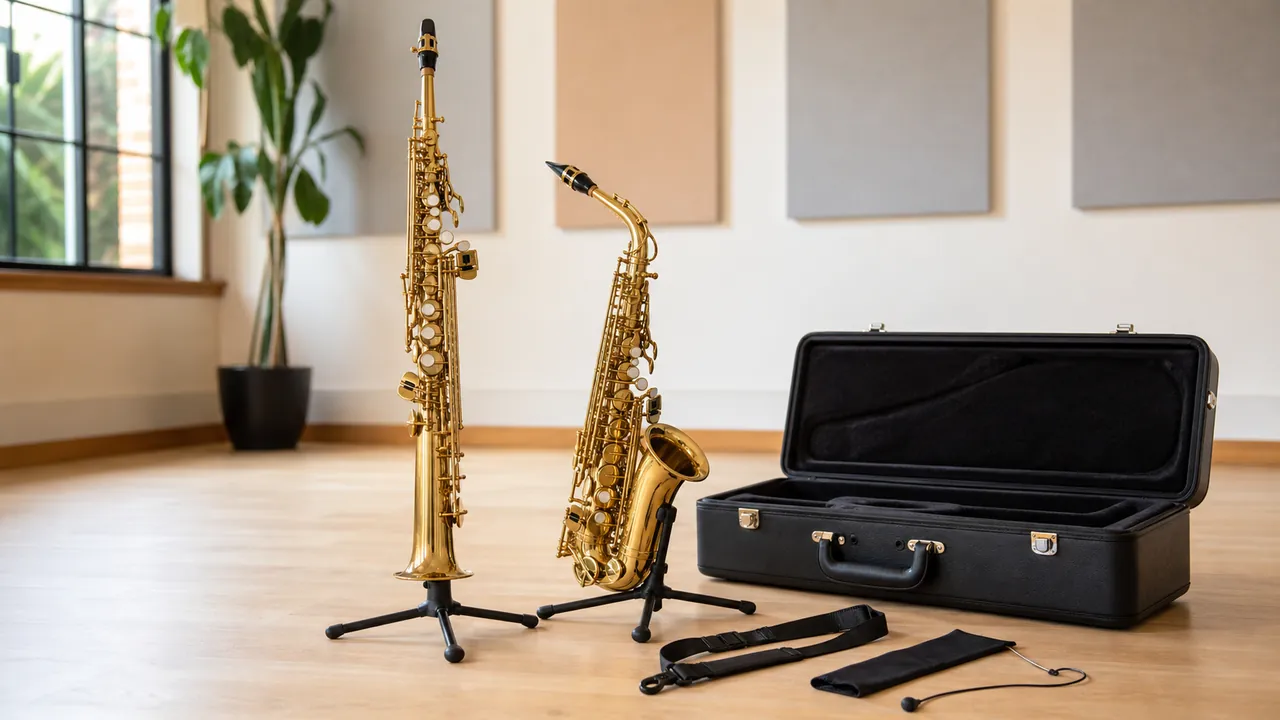
- Exact model suffix and stock status
- Body/neck configuration and complete case contents
- Return deadline long enough for a leak check
- Neutral wrist and readable tuner pattern across registers
Avoid: treating a smaller saxophone as a beginner saxophone. Soprano asks for controlled voicing and pitch work.
Read the tube, neck and tuner before the badge
Straight soprano
Meaning: A body shaped like a narrow straight tube.
Why it matters: It changes hold, bell direction and case shape.
Check: Try standing and seated with your normal strap/support.
Do not assume: Straight does not mean easier intonation.
Curved soprano
Meaning: A compact saxophone with a curved bow and upward bell.
Why it matters: Its alto-like position can change wrist and neck comfort.
Check: Compare key spacing and bell clearance, not appearance.
Do not assume: Curved does not automatically sound darker or play more easily.
One-piece body
Meaning: Body and neck form one fixed tube.
Why it matters: There is no neck choice or neck-tenon assembly step.
Check: Inspect the octave mechanism and case support.
Do not assume: Fewer parts do not guarantee better regulation.
Detachable neck
Meaning: A separate neck fits into the body tenon.
Why it matters: Straight/curved neck options can alter holding angle.
Check: Mark which neck was used in every A/B test.
Do not assume: A neck option is not free tonal improvement.
Concert pitch
Meaning: The pitch heard by the audience or tuner.
Why it matters: B-flat soprano reads a whole step above concert pitch.
Check: Use a transposing tuner setting or know the conversion.
Do not assume: A centered tuner needle alone does not prove good tone or voicing.
Voicing
Meaning: Tongue, oral-cavity and air adjustments that guide pitch and response.
Why it matters: Soprano exposes small changes strongly.
Check: Play long tones with a drone before blaming the instrument.
Do not assume: Do not fix every note by biting.
High F# key
Meaning: An auxiliary key for the written high-F-sharp range.
Why it matters: It changes fingering options, not the instrument's normal low range.
Check: Check whether your repertoire/teacher uses it.
Do not assume: More keys do not prove better intonation.
Setup and leak check
Meaning: Adjustment of pads, springs, key heights and octave mechanism.
Why it matters: A small leak can look like poor embouchure or unstable pitch.
Check: Book a technician check inside the return window.
Do not assume: New-in-box does not mean shipment-proof regulation.
A tuner map for a B-flat soprano trial
Set the tuner to B-flat transposition or translate written C to concert B-flat. With one mouthpiece and reed, hold written low B, middle B, second-register B and palm-key E for several seconds at soft and medium dynamics. Record direction and size of the pitch tendency, but reject false precision: room temperature, reed condition and the player change the result.
A stable pattern you can voice is more useful than one perfect needle hit. If one note is dramatically resistant or unstable, stop and ask for a leak and octave-mechanism check before changing embouchure.
Why current stock was only the first filter
Sweetwater and Thomann supplied the cross-market candidate pool and visible demand signals. Maker pages controlled construction. A product survived only if it was orderable now, served a distinct geometry/experience lane and left enough evidence to describe a downside. Backordered curved models and marketplace-only instruments were removed.
Curved hold, neck choice, fixed tube or pro reference?
| Model | Lane | Retail evidence | Unresolved decision |
|---|---|---|---|
| BetterSax Classic Curved Soprano Sax | Curved-body value lane | Sweetwater in stock/top listed with 10 reviews; Thomann in stock, rank 7, four reviews and 75% viewed-then-bought | The package may require a separate mouthpiece/strap check, and a curved body does not make soprano intonation automatic. |
| Jupiter JSS1000Q | Straight body with two neck options | Thomann exact model current with six reviews; Jupiter official current product page; verify Sweetwater exact stock before payment | US and European suffixes/bundles require careful matching, and the maker does not list exact weight. |
| Yamaha YSS-475II | Straight one-piece step-up | Sweetwater in stock, third on popular list with two reviews; Thomann current with 35 reviews | A fixed straight geometry gives fewer posture options, and the exact instrument still needs an intonation and key-height check. |
| Yanagisawa S-WO1 | Professional straight reference | Sweetwater in stock and fifth on popular list; Thomann current exact model | Its price makes blind buying especially costly, and specification tables cannot predict the preferred response. |
Choose the shape you can control through a whole set
BetterSax Classic Curved Soprano Sax
A genuinely curved geometry at ordinary current stock in both markets, with unusually visible retailer demand. It is the useful first comparison when an alto-like holding position matters more than owning a traditional straight soprano.
Useful advantage: Curved body brings the bell and hand position closer to an alto-like layout.
Real drawback: The package may require a separate mouthpiece/strap check, and a curved body does not make soprano intonation automatic.
Avoid if: you need a straight soprano for ensemble matching or cannot try the exact key spacing.
Closest alternative: Jupiter JSS1000Q.
What we could verify: Sweetwater in stock/top listed with 10 reviews; Thomann in stock, rank 7, four reviews and 75% viewed-then-bought. Subjective response remains a player test.
Jupiter JSS1000Q
Jupiter's current 1000-series listing gives the developing doubler a straight brass body and a curved-neck option to compare. Choose it only after the same mouthpiece and tuner routine shows that the neck choice improves posture without creating an intonation surprise.
Useful advantage: Two-neck concept creates a real geometry experiment before moving up in price.
Real drawback: US and European suffixes/bundles require careful matching, and the maker does not list exact weight.
Avoid if: the dealer cannot identify the exact Q configuration and included necks in writing.
Closest alternative: Yamaha YSS-475II.
What we could verify: Thomann exact model current with six reviews; Jupiter official current product page; verify Sweetwater exact stock before payment. Subjective response remains a player test.
Yamaha YSS-475II
The one-piece straight body removes the detachable-neck decision and gives a clear intermediate reference. Sweetwater ranks it among its most popular current sopranos, while Thomann supplies the stronger European review signal.
Useful advantage: One-piece layout is simple to assemble and has broad cross-market dealer support.
Real drawback: A fixed straight geometry gives fewer posture options, and the exact instrument still needs an intonation and key-height check.
Avoid if: the straight hold cannot be made comfortable with a suitable strap/support and neutral wrist.
Closest alternative: Jupiter JSS1000Q.
What we could verify: Sweetwater in stock, third on popular list with two reviews; Thomann current with 35 reviews. Subjective response remains a player test.
Yanagisawa S-WO1
The brass S-WO1 is the professional straight-body comparison when the player already has stable soprano control and can judge key feel, response and intonation tendencies. It should win an A/B trial, not a reputation contest.
Useful advantage: Current professional model stocked by both anchors with a visible Sweetwater popularity signal.
Real drawback: Its price makes blind buying especially costly, and specification tables cannot predict the preferred response.
Avoid if: you cannot compare the exact instrument with your mouthpiece and have a technician inspect it.
Closest alternative: Yamaha YSS-475II.
What we could verify: Sweetwater in stock and fifth on popular list; Thomann current exact model. Subjective response remains a player test.
Due-diligence facts behind the trial list
Scroll sideways on a phone. Missing exact measurements and factory statements remain explicit.
| Product | Size/weight | Materials | Manufacturing origin | Brand | Warranty/support |
|---|---|---|---|---|---|
| BetterSax Classic Curved Soprano Sax | Not listed by the maker or anchors for the exact instrument; Exact assembled dimensions are not listed. | Lacquered brass curved body; high F# and front F; blue-steel springs; Pisoni pads with metal resonators. | Not verified for this exact model. | BetterSax; US-based saxophone education/product brand; established date not verified. | Sweetwater advertises two-year retailer coverage; Thomann advertises three years; confirm regional exclusions. |
| Jupiter JSS1000Q | Not disclosed for the exact model; Exact assembled dimensions not disclosed. | Gold-lacquered brass body and mechanism; curved brass neck; Pisoni pads with plastic resonators; adjustable thumb rest. | Not verified for this exact model. | Jupiter; KHS musical-instrument brand based in Taiwan; established in 1980. | Regional written term varies; confirm the authorized dealer, exact coverage and transport responsibility. |
| Yamaha YSS-475II | Not listed on Yamaha's current specification page; Exact overall dimensions not listed. | One-piece yellow-brass straight body; high F#; polyester key touches; Yamaha 4C mouthpiece and case. | Not verified for this exact model. | Yamaha; Hamamatsu, Japan; founded 1887; musical instruments and professional audio. | Sweetwater advertises two-year retailer coverage; Yamaha requires authorized purchase and regional terms. |
| Yanagisawa S-WO1 | 1.5 kg item weight published by Thomann; exact overall dimensions are not listed. | Lacquered brass straight soprano; high F#; included mouthpiece and case. | Japan, supported by current Yanagisawa distributor/model material. | Yanagisawa; Tokyo, Japan; saxophone maker whose first own saxophone dates to 1954. | Sweetwater advertises two-year retailer coverage; confirm distributor/manufacturer term and service route. |
Open the case before the return clock runs
- Photograph the saxophone, neck or necks, mouthpiece, cap, ligature, strap and case supports.
- Confirm the model engraving and invoice describe the same exact configuration.
- Assemble without forcing the neck tenon; inspect octave-key contact.
- Run the tuner map, then have a technician check leaks and key heights.
- Try seated and standing; check right-thumb, wrist and bell clearance.
- Put every part back in its shaped recess and decide before the written deadline.
What soprano ownership adds to an alto or tenor case
Plan for soprano reeds, a correctly sized mouthpiece/ligature, a body swab that will not lodge in the narrow bore, cork grease for detachable necks, a stable stand and a case layout that protects octave mechanisms. Swab after playing and dry detachable parts before storage. Do not pull a stuck swab harder; take it to a repairer.
Source trail and refresh points
- Sweetwater soprano category
- Thomann BetterSax curved
- Sweetwater BetterSax curved
- Jupiter JSS1000Q
- Jupiter catalog
- Thomann JSS1000Q
- Yamaha YSS-475II specs
- Sweetwater YSS-475II
- Thomann YSS-475II
- Sweetwater S-WO1
- Thomann S-WO1
- Yamaha saxophone manual
Stock, bundles, warranty and return terms can change. Reopen the exact regional page and save the seller's configuration in writing.
Found something that needs correcting? Contact the Consordini editorial team.