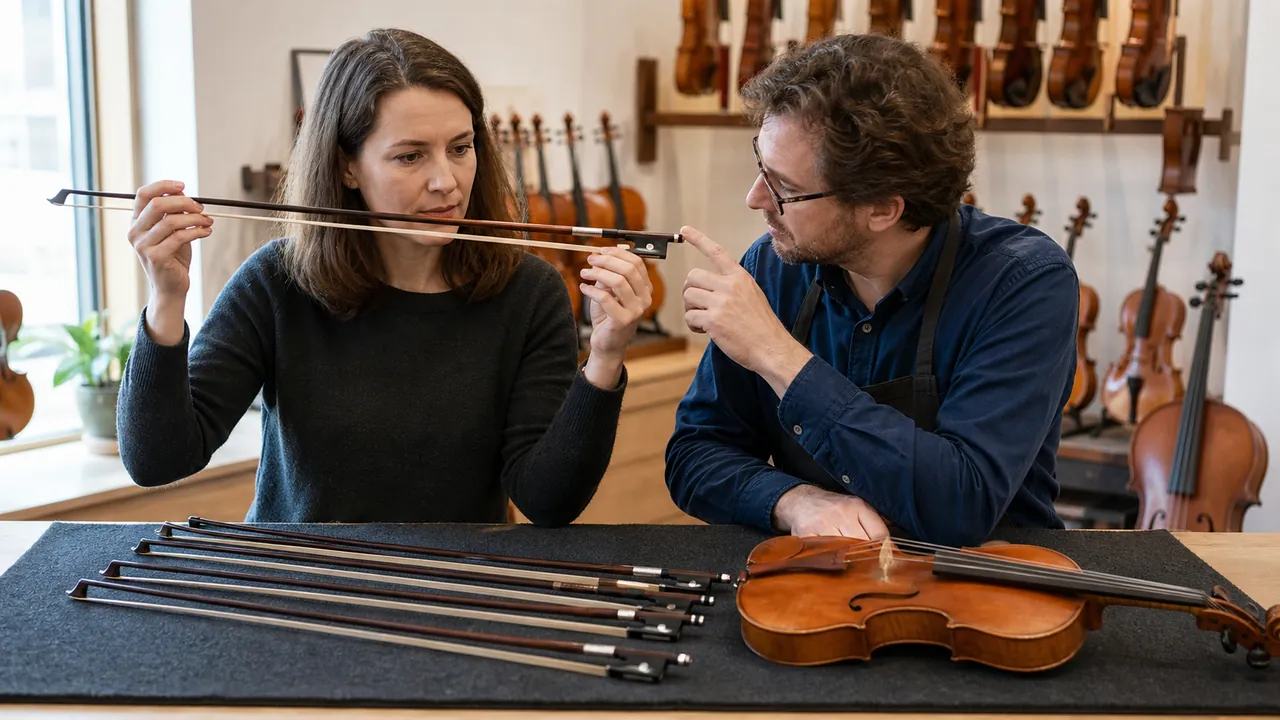
Best carbon-fiber violin bows for a careful shop trial
Choose the bow that fits the player, violin and service plan, then let a teacher-led comparison decide which individual stick earns the case slot.
We checked current maker specifications, warranty terms and specialist-retailer listings. We did not play these bows. Sound, balance, tracking, off-string response and the condition of the delivered bow still need a real trial on the player's violin.
For: full-size violinists, parents buying with a teacher, and programs replacing a weak outfit bow. Fractional players should stop and match the bow to the instrument size first.
Avoid buying blind: carbon fiber does not make two models interchangeable, and it does not prove good sound on a particular violin. Verify before paying: exact 4/4 identity, straight stick at normal hair tension, return/trial rules, and who will rehair or service it locally.
Bow language that changes the trial
These terms are not quality scores. They tell you what to compare and what to ask the teacher or bow technician.
4/4 bow
The full-size violin-bow format.
A full-size bow can be the wrong length and balance for a fractional violinist.
Match the printed or measured violin size and ask the teacher before changing bow size.
“Beginner” does not mean one size fits every student.
Stick
The long structural shaft between tip and adjuster.
Its straightness, camber and stiffness affect how the bow tracks and springs.
Sight along the relaxed and normally tensioned bow; ask a technician about a persistent sideways curve.
Carbon construction reduces some wood variability but does not remove the need to inspect an individual bow.
Camber
The intentional inward curve of the stick toward the hair.
It helps the bow retain useful spring at playing tension.
Let a bow specialist judge it; do not heat or bend a composite stick at home.
A visible curve is not automatically damage, while a sideways warp is a different problem.
Balance point
Where the bow balances along its length.
Two bows with similar total weight can feel different because their mass is distributed differently.
Compare slow whole bows and controlled starts before off-string strokes.
A single balance measurement cannot predict comfort or sound.
Frog
The sliding part held by the bow hand; it carries one end of the hair.
Fit, edges, screw action and material affect handling and service.
Check that it travels smoothly and has no visible gap, wobble or sharp edge.
Ebony-looking material is not necessarily ebony; CodaBow identifies its composite as Xebony.
Hair tension
The distance and spring created when the adjuster tightens the hair.
Too little tension can bottom the stick; too much can stress the bow and distort the comparison.
Ask the teacher to set normal playing tension, then loosen the bow after playing.
A larger stick-to-hair gap is not a mark of a better bow.
Rehair
Replacing worn, stretched or contaminated bow hair.
Hair is a consumable and commonly excluded from bow warranties.
Before buying, confirm that a local shop will rehair the exact frog and tip construction.
Replacing a whole inexpensive bow is not automatically cheaper or less wasteful than service.
Round stick
A shaft with a rounded rather than visibly octagonal cross-section.
It identifies construction, not a guaranteed handling or tone result.
Record it for exact-model identification, then judge the actual bow through the same trial.
Round and octagonal labels do not rank bows by quality.
Current shortlist by buying job
Use this as a route into a trial, not a finish line. Retailer review counts are recorded only as observable stocking/popularity signals; they are not proof that a bow will suit your violin.
| Exact model | Buyer lane | Verified construction | Current market signal | Main caution |
|---|---|---|---|---|
| Artino BF-11 Carbon Violinbow 4/4 | Low-cost full-size replacement | Round carbon stick, ebony frog, nickel fittings, natural hair | Thomann showed immediate stock and 34 customer ratings | No maker-disclosed item weight or exact-model origin found |
| JonPaul Matrix Carbon Fiber Violin Bow | Specialist-supported woven-carbon step | Burgundy woven carbon fiber and Mongolian horsehair | Fiddlershop showed in stock; specialist retailers stock the Matrix line | Exact violin-bow weight is not disclosed on the maker page |
| CodaBow Prodigy Violin 4/4 | Developing student with teacher input | Blended core, carbon weave, Xebony frog, horsehair; firm/stiff maker brief | Orderable at Johnson String and listed by Thomann; CodaBow direct line remains current | Do not buy the maker's handling words without comparing it on the player's violin |
| CodaBow Diamond NX Violin 4/4 | Advancing player arranging several trials | Blended core, 3-D diamond weave, Xebony frog, composite high-wear parts | Direct add-to-cart, 21 maker-site reviews; stocked by Sweetwater and Thomann | Higher spend should widen the trial set, including good wood bows |
Where each bow earns a place on the stand
For a low-cost 4/4 replacement with strong retailer evidence
Artino BF-11 Carbon Violinbow 4/4
Thomann identifies the exact 4/4 model, construction and immediate orderability, while 34 customer ratings provide a concrete popularity signal. It is the sensible first trial when the current outfit bow is visibly poor and the buyer needs a modestly priced, serviceable carbon stick.
Avoid if: there is no local rehairer willing to service it, or the player cannot compare it against the current bow.
Alternative: move to the JonPaul Matrix when a string specialist and a longer written stick warranty matter more than the lowest entry cost.
What supports this: current major-retailer listing and dealer terms; construction is dealer-sourced, with gaps stated.
For a buyer who wants string-shop support around the mid-entry lane
JonPaul Matrix Carbon Fiber Violin Bow
JonPaul confirms the Matrix as a current woven-carbon model, and Fiddlershop shows the exact violin bow in stock with a written limited-lifetime warranty summary. This lane suits a buyer who values specialist trial advice and a clear service route.
Avoid if: a burgundy visible weave is unwanted, or the seller cannot confirm the exact return and trial conditions for your region.
Alternative: choose the CodaBow Prodigy lane when teacher-oriented handling specifications and a model-specific five-year term are more useful.
What supports this: maker construction/about pages plus a current category-specialist listing; numeric weight remains unresolved.
For a developing full-size player whose teacher wants a firm reference point
CodaBow Prodigy Violin 4/4
CodaBow describes a center-tip balance, medium-light weight category, firm action and stiff shaft for the Prodigy; Johnson String confirms the exact 4/4 violin variant in stock. Those labels form a useful trial hypothesis, not a verdict.
Avoid if: the player still uses a fractional violin, or the teacher wants a softer or more frog-centered response after comparing bows.
Alternative: test the Diamond NX when the player can demonstrate a specific control problem that a firmer, higher-tier trial set may solve.
What supports this: maker product and warranty documents, exact specialist stock and Thomann cross-market listing.
For an advancing player who can compare several bows over the same passages
CodaBow Diamond NX Violin 4/4
The NX is current across CodaBow, Sweetwater and Thomann, and CodaBow publishes its stronger/firmer design brief and blended-core construction. It belongs in a serious trial set because its identity and support are unusually traceable, not because specifications predict its sound.
Avoid if: the buyer cannot secure a return or trial period, or is using price as a shortcut for fit.
Alternative: keep the Prodigy or JonPaul Matrix in the comparison if either produces cleaner starts and easier dynamic control on the actual violin.
What supports this: current maker page, maker warranty, product-family popularity signal, and major US/EU retailer listings.
The same-violin four-pass trial
Use the same violin, strings, room and short musical excerpts. Have the teacher shuffle the bows when possible; write observations before discussing brand or price.
Play slow bows at soft and medium dynamics. Record whether starts remain clean without extra index-finger pressure.
Use a familiar eight-bar passage. Note accidental neighboring-string contact and whether the correction is repeatable.
Only if the player already studies spiccato, compare one comfortable tempo. Do not force a new technique to audition a bow.
Re-play the first passage. Ask which problem changed and whether the change matters enough to pay for.
Static decision rule: reject any bow with a mechanical concern, then keep at most two that improve a named playing task. A teacher or bow technician should inspect the finalist before the return window closes.
Carbon solves some ownership problems, not the pairing problem
A composite stick can make material and construction more consistent and can avoid some regulated-species concerns when the maker documents the whole bow. It still has hair, a frog, a screw and fitted parts that wear or need service. It can also be damaged.
More importantly, the bow and violin operate as a pair. A model that feels stable in one hand may feel resistant in another; a bow that helps one violin speak can expose a harsh edge on another. Those are audition questions. No retailer specification, star rating or material label settles them.
Make a passport before the return clock runs out
On delivery day, record the exact model and size, seller, serial or identifying marks, return deadline, warranty registration deadline, and the name of the local rehairer who confirmed service. Add the teacher's two comparison passages and one sentence about the problem the new bow is meant to solve.
This prevents a common mistake: keeping a bow because it looks like an upgrade while forgetting the original playing problem and the dates that protect the purchase. Photographs can document condition for the seller, but they are not a structural diagnosis.
Construction, origin and written support
These facts help with due diligence. They do not rank sound or handling. “Not verified” means the checked maker or dealer pages did not support the exact claim.
| Product | Size / weight | Construction | Manufacturing origin | Brand | Warranty |
|---|---|---|---|---|---|
| Artino BF-11 Carbon Violinbow 4/4 | 4/4; item weight not disclosed on the checked listing | Round carbon stick, ebony frog, nickel fittings, natural hair | Not verified for this exact model; retailer location is not manufacturing evidence | Artino; brand base and establishment date were not verified in a suitable primary source | Thomann advertises its three-year dealer guarantee and 30-day return policy; request regional terms |
| JonPaul Matrix Carbon Fiber Violin Bow | Violin format; exact length and item weight not disclosed on checked maker/dealer pages | Burgundy woven carbon-fiber stick; Mongolian horsehair | JonPaul says each carbon-composite bow is handcrafted in the USA; confirm label on the exact bow | JonPaul, Salt Lake City; establishment year not disclosed on checked about page; known for wood and carbon bows | Limited lifetime for stick and mechanics under normal playing; hair and normal wear excluded, per Fiddlershop summary |
| CodaBow Prodigy Violin 4/4 | 4/4; maker classifies violin version as medium-light, but exact grams were not verified | Blended acoustic core, carbon weave, Xebony composite frog, Mongolian horsehair | Not explicitly verified for this exact model on the checked product page; inspect label | CodaBow, Winona, Minnesota; founded 1991; carbon-composite orchestral bows | Five-year shaft and one-year frog; original owner, authorized new purchase and registration within 90 days required |
| CodaBow Diamond NX Violin 4/4 | 4/4; current buying guide specifies about 61 g, with ±1 g manufacturing tolerance | Blended acoustic core, 3-D diamond weave, Xebony frog, composite high-wear parts | CodaBow and retailers identify current Diamond bows as made in USA; verify exact bow label | CodaBow, Winona, Minnesota; founded 1991; carbon-composite orchestral bows | Ten-year shaft and one-year frog; original owner, authorized new purchase and registration within 90 days required |
How the trial set was assembled
We began with Thomann's European violin-bow listings and Sweetwater's US CodaBow inventory, then checked current maker pages and specialist string retailers. Inclusion required an exact current identity, a distinct buyer lane, current orderability, an observable stocking or popularity signal, and enough construction and support evidence to explain a drawback. Retailer ratings helped establish market presence only.
We excluded anonymous marketplace bows, unavailable models, and high-end options whose extra cost could not be explained without hands-on judgment. The shortlist deliberately stops before presenting a universal winner: at this point the player's violin, teacher and trial room carry more decision weight than another specification.
Checks to complete before checkout
- Confirm violin and bow size; do not put a 4/4 recommendation into a fractional case by assumption.
- Get the return deadline and any trial fee in writing.
- Ask whether warranty registration is required and whether the retailer is authorized.
- Confirm that a local bow technician will rehair and service the exact construction.
- On arrival, inspect stick, tip, frog, screw and hair before applying rosin.
- Use familiar passages and compare at matched hair tension.
Sources used for product identity and support
- Thomann: Artino BF-11 4/4
- Thomann: Artino Bois Carbon 4/4
- JonPaul: Matrix model
- JonPaul: company and construction
- Fiddlershop: Matrix stock and warranty
- CodaBow: Prodigy Violin
- Johnson String: Prodigy 4/4 stock
- Thomann: Prodigy 4/4
- CodaBow: Diamond NX Violin
- Thomann: Diamond NX 4/4
- Sweetwater: current CodaBow violin bows
- CodaBow: warranty terms
- CodaBow: 2026 buying guide
- CodaBow: company history
- CodaBow: Diamond NX collection signal
Retail availability and warranty terms can change. Reopen the seller and maker pages before ordering. Found a factual problem? Contact Consordini.