Beginner drum machine buying guide
Best Cheap Beginner Drum Machine Guide
Buy the shortest workflow that can finish your music, not the box with the longest feature list.
We checked current stock, manuals, specifications, retailer signals, and connection requirements on . We did not play, hear, record, time, or compare these machines in person. Treat sound preference, pad feel, noise, clock behavior, and reliability as audition questions.
Battery one-bar sketchpad: Korg volca beats
Pattern chains and separate outs: Behringer RD-6-SR
Long patterns and playable pads: Arturia DrumBrute Impact
Avoid: ordering before you can draw the complete power, audio, and clock path. Verify: every cable and adapter in the checkout basket.
Draw the signal path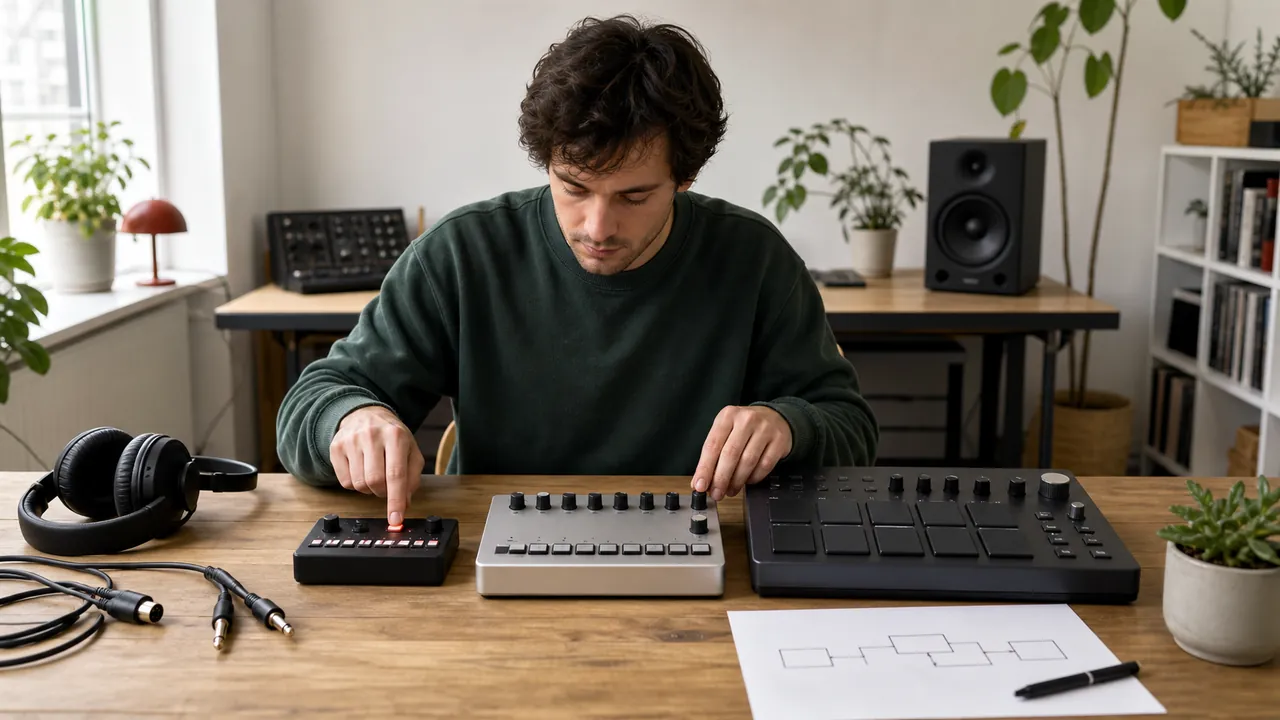
Before choosing
Draw what happens after you press play
Power
Write battery type or exact adapter, whether it is included, and the outlet you will use. USB data does not always mean USB power.
Audio
Draw the output jack, cable, and destination: headphones, powered speaker, mixer, audio interface, or amp. Passive speakers cannot accept a line output by themselves.
Clock and notes
Name one timing leader. Mark MIDI, USB MIDI, or analog sync separately; identical plug sizes do not guarantee identical clock formats.
A complete line looks like “RD-6 mix out, quarter-inch TS cable, powered monitor input.” “Connect it to my laptop” is incomplete until you know whether you need MIDI only or recorded audio through an interface.
Plain language
Beat language that changes the first purchase
Voice
One drum sound channel, such as kick or closed hat.
Voice count and edit controls define the available kit.
List the sounds you need before counting voices.
Ten voices do not mean ten simultaneous audio outputs.
Step
A timed slot where a drum trigger can occur.
Sixteen steps commonly represent one bar of sixteenth notes.
Program the same kick/snare/hat beat on a demo.
More steps do not create a longer song unless patterns chain.
Pattern
A saved loop containing steps for several voices.
Pattern length sets how long the loop runs before repeating.
Count how many distinct sections your music needs.
Pattern memory is not automatically song mode.
Song mode
A way to arrange saved patterns into a longer order.
It lets the machine play changes without both hands.
Ask whether the arrangement saves and recalls.
Manual pattern switching is not unattended song playback.
Accent
A programmed stronger hit or altered emphasis.
It makes repeated steps less mechanically identical.
Check whether accent is global, per voice, or per step.
Accent is not the same as velocity-sensitive pads.
Swing
A timing offset that delays selected subdivisions.
It changes groove without changing the basic hit order.
Audition the usable range at your normal tempo.
Not every affordable machine provides a swing control.
Clock
The pulse or message that keeps devices at one tempo.
One leader and compatible followers prevent drifting starts.
Choose internal, MIDI, USB, or analog clock before buying cables.
A 3.5 mm jack may carry audio, sync, clock, or trigger; labels matter.
Three current workflows
Choose by pattern horizon
| Machine | Pattern horizon | Audio path | Current signal |
|---|---|---|---|
| Korg volca beats | 8 patterns x 16 steps; no chain | One 3.5 mm headphones/audio out | Both anchors; 256/33 ratings/reviews |
| Behringer RD-6-SR | 32 patterns; chains to 250 bars | Mix plus six voice outs | Exact silver in stock; 4 recent reviews |
| Arturia DrumBrute Impact | 64 patterns x up to 64 steps; song mode | Master plus four group outs | Both anchors; rank 10, 144/27 reviews |
Korg volca beats
Volca beats is the smallest first step because it is battery-capable, has a speaker, ten parts, direct 16-step keys, and unusually deep current review evidence at both anchor stores.
Advantage: 372 g, six analog drum voices plus four PCM voices, MIDI in, analog sync, stutter, Active Step, Step Jump, and eight pattern memories.
Drawback: patterns are only 16 steps and do not chain into a song. Audio shares one 3.5 mm output, there is no USB, and Thomann says batteries and adapter are not included.
Avoid if: you need automatic verse/chorus changes, separate tracks, or direct USB MIDI.
Alternative: RD-6-SR for song chains and voice outs; DrumBrute Impact for pads and longer patterns.
Verify before ordering: add six AA batteries or the correct KA-350 supply, plus the exact cable from 3.5 mm output to your listening device.
Found a changed specification or source? Report a correction.
Behringer RD-6-SR
The silver RD-6 is the affordable bridge between a one-bar box and a studio setup: it keeps direct 16-step programming, chains patterns up to 250 bars, and exposes mix, voice, MIDI, sync, and trigger connections.
Advantage: eight analog voices, 32 patterns, six individual voice outputs, DIN MIDI in/out/thru, USB MIDI, sync, trigger, headphones, and an included 9 V adapter in retailer listings.
Drawback: no battery operation or playing pads, only 16 steps per base pattern, and fewer groove/variation controls than DrumBrute Impact. Exact EU color stock was not confirmed.
Avoid if: you want velocity playing, 64-step patterns, per-track swing/randomness, or broad clock-format selection.
Alternative: volca beats for true portable sketching; DrumBrute Impact for a more expansive sequencer.
Verify before ordering: confirm the exact silver SKU, regional adapter, and whether you need one mix cable or several 3.5 mm voice-out cables.
Arturia DrumBrute Impact
DrumBrute Impact is the most complete beginner sequencer here: exact two-anchor stock, rank/review depth, eight pads, 64-step patterns, song mode, swing, randomness, polyrhythm, and multiple clock formats.
Advantage: ten analog sounds, 64 pattern slots, Color variations, distortion, roller, metronome, USB/DIN MIDI, clock in/out, and group outputs for kick, snares, hats, and FM.
Drawback: it is the largest and heaviest option at 1.84 kg, needs mains power, and its analog palette is fixed rather than sample-based.
Avoid if: pocket carry or battery operation matters more than arrangement depth.
Alternative: volca beats for compact battery use; RD-6-SR for cheaper pattern chaining and more individual voice outs.
Verify before ordering: audition the fixed drum palette and confirm whether master output or four group outputs match your interface inputs.
Reader tool
Make the same 16-step beat before comparing extras
The ten-minute sequence
- Set a comfortable tempo and clear one pattern.
- Place kick on steps 1 and 9; snare on 5 and 13; closed hat on every odd step.
- Mute one voice, add one accent, then save and recall the pattern.
- Create a second pattern with one changed kick. Move between patterns without stopping.
- Try to arrange both patterns to play automatically. Record exactly where the machine requires manual switching.
This compares navigation and pattern horizon. It does not establish sound quality, timing accuracy, or pad feel.
Connection check
Use a cable passport, not a shopping-list guess
Solo box
Write the power source, headphone connector, and volume control. If using speakers, name the powered input and cable. Include adapters only where the manufacturer permits them.
Growing setup
Choose one clock leader. Draw MIDI and analog sync as separate lines. Then draw audio separately into a mixer or interface; USB MIDI alone does not record the analog mix.
At checkout, every line gets two labeled ends. “3.5 mm to quarter-inch” is not enough: note mono TS, stereo TRS, input purpose, and whether a split cable is required.
Due diligence
Drum-machine size, controls, company and warranty
| Product | Size / weight | Construction | Manufacturing origin | Brand | Warranty / support |
|---|---|---|---|---|---|
| Korg volca beats | 193 x 115 x 45 mm; 372 g excluding batteries. | Desktop enclosure; six analog-synthesis voices plus four PCM voices; 16 step keys. | Not verified for this exact model. | Korg, Tokyo; known for electronic instruments and the compact volca range. Establishment date not verified here. | Manufacturer term not verified; Sweetwater and Thomann display separate retailer coverage. |
| Behringer RD-6-SR | 305 x 165 x 56 mm; 0.9 kg (distributor/manual fallback). | Desktop enclosure; eight analog voices; 16 step buttons; plastic construction not specified in exact official source. | Not verified for this exact model. | Behringer; dealer lists 1989 founding and Penang company headquarters; known for affordable audio and synth hardware. | Japanese distributor states three years regionally; Sweetwater displays separate two-year retailer coverage. Confirm local terms. |
| Arturia DrumBrute Impact | 342 x 243 x 57 mm; 1.84 kg. | Desktop hardware with ten analog voices, eight pads, 16 step buttons, and external power supply. | Not verified for this exact model. | Arturia, Grenoble, France; known for hardware/software instruments, sequencers, and controllers. Establishment date not verified here. | Manufacturer term not verified; exact listings display Sweetwater two-year and Thomann three-year retailer coverage. |
Checkout script
Questions that reveal the missing purchase
- Is this exact color and SKU physically in stock?
- How many steps, patterns, and saved songs are available?
- Can patterns chain without manual switching?
- Which voices are analog, PCM, or digitally modeled?
- Is the power supply included for my region?
- Can headphones plug in directly, and at what size?
- What cable reaches my powered speaker or interface?
- Does USB carry MIDI, audio, power, or a subset?
- Which device will lead clock, and which format follows?
- Which warranty covers controls, adapter, and transport?
Trace the evidence
Sources checked for this guide
- Korg volca beats overview
- Korg volca beats specifications
- Thomann volca beats
- Sweetwater volca beats
- Sweetwater volca beats reviews
- Sweetwater RD-6-SR
- Electori RD-6 specifications
- RD-6 manual fallback
- Thomann Behringer context
- Arturia DrumBrute Impact
- Thomann DrumBrute Impact
- Sweetwater DrumBrute Impact
- DrumBrute Impact manual
- Sweetwater T-8 availability conflict
- Thomann volca drum exclusion
Availability and review/rank signals can change. Product descriptions and manuals are source evidence, not independent performance results.