Hardware rhythm guide
Best Drum Machines for Live Beats, Sampling and Songwriting
Choose the sound source first, then make sure the sequencer, outputs and power plan fit the rig you already own.
Researched
We checked current manufacturer pages, manuals, firmware support and orderability at specialist US and European stores. We did not play, record or reliability-test these machines. Sound character, pad feel, menu speed and stage visibility still require a personal audition.
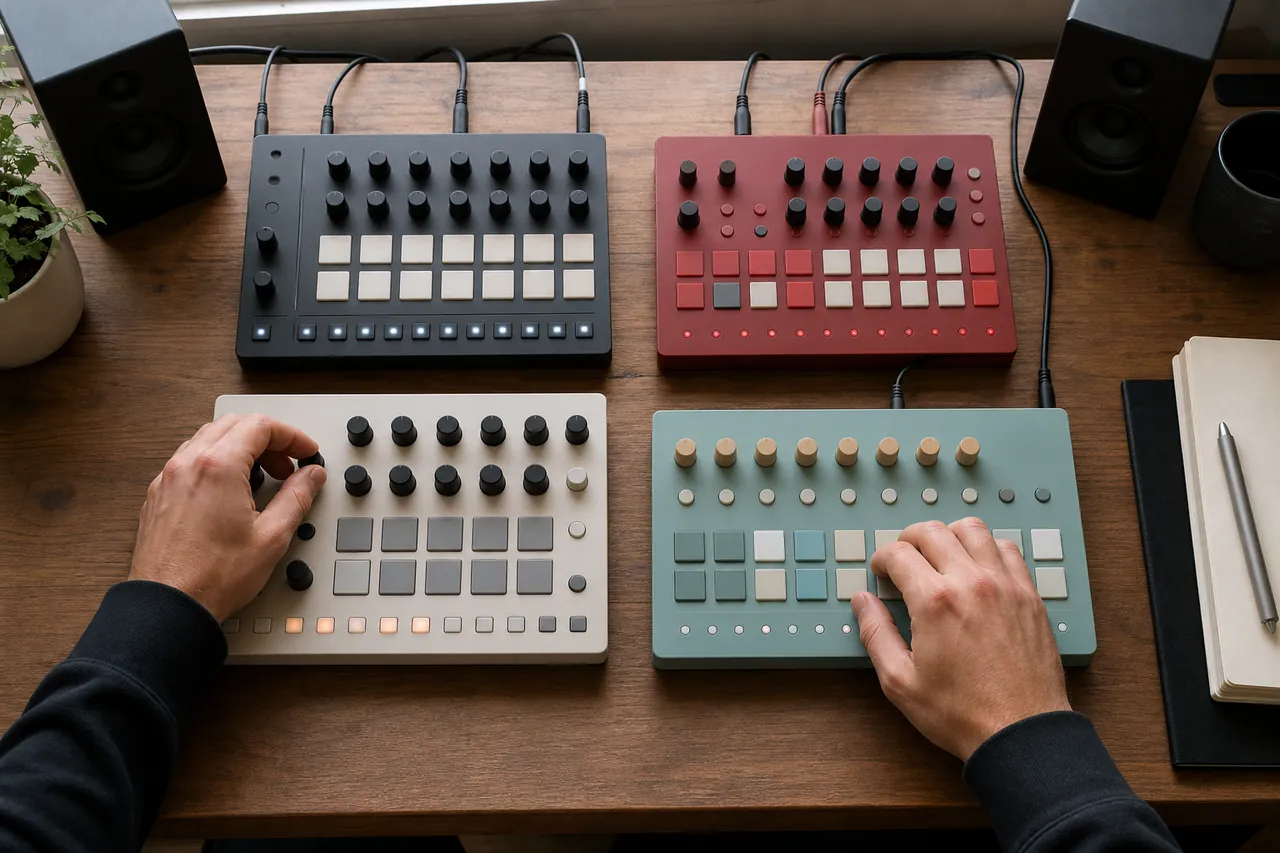
Bottom line. Roland TR-8S is the most direct performance hub here; Elektron Digitakt II is the stereo-sampling workstation; Arturia DrumBrute Impact is the focused analog instrument; Roland TR-6S is the compact, battery-capable option.
- Live mixing and separate outputs: TR-8S
- Recording and reshaping your own samples: Digitakt II
- Immediate analog patterns: DrumBrute Impact
- Small bag or battery sessions: TR-6S
Avoid: buying by famous drum sound alone when your actual bottleneck is sampling, song arrangement, output count or portable power.
Verify before paying: rehearse every cable and audio channel on paper. Build the rig rehearsal.
Read the front panel without swallowing the brochure
These terms decide what the box can actually do between the first pattern and a finished performance.
Drum synthesis
Electronic circuits or digital models generate a drum voice instead of replaying a recording.
Controls can reshape pitch, decay and timbre, but each engine has a defined range.
Listen while moving every voice control through its useful range.
“Analog” does not automatically mean more realistic, warmer or better.
Sample playback
The machine triggers stored audio recordings.
It broadens the palette, but file format, memory, transfer method and editing depth vary.
Import one of your own stereo and mono files before the return period closes.
Sample import is not the same as recording directly into the machine.
Step sequencer
A grid places events at numbered positions in a repeating pattern.
Maximum steps, per-track lengths and variation handling affect phrases longer than one bar.
Program a verse, fill and transition rather than only a four-on-the-floor loop.
More steps do not guarantee easier song arrangement.
Parameter lock or motion
A setting changes on selected steps while the pattern plays.
One sound can become several rhythmic variations without extra tracks.
Check which parameters can be recorded and whether values are easy to clear.
Real-time knob recording and per-step locks are related, not identical workflows.
Individual output
A drum or group leaves through its own audio jack instead of only the stereo mix.
It lets a mixer, interface or effect process that part separately.
Count physical inputs and cables before valuing extra outputs.
An output is useful only when the rest of the rig can receive it.
MIDI track
A sequencer lane sends note and control messages to another instrument.
It can make the drum machine a clock and pattern hub for a larger setup.
Confirm connector type, channel assignment and whether the track reduces internal audio capacity.
MIDI carries performance data, not the instrument's sound.
USB audio
The machine can send audio digitally through USB to a compatible computer and driver.
It may reduce analog cabling and expose several channels to a DAW.
Check current driver support for the exact operating system and DAW.
A USB socket may carry only MIDI, storage or power.
Sync or clock
A shared timing signal keeps devices moving at the same tempo.
Connector format, clock direction and start/stop behavior determine whether a mixed rig behaves predictably.
Test who is master, who follows and what happens after stopping mid-pattern.
Matching BPM displays does not prove stable synchronization.
Why the shortlist is deliberately narrow
We separated four buyer lanes before choosing products: performance mixing, stereo sample production, immediate analog sequencing and truly compact operation. A machine stayed only when its exact model was supported by a current official page, was orderable in the checked market, and had a visible specialist-store signal such as cross-store stocking or meaningful purchaser-review volume. Sweetwater and Thomann formed the US/EU retailer map; manufacturer pages and manuals supplied the product facts. Grooveboxes were considered only when percussion remained a central, explicitly supported job.
Match the machine to the unfinished part of your music
| Model | Sound source | Pattern scope | Audio path | Best starting lane |
|---|---|---|---|---|
| Roland TR-8S | Modeled TR/CR voices, FM tones, factory and user samples | 128 patterns; eight variations; fills | Stereo mix, six assignable outs plus trigger, stereo input, multichannel USB audio | Hands-on live arrangement and external mixing |
| Elektron Digitakt II | Stereo sampling and sample playback | 16 flexible audio/MIDI tracks; 128-step sequencer | Stereo input/output, headphones, USB audio/MIDI | Deep sampled drums and sequence-controlled hardware |
| Arturia DrumBrute Impact | Ten fixed analog voices with Color variations | 64 patterns up to 64 steps; song chaining and polyrhythm | Stereo mix plus grouped kick, snare, hats and FM outputs | Fast analog pattern building with limited menu work |
| Roland TR-6S | Modeled TR/CR voices, FM tones, factory and user samples | Six parts; 128 patterns; eight variations | Stereo output, headphones, MIDI and USB audio/MIDI | Portable TR workflow when six parts and a stereo mix are enough |
Choose the workflow you will still enjoy after pattern one
For live mixing and a multi-output studio
Roland TR-8S
The TR-8S makes sense when performance controls and routing matter as much as the sound library. Eleven instrument parts, eight variations per pattern, assignable outputs, external audio input and multichannel USB audio give it a credible center-of-rig role. User samples extend the included modeled and FM voices without turning the instrument into a full recording sampler.
Advantage: the richest physical output plan in this shortlist, with faders and pattern variations aimed at live movement.
Drawback: its two-line display and deeper settings still create menu work, and it cannot record samples directly.
Avoid if: stereo sampling, detailed waveform editing or a small battery-powered box is the primary need.
Closest alternative here: TR-6S for related sound engines in a smaller six-part format.
Check in person: fader feel, menu navigation, sample-transfer routine and whether your mixer or interface can use the extra outputs.
For stereo sampling and sequence depth
Elektron Digitakt II
Digitakt II is the strongest fit when drums begin with your own recordings and grow through detailed sequencing. Its current manual documents 16 tracks that can be audio or MIDI, stereo sampling, multiple playback machines, parameter locks and patterns up to 128 steps. That scope also makes it the least instant choice for someone who only wants fixed classic drum voices.
Advantage: direct stereo sampling and unusually deep per-step control in a compact steel chassis.
Drawback: no individual analog drum outputs, and the Elektron workflow asks for deliberate study.
Avoid if: you need one-knob-per-voice analog controls or separate physical outputs for several drums.
Closest alternative here: TR-8S when live channel faders and output routing outrank sampling depth.
Check in person: sample capture, track-mode changes, pattern transitions and the exact Overbridge/OS support for your computer.
For immediate analog sequencing
Arturia DrumBrute Impact
DrumBrute Impact earns its place by doing less, visibly. Ten analog voices, per-instrument Color changes, a 64-step sequencer, song chains and several sync formats create a self-contained pattern instrument. The constraint is the point: there is no sample library to curate, but the fixed voice palette must suit the buyer before purchase.
Advantage: direct controls, analog voices, polyrhythmic track lengths and useful grouped outputs at the lowest complexity here.
Drawback: the sound set is fixed and narrower; parameter automation is limited compared with Digitakt II.
Avoid if: realistic acoustic kits, imported samples or broad digital sound design are required.
Closest alternative here: TR-8S for a wider palette while retaining performance-oriented control.
Check in person: every voice at several pitches and decay settings, especially the cymbal, hats and FM voice that cannot be swapped for samples.
For compact and battery-capable sessions
Roland TR-6S
TR-6S condenses the current Roland rhythm engine into a 224 mm-wide box that can run from four AA batteries or USB bus power. Six parts, sample import, FM tones and eight variations cover substantial beat work when portability matters more than dedicated faders and separate outputs. It is not a cheaper TR-8S in every practical sense; the smaller panel changes how much can happen at once.
Advantage: 705 g including batteries, current version-two support and a broad sound palette for its footprint.
Drawback: six parts, a stereo-only analog output and tighter controls impose real arrangement limits.
Avoid if: a live set needs many simultaneous parts, dedicated channel faders or separate analog processing.
Closest alternative here: TR-8S when the rig can accept the larger size and mains power.
Check in person: battery runtime in your conditions, small-panel editing, headphone connector size and USB driver support.
Physical, construction and support facts
Manufacturing origin is not inferred from brand headquarters. None of the checked manufacturers published an exact assembly country for these four current units, so that field remains explicit.
| Product | Size and weight | Construction | Manufacturing origin | Brand | Warranty/support |
|---|---|---|---|---|---|
| Roland TR-8S | 409 x 263 x 58 mm; 2.1 kg | Desktop electronic instrument; enclosure material not stated on official specification page | Not disclosed for this exact model by Roland | Roland, Hamamatsu, Japan; established 1972; electronic instruments and rhythm products | Terms vary by region and authorized seller; verify serial eligibility and local labor/parts coverage before purchase |
| Elektron Digitakt II | 215 x 176 x 63 mm; approximately 1.48 kg | Official manual states a sturdy steel casing | Not disclosed for this exact model by Elektron | Elektron Music Machines, Gothenburg, Sweden; established 1998; sequencers, samplers and synthesizers | Product-specific term not verified on the public product page; buy from an authorized seller and confirm regional coverage |
| Arturia DrumBrute Impact | 342 x 243 x 57 mm; 1.84 kg | Analog drum circuitry with pressure/velocity-sensitive pads; chassis material not stated on official page | Not disclosed for this exact model by Arturia | Arturia, Grenoble, France; established 1999; music software, synthesizers and controllers | Product-specific public term not verified; registration, dealer status and region can affect service route |
| Roland TR-6S | 224 x 132 x 60.1 mm; 705 g including batteries | Compact desktop electronic instrument; enclosure material not stated on official specification page | Not disclosed for this exact model by Roland | Roland, Hamamatsu, Japan; established 1972; electronic instruments and rhythm products | Terms vary by region and authorized seller; retain proof of purchase and verify local coverage |
Build the rig before you buy the box
Draw one line for every signal. This catches the expensive mismatch where a machine has useful outputs but the interface has nowhere to put them.
clock master -> MIDI or sync cable -> followerdrum outputs -> named mixer/interface inputs -> DAW tracksheadphones/monitors -> volume control -> listenercomputer connection -> supported driver -> exact operating systempower supply or batteries -> outlet plan -> stage backupFor TR-8S, assign at least kick and snare to separate outputs and count the remaining cables. For Digitakt II, decide whether stereo recording is acceptable. For DrumBrute Impact, remember that its extra jacks are grouped. For TR-6S, accept the stereo analog mix before ordering.
The missing feature usually appears after the first loop
A captivating kit can hide an arrangement problem. Make a 90-second piece with an intro, two contrasting sections, one fill, a mute, a transition and an ending. Count the tracks, variations and manual moves it requires. Then repeat the exercise while imagining one hand is playing another instrument. Machines that look equally capable in a specification table separate quickly when the performance needs a free hand, a dedicated output or a recoverable pattern change.
Know which job stays outside the box
TR-8S still needs a computer or another recorder for direct sample capture. It can import user files and send many channels over USB, but the sampling workflow starts elsewhere. Budget time for file preparation, SD-card organization and backups. Its assignable outputs also create a cable and interface bill that a two-input studio cannot exploit.
Digitakt II still needs an external mixer or interface when several drums must leave on separate analog channels. Its stereo sampling and per-step treatment are much deeper than a simple playback box, but the main analog output remains a stereo decision. USB integration can change the recording plan only when the current software supports your exact computer.
DrumBrute Impact still needs another sound source when the fixed voices miss the arrangement. Processing its grouped outputs can stretch the palette, but no cable changes the underlying set into an acoustic kit or a personal sample library. Buy it because those analog voices and the immediate sequencer suit the music, not because “analog” sounds reassuring on a feature list.
TR-6S still needs restraint. Six parts can cover a complete groove, yet imported percussion, layered kicks and extra transitions consume them quickly. Write down the maximum part count of three representative tracks before treating portability as a free upgrade. If those songs repeatedly need eight or more independent drum lanes, the larger TR-8S panel is the more honest starting point.
Use the return window for a pattern audit
- Create a pattern without reading a tutorial; record where the panel stops being self-explanatory.
- Save, power down, restart and recover the exact pattern and kit.
- Duplicate the pattern, alter one section and move between versions without an audio gap you cannot accept.
- Export or back up the project using the current official method.
- Reconnect every external device and confirm clock, start, stop and audio routing.
- Photograph the cable map and keep the packaging until the test is complete.
This is not a sound-quality verdict. It tests whether the machine preserves work and behaves as the center, satellite or portable sketchpad you intend it to be.
Take one audition script to the store
- Program a straight pattern, then add off-grid or per-step variation without deleting the original.
- Move from verse to fill to the next pattern with both hands, then with one hand.
- Audition the outputs your real mixer can record, not every jack in isolation.
- Import or record one personal sample when that feature decides the purchase.
- Confirm current firmware, included power accessories, return terms and regional service.
- Reject a workflow that becomes opaque before the arrangement you actually make.
Sources to reopen before ordering
- Roland TR-8S product and specifications
- Roland TR-8S manuals and current version support
- Roland TR-8S version 3 reference manual
- Elektron Digitakt II current manual
- Elektron Digitakt II product page
- Arturia DrumBrute Impact product page
- Arturia DrumBrute Impact support files
- Roland TR-6S product and specifications
- Roland TR-6S version 2 manual
- Sweetwater Roland TR-8S listing
- Sweetwater Digitakt II listing
- Sweetwater DrumBrute Impact listing
- Sweetwater Roland TR-6S listing
- Thomann Roland TR-8S listing and purchaser reviews
- Thomann Digitakt II listing
- Thomann DrumBrute Impact listing
- Thomann Roland TR-6S listing
- Sweetwater Korg drumlogue unavailable listing
- Sweetwater Alesis SR-18 backorder listing
Stock, firmware, warranty and bundles can change. Reopen the exact product and seller pages on purchase day, and compare the seller's return window with the pattern audit above. Corrections can be sent through the Consordini contact page.