Violin case buying guide
Best Violin Case Guide
The right case fits your violin, bows, shoulder rest, route, and hands. “4/4” is only the first measurement.
We checked manufacturer construction, dimensions, warranty language, and current ordering at specialist stores on . We did not fit an instrument, carry, drop, wet, heat, chill, or fly with these cases. Confirm every contact point with the seller and keep a return path until your violin and bows sit without pressure or movement.
Simple molded 4/4 case: Gator Andante
Oblong storage and four bows: GEWA Air 2.1
Compact premium shaped carry: BAM 2002XLC
Avoid: buying from shell material or instrument value alone. Verify: scroll, bridge, chinrest, neck restraint, and bow-tip clearance.
Build the fit card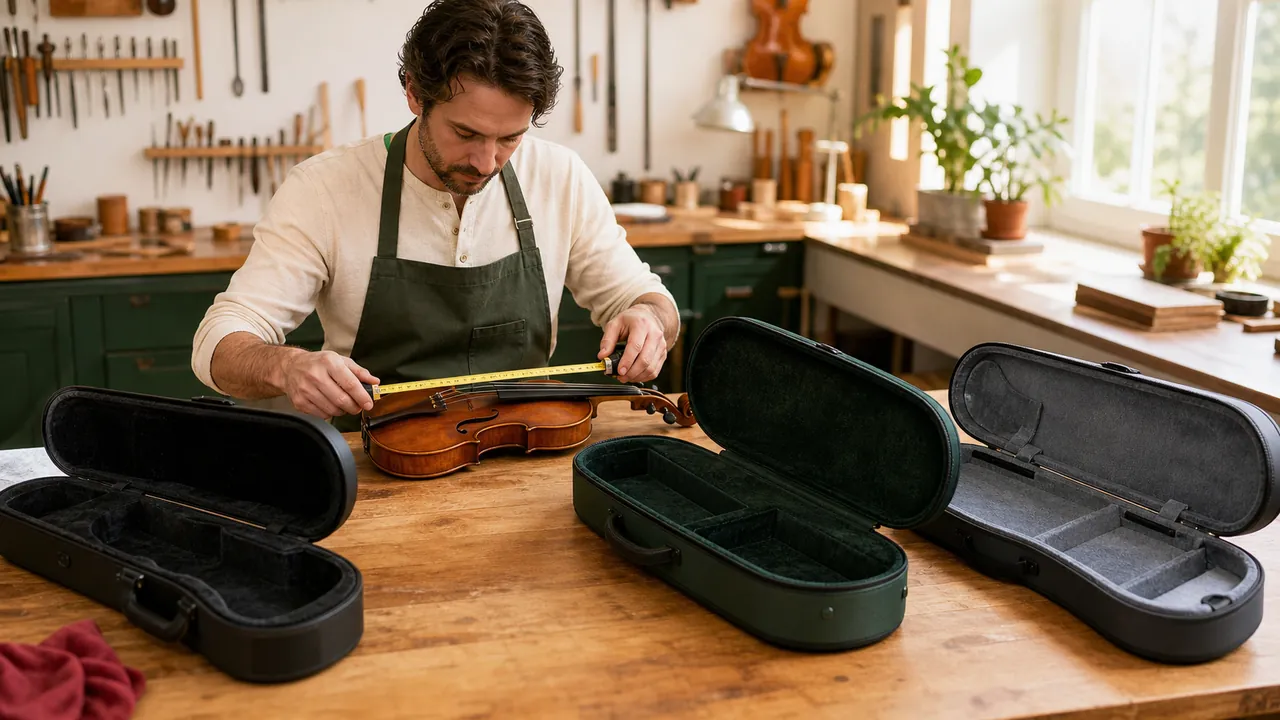
Before choosing
Make one card for the instrument and one for the journey
Instrument envelope
Record body length, upper and lower bout, total length, and maximum height with the normal chinrest fitted. Note unusual arching, a tall chinrest, and any pickup hardware.
Bow and accessory load
Count full-length bows. List the shoulder rest, rosin, cloth, mute, spare strings, pencil, and music you truly carry. A case is not bigger inside because a product photo looks roomy.
Travel custody
Distinguish walking, school lockers, car-only trips, crowded transit, and carrier custody. A backpack strap changes carrying; it does not certify a case for baggage handling.
The card makes the seller conversation specific: “Will a 35.8 cm body with this chinrest clear the lid, and does a 74.5 cm bow clear both end blocks?” That is answerable. “Will my violin fit?” invites a guess.
Plain language
Case terms that change the purchase
4/4 violin
The standard full-size category, not one universal outline.
Body, arching, chinrest, and scroll geometry still vary.
Measure your exact violin and fittings.
“4/4 case” is not a complete fit guarantee.
Shaped case
A case whose exterior follows the violin outline.
It usually reduces the carry envelope.
Choose it when compact transit matters more than broad storage.
Shaped does not automatically mean lighter or stronger.
Oblong case
A rectangular case with space around the instrument nest.
It can hold more bows, accessories, or sheet music.
Map every stored item before accepting the extra width.
Extra room must not let the violin move.
Suspension
Padded supports hold the instrument away from parts of the shell.
The neck and body supports determine where loads enter the violin.
Ask where your exact body and neck make contact.
The word is not an impact-test result.
Bow spinner
A rotating retainer that secures a bow near the frog.
Its position and the tip pocket must suit the bow length.
Check both ends before closing the lid.
A listed bow count does not prove every bow fits.
Subway handle
A short end handle for holding the case vertically in close quarters.
It changes the case footprint on a bus, train, or doorway.
Rehearse the vertical hold without resting weight on the case end.
It is not permission to stand the case unattended.
Airtight seal
A manufacturer's description of how shell halves meet.
It may reduce direct air or water entry at the seam.
Read the exact warranty and ask about rain covers.
It does not prove waterproofing, climate control, or flotation.
Three current choices
Choose the case architecture before the finish
| Case | Best fit | Carry envelope | Current signal |
|---|---|---|---|
| Gator Andante | Simple molded 4/4 carry | 31 x 10.25 x 6.13 in | Sweetwater in stock; popular-list position 2 |
| GEWA Air 2.1 | Four bows, music, accessories | 80 x 27.5 x 15 cm | US/EU stock; 48 specialist reviews |
| BAM 2002XLC | Compact premium shaped carry | 79 x 25 x 18 cm | US/EU stock; 13 Thomann ratings |
Gator Andante GC-VIOLIN44-23
The Andante is the practical baseline because Gator publishes the cavity, shell, valance, and warranty limits, while Sweetwater showed the exact model in stock and second on its current popular violin-case list.
Advantage: ABS shell, aluminum valance, molded plush nest, two bow positions, shoulder strap, and a relatively compact exterior.
Drawback: Gator did not publish exact-model weight in the checked page, and the case does not offer the Air 2.1's sheet-music pocket or four-bow layout.
Avoid if: your violin with chinrest exceeds the 23.5 x 8 x 3.5 inch cavity, or you need oblong accessory storage.
Alternative: GEWA Air 2.1 for four bows and music; BAM 2002XLC for a narrower premium carry envelope.
Verify before ordering: ask whether the scroll, bridge, chinrest, and both bow tips clear this exact current interior.
Found a changed specification or source? Report a correction.
GEWA Air 2.1
The Air 2.1 earns the oblong lane through exact US and EU stock, four bow holders, a removable accessory pouch, attached music pocket, suspension supports, and the strongest specialist-store review volume in this shortlist.
Advantage: a complete ensemble-day layout with blanket, pouch, music storage, backpack straps, and a published 62 x 36 x 22.5 x 22.5 x 13 cm interior.
Drawback: listed weight is about 2.1 kg before accessories, and the 80 x 27.5 cm outline is the broadest here. A shorter full-size violin still needs a movement check.
Avoid if: you carry only one or two bows and compact doorway/transit behavior matters more than storage.
Alternative: BAM 2002XLC for shaped carry; Gator Andante when a simpler molded case meets the load.
Verify before ordering: confirm the neck restraint immobilizes your exact violin and that the music pocket accepts your folder without bending it.
BAM 2002XLC Hightech Contoured
The 2002XLC has the smallest cross-section here, exact two-market stock, published triple-ply construction, suspension cushions, keyed latches, and a long-running Thomann signal of 13 ratings.
Advantage: 79 x 25 x 18 cm exterior, two bow holders, shoulder-rest strap, removable pouch, backpack straps, and a subway handle. Listed weight is 1.6-1.7 kg.
Drawback: it trades away oblong sheet-music space and two bow positions. BAM and Thomann disagree by 0.1 kg on weight.
Avoid if: you need four bows, built-in music storage, or your body/bouts exceed the published 38/17/22 cm envelope.
Alternative: GEWA Air 2.1 for storage; Gator Andante for the simpler molded lane.
Verify before ordering: ask the seller to confirm current 2002XLC interior height at the chinrest and bridge; the checked BAM dimensions omit that field.
Reader tool
Run a bow-tip and lid-contact check before removing tags
The reversible close test
- Get the seller's return permission and leave every protective film and tag intact.
- Place the covered violin in its intended supports. It should not rock, slide, or require the neck strap to bend the neck sideways.
- Seat each bow with the hair relaxed and the spinner fully engaged. Confirm the tip enters its pocket rather than the shell.
- Lay loose tissue tabs near the scroll, bridge, chinrest, and bow tips. Close the empty-pressure lid gently; do not force a latch.
- Reopen. A displaced or compressed tab identifies contact that needs a seller or luthier decision.
This is a contact screen, not an impact or protection test. Do not add improvised padding around the instrument without luthier guidance.
Carry rehearsal
Make the case pass your narrowest doorway
Trace the envelope
Tape the listed length and width on cardboard. Add the protruding handle, straps, music pocket, and your elbow. Walk through the smallest door, stair turn, bus aisle, and locker opening on your route.
Load the real weight
Add the violin, bows, shoulder rest, music, and accessories to the empty-case weight. Wear the same coat you use in winter. Check whether you can control the case while opening a door without striking its end.
A subway handle is useful only when you can hold the case vertically without placing it on its end. Backpack straps free a hand, but the case becomes longer than your torso and can strike a frame behind you. The cardboard rehearsal reveals that before the purchase.
Due diligence
Violin-case size, shell, maker and warranty
| Product | Size / weight | Construction | Manufacturing origin | Brand | Warranty / support |
|---|---|---|---|---|---|
| Gator Andante GC-VIOLIN44-23 | Interior 23.5 x 8 x 3.5 in; exterior 31 x 10.25 x 6.13 in; exact-model weight not disclosed. | ABS shell, aluminum valance, plush-lined molded nest, chrome-finished latches. | Not disclosed for this exact model. | Gator Cases; founded in Tampa in 2000; broad case and bag maker. | Limited lifetime for manufacturing defects to original owner; moving parts one year; transport damage excluded. |
| GEWA Air 2.1 | Interior 62 cm total, 36 cm body, 22.5/22.5 cm bouts, 13 cm height; exterior 80 x 27.5 x 15 cm; about 2.1 kg without accessories. | Thermoplastic shell, velour lining, padded suspension, four swivel bow holders. | Not verified for this exact current variant. GEWA says its production spans Germany, Europe, and Asia. | GEWA music; founded in 1925 and based in Adorf, Germany. | Manufacturer term not verified in checked sources; exact listings displayed Sweetwater two-year and Thomann three-year retailer coverage. |
| BAM 2002XLC Hightech Contoured | Interior 62 cm total, 38 cm body, 17/22 cm bouts; exterior 79 x 25 x 18 cm. BAM 1.7 kg; Thomann 1.6 kg. | ABS, injected solid polyurethane foam, and PETG triple-ply shell; injected-foam suspension cushions. | Exact-model origin not explicit; BAM lists its company address in Dives-sur-Mer, France. | BAM; known for instrument cases using its Hightech construction. Establishment year not verified. | BAM EU product-family pages state a two-year case warranty; ask the regional seller which terms apply. |
Checkout script
Questions worth getting in writing
- Does this exact color/variant remain orderable today?
- What are the narrowest interior height and neck-rest positions?
- Will my measured body, bouts, chinrest, and scroll clear?
- What full bow length fits each holder and tip pocket?
- Can the neck restraint be adjusted without pressing the neck?
- Does empty-case weight include straps, pouch, blanket, and music pocket?
- Which shell, latch, zipper, and strap failures are covered?
- Is carrier damage excluded, and who handles a carrier claim?
- May I conduct the reversible fit check and still return it?
- Which replacement straps, latches, or pouches are stocked locally?
Trace the evidence
Sources checked for this guide
- Sweetwater violin cases
- Gator Andante exact model
- Gator company history
- Gator 2026 catalog
- Sweetwater GEWA Air 2.1
- Thomann GEWA Air 2.1
- GEWA company history
- Great Violin Cases Air 2.1 reviews
- Sweetwater BAM 2002XLC
- Thomann BAM 2002XLC
- BAM 2002XL specifications
- BAM warranty statement
- Sweetwater Protec MX044
- Gator Adagio exact model
- Sweetwater BAM category
Retail availability, rankings, ratings, and warranty displays were observed on the research date and can change. Manufacturer specifications describe products; they are not independent test results.