Live vocals
Best Karaoke Microphones
Start at the karaoke machine, mixer or speaker input. A good vocal microphone cannot fix the wrong connector, missing mic preamp, illegal wireless band or speaker aimed at the singer.
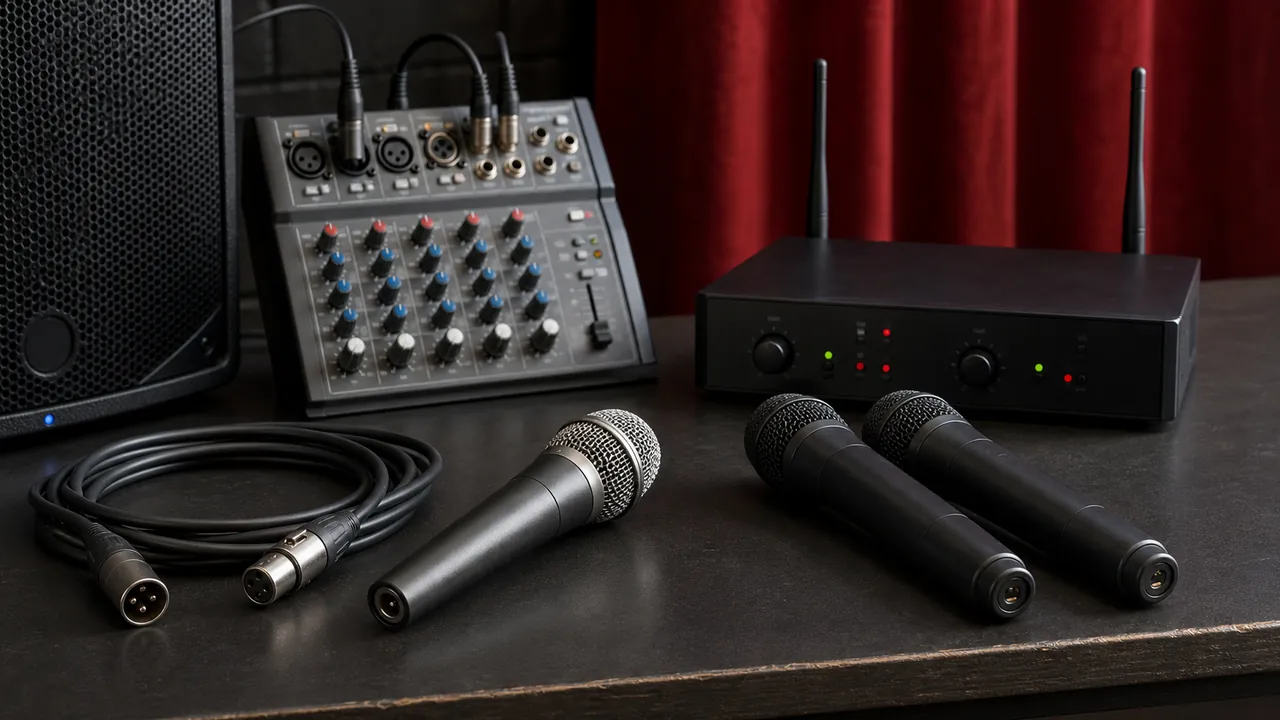
We checked current maker specifications, manuals, regional frequency information, warranty terms and specialist-store availability. We did not sing through, drop, range-test or compare these microphones. Test the complete system at the real room volume while the return window is open.
Budget wired: Shure PGA58
Long-term wired: Shure SM58
Dual Shure wireless: BLX288/SM58
Dual Sennheiser: XSW 1-825
Do not buy a wireless band by model name alone. Legal and usable frequencies vary by country, venue and local spectrum conditions. The US A-range Sennheiser and a European E-band unit are not interchangeable purchase recommendations.
Verify before buying: mic-level input, connector, cable/receiver output, available channels, local frequency band and speaker placement. Build the room card
Translate the audio vocabulary
Microphone terms that prevent mismatches
Dynamic microphone
A moving-coil microphone that produces a low-level signal without phantom power.
It needs a real microphone preamp, not merely any audio socket.
Confirm the input is labelled for microphone level and has gain control.
An XLR-shaped connector alone does not prove the input is suitable.
Cardioid pattern
A directional pattern most sensitive at the front and less sensitive at the rear.
Speaker position relative to the rejection area affects feedback margin.
Aim the microphone at the singer and keep the main speaker in front of the singer rather than behind the mic.
Cardioid does not remove room noise or make feedback impossible.
Mic level
The small electrical signal produced by a wired microphone or receiver set to mic output.
Line and auxiliary inputs expect different levels.
Match receiver output mode and mixer input; begin with gain down.
A passive adapter is not a microphone preamp.
Proximity effect
Bass rises as a directional singer moves very close to the grille.
Changing distance alters tone and apparent level during a song.
Teach a consistent close working distance and move the mic away slightly for loud notes.
Covering the grille is not a tone control; it can damage pattern and feedback margin.
Diversity receiver
A wireless receiver architecture that selects between reception paths to reduce dropouts.
It helps reception but does not override interference, blocked antennas or wrong frequencies.
Place the receiver with clear antenna exposure and scan/set channels at the venue.
Quoted line-of-sight range is not a promise through people and walls.
Frequency band
The radio spectrum range built into a wireless-system variant.
Legality and interference change by country and location.
Use the maker's regional frequency finder and local regulator guidance before ordering.
Two products with the same family name can transmit in different bands.
One category, two infrastructures
Why wired and wireless are separate lanes
We required current exact products, official electrical/radio specifications and ordinary specialist ordering evidence. Thomann anchors Europe and Sweetwater the US; maker pages control facts. Retail activity shows a live market, not superiority.
Phone-shaped Bluetooth karaoke gadgets were excluded because their built-in speaker/effects design is a different product. USB studio microphones do not plug into most karaoke mic inputs. Wireless variants are named with a band/region warning because copying a US SKU into Europe can be irresponsible.
Match infrastructure before price
Four paths into the karaoke mix
| Product | Path | Pattern/output | Power | Main caution |
|---|---|---|---|---|
| Shure PGA58 | One wired singer | Cardioid dynamic; XLR; on/off switch | None at mic | Cable and mic preamp required |
| Shure SM58 | One wired singer; replaceable service parts | Cardioid dynamic; XLR | None at mic | No switch on standard SM58 |
| BLX288/SM58 | Two wireless singers | Dual receiver; XLR and 6.35 mm receiver outputs | Two AA per transmitter; receiver supply | Exact frequency variant must be legal/clear |
| XSW 1-825 Dual | Two wireless singers | Dual diversity receiver; XLR and 6.35 mm output | Two AA per transmitter; receiver supply | Band suffix is region-specific |
Choose the room's operating model
Recommendations by singer count and signal path
Affordable wired karaoke with a real mic input
Shure PGA58: a switched wired starting point
The current cardioid dynamic model includes an on/off switch and a documented XLR path, with broad European specialist availability.
Advantage: no batteries, frequency coordination or receiver; 294 g and replacement grille available.
Tradeoff: tethered movement and a cable/preamp remain part of the purchase.
Avoid if: the karaoke device has only USB, Bluetooth or line/aux input with no microphone gain.
Alternative: standard SM58 for the longer-established service/parts ecosystem.
Check at purchase: whether the exact package includes an XLR-XLR cable or XLR-to-6.35 mm cable appropriate to your mic input.
Wired mic for repeated hosted use
Shure SM58: the serviceable wired baseline
Its current manual documents the 300-ohm XLR output, metal housing, steel grille, published placement guidance and replaceable grille/cartridge path.
Advantage: no radio planning or battery logistics and unusually broad specialist support.
Tradeoff: the standard SM58 has no on/off switch; cable handling and stand discipline remain.
Avoid if: singers must mute locally without a host/mixer or need unrestricted movement.
Alternative: SM58S for a switched version after checking the exact suffix.
Check at purchase: exact suffix, authenticity, cable, clip, spare grille and mixer gain.
Two-singer wireless event system in a verified band
BLX288/SM58: two familiar capsules, one radio decision
The package combines two SM58 handheld transmitters with a dual receiver; Shure states up to 14 hours from one AA pair per transmitter and up to 100 m line of sight.
Advantage: one coordinated dual system and broad regional variant support.
Tradeoff: band selection, interference scan, batteries, receiver placement and two mixer channels add work.
Avoid if: a qualified seller cannot confirm the exact suffix for the country and venue.
Alternative: two wired SM58/PGA58 paths remove RF uncertainty where cables are acceptable.
Check at purchase: exact band suffix, output cables, rack/table position and local channel plan.
Dual wireless alternative with automatic management
XSW 1-825 Dual: select the country variant first
Sennheiser publishes a two-channel diversity receiver, automatic frequency management, dynamic cardioid 825 capsules and about 10 hours of battery operation.
Advantage: dual package includes clips, receiver supply and four AA batteries; current US and EU specialist listings exist in different bands.
Tradeoff: the A-range US listing and E-band European listing are different RF products despite the shared family name.
Avoid if: you are importing without local spectrum and warranty confirmation.
Alternative: BLX288/SM58 when the local supplier supports its band/service ecosystem more clearly.
Check at purchase: article number, frequency range printed on the unit, local permitted use and receiver-to-mixer cables.
Prevent the adapter pile
Build a one-page room signal card
- Input: photograph and name the mixer/speaker/karaoke mic connector and gain control.
- Path: write mic or receiver output, cable type and destination channel for each singer.
- Speaker: sketch singer, microphone rear rejection and speaker positions.
- Wireless: record exact band, scanned channel and receiver antenna clearance.
- Power: list fresh/spare batteries and receiver supply; begin with gains down.
Rehearse before guests arrive
Walk the room at the real operating level
Set one microphone at a time, speak and sing from expected positions, then enable both together. Move through the actual area without covering the grille. Mark feedback-prone positions and reduce gain or reposition speakers rather than relying on frantic EQ. Never test hearing safety by pushing to maximum volume.
Keep two handhelds distinguishable
Make a battery and channel handoff log
Color-mark transmitter one and two without covering antennas, record fresh-battery time, receiver channel, mixer channel and mute state, and assign one person to collect both units. This prevents the common “wrong fader/wrong battery” failure without claiming extra radio reliability.
Convenience moves the work
Wireless freedom adds coordination
Feedback
Wireless movement makes it easier to walk behind speakers. Directional technique and room layout still matter.
Radio
A legal band can still be busy. Scan at the venue and keep antennas visible; quoted range is line-of-sight context.
Batteries
Runtime claims assume suitable batteries and conditions. Replace or recharge on a documented schedule rather than waiting for failure.
Purchase-day checkpoint
Verify the exact suffix and every connector
For wired models, confirm mic suffix, cable and mic-level preamp. For wireless, confirm country-legal frequency range, receiver outputs, included supply, two transmitter battery requirements, local warranty and return terms in writing.
Ownership due diligence
Four microphone paths, materials and support facts
| Product | Size/weight | Construction | Origin | Brand | Warranty/support |
|---|---|---|---|---|---|
| Shure PGA58 | 294 g handheld | Dynamic capsule; cardioid; switched metal handheld; XLR | Not stated for exact model in checked official source; verify label | Shure; Niles Illinois; audio manufacturer founded 1925 | Regional terms apply; official replacement grille and clip/cable accessories listed |
| Shure SM58 | 330 g | Die-cast metal housing; steel mesh grille; dynamic cardioid capsule; XLR | Not stated for exact model in checked official source; verify label | Shure; professional microphones and wireless systems | Regional Shure/dealer terms; replacement grille and cartridge available |
| BLX288/SM58 | Two handheld transmitters plus dual tabletop receiver; exact weights in system guide | Two integrated SM58 transmitters; BLX88 dual receiver; clips; supply | Not disclosed for exact system in checked source; verify labels | Shure; wired and wireless professional audio systems | Region and band-specific dealer support; use Shure frequency finder before ordering |
| XSW 1-825 Dual | Handheld 180 x 48 mm and 330 g; receiver 430 x 345 x 85 mm listed product envelope | Two dynamic cardioid handhelds; dual diversity receiver with integrated antennas | Not stated for exact system in checked official page; verify labels | Sennheiser; German professional audio company founded 1945 | Official page states two years; Sweetwater advertised two-year coverage |
Trace the room plan
Microphone, radio and retailer sources
- Shure PGA58 official user guide
- Shure SM58 official user guide
- Shure SM58 current product page
- Shure BLX288/SM58 current system page
- Shure BLX band-selection context
- Sennheiser XSW 1-825 Dual official specifications
- Sweetwater XSW 1-825 Dual A-range listing
- Thomann XSW 1-825 Dual E-band listing
- Thomann Shure PGA58 listing
- Shure Europe BLX2/SM58 band variants
Correction contact: Contact Consordini with route, country and source.