Home recording, below $100
Best Cheap Condenser Microphones Under $100
Choose the microphone only after the room, input and mounting plan pass. The useful differences here are controls and complete-system cost, not an invented sound ranking.
Researched for first-time XLR recording setups.
We checked current manufacturer pages and manuals, then confirmed exact order state and observable retailer signals at Sweetwater and Thomann. We did not record with these microphones. Voice match, instrument balance, room pickup and unit noise still need a returnable audition in your space.
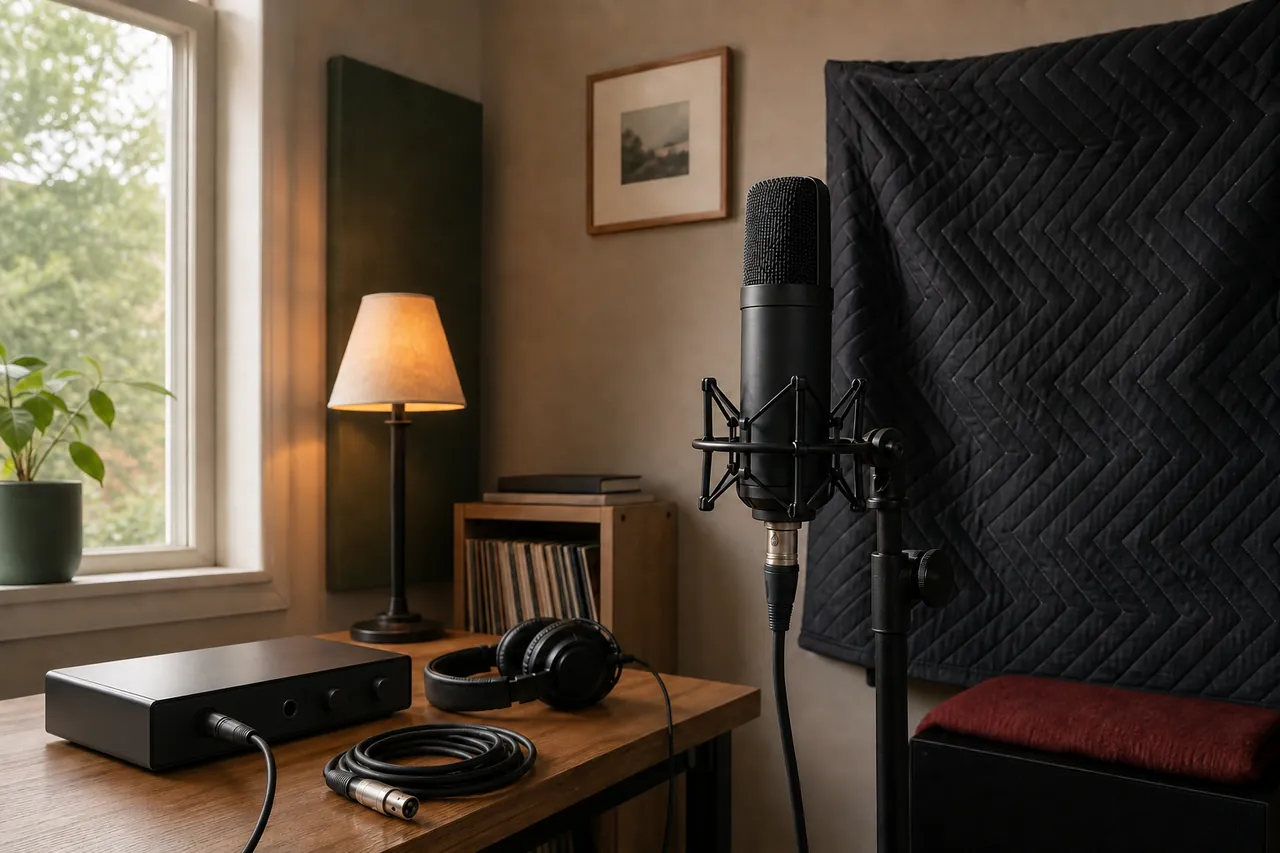
Pick the AKG P120 for separate pad and bass-cut controls, the MXL 990 when an included shockmount and case solve missing parts, the Behringer B-5 when interchangeable cardioid and omnidirectional capsules serve a real plan, or the Behringer C-1 when the microphone must leave the most budget for the rest of the chain.
All four are analog XLR microphones that require phantom power. None plugs straight into a computer's USB port.
Verify: a compatible mic input, balanced XLR cable, stable stand, mounting thread and a return policy that permits a room test.
Run the complete-chain gateRead the connection before the frequency chart
A cheap microphone becomes an expensive mistake when one of these terms is assumed rather than checked.
XLR
Meaning: the three-pin balanced analog connector used by these four microphones.
Why it matters: the connector carries audio to an interface or mixer; it is not USB and does not perform conversion by itself.
Check: find an XLR microphone input on the receiving device and add a proper balanced cable.
Do not assume: an inexpensive XLR-to-USB cable replaces a microphone preamp, phantom supply and audio converter.
48 V phantom power
Meaning: DC power sent through the XLR cable by a compatible interface, mixer or supply.
Why it matters: these microphones require it within their published voltage range.
Check: read both manuals, lower monitoring levels and follow the equipment maker's switching sequence.
Do not assume: every socket labeled “mic” supplies phantom power.
Cardioid and omnidirectional
Meaning: cardioid favors sound arriving from the front; omnidirectional accepts sound around the capsule.
Why it matters: the B-5 includes both capsules, but the omnidirectional option deliberately admits more of the room and nearby sources.
Check: choose the capsule for a named placement problem, then test front, side and rear noise at the planned position.
Do not assume: omnidirectional means distant sound is equally loud, or cardioid removes room reflections.
Side address and end address
Meaning: a side-address microphone points a marked body face at the source; an end-address microphone points its capsule end at the source.
Why it matters: the P120, MXL 990 and C-1 use a body face, while the pencil-shaped B-5 is aimed from its capsule end.
Check: find the front or capsule direction in the exact manual before placing the stand.
Do not assume: every upright studio microphone is addressed from the top, or every slim microphone from the side.
Pad and bass-cut filter
Meaning: a pad reduces level before later circuitry; a bass-cut filter attenuates low frequencies below its stated region.
Why it matters: the P120 is the only shortlist model with both switches.
Check: begin with switches neutral, then change one at a time when level or low-frequency pickup gives a specific reason.
Do not assume: either switch repairs room acoustics or automatically improves a voice.
Equivalent noise level
Meaning: a maker's stated measure of the microphone's own noise under defined conditions.
Why it matters: it can matter on quiet sources, but room, preamp gain and distance also shape the audible noise floor.
Check: compare specifications only when weighting and test conventions match, then make a silent recording.
Do not assume: the smallest number proves the best sound.
Shockmount
Meaning: an elastic suspension between microphone and stand.
Why it matters: it can reduce some stand-borne vibration and changes the required space and thread hardware.
Check: confirm diameter, thread adapter, stand load and whether the mount is actually included.
Do not assume: a shockmount blocks airborne traffic, fans or room echo.
Why these four cleared the microphone-only ceiling
We first required an exact XLR condenser listing below USD 100 and orderable at Sweetwater on July 18, 2026. We then required current model identity, purchase-relevant specifications and an observable specialist-store signal. Sweetwater showed 25 reviews each for the P120 and MXL 990, 12 for the B-5 and 45 for the C-1. Thomann showed the B-5 in stock with 221 ratings and the C-1 in stock with more than 380 ratings; it also carried the exact MXL 990 and P120 during the run.
The ceiling covers the microphone listing before tax and shipping. It does not cover an interface, cable, stand, pop filter, treatment, headphones or return cost. Exact prices are dated evidence, not permanent product characteristics. USB condensers were excluded because their built-in conversion makes them a different system decision.
Four lanes, all analog XLR
| Model | Pattern | Controls | Included mounting/storage | Checked US listing | Use this lane when |
|---|---|---|---|---|---|
| AKG P120 | Cardioid | -20 dB pad; bass cut | Stand adapter | $99 | You have a specific need for onboard level and low-cut switches. |
| MXL 990 | Cardioid | None | Shockmount, adapter, case | $89.95 | Included suspension and storage reduce the parts list. |
| Behringer B-5 | Interchangeable cardioid and omnidirectional capsules | Three-position flat / -10 dB pad / low-cut switch | Clamp, windscreen, case | $72.90 | You have a defined reason to compare directional and all-around pickup. |
| Behringer C-1 | Cardioid | None | Swivel adapter, case | $53.90 | The remaining budget must buy the required chain. |
Prices can move above the route ceiling. Recheck the exact SKU and delivered total.
Choose a constraint, then audition the microphone
AKG P120
The P120 is the controls-first choice. Its -20 dB pad and bass-cut switch are separate, so they can address level and low-frequency pickup together; the B-5's single control makes those settings alternatives. That matters only when your setup has a defined problem, and it is not proof of superior sound.
Official specifications, dimensions and power requirements are unusually complete, and the exact model was listed by both US and European specialists.
It used the entire $99 microphone allowance and includes a stand adapter rather than a suspension mount.
Avoid if: the rest of the recording chain is not already funded or you mainly need included suspension and storage.
Closest alternative: MXL 990 for the included shockmount/case; B-5 for interchangeable pickup capsules.
Check the controls: start with both switches neutral, confirm current orderability and regional warranty, then test one setting at a time. Exact manufacturing origin was not disclosed.
MXL 990
The MXL 990 makes the strongest package argument: microphone, custom shockmount, stand adapter and carrying case were all listed together. It suits a buyer who already owns a compatible interface and stand but wants fewer mounting pieces to source.
The official page and manual agree on 48 V power, physical size and included hardware, while both anchor retailers showed current orderability.
There is no onboard pad or bass-cut filter, and the large body plus suspension needs more stand clearance.
Avoid if: the microphone must fit a tight stand envelope or switchable controls are part of the plan.
Closest alternative: AKG P120 for separate pad and bass cut; Behringer B-5 for interchangeable pickup capsules.
Check the package: confirm the shockmount, adapter and case remain included, then allow clearance for the suspension. Exact factory was not disclosed.
Behringer B-5
The B-5 is the pattern-choice lane. It includes separate cardioid and omnidirectional capsules, so one body can test a front-focused position against deliberate all-around room or ensemble pickup. That is useful only when both placements are part of the plan.
Both anchor retailers had the exact model in stock, Thomann showed 221 ratings, and the package includes a clamp, windscreen and case as well as both capsules.
The pad and low-cut share one three-position control, so they cannot be engaged together. Two separately bought units are not a manufacturer-matched stereo pair.
Avoid if: you do not have a specific omnidirectional use, need simultaneous pad and low-cut, or require a matched pair.
Closest alternative: AKG P120 for separate pad and bass-cut switches; MXL 990 for included suspension.
Check the capsule kit: confirm both capsules, clamp, windscreen and case are present, then compare pickup modes at one marked position. Exact manufacturing origin was not disclosed.
Behringer C-1
The C-1 is the budget-allocation choice. At the checked $53.90, it leaves roughly $45 of the microphone cap available for a cable, stand or pop filter. It still requires a phantom-powered interface, so this is only cheap when that device already exists.
It had the strongest observable European popularity signal here: more than 380 Thomann ratings, plus current stock at both anchor retailers.
There is no pad, low-cut or included shockmount. A low sticker price cannot compensate for a poor room/category match.
Avoid if: fans, traffic or hard reflections dominate the intended position; compare a dynamic microphone before buying any condenser.
Closest alternative: MXL 990 for included suspension; B-5 for interchangeable pickup capsules.
Price the whole chain: confirm stock, cable, stand, pop filter and local warranty before treating the low microphone price as savings. Exact origin remains undisclosed.
A condenser can be the wrong bargain
A sensitive studio condenser does not separate a voice from a hard room by price alone. If the planned position captures keyboard taps, computer fans, traffic or a close wall, first change placement and source distance. Then compare a directional dynamic microphone. Buying a condenser because it looks like a studio microphone is not a recording strategy.
The same caution applies to specifications. Maximum level, frequency range and equivalent noise are measured under stated conditions. They help screen compatibility, but they do not rank voice match, off-axis behavior or the individual unit on your stand. Keep the retailer's return terms intact while you run a repeatable test.
The microphone is allowed to cost $100; the missing chain is not
Record a yes only when the exact item is present or priced. JavaScript updates the count, but the list is complete without it.
Listen to ten seconds in which nobody performs
Put the microphone at the intended position, set a normal working level without clipping, and record ten seconds of room tone. Do not add noise reduction. Listen on headphones for fan cycles, traffic, electrical buzz, stand movement and reflections that appear when you speak one sentence. Repeat after moving the microphone closer to the source and away from the loudest boundary. This is not a lab noise measurement; it is a rejection test for your actual room and chain.
The noise remains unobtrusive at the distance you can use.
A small move changes fan, wall or desk pickup meaningfully.
The room dominates every practical condenser position.
Find the working end before setting the stand
Use the exact manual before tightening the mount. Aim the marked body face of the P120, MXL 990 or C-1 at the source; aim the installed capsule end of the pencil-shaped B-5. At a constant distance, record “front, quarter turn, side, back” while rotating the microphone rather than moving the source. Repeat the B-5 pass with its omnidirectional capsule only when all-around pickup is relevant. Mark the usable direction and capsule on the stand; a pattern name is not a substitute for hearing the actual room.
Physical and support facts for the exact shortlist
These are due-diligence fields, not performance scores. Origin remains undisclosed where the maker did not identify the exact model's factory or country.
| Product | Size and weight | Construction | Manufacturing origin | Brand | Warranty/support |
|---|---|---|---|---|---|
| AKG P120 | 165 mm long, 54 mm diameter; 453 g. | All-metal body; 2/3-inch diaphragm; stand adapter included. | Not disclosed by the manufacturer for this exact model. | AKG began in Vienna in 1947 and is a Harman professional-audio brand known for microphones and headphones. | AKG states two years for qualifying professional purchases in the supported region; authorized-dealer and regional conditions apply. |
| MXL 990 | 130 mm long, 60 mm diameter; 544.3 g. | Metal body; 6-micron gold-sputtered capsule; shockmount, adapter and case included. | Not disclosed by the manufacturer for this exact model. | MXL is a Marshall Electronics microphone brand based in Torrance, California, established in 1998. | One-year limited microphone warranty against material and workmanship defects; dated receipt and misuse exclusions apply. |
| Behringer B-5 | 120 mm long, 20 mm shaft diameter; about 240 g in the current quick-start specification. | Die-cast metal body, gold-sputtered 18 mm diaphragm, interchangeable cardioid/omnidirectional capsules, clamp, windscreen and case. | Not disclosed by the manufacturer for this exact model. | Behringer was established in 1989 and operates as a Music Tribe recording and live-sound brand. | Music Tribe terms depend on region and registration; Sweetwater and Thomann list their own current coverage. |
| Behringer C-1 | 169 mm long, 54 mm diameter; 450 g. | Metal body, transformerless FET input, swivel adapter and transport case. | Not disclosed by the manufacturer for this exact model. | Behringer was established in 1989 and operates as a Music Tribe recording and live-sound brand. | Music Tribe terms depend on region and registration; confirm the current local duration and process. |
The shop and first-session script
- “Does this exact box include the mount, thread adapter and case shown in the listing?”
- “What happens to the return right after I register software or discard packaging?”
- “Which warranty applies in my country, and is this seller authorized?”
- Confirm the receiving device's phantom-voltage range in its manual.
- Test stand balance with the cable attached and positioned.
- Record silence, speech and the intended instrument at matched positions before applying processing.
- Keep the unit only when the room, complete cost and connection pass independently of brand familiarity.
Specifications, order checks and support
Order state, prices and retailer counts were checked July 18, 2026 and can change. Manufacturer and manual links control stable specifications; retailer pages establish the dated commercial check.
- AKG P120 product page
- AKG P120 cut sheet
- Sweetwater AKG P120 listing
- Thomann AKG P120 listing
- MXL 990 product page
- MXL 990 manual and warranty
- Sweetwater MXL 990 listing
- Thomann MXL 990 listing
- Behringer B-5 product page
- Behringer B-5 quick-start guide mirror
- Sweetwater Behringer B-5 listing
- Thomann Behringer B-5 listing
- Behringer C-1 product page
- Behringer C-1 manual
- Sweetwater Behringer C-1 listing
- Thomann Behringer C-1 listing
- Music Tribe warranty terms
- AKG warranty support
- Sweetwater condenser microphone category
No affiliate tracking or product photography is used. Reconfirm price, included hardware, seller authorization and regional support before ordering. To report a factual error, use Consordini's contact page.