Consordini buyer guide
Best keyboard amps for practice, rehearsal and stage monitoring
Choose the signal path before the cabinet. A compact mono amp can be right for lessons; a four-channel monitor can solve a two-keyboard rehearsal; a stereo-link rig only earns its weight when the stage plan uses it.
We checked current manufacturer specifications, manuals, support terms, and US/EU specialist-store listings. We did not play, measure, or loudness-test these amps. Audition your keyboard through the exact unit and confirm the seller's warranty before paying.
Bottom line: start with the Roland KC-80 for one-keyboard portability, KC-200 for extra sources and a monitor-only channel, KC-400 when stereo link is part of the actual stage plan, or Behringer KXD12 when onboard mixing, effects, and balanced stereo XLR line outputs matter more than minimal controls.
Avoid buying by watts alone. The makers publish unlike power figures, and none is a controlled comparison of usable level or sound in your room. Verify first: whether your keyboard output, PA feed, click track, and headphones need mono or stereo paths.
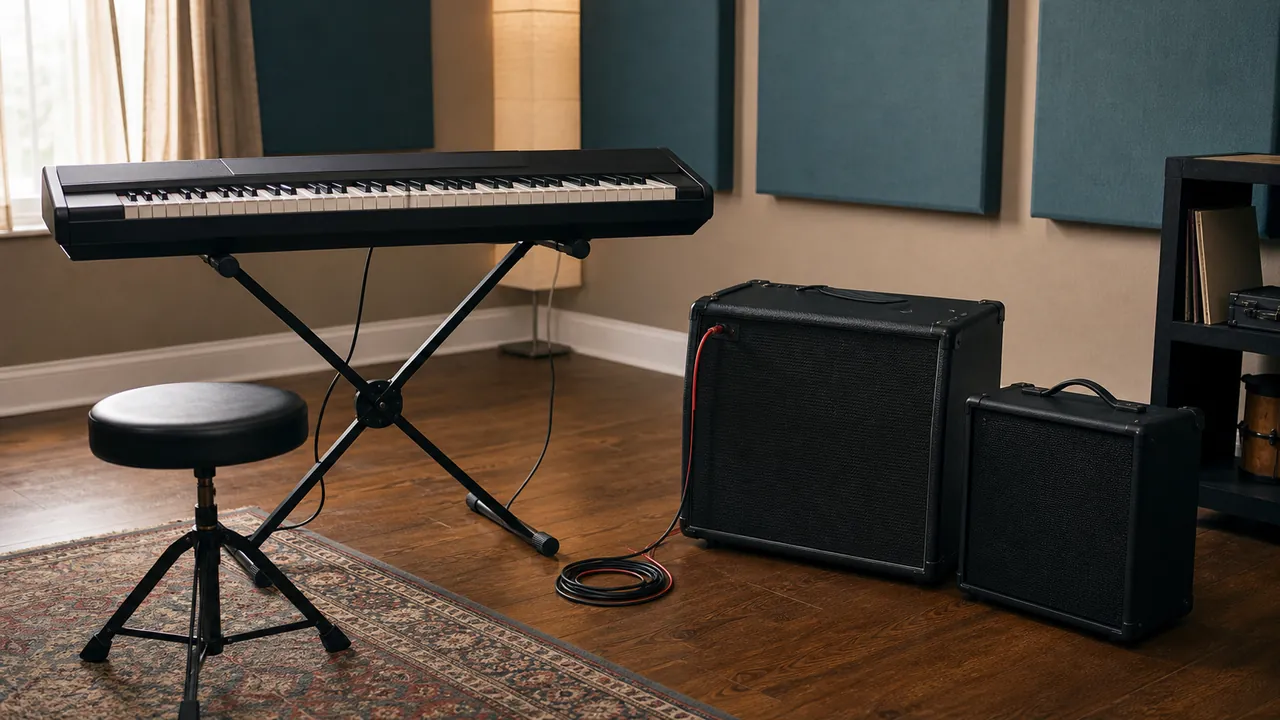
Header image is AI-generated and shows generic, unbranded equipment; it is not a tested product.
Read the sockets before the watt label
Line input
A line input accepts the output level produced by a keyboard or sound module.
It matters because an XLR microphone socket is not automatically a second keyboard channel.
Count every keyboard, module, laptop, and backing-track feed you will use at once.
Two physical sockets may belong to one stereo channel rather than two independently controlled sources.
Mono, stereo, and stereo link
Mono sends one combined signal; stereo preserves separate left and right channels. Stereo link joins two compatible cabinets.
Piano samples and rotary effects may be programmed in stereo, but many stages monitor keys in mono.
Ask the sound engineer what reaches the PA and decide whether one or two cabinets will be carried.
A cabinet with paired left/right inputs does not necessarily contain two separate speaker channels.
Monitor-only channel
A monitor channel can feed the local speaker while being omitted from the main line output.
That can keep a click or guide track in the player's monitor instead of sending it to the audience.
Trace the manual's block diagram and rehearse the exact output used for the PA.
It is routing, not an automatic privacy guarantee; the wrong socket or cable can defeat the plan.
DI or line output
An output sends the amp's mixed signal onward to a PA or recorder; balanced XLR and unbalanced quarter-inch connections are different.
It determines whether an extra DI box or adapter may be needed.
Ask the venue which connector and mono/stereo feed it expects.
A line output does not prove that every local input is included in that feed.
Woofer and tweeter
The larger driver handles much of the low and middle range; the tweeter handles higher frequencies.
Keyboard sounds span a broad range, so these are full-range systems rather than guitar-style tone cabinets.
Audition low piano notes and bright patches at your working level.
A larger woofer does not by itself prove better bass, clarity, or volume.
Rated power
A maker's electrical output figure under its stated method.
It can help compare models inside one documented family but is weak evidence across different brands and methods.
Use it with speaker design, routing, room, and an audition rather than as a scoreboard.
Twice the printed watts does not mean twice the perceived loudness.
Carry weight
The cabinet's published net weight before covers, cables, stands, or a second amp.
A 22 kg cabinet changes stairs, vehicle loading, and whether one person can manage the rig.
Rehearse the route with an equivalent weight and include the keyboard itself.
A handle makes lifting possible; it does not make a bulky cabinet easy to carry.
How these amps earned a lane
We began with current keyboard-combo listings at Sweetwater and Thomann, then checked exact model pages, manuals, dimensions, outputs, support terms, and brand records. A model had to be currently sold by at least one anchor, documented, visible in both US and European specialist-store research, and meaningfully different. Retailer rank and review counts show market presence only; they did not decide the recommendation. Larger duplicates were left out when they added weight without changing the decision.
Compare the rig, not the badge
| Model | Useful lane | Routing | Published weight | Main caution |
|---|---|---|---|---|
| Roland KC-80 | One-keyboard practice | 3 line channels; mono speaker; line/sub/phones out | 12.5 kg | No stereo link |
| Roland KC-200 | Multiple rehearsal sources | 4 channels; channel 4 monitor-only option | 15 kg | Mono reproduction |
| Roland KC-400 | Stage rig with planned stereo link | 4 stereo-capable channels; stereo link | 22 kg | Heavy before second cabinet |
| Behringer KXD12 | Onboard mixer/effects and balanced line output | 4-channel stereo mixer; effects; stereo XLR line out | 18.3 kg in maker guide | European listing was backordered |
Recommendations by signal problem
Roland KC-80: for a compact mono practice rig
Best fit: one keyboard, a backing source, and occasional microphone input where 12.5 kg is still manageable.
It made the shortlist because its current documentation is clear, both anchor stores carry it, and its three-channel mixer covers a small rehearsal without the weight of the larger models.
Advantage: lowest published carry weight here, with line, sub, and headphone outputs.
Drawback: mono speaker/output use and fewer source controls.
Avoid if: the job genuinely needs stereo stage monitoring or four separately controlled feeds.
Alternative: KC-200 for the fourth monitor-capable channel.
Official product page and shared manual support the decision; audition sound and working level.
Roland KC-200: for two keyboards plus private guide routing
Best fit: rehearsal players who need more local sources and want a click or guide feed kept out of the line output.
The four channels, dedicated channel-4 monitor behavior, current cross-store presence, and modest step up from the KC-80 create a distinct job.
Advantage: useful monitor routing without an external mixer.
Drawback: 15 kg and still a mono cabinet.
Avoid if: separate left/right stage reproduction is non-negotiable.
Alternative: KC-400 when stereo link will actually be used.
Maker specifications and manual are strong; the private-feed result depends on following the documented sockets.
Roland KC-400: for a stereo-link stage plan
Best fit: players with several stereo sources who can transport one 22 kg cabinet now and may deliberately add a compatible second cabinet.
Its four stereo-capable channels and stereo-link sockets solve a routing problem the smaller KC models do not.
Advantage: stereo expansion and flexible local mixing in one family.
Drawback: the cabinet is already 22 kg; a true stereo rig doubles cabinet handling.
Avoid if: stairs, solo loading, or a mono venue feed make the second-cabinet plan unrealistic.
Alternative: KC-200 for a lighter mono rehearsal system.
Current official manual and retailer stock are clear; stereo sound quality remains an audition question.
Behringer Ultratone KXD12: for onboard mixing, effects, and balanced line output
Best fit: a keys-and-vocal setup that benefits from a graphic EQ, built-in effects, feedback indication, and balanced stereo XLR feed to a compatible PA input.
It offers a different control and output set, is in stock at Sweetwater, remains listed but backordered at Thomann, and has substantial observable retailer-review presence.
Advantage: broad mixer and output functionality without adding a separate small mixer.
Drawback: denser controls, uncertain near-term European availability, and a power figure that cannot be ranked against Roland's rated watts.
Avoid if: you want the fewest controls or the lightest cabinet, or need quick European delivery.
Alternative: KC-200 for simpler four-source monitoring and current Thomann stock.
Official feature and dimension evidence is strong; verify the venue's required input, regional stock, service, and actual operating level with the seller.
Where a powered speaker may be the better answer
A keyboard combo is attractive when you want instrument-level inputs, front-panel mixing, a headphone path, and one self-contained box. A powered PA speaker plus small mixer may fit better when the venue already works in balanced XLR, when pole mounting and wedge placement matter, or when you want to replace mixer and speaker separately. Do not rank unlike published watt figures across those systems. Price the full cable-and-mixer system and rehearse setup time.
Write a signal-path passport before ordering
This prevents the common mistake of discovering at soundcheck that one feed is mono, a click leaks into the PA, or the venue expects an XLR output your cabinet does not provide.
Run a cable-and-carry rehearsal
Lay out the keyboard, pedals, music stand, amp position, and the exact cables at home. Start from silence, connect the local monitor, then connect a mock PA feed. Confirm which volume control changes which destination. Finally, carry an equivalent published weight from storage to vehicle and through the tightest doorway. This rehearsal catches missing DI boxes, short cables, inaccessible rear panels, and a cabinet that is manageable only on a flat showroom floor.
Shop audition script
Bring your keyboard or the same model. Ask to disable flattering demo effects. Play quiet piano notes, dense chords, bright synth patches, and the lowest notes you use. Increase only to your real working level. Listen for a usable balance rather than a dramatic first impression, and compare the mono sum if the gig will be mono. None of those results can be inferred from the specification sheet.
Product details for due diligence
| Product | Size and weight | Materials | Manufacturing origin | Brand | Warranty and support |
|---|---|---|---|---|---|
| Roland KC-80 | 420 x 300 x 410 mm; 12.5 kg | 10-inch woofer and tweeter; twin bass-reflex cabinet; exact cabinet material not disclosed. | Not disclosed by Roland for this exact model. | Roland, established 1972, based in Hamamatsu, Japan; electronic instruments and amplification. | Current US limited-warranty categories and exclusions apply; confirm exact category and regional term with an authorized seller. |
| Roland KC-200 | 480 x 295 x 435 mm; 15 kg | 12-inch woofer, tweeter, twin bass-reflex cabinet, and metal jacks; exact cabinet material not disclosed. | Not disclosed by Roland for this exact model. | Roland, established 1972, based in Hamamatsu, Japan; electronic instruments and amplification. | Current US limited-warranty categories and exclusions apply; confirm exact category and regional term with an authorized seller. |
| Roland KC-400 | 490 x 385 x 470 mm; 22 kg | 12-inch woofer, horn tweeter, and metal jacks; exact cabinet material not disclosed. | Not disclosed by Roland for this exact model. | Roland, established 1972, based in Hamamatsu, Japan; electronic instruments and amplification. | Current US limited-warranty categories and exclusions apply; confirm exact category and regional term with an authorized seller. |
| Behringer Ultratone KXD12 | 468 x 298 x 441 mm and 18.3 kg in the current maker guide. | 12-inch Turbosound woofer, 1-inch compression driver, reinforced wood construction, and perforated steel grille; Class-D woofer and Class-AB tweeter amplification. | Not disclosed by Behringer for this exact model. | Behringer, established 1989 in Germany; musician, live-sound and recording equipment. | One-year limited US term and two-year EU term; eligible registration within 90 days can extend coverage up to three years, subject to terms and region. |
Sources and what to recheck
Specifications can change and retailer stock is temporary. Reopen the exact model page, download the current manual, and obtain the seller's written warranty term before ordering.
- Roland KC-80 product page
- Roland KC-200 product page
- Roland KC-400 product page
- Roland KC-80/KC-200 manual
- Roland KC-400 family manual
- Behringer KXD12 product page
- Behringer KXD12 quick-start guide
- Roland US warranty information
- Music Tribe warranty terms
- Roland company overview
- Behringer company overview
- Sweetwater KC-80 listing
- Sweetwater KC-200 listing
- Sweetwater KC-400 listing
- Sweetwater KXD12 listing
- Thomann KC-80 listing
- Thomann KC-200 listing
- Thomann KC-400 listing
- Thomann KXD12 listing