Cases and transport
Best Waterproof Guitar Cases
Choose by the guitar’s actual outline, then by the seal. A waterproof claim cannot rescue a case that presses on the bridge, neck angle or headstock.
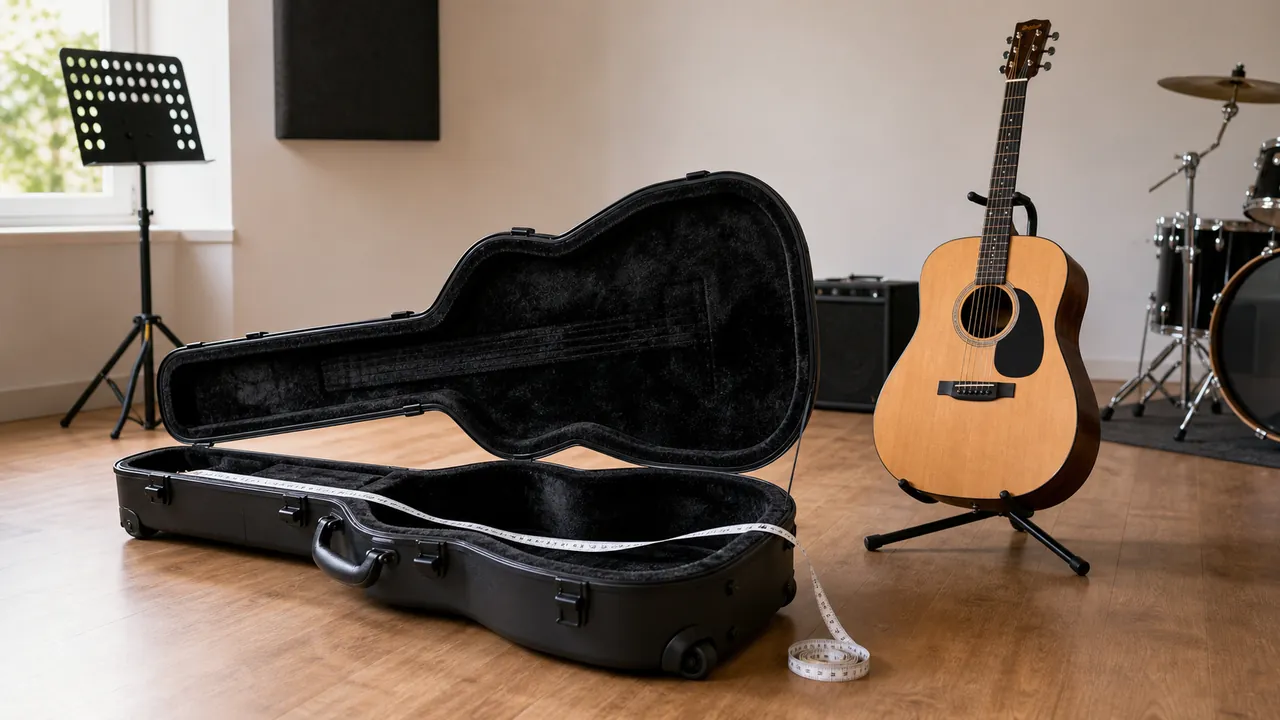
We checked current maker specifications, certification wording, warranty terms and specialist-store availability. We did not fit, carry, submerge or impact-test these cases. Dry-fit your exact guitar and inspect the seal before trusting any case to wet transport.
Dreadnought: SKB 3i-4217-18
Classical: SKB 3i-4217-30
Strat/Tele: Gator GWP-ELECTRIC
Single-cut: Gator GWP-LP
Avoid all four if your guitar is a jumbo, 335-style, offset, extended-scale, 12-string, Explorer/V or has unusual headstock geometry without a documented dry-fit.
Verify before buying: cavity length, lower bout, body depth and free space above the bridge and headstock. Open the fit workbench
Read the label before the weather forecast
What sealed-case language really asks you to check
IP67
An enclosure rating: the first digit addresses dust ingress and the second addresses a defined temporary water-immersion test.
It describes a closed enclosure under test conditions, not an unlimited flood guarantee for the guitar.
Confirm the exact model carries the rating, then inspect the gasket and every latch.
“7” does not mean indefinitely waterproof or covered against water damage by warranty.
Gasket seal
A compressible ring between lid and shell that closes the path for water and dust.
A cable, strap end, grit or twisted section can interrupt that path.
Wipe it clean, run a finger around it and close all latches evenly.
A rugged shell alone is not a sealed case.
Maximum cavity
The published inside envelope, usually length, bout widths and depth.
A guitar touching the stated maximum has no margin for lining, hardware or measurement error.
Measure the instrument at its widest and tallest points and ask the seller for a dry-fit.
Matching total length does not prove bridge or headstock clearance.
Bout
The wide upper and lower portions of a guitar body.
The lower bout often controls whether an acoustic enters the molded cavity.
Measure straight across the widest point, not around the curve.
Two guitars sold under the same body-family name can have different bout measurements.
Pressure valve
A valve intended to equalize pressure while preserving the enclosure seal.
It can make a sealed case easier to open after altitude or pressure changes.
Keep it unobstructed and follow the maker’s instructions.
It is not ventilation for a wet guitar; moisture trapped inside remains a problem.
ATA-300
A reusable-container performance specification referenced for airline-style transport cases.
It concerns the container, while baggage handling, instrument fit and carrier liability remain separate.
Check the airline’s instrument and claim rules before the trip.
ATA wording is not airline approval, insurance or a promise of damage-free travel.
Selection boundary
Why these four cases are compared by cavity, not rank
Thomann was the European retailer anchor and Sweetwater the US anchor. We looked for current ordering evidence, exact-model activity signals and official water-sealing language. Review counts only showed that buyers are engaging with a model; they did not become a quality score.
The shortlist stops where the evidence stops. Ordinary padded bags, even useful rain-resistant ones, are not substitutes for gasketed molded cases. The broad-cavity SKB 3i-4214-OP was removed after the current availability check showed backorder or unavailable states. That is more useful than preserving a familiar name in a shopping list.
Use measurements, not body-family confidence
Shortlist by instrument envelope
Use this table to choose the lane to investigate. Treat every dimension as a ceiling, not a target; lining compression and vulnerable hardware need space.
| Case | Intended fit | Published interior clues | Seal/test language | Empty weight | Primary caution |
|---|---|---|---|---|---|
| SKB 3i-4217-18 | Dreadnought; maker also names Taylor Grand Auditorium | 41 in length; 16 in lower bout; 5.25 in body depth | MIL-STD 810H water/dust-tight and submersible wording | 23.58 lb / 10.7 kg | Not a jumbo cavity |
| SKB 3i-4217-30 | Most classical and some thinline acoustics | 40.75 in length; 15.5 in lower bout; 4.5 in depth | Gasketed watertight/submersible wording | 24.18 lb / 10.97 kg | Check bridge and headstock height |
| Gator GWP-ELECTRIC | Standard Strat/Tele-style electric | 40.9 in overall; 13 in lower bout; 2.8 in body height | IP67 and MIL-STD-810F immersion | 21.87 lb / 9.92 kg | Not for angled-headstock single-cuts |
| Gator GWP-LP | Compatible left/right single-cut electric | 41.1 in overall; 13.4 in lower bout; 3.7 in body height | IP67 and MIL-STD-810F immersion | 21.71 lb / 9.85 kg | Neck pitch and headstock still need a dry-fit |
Four different jobs
Case choices that survive the fit question
Dreadnought and measured Grand Auditorium
SKB 3i-4217-18: begin with the lower bout
The 16-inch lower-bout and 5.25-inch body-depth figures make this the clearest current acoustic lane, and both US and European specialist retailers carried it during research.
Advantage: complete published cavity, wheels, pressure valve and strong current retailer activity.
Tradeoff: 23.58 lb before the guitar, accessories or tracking device.
Avoid if: the instrument is a jumbo, has unusually tall bridge hardware, or reaches any cavity maximum without margin.
Alternative: the 3i-4217-30 only for a genuinely smaller classical/thinline outline, not merely to save space.
Check at purchase: compare the maker’s current drawing with your own measurements and request a lid-clearance dry-fit.
Found a changed specification or source? Report a correction.
Classical and thinline acoustic
SKB 3i-4217-30: the smaller acoustic cavity
Its 15.5-inch lower bout and 4.5-inch depth establish a different body lane rather than a cheaper or “better” version of the dreadnought case.
Advantage: exact-model page publishes dimensions, construction and Orange, California manufacture.
Tradeoff: it is actually the heaviest case here at 24.18 lb empty.
Avoid if: an armrest, pickup hardware, tall bridge or headstock shape approaches the lid.
Alternative: move to the 3i-4217-18 only when its body supports match; excess cavity space is not automatically safer.
Check at purchase: ask the shop to close the lid over thin witness paper at the bridge and headstock without forcing it.
Standard Strat/Tele-style electric
Gator GWP-ELECTRIC: a defined solidbody lane
The official fit statement, 2.8-inch body-height figure and current Sweetwater stock make it the most supportable sealed choice here for conventional Strat/Tele outlines.
Advantage: IP67 and immersion-test wording, wheels and a lower empty weight than the acoustic cases.
Tradeoff: model-specific origin was not disclosed in the checked maker material, and 21.87 lb is still substantial.
Avoid if: the guitar has an offset body, long scale, angled headstock or nonstandard control hardware.
Alternative: wait for an ordinarily stocked broad-cavity case or commission a fitted flight case; do not force a different Titan cavity.
Check at purchase: verify the physical origin label and dry-fit the exact instrument, including strap locks.
Compatible Les Paul-style single-cut electric
Gator GWP-LP: room for the single-cut geometry
The maker provides a 3.7-inch body-height limit and explicitly includes left- and right-handed single-cuts; Sweetwater and Thomann both carried the exact case.
Advantage: strongest cross-market presence among the electric lanes and the lightest empty figure here, though only by a small margin.
Tradeoff: a carved top, neck pitch and angled headstock make real lid clearance more important than the family name.
Avoid if: closing the lid needs pressure or leaves witness marks over the bridge/headstock.
Alternative: a seller-fitted or custom cavity is preferable to substituting the shallower GWP-ELECTRIC.
Check at purchase: Thomann states US manufacture; verify the delivered label because batch and market details can change.
Prevent a pressure-point purchase
Build a three-number fit envelope before ordering
- Outline: place the guitar on clean paper and trace around the body and headstock without touching the finish with ink.
- Height: with strings facing up, measure from the supporting back plane to the highest bridge, control or headstock point.
- Margin: compare your maximums with the case drawing. Do not count plush compression as clearance.
- Lid test: ask the seller to place loose witness paper over vulnerable points and close the lid without pressure. Creasing or a hard imprint means stop.
Prevent a broken seal at load-out
Do one closed-gasket rehearsal while everything is dry
Pack the real strap, cable, tools and humidity accessories. Confirm nothing crosses the gasket channel. Clean the seal, close every latch in sequence, lift by each intended handle and roll the loaded case over the surfaces you actually use. Reopen it and look for shifted accessories, lining pressure and gasket debris. This checks packing discipline; it does not recreate an immersion test.
Protection has edges
Waterproof does not mean heatproof, insured or maintenance-free
Heat
A dark closed case can still become hot. Do not leave the instrument in a vehicle or direct sun because the shell carries a water rating.
Humidity
A seal can keep unwanted moisture in as effectively as it keeps rain out. Dry the guitar and case before closing; monitor humidity when the instrument requires it.
Claims
Gator’s written warranty excludes water, accidental and transport damage. SKB’s lifetime language covers defects for the original owner under stated conditions. Neither replaces carrier insurance or prompt documentation.
Due diligence after fit
Shell, origin and written support facts
| Product | Size and weight | Construction | Manufacturing origin | Brand | Warranty/support |
|---|---|---|---|---|---|
| SKB 3i-4217-18 | 23.58 lb; exterior 45 × 19.75 × 8.25 in | Injection-molded polypropylene copolymer; plush support; gasket; wheels; pressure valve | SKB states iSeries cases are made in Orange, California, USA | SKB; Orange, California; founded 1977; molded protective cases | Original-owner lifetime defect coverage with proof; modifications, previous ownership and rental/institutional use excluded |
| SKB 3i-4217-30 | 24.18 lb; exterior 45 × 19.75 × 8.25 in | Injection-molded polypropylene copolymer; plush support; gasket; wheels; pressure valve | Exact-model page states designed, made, assembled and finished in Orange, California, USA | SKB; Orange, California; founded 1977; molded protective cases | Original-owner lifetime defect coverage with proof; inbound shipping and listed use/ownership exclusions apply |
| Gator GWP-ELECTRIC | 21.87 lb; exterior 47.2 × 17.7 × 6.7 in | NK-7 resin; plush foam interior; PowerClaw latches; wheels and tow handle | Not disclosed by the manufacturer for this exact model; verify the delivered label | Gator Cases; Tampa, Florida; founded 2000; instrument and technical-equipment cases | Original-owner limited lifetime manufacturing-defect coverage; moving parts one year; water and transport damage excluded |
| Gator GWP-LP | 21.71 lb; exterior 47.2 × 17.1 × 6.7 in | NK-7 resin; plush foam interior; PowerClaw latches; wheels and tow handle | Thomann exact-model listing states made in USA; verify the delivered label | Gator Cases; Tampa, Florida; founded 2000; instrument and technical-equipment cases | Original-owner limited lifetime manufacturing-defect coverage; moving parts one year; water and transport damage excluded |
Before the first wet journey
Make a weather-and-carrier evidence passport
- Photograph the empty cavity, clean gasket and all closed latches.
- Record the case and instrument serial numbers separately.
- Save the current warranty and airline instrument/baggage terms offline.
- Photograph the packed guitar before handoff, without publishing the serial number.
- On arrival, photograph exterior damage before opening or adjusting anything.
- Report carrier damage under the carrier’s deadline; do not assume the case maker covers it.
Check the current page before paying
Maker specifications, warranties and current store signals
- SKB 3i-4217-18 specifications
- SKB 3i-4217-30 specifications
- Gator GWP-ELECTRIC specifications
- Gator GWP-LP specifications
- SKB warranty terms
- Gator warranty terms
- Sweetwater SKB acoustic availability
- Sweetwater Gator waterproof case category
- Thomann SKB iSeries acoustic listing
- Thomann Gator electric-case category
- SKB company history
- Gator company history