Banjo case buying guide
Best Banjo Cases
A case earns its place only when the pot, bridge, neck, fifth-string tuner, and peghead clear the interior.
We checked manufacturer dimensions, construction, warranties, and current ordering at specialist stores on . We did not fit, carry, wet, drop, or check these cases with a carrier. Bring your banjo measurements and keep a return path until the lid closes without contact.
Local backpack carry: Protec CF204
Measured molded hard case: Gator GC-BANJO-XL
Closed-back 4/5-string latch case: SKB 1SKB-50
Avoid: ordering from pot diameter alone. Verify: bridge and peghead clearance with the seller's permission before removing tags.
Build the fit passport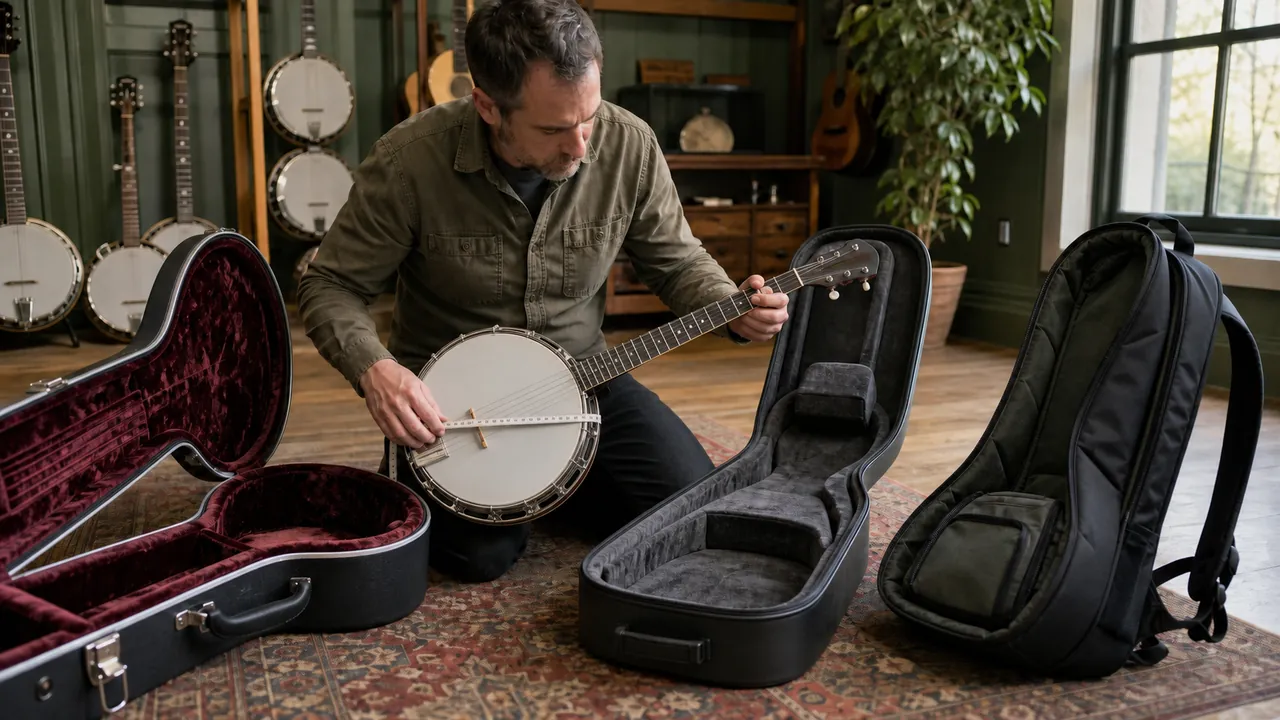
Measure the instrument you own
Write a six-line fit passport before viewing cases
1. Overall length
Tailpiece end to farthest peghead point.
2. Pot envelope
Maximum width and depth, including resonator and hardware.
3. Peghead envelope
Widest point, angle, and tuner projections.
4. Fifth-string projection
Where the side tuner sits and how far it protrudes.
5. Bridge/top height
Highest point above the back when the banjo lies naturally.
6. Attached hardware
Strap, pickup jack, armrest, and anything not removed for travel.
Compare each line with the case's usable interior, not its exterior. Published maxima do not reveal every contour or foam-compression point, so passing the numbers earns a trial, not a fit guarantee.
Read the cavity, not the adjectives
Case terms that change what touches the banjo
Pot
The circular body containing the rim and head.
Its widest hardware or resonator edge controls body-cavity fit.
Measure the true maximum width and depth with armrest and flange.
An 11-inch head does not mean an 11-inch overall pot envelope.
Resonator / open back
A resonator is the back bowl on many bluegrass banjos; an open-back banjo omits it.
It changes depth, support points, and how a universal cavity holds the instrument.
Tell the seller which construction you have and provide depth.
A case labeled for banjo may be scoped only to closed-back instruments.
Neck cradle
A padded support holds the neck above the case floor.
Its height and position affect peghead and bridge clearance.
Check that the neck rests naturally without levering the pot or peghead.
More foam is not automatically better if it pushes at the wrong point.
Bridge clearance
The space between the banjo's highest bridge/top area and the closed lid.
Lid pressure can load a vulnerable point even when pot width fits.
Use the reversible tissue contact test below.
A lid that latches under force is not evidence of safe clearance.
EPS / polyfoam
Expanded foam forms a rigid, shaped support core inside some cases.
It can reduce weight and hold contours, but shell systems still differ.
Inspect cracks, compression, neck support, and replaceable hardware.
Foam thickness alone does not predict impact performance.
Valance
The reinforced edge where hard-case lid and base meet.
Alignment affects closure and where pressure enters the shell.
Close every latch without pressing the lid down and inspect edge alignment.
A metal valance does not make the whole case an airline container.
TSA-recognized latch
A lock can be opened and relocked by authorized airport security tools.
It may reduce forced-lock damage during inspection.
Check current carrier size/custody rules and instrument insurance separately.
The latch is not a guarantee against loss, crushing, or carrier mishandling.
Shortlist method
Three travel jobs survived the fit and stock checks
We mapped Thomann in Europe and Sweetwater in the US, then added Bax for the exact SKB EU order path. Inclusion required a current exact identity, active order path, observable rank/review signal, usable interior evidence, and a lane not duplicated by another case.
Gator's Journeyman was excluded despite high US review volume because recent fit reports and weaker EU confirmation made it a less defensible universal recommendation. Gator GL-BANJO XL was excluded when the exact EU path could not be confirmed. Six-string and brand-fitted cases belong in separate measurements. Three products are enough because the decision is custody and fit, not shell-color variety.
Measured comparison
Choose the custody level, then check the envelope
| Case | Published usable interior | Carry / closure | Best-controlled job | Retail signal |
|---|---|---|---|---|
| Protec CF204 | 950 x 370 x 130 mm dealer-listed interior | 1.0 kg; backpack strap; zip | Owner-controlled walking, lessons, local transit | Thomann rank 18, 63 ratings; both anchors in stock |
| Gator GC-BANJO-XL | 1049 mm overall; 366 mm body width; 99 mm body height | ABS/EPS; latches; handle/strap | Car, rehearsal, home and owner-controlled loading | Thomann rank 16, 15 ratings; Sweetwater 6 reviews |
| SKB 1SKB-50 | 1060 mm overall; 362 mm body width; 107 mm depth | ABS/EPS; handle; TSA-recognized latches | Closed-back 4/5-string travel with a latch system | Sweetwater 8 reviews/in stock; Bax 4 reviews/orderable |
Cases by handoff risk
Use the least case that matches the real journey
Protec CF204 Gold Series Banjo Gig Bag
The CF204 earns the soft-case lane because its dealer-listed 950 x 370 x 130 mm interior, 25 mm padding, backpack carry, and 1.0 kg weight are unusually legible for a banjo bag.
Advantage: lowest added weight, backpack carry, pockets, and strong Thomann market signal.
Drawback: a zipped padded bag leaves crush, stacking, and custody control to the player; manufacturer detail provenance is incomplete.
Avoid if: the banjo enters a shared gear pile, cargo area, or unsupervised handoff.
Alternative: Gator GC-BANJO-XL for a molded shell.
Verify: exact interior contours, strap adjustment, fifth tuner/peghead space, zipper path, origin, and written warranty.
Found a changed specification or source? Report a correction.
Gator GC-BANJO-XL
This is the baseline hard case because Gator publishes a 1049 mm overall interior, 366 mm body width, 99 mm body height, ABS shell, EPS core, valance, and warranty limits while both anchors stock it.
Advantage: strongest exact-model evidence in the shortlist, lockable latches, handle plus shoulder strap, and two-market stock.
Drawback: official 3.62 kg and Thomann 4.54 kg weights conflict; storage is small and user fit reports are mixed.
Avoid if: any fit-passport line approaches a cavity maximum or the lid touches bridge, tuners, or tailpiece.
Alternative: Protec for owner-controlled light carry; SKB for a closed-back latch system.
Verify: empty weight, all contact points, accessory compartment, replacement hardware, origin, and local warranty process.
SKB 1SKB-50 Universal Banjo Case
Choose the 1SKB-50 only when its explicit closed-back 4/5-string scope and 1060 x 362 x 107 mm envelope match the instrument, and TSA-recognized latches solve an inspection need.
Advantage: molded bumpers, EPS support, replaceable latch system, US stock, EU order path, and a clear manufacturer defect warranty.
Drawback: no backpack carry, exclusion of six-string banjos, 3.6/3.9 kg weight conflict, and no carrier-damage promise.
Avoid if: the banjo is open-back, six-string, oversized, or likely to be checked without a separate custody/insurance plan.
Alternative: Gator GC-BANJO-XL for a different measured cavity.
Verify: exact fit, empty weight, current carrier rules, manufacturing label, lock procedure, and proof-of-purchase requirements.
The no-pressure close
Use tissue to find hidden lid contact
- With seller permission and tags attached, place small loose pieces of plain tissue over the bridge, peghead tips, fifth-string tuner, armrest, and tailpiece.
- Lay the banjo in naturally. Do not remove the bridge, force foam, or push the lid.
- Close and latch using normal finger effort, reopen, and inspect for compressed, torn, or displaced tissue.
- Reject or refit when a vulnerable point shows contact. Added loose padding can move pressure rather than solve it; ask a repair technician or case fitter before modifying support.
Travel custody ladder
Escalate the case when control leaves your hands
On your body: padded bag may be rational after fit and zipper checks.
Your vehicle, your loading: measured hard shell adds structure.
Shared van or stage pile: require hard-shell fit, labeled orientation, and a no-stacking conversation.
Carrier handoff: current carrier rules, gate/cabin options, insurance, documentation, and instrument setup matter beyond the latch. A TSA-recognized lock is only one detail.
Shop script
Ask for the cavity, not “Will my banjo fit?”
“My banjo is ___ mm overall, ___ mm across and ___ mm deep at the pot, with a ___ mm peghead and a fifth tuner projecting ___ mm. The highest bridge/top point is ___ mm. Which interior points did you measure, may I test lid contact before removing tags, and can I return it if the neck cradle or lid creates pressure?”
Due diligence
Banjo-case size, shell, maker and warranty
| Product | Size / weight | Construction | Manufacturing origin | Brand | Warranty / support |
|---|---|---|---|---|---|
| Protec CF204 Gold Series Banjo Gig Bag | Exterior 1020 x 406 x 127 mm; interior 950 x 370 x 130 mm; 1.0 kg (dealer fallback). | 600D nylon, 25 mm padding, YKK zips, pockets, backpack strap. | Not verified for this exact model. | Protec; base and establishment date were not verified in the checked sources; known here for padded instrument cases/bags. | Manufacturer term not verified; obtain it in writing. Thomann and Sweetwater list separate retailer coverage. |
| Gator GC-BANJO-XL | Exterior 1130 x 429 x 180 mm. Gator: 3.62 kg; Thomann: 4.54 kg. Verify empty-case weight. | ABS shell, aluminum valance, EPS foam, plush lining, lockable latches. | Not disclosed by Gator for this exact model. | Gator Cases, Tampa, Florida; founded 2000; molded, wood, sewn, and EVA case systems. | Limited lifetime manufacturing-defect coverage for original owner; moving parts one year; transport damage excluded. |
| SKB 1SKB-50 Universal Banjo Case | Exterior 1111 x 412 x 184 mm. SKB Europe: 3.9 kg; B&H: 3.6 kg. Verify. | ABS shell, molded bumpers, EPS plush interior, aluminum valance, trigger latches. | Not verified for this exact model; general US-manufacturing claims are not exact-model evidence. | SKB Cases, Orange, California; founded 1977; molded protection for music and other industries. | Lifetime material/workmanship defect coverage to original owner; proof required; foam, normal wear, misuse, and prior ownership excluded. |
Protection claims to refuse
A case cannot promise custody it does not control
- “Universal”: means a target range, not your instrument's fit result.
- “Water resistant”: is not submersion or indefinite-rain protection.
- “Hard shell”: does not establish tested impact performance.
- “TSA lock”: describes authorized access, not baggage handling.
- “Lifetime warranty”: usually covers manufacturing defects under named ownership/proof limits, not the banjo or carrier damage.
Before tags come off
Run the closure, carry, and return checks
- Match the fit passport to the seller's measurement context and request missing contour data.
- Confirm the exact banjo type, string count, resonator/open-back scope, and attached hardware.
- Close every latch or zipper without lid pressure; run the tissue contact check.
- Load only harmless equivalent weight first and inspect handle/strap adjustment; this is not durability testing.
- Photograph the empty case, fit, serial/labels, and written warranty/return terms before travel.
Sources and current order checks
Recheck dimensions and stock before buying
- Sweetwater banjo cases category
- Thomann other fretted-instrument cases
- Gator GC-BANJO-XL specifications and warranty
- Thomann Gator molded case listing
- Sweetwater Gator ordering page
- Thomann Protec CF204 listing
- Sweetwater Protec CF204 listing
- SKB 1SKB-50 product page
- SKB Europe 1SKB-50 dimensions
- Sweetwater SKB ordering page
- Bax SKB EU/UK order page
- B&H SKB dimension fallback
- Gator company history
- SKB company history
- SKB warranty terms
No affiliate links are used. Stock, dimensions, carrier rules, and warranty terms can change. No unverified correction/contact link is published.