The band suffix is part of the product
Best wireless microphone systems by frequency, channels, and connections
Start with the country and venue, then choose the exact radio variant, simultaneous-channel plan, and mixer path.
We checked current maker documents, exact US and continental-European store offers, regulator boundaries, and seller policies on . We did not perform listening, range, RF-reliability, or interference tests. A legal band can still fail in a crowded room, so every pick needs a local check and full rehearsal.
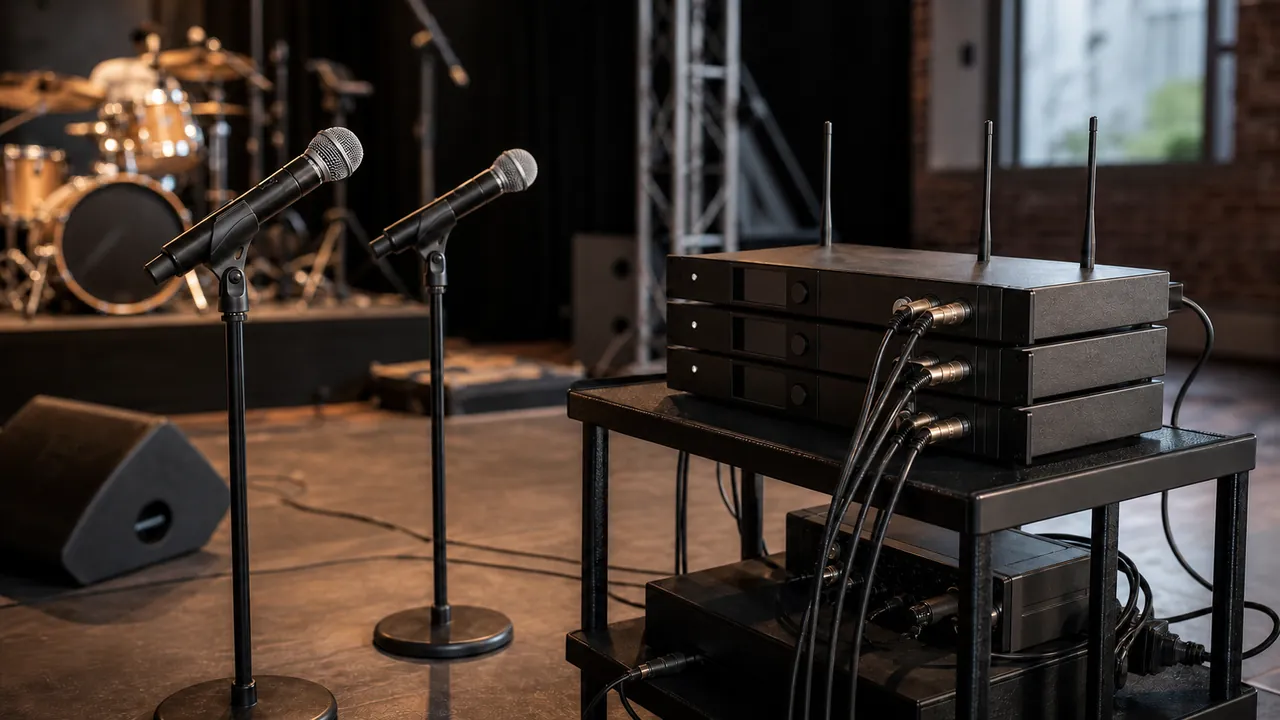
Quick direction: BLX is the bounded analog choice; GLX-D+ is the rechargeable shared-band choice; EW-D is the scalable digital-UHF path; SLX-D+ is for a staffed production that will use its management tools.
Do not import the frequency set. The US H10, R4-9, and G57 examples are not European buying advice. The EU T11, R1-6, and S50 examples are not US substitutes.
Choose the operating lane before the capsule
| System | Selected US / EU variants | Channels and tuning | Connections and power | Best fit |
|---|---|---|---|---|
| Shure BLX24/SM58 | H10 542-572 MHz / T11 863-865 MHz | One channel; H10 30 MHz, T11 2 MHz. T11 retailer page says up to three systems. | XLR and 1/4-inch; external supply; two AA cells; tabletop, fixed antennas | A small, stable one-channel room with a verified local band |
| Shure GLXD24+/SM58 | US Z3 maker SKU / EU exact set but suffix unpublished | One channel; automatic 2.4/5.8 GHz modes are region dependent | XLR and 1/4-inch; SB904 rechargeable battery; receiver charging bay; tabletop | One rechargeable channel where event-load Wi-Fi checks are practical |
| Sennheiser EW-D 835-S | R4-9 552-607.8 MHz / R1-6 520-576 MHz | One channel per receiver; 56 MHz tuning; 1.9 ms published latency | XLR and 1/4-inch; detachable BNC antennas; rack kit; AA base, optional BA 70 | A coordinated UHF inventory expected to grow |
| Shure SLXD24+/SM58 | G57 470-608 MHz / S50 823-832 and 863-865 MHz | One channel; G57 138 MHz, S50 split 42 MHz span; 2.8 ms latency | XLR and 1/4-inch; Ethernet/management; rack kit; AA base, optional SB903 | A trained operator who needs remote status and control |
Terms that change what you should order
Frequency band and band suffix
The frequency band is the radio range a transmitter and receiver can tune. H10, T11, R4-9, R1-6, G57, and S50 are not cosmetic suffixes: they identify different ranges. Match the maker SKU and delivered label to the destination regulator and venue record. A family name alone is not enough.
UHF
UHF here means radio spectrum used by many professional wireless systems. It can offer useful venue-specific tuning space, but access depends on country, location, TV use, licence class, and exact frequency. Check the exact frequency against the destination regulator and venue plan. “UHF” never means universally legal.
Shared 2.4 and 5.8 GHz spectrum
These bands are also used by Wi-Fi and other equipment. A system may be licence-exempt under local conditions while still competing for airtime. Turn on event Wi-Fi and nearby devices before scanning. Automatic switching is a tool, not proof of a clean show.
Tuning bandwidth
This is the span an exact variant can tune, not the amount guaranteed to be legal or free. More span gives a coordinator more places to look. Compare the exact variant's span with local permission and occupied channels. It does not create permission or erase local transmitters; S50's split ranges are not G57's continuous 138 MHz.
Simultaneous channel
One independent voice needs one receiver channel and one matching transmitter. “Up to” counts assume specific spacing, bands, and environments. Count every vocal mic, headset, guest set, instrument pack, and in-ear system before buying receivers or mixer inputs. A receiver name does not guarantee every advertised channel count in every room.
Scan versus coordination
A scan looks for energy at one place and time. Coordination considers every transmitter together, compatible spacing, local TV assignments, spares, and other venue RF. For several channels, name the person and software or service that owns this work. One clean scan does not prove a multi-system plan will coexist.
XLR, 1/4-inch, and receiver output level
XLR is the usual balanced path to a mixer microphone input; 1/4-inch may serve an instrument or line-oriented path depending on the receiver and mixer. The wrong level or input can make gain setup difficult. Confirm connector, cable, input type, gain range, and the receiver's phantom-power guidance. A matching plug shape does not by itself prove electrical compatibility.
Rack kit, detachable antennas, and remote placement
A rack kit secures a receiver in a standard equipment rack; detachable BNC antennas support different mounting and distribution plans. Fixed and detachable antennas create different installation constraints. Draw receiver position, antenna line of sight, cable runs, rack units, power outlets, and ventilation before buying. Rack ears do not automatically include every cable, distributor, or remote antenna needed.
Match the system to the room and channel count
Shure BLX24/SM58: one bounded analog-UHF channel
For: a rehearsal room, presentation space, or small stage that needs one uncomplicated handheld and has already verified a local frequency block.
The exact US H10 set and continental-European T11 set were directly orderable, but they are different products for different radio contexts. Both include a BLX receiver, BLX2/SM58 handheld, supply, clip, and AA cells. The practical case is simplicity, not a claim that BLX sounds or travels better.
Advantage: straightforward scan/group controls, XLR and 1/4-inch outputs, and a published up-to-14-hour AA headline.
Tradeoff: fixed internal antennas and narrow tuning limit the growth path. The T11 page says up to three systems, so do not borrow a higher family count.
Avoid if: more channels, touring, remote antennas, or centralized coordination are likely.
Alternative: EW-D 835-S for rack mounting, detachable antennas, and a documented 56 MHz regional tuning path.
Verify: exact H10 or T11 maker suffix, local permission, other venue RF, receiver-to-mixer cable, power-supply plug, and allowed seller handling.
Shure GLXD24+/SM58: rechargeable shared-spectrum simplicity
For: one handheld where a rechargeable battery and automatic 2.4/5.8 GHz operation matter more than UHF tuning or a rack.
The tabletop set includes the GLXD4+ receiver, GLXD2+/SM58 handheld, and SB904 rechargeable battery; the receiver provides XLR and 1/4-inch outputs plus a charging bay. The US maker page identifies Z3. The checked EU retailer page does not print its maker suffix, so cross-market identity stays unresolved.
Advantage: the included rechargeable path removes routine AA purchases, and dual-band automation can move among locally supported shared-band options.
Tradeoff: event Wi-Fi, computers, routers, and other 2.4/5.8 GHz devices share the environment. Fixed tabletop antennas restrict placement choices.
Avoid if: the venue has heavy shared-band load, several channels, remote-antenna requirements, or no time for an event-load rehearsal.
Alternative: EW-D for coordinated UHF and rack/antenna expansion; GLXD24R+/SM58 when the same family needs a rack receiver and detachable antennas.
Verify: exact regional suffix and power pack, supported band modes, live Wi-Fi load, charger/cable contents, mixer input, and firmware.
Sennheiser EW-D 835-S: the clearest scalable UHF path
For: a band, school, worship room, or venue building a coordinated rack one channel at a time.
Current Sennheiser documentation maps US R4-9 to article 508752 and EU R1-6 to 508751. Each set includes a rack receiver, SKM-S handheld, MMD 835 capsule, antennas, rack kit, supply with country adapters, clip, and AA cells. The system publishes 56 MHz tuning and 1.9 ms latency.
Advantage: exact article mapping, detachable BNC antennas, rack hardware, app-assisted setup, interchangeable capsule, and a coherent expansion path.
Tradeoff: one receiver still equals one channel; rechargeable BA 70 packs and charging hardware cost extra, and country changes demand new coordination.
Avoid if: nobody will own frequency planning or the system must cross borders without destination-specific research.
Alternative: GLX-D+ for one rechargeable tabletop channel; SLX-D+ when remote transmitter control and wider regional tuning earn their complexity.
Verify: maker article 508752 or 508751, lawful usable frequencies at every venue, total receiver count, antenna plan, rack depth, mixer inputs, and battery accessories.
Shure SLXD24+/SM58: management tools for a staffed production
For: an operator who will use network monitoring, remote transmitter control, encryption, scans, a show file, and fallback assignments.
The US G57 exact set covers 470-608 MHz; the European S50 set covers 823-832 and 863-865 MHz. Both include a one-channel rack receiver, SM58 handheld, antennas, rack hardware, supply, clip, pouch, and AA cells. Shure publishes 2.8 ms latency and management features for SLX-D+.
Advantage: remote status/control, Wireless Workbench support, encryption, detachable antennas, and G57's broad US tuning give a trained operator more tools.
Tradeoff: S50 is a split 42 MHz regional span, not G57's 138 MHz. Automatic actions and feedback-reduction software do not replace RF or acoustic engineering.
Avoid if: one occasional channel is the whole job or nobody will maintain firmware, scans, frequency files, and spares.
Alternative: EW-D for a simpler documented UHF growth path. The checked EU S50 offer was orderable at short notice, not immediately in stock.
Verify: G57 or S50 maker SKU, local authorization for each tuned frequency, current lead time, software/device support, antenna distribution, and written warranty terms.
US and European frequency rules are not interchangeable
In the United States, FCC material states that after July 13, 2020, wireless microphone operation in the repurposed 600 MHz service band is restricted to specified guard-band and duplex-gap segments. A receiver that can display a frequency does not prove you may transmit there. Use the current FCC rules and a location-specific coordination tool, then account for local TV use and licence eligibility.
For the European Union, the current reference is Implementing Decision (EU) 2025/105. It replaced the older 2014 PMSE decision from July 1, 2025 and sets harmonized technical conditions that include 821.5-832 MHz and 863-865 MHz with power and use conditions. Member-state implementation still matters. Germany's Bundesnetzagentur assignments are useful for Germany, not a passport for France, Greece, Spain, or another destination.
The safe purchase question is never “Is UHF legal?” It is “May this exact transmitter operate at this exact frequency and power, for this user and event, at this address and date?” Ask the national regulator or a qualified local coordinator when the answer is unclear.
Build a frequency passport before checkout
Write the destination
Country, venue address, event date, indoor/outdoor use, user/licence class, and the regulator page or coordinator who confirmed the plan.
Write the exact box
Maker SKU, band suffix, lower/upper ranges, output power, receiver, transmitter, capsule, supply, plug, and seller URL. Keep seller IDs labeled as seller IDs.
Match delivery
Before discarding packaging, compare invoice, receiver label, transmitter label, power supply, and included parts with the passport. Stop on any mismatch.
Rehearse the whole wireless system, not one microphone
Manufacturer range and channel headlines are test conditions, not room promises. Bodies absorb RF, metal and walls reflect it, and a clean scan before doors may change when the audience and network arrive. This rehearsal is a buyer test, not evidence that these picks already passed your venue.
Ask permission before turning the return window into a rehearsal
Sweetwater, US: the new-product policy is usually about 30 days from shipping and can provide refund, in-house credit, or exchange after an RA. Return the item in received condition with every accessory, document, original box, intact UPC, and original packing; double-box when it arrived that way. The customer normally pays tracked return shipping, free outbound shipping can be deducted, and redeemed promotions can trigger a restocking fee. Special orders, modifications, closeouts, used gear, and listed exceptions follow different rules.
Thomann, continental EU: its voluntary 30-day promise sits alongside statutory rights and asks for original packaging, every component/accessory, and no signs of use. The EU-localized page says Thomann assumes return-delivery cost within the EU, but country, carrier, freight, and self-arranged cases should be confirmed. Custom/modified, wear, hygiene, and registered/licensed items are exceptions. Remedy can be refund, account credit, or credit toward another product.
Neither seller promises that a paid show or unrestricted venue walk preserves the remedy. Before inserting batteries, rack mounting, removing films, or conducting a rehearsal, describe the planned handling and get the allowed condition and costs in writing.
Which wireless sets earn a venue rehearsal
We started with current Sweetwater and Thomann handheld-wireless ranges, then challenged each lane with XSW 1, System 10, BLX rack, GLX-D+ rack, QLX-D, EW-DX, and dual-channel alternatives. Inclusion required a current complete set, official identity, exact US and continental-European order paths, a separate popularity signal, useful regional documentation, a clear downside, and a distinct buyer lane. Popularity decided which models deserved investigation, not which product performed best.
No matched independent test covered both exact regional variants under the same RF and acoustic conditions. The guide therefore does not rank sound, range, reliability, interference resistance, or feedback behavior. The winners are documented purchase paths; the reader's local check and return-safe rehearsal carry the unresolved performance question.
What arrives in the set and who covers it
| Product | Brand | Size and weight | Construction and set | Manufacturing origin | Regional identity | Warranty |
|---|---|---|---|---|---|---|
| Shure BLX24/SM58 | Shure, founded 1925 | BLX4 40 x 188 x 103 mm, 241 g; BLX2 224 x 53 mm, 218 g without cells | Moulded ABS receiver/handheld; SM58 capsule, supply, clip, AA cells | Not disclosed for either exact complete set | Paired variants: BLX24/SM58-H10 US; BLX24/SM58-T11 EU | Shure US says two years for covered authorized-channel products; Thomann seller coverage is separate. Purchaser, proof, exclusions, shipping, remedy, and local rights apply. |
| Shure GLXD24+/SM58 | Shure, founded 1925 | GLXD4+ 182.82 x 121.97 x 40.3 mm folded, 310 g; Thomann complete-set total 0.95 kg | PC/ABS tabletop receiver, fixed antennas, GLXD2+/SM58, SB904, charging path, supply, clip, case | Not disclosed for either exact complete set | US is GLXD24+/SM58-Z3; EU maker suffix unpublished on selected offer, so relationship unresolved | Shure US service and Thomann seller coverage are separate; exact market, authorized channel, proof, transfer, exclusions, costs, and remedy must be confirmed. |
| Sennheiser EW-D 835-S | Sennheiser, founded 1945 | EW-D EM receiver 212 x 44 x 189 mm; about 1 kg on retailer record | Rack receiver, SKM-S handheld, MMD 835 capsule, antennas, rack kit, country-adapter supply, clip, AA cells | Not disclosed for exact complete regional articles | Paired maker articles: 508752 R4-9 US; 508751 R1-6 EU | Maker and seller coverage depend on region, authorized channel, proof, exclusions, service route, shipment, and local rights; Thomann's seller guarantee is separate. |
| Shure SLXD24+/SM58 | Shure, founded 1925 | Receiver 197 x 42 x 152 mm, 900 g; handheld 144 g before cells on EU retailer record | Metal rack receiver/handheld, SM58 capsule, antennas, rack kit, supply, clip, pouch, AA cells | Not disclosed for either exact complete set | Paired variants: SLXD24+/58-G57 US; SLXD24+E/SM58-S50 EU | Shure US and Thomann seller terms are separate. Confirm exact SLX-D+ market/channel eligibility, proof, transfer, exclusions, buyer costs, service handler, and remedy. |
Sources
- BLX: Shure BLX24/SM58, BLX guide, Sweetwater H10, H10 reviews, Thomann T11.
- GLX-D+: Shure GLXD24+/SM58, GLXD4+ guide, Sweetwater tabletop SM58, GLX-D+ reviews, Thomann tabletop SM58.
- EW-D: EW-D 835-S exact articles, EW-D system specifications, Sweetwater R4-R9, R4-R9 reviews, Thomann R1-6.
- SLX-D+: Shure US G57 set, Shure Europe variants, SLXD4+ guide, Sweetwater G57, G57 reviews, Thomann Greece S50.
- Spectrum: FCC 24-22, Shure Frequency Finder, EU Implementing Decision 2025/105, Bundesnetzagentur assignments.
- Returns and warranty: Sweetwater returns, Thomann EU money-back policy, Thomann terms and guarantee, Shure service/warranty, Sennheiser warranty conditions.
- Candidate pool: Sweetwater handheld systems, Thomann handheld systems, Sennheiser XSW 1-835 A, Audio-Technica ATW-1102, Shure BLX24R/SM58 H10, Shure QLXD24/SM58 G51.
Stock, lead time, firmware, policies, and spectrum rules can change. Reopen the exact offer and regulator record for the destination immediately before ordering.