Exact models checked
Best mixing and mastering headphones by check
Choose the flaw you need to expose, then build a second check around it. An open headphone can clarify detail in a quiet room; a closed headphone can test isolation-dependent work. Neither replaces speakers, references or level matching.
We checked current manufacturer specifications, manuals, replaceable parts, and US/EU order paths at Sweetwater and Thomann. We did not listen to, measure or wear these headphones. Tonal balance, seal, comfort, unit variation and translation remain buyer tests; no model is called flat from marketing language alone.
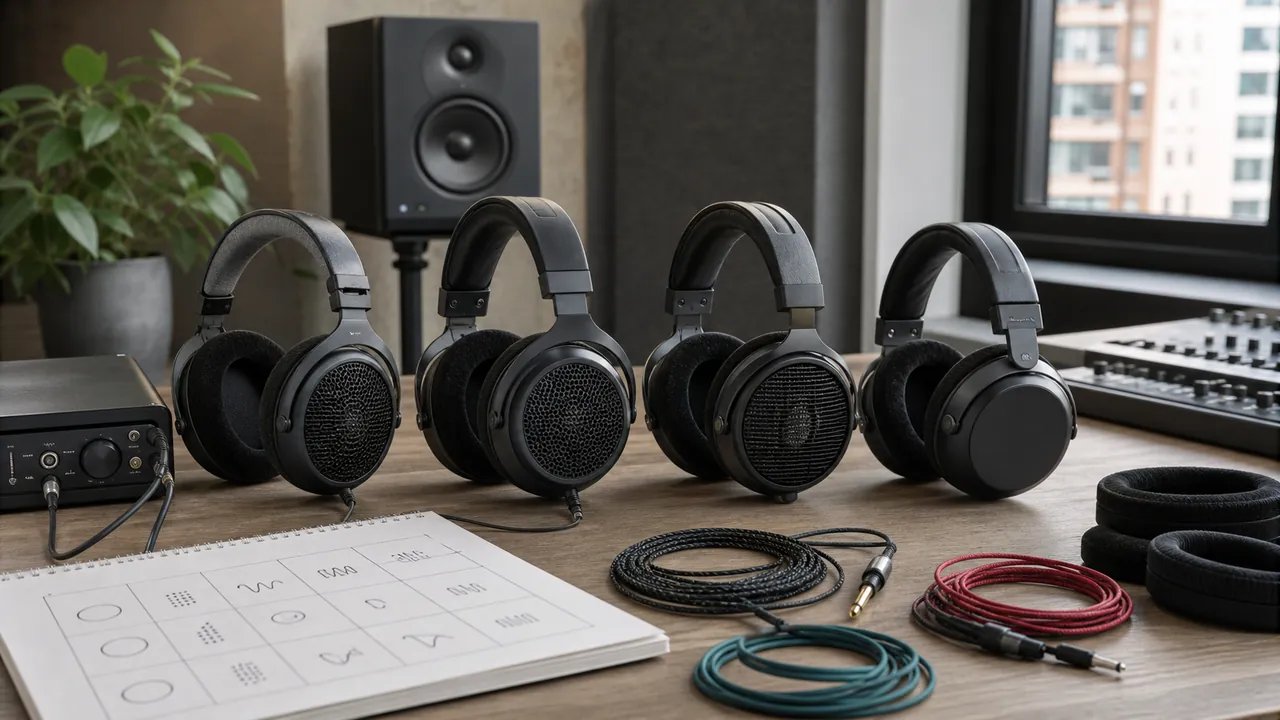
A useful shortlist is a set of different checks
| Exact model | Design / load | Why it earns a lane | Ownership reality | Reject when |
|---|---|---|---|---|
| ATH-R70xa | Open / 470 ohms | 199 g current-generation open reference | Detachable 3 m cable; replaceable pads and head pad | Your output cannot provide clean useful level |
| DT 1990 PRO MKII | Open / 30 ohms | Two supplied pad tunings and strong parts path | Detachable mini-XLR; two cables; hard case | You want one fixed presentation, not pad-dependent choices |
| HD 650 | Open / 300 ohms | Long-running modular reference with broad activity | Detachable 3 m cable; many replaceable components | 6.3 mm-first long cable or open leakage conflicts |
| NDH 20 | Closed / 150 ohms | Isolation cross-check and mobile editing lane | About 390 g; two detachable cables; replaceable pads | You need an airy open primary or low clamp mass |
Model boundary: ATH-R70xa is the current “a” revision, not the older ATH-R70x. DT 1990 PRO MKII is the 30-ohm second generation, not the 250-ohm original. Those suffixes change the source and ownership decision.
Turn specification words into monitoring decisions
Open-back
A vented cup lets sound pass through the rear of the driver. Room noise enters and program sound leaves. Use it in the quiet room where mix decisions happen. Open construction is not proof of neutrality or wider imaging.
Closed-back
A solid outer cup restricts the rear acoustic path. It can reduce leakage compared with an open design. Check seal with glasses and beside the actual microphone. Closed is not soundproof and does not guarantee accurate bass.
Impedance
Electrical opposition stated in ohms. It combines with sensitivity and source voltage/current to affect level. Test the exact interface output with headroom. 470 ohms is not a quality score, and 30 ohms is not automatically easy for every source.
Sensitivity
Output level for a stated electrical input. Units may be dB per volt or per milliwatt. Compare only like methods and verify at the source. Different units cannot be ranked as if they were one scale.
Translation
How a decision holds up on other known playback systems. A revealing headphone is useful only when its recurring bias is understood. Log the same passages on speakers and ordinary playback. A mix sounding impressive on one headphone is not translation evidence.
Level matching
Comparing sources at closely similar perceived loudness. A small level advantage can be mistaken for more detail or bass. Set repeatable interface positions and avoid instant uncontrolled swaps. The same knob position does not create the same acoustic level across headphones.
Replaceable wear parts
Pads, head cushions and cables available as specified parts. Pad compression can change fit and acoustic behavior over time. Price exact regional parts before purchase and date each pad change. Detachable does not mean universal; connectors and wiring can be proprietary.
Pick the primary view, then name its blind spot
Light open primary
Audio-Technica ATH-R70xa
The 2024 revision combines a 199 g open frame, replaceable wear parts and current US/EU stock.
Advantage: lowest published mass here and assembled in Audio-Technica's Tokyo factory.
Meaningful drawback: 470-ohm load makes the exact output test mandatory.
Avoid if: room noise or microphone leakage is part of daily work.
Alternative: NDH 20 for a closed check.
Exact model and physical facts verified; tonal claims remain untested.
Serviceable open toolkit
Beyerdynamic DT 1990 PRO MKII
The current 30-ohm revision ships with Producing and Mixing pads, two cables and a hard case, creating a documented comparison system.
Advantage: German manufacture and a mature replacement-parts path.
Meaningful drawback: pad choice changes the presentation and must be logged.
Avoid if: you want one immutable reference with no configuration variable.
Alternative: ATH-R70xa for lower mass and one pad voicing.
Current suffix, load and included kit verified; sound and clamp untested.
Known modular baseline
Sennheiser HD 650
Broad cross-market activity, a 300-ohm open design and readily identified modular parts make it a useful learned reference.
Advantage: pads, cable, headband padding and other parts have explicit replacement routes.
Meaningful drawback: the 3 m cable terminates in 6.3 mm and the load needs suitable voltage.
Avoid if: mobile isolation or a short 3.5 mm-first lead matters.
Alternative: DT 1990 PRO MKII for a lower-impedance current studio kit.
Specifications and current order paths verified; no listening inference made from longevity.
Closed translation check
Neumann NDH 20
The closed foldable design, two cables and established US/EU activity make it the deliberate contrast, not a substitute disguised as identical.
Advantage: isolation supports editing where open cups are impractical.
Meaningful drawback: about 390 g and published 5.5-6.8 N contact pressure demand a fit test.
Avoid if: you need a light open primary in a quiet room.
Alternative: ATH-R70xa for the light open lane.
Construction, load, cables and orderability verified; seal and tonal balance untested.
No cup design settles the low end or the master
Open designs still interact with ear shape, pads and room noise. Closed designs add seal as a variable. Published frequency limits do not describe level, smoothness or translation. Final low-end, vocal and limiter decisions should be checked against calibrated speakers where available, familiar references, metering and ordinary playback. This guide selects tools for that system; it does not declare a one-headphone mastering chain.
Build a translation error matrix from three bounces
Bounce the same work after three short decision passes. Change one variable per pass and write the error that reappears elsewhere.
- Balance pass: set vocal, snare and bass relationships on the candidate, then check speakers at a matched working level.
- Edge pass: inspect sibilance, cymbal texture and distortion; check one familiar everyday system.
- Low-end pass: make no correction until you can name whether the issue repeats on speakers and a second headphone.
- Matrix: record recurring over- or under-correction by device. A predictable bias is more useful than a flattering first listen.
Rehearse the source before buying an amplifier
Use the exact interface or monitor controller. Play a familiar uncompressed passage, raise level through the normal working range, and note useful control travel, hiss, channel balance near the bottom and remaining headroom. Do not infer the answer from impedance alone. If an external amplifier is considered, define the problem it solves and preserve a controlled level comparison.
Date the pads because the reference changes with them
Photograph pad thickness from the side on day one, record the part number, and repeat before a critical project or when the seal changes. For DT 1990 PRO MKII, record whether Producing or Mixing pads were installed. For every model, replace left and right as a pair unless the maker instructs otherwise, then rebuild the translation notes instead of assuming continuity.
Physical and support facts behind the shortlist
| Product | Size and weight | Construction | Manufacturing origin | Brand | Warranty/support |
|---|---|---|---|---|---|
| Audio-Technica ATH-R70xa | 199 g without cable; the maker does not state complete external dimensions. | Open aluminum honeycomb housings, carbon-composite resin, detachable 3 m cable. | Assembled at Audio-Technica's Tokyo factory per current product material. | Audio-Technica; Tokyo; founded 1962; cartridges, microphones and headphones. | Regional limited warranty; pads, head pad and cable listed separately. |
| Beyerdynamic DT 1990 PRO MKII | About 376 g without cable; the maker does not state full exterior dimensions. | Open metal frame, mini-XLR cable, two velour pad sets, hard case. | Made in Germany per manufacturer. | Beyerdynamic; Heilbronn; founded 1924; microphones and headphones. | Regional two-year limited warranty; service parts listed. |
| Sennheiser HD 650 | 260 g; the maker does not state full external dimensions. | Open dynamic circumaural frame; detachable 3 m dual-entry cable. | Exact current unit origin not established by cited page. | Sennheiser consumer hearing; German-founded 1945; Sonova-owned. | Two-year regional coverage; modular replacement parts available. |
| Neumann NDH 20 | About 390 g without cable; package 245 x 255 x 84 mm. | Closed aluminum cups, spring-steel band, memory-foam pads, folding hinges. | Not disclosed for the exact cited current unit. | Neumann; Berlin; founded 1928; microphones, monitors and headphones; Sennheiser group. | Two-year term reported in regional material; cables and pads sold separately. |
How market activity was separated from sound claims
Manufacturer pages controlled design, impedance, sensitivity method, weight, included accessories and service parts. Sweetwater and Thomann established current orderability and visible buyer activity. Review counts and long-running stock can lower ownership uncertainty; they cannot establish neutrality, comfort or mastering suitability.
We selected distinct jobs rather than four open headphones with similar copy. Current exact suffixes were required. Wireless, active-noise-canceling and legacy-discontinued models were excluded because battery, codec, latency and software support create a different comparison.
Checks to complete inside the return window
- Verify exact suffix and included pads, cables and adapters.
- Run the source-headroom rehearsal without equating knob position to level.
- Check room leakage and closed-cup seal in the real workspace.
- Complete all three translation bounces before changing equipment.
- Price regional pads, cable and headband parts.
- Confirm return hygiene rules and local warranty handling.
Manufacturer documents and retail checkpoints
- Audio-Technica ATH-R70xa
- ATH-R70xa manual/specification
- Sweetwater ATH-R70xa
- Thomann ATH-R70xa
- Beyerdynamic DT 1990 PRO MKII
- DT 1990 PRO MKII technical data
- Sweetwater DT 1990 PRO MKII
- Thomann DT 1990 PRO MKII
- Sennheiser HD 650
- HD 650 manual
- Sweetwater HD 650
- Thomann HD 650
- Neumann NDH 20
- Sweetwater NDH 20
- Thomann NDH 20
- Audio-Technica warranty
- Beyerdynamic warranty
Found a changed suffix, part or stock state? Contact Consordini with the exact source.
No affiliate links are enabled. The sole image is AI-generated and is not product or test evidence.