Carry class before feature count
Best Portable Bluetooth Speakers
Pick the distance you will carry it, the group it must serve, and the charging plan before comparing published output or battery numbers.
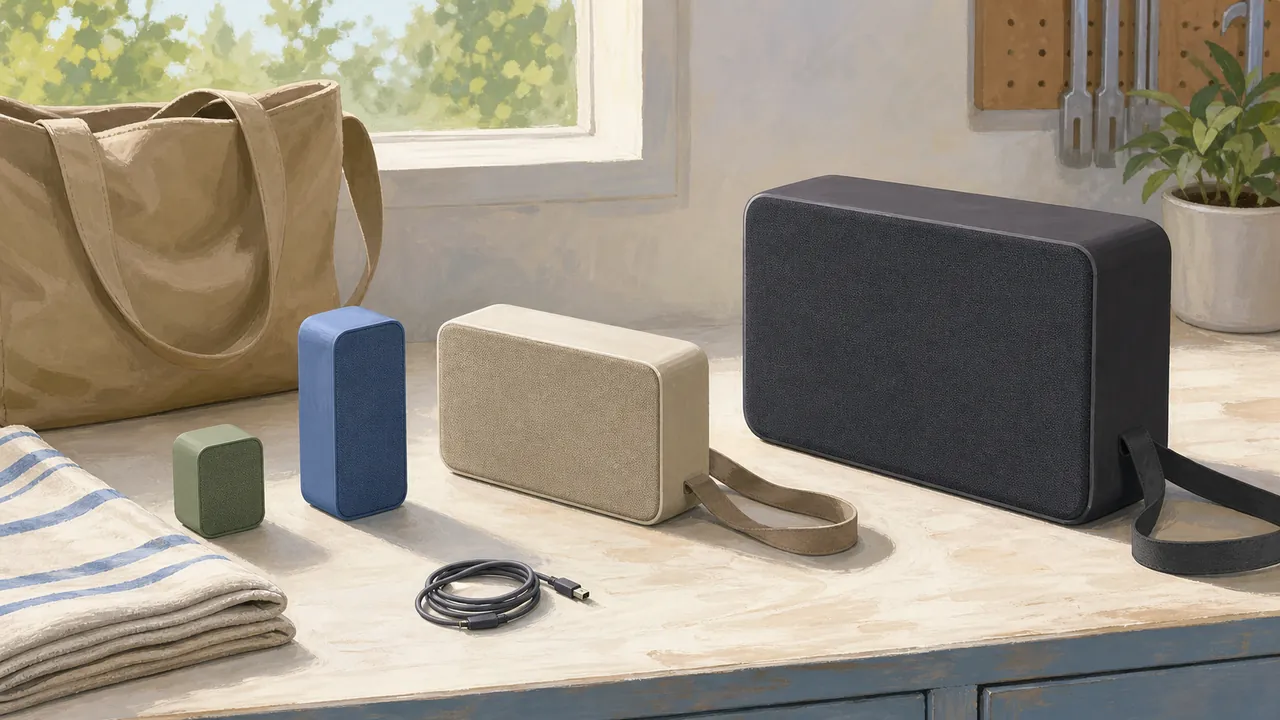
We checked current manufacturer specifications, manuals, warranty pages, and ordering evidence at B&H, Thomann, and the manufacturer. We did not audition these speakers or verify output, battery life, wireless range, durability, or water resistance. Published runtime varies with level and content; IP ratings require the maker's care instructions.
Palm-size
JBL Go 4
Everyday carry
JBL Flip 7
Long day + phone power
JBL Charge 6
Group/event carry
SOUNDBOKS Go
Do not buy from “portable” alone: the word spans 0.19 kg to 9.2 kg here. Carry each model's mass in an ordinary bag or handle test before assuming it travels the way you need.
Verify before paying: speaker, source device, charging supply, cable, destination, and whether any required app works on the current phone OS.
Translate the label
Read protection and power claims correctly
IP rating
The two digits describe tested resistance to solids and water under specified laboratory conditions.
IP67, IP68, and IP65 do not describe identical water exposure, and ports or charging state can add restrictions.
Read the exact manual's water, drying, and charging instructions before outdoor use.
“Waterproof” is not permission for salt water, charging while wet, high-pressure jets, or indefinite submersion.
Published playtime
A manufacturer estimate measured under its chosen volume, program, feature, and battery conditions.
Higher volume, bass-heavy material, cold, phone charging, battery age, and wireless features can reduce it.
Plan from the normal base figure with reserve, then log your first three real sessions.
A “24-hour” label is not a promise at maximum level.
Mono, stereo pair, and multi-speaker broadcast
One compact enclosure may reproduce a mixed signal; two compatible units may form left/right; Auracast or a brand link can distribute audio to more speakers.
Compatibility and stereo behavior depend on exact models, firmware, and mode.
Verify the exact pairing combination in the current manual before buying multiples.
Bluetooth on two speakers does not automatically make them a stereo pair.
Bluetooth latency
Latency is the delay between source action and audible output across the wireless chain.
It may be irrelevant for music playback but distracting for video, games, instruments, or live monitoring.
Test the exact phone/app/content path; use a documented wired or USB-audio path when timing is critical.
A newer Bluetooth version alone does not guarantee low-latency playback.
Power bank
A speaker with power output can send part of its battery charge to another device.
Charging a phone reduces the energy available for playback and requires the correct port/cable.
Confirm direction, voltage/current support, cable inclusion, and whether playback continues during output.
Every USB-C speaker port does not provide power out or digital audio.
SPL
Sound-pressure level is a measured acoustic level under specified conditions, often reported as a maximum.
It does not establish sound quality, coverage, distortion, or a safe listening duration.
Use only the level needed, increase distance from ears, and follow local noise and hearing-safety guidance.
The highest dB number is not automatically the best speaker for a room or group.
How these four made the list
We began with transport jobs instead of a single ranking. A speaker that lives in a coat pocket should not be penalized for failing to serve a gathering, and a 9.2 kg event unit should not win a picnic comparison because it publishes a larger maximum level. Each lane therefore has a distinct carry method and energy plan.
Every included model has a current manufacturer page and current ordering evidence. The three JBL models are in stock at B&H with substantial exact-family review signals. SOUNDBOKS Go is in stock at Thomann and orderable from SOUNDBOKS US. B&H's older Go SKU is marked discontinued, so we disclose it instead of pretending two-retailer US stock.
We used manufacturer dimensions, mass, battery, connections, and protection classifications. We did not turn marketing descriptions, user reviews, driver counts, or power ratings into claims about tonal balance, bass reach, clarity, or real-world coverage. Those require controlled measurement or listening that did not happen here.
The useful comparison
From hand loop to event handle
| Model | Carry mass | Base playtime claim | Protection | Connection distinction |
|---|---|---|---|---|
| JBL Go 4 | 0.19 kg | Up to 7 hours | IP67 | Bluetooth; USB-C power; no microphone |
| JBL Flip 7 | About 0.56 kg | Up to 14 hours | IP68 | Bluetooth/Auracast; USB-C audio path documented |
| JBL Charge 6 | 0.99 kg with strap | Up to 24 hours | IP68 | USB-C audio and power in/out |
| SOUNDBOKS Go | 9.2 kg | Up to 40 hours at mid-volume | IP65-rated electronics | Bluetooth, 3.5 mm input, TeamUP; removable battery |
The runtime numbers are not directly controlled tests. JBL's boost modes can extend stated time while changing operation; SOUNDBOKS publishes separate mid- and full-volume estimates. Use them to plan charging reserve, not to declare a winner.
Size the speaker from the trip backward
Start with the longest unassisted carry, not the listening location. Go 4 can hang from a finger loop or disappear into a small bag, but its published seven-hour base figure and lack of power-bank output narrow the job. Flip 7 still fits many bottle pockets and moves to a longer published base runtime. Charge 6 is close to one kilogram before the rest of the bag is counted. Its battery and phone-power role can justify that weight on a long day.
SOUNDBOKS Go changes the category. At 459 x 316 x 266 mm and 9.2 kg, it belongs in a vehicle-to-site or deliberate event carry. The handle, optional strap ecosystem, removable battery, 35 mm stand mount, and 3.5 mm input matter more than whether the word “portable” appears. It has no microphone or instrument inputs, so a buyer who needs announcements or performance mixing should compare true battery PA systems.
Then define the audience. “Four people at a table,” “one person in a hotel room,” and “thirty people spread across a yard” are different requirements. We do not attach coverage promises to these models because room reflections, outdoors, placement, background noise, level limits, and listener distance change the result. A return-window test in the real setting is the honest bridge between published specifications and the job.
Recommendations by carrying job
For palm-size personal listening
JBL Go 4
Choose Go 4 when the speaker must fit in a small bag, hang from an integrated loop, and serve close personal listening. Its 94.3 x 75.7 x 42.2 mm body and 0.19 kg mass are the reason for the lane, not an unsupported sound claim.
Advantage: smallest and lightest option here, with IP67 classification and current B&H stock.
Tradeoff: published base playtime is up to seven hours. There is no built-in microphone, wired audio input, or phone power-bank role in the checked specifications.
Avoid it if: the speaker must cover a long unplugged day, recharge a phone, or serve a spread-out group.
Alternative: Flip 7 for a larger one-hand speaker and longer stated runtime.
Verify: charge it fully, update firmware, then log runtime at your normal level without Playtime Boost.
For everyday bottle-size carry
JBL Flip 7
Flip 7 suits the buyer who will carry one speaker often but wants a meaningful step from the palm-size class. The published two-way 35 W layout, IP68 classification, replaceable carry accessory, and up-to-14-hour base estimate define the package.
Advantage: about 0.56 kg remains one-hand portable while creating more battery reserve than Go 4 on paper.
Tradeoff: it is about three Go 4 masses. It does not replace a power bank, and no published rating decides whether its presentation suits you.
Avoid it if: every gram matters or charging a phone from the speaker is part of the plan.
Alternative: Go 4 for minimum carry; Charge 6 for phone power and longer stated runtime.
Verify: disconnect cables before liquid exposure, inspect seals, and test your phone, app, video sync, and Auracast combination.
For a long day when the phone may need power
JBL Charge 6
Choose Charge 6 when a 34 Wh battery, up-to-24-hour base claim, and USB-C power output can replace a separate small power bank. It also documents USB-C audio, which may help a compatible laptop path where Bluetooth delay is undesirable.
Advantage: energy reserve and bidirectional USB-C create a specific travel job beyond “bigger speaker.”
Tradeoff: 0.99 kg with strap is noticeable in a day bag. The checked source says a USB cable is not included, and sealed-battery service economics remain unknown.
Avoid it if: you only need close listening for a few hours or already carry a separate power bank.
Alternative: Flip 7 reduces bulk; SOUNDBOKS Go enters the event-system class.
Verify: supply a charger meeting the current 12–20 V/3 A specification and test phone charging while playing before travel.
For vehicle-to-site group use with a replaceable battery
SOUNDBOKS Go
This is the deliberate group/event lane: 9.2 kg, 459 mm tall, a removable 99.84 Wh LiFePO4 battery, 35 mm stand mount, 3.5 mm input, and wireless TeamUP. It is current at Thomann and directly orderable from SOUNDBOKS US.
Advantage: battery swapping and stand placement address longer organized sessions in ways the sealed compact models do not.
Tradeoff: it is luggage, not bottle-pocket portable. A suitable 65 W USB-C PD supply is required to play while charging and may be sold separately. The ports mean it must never be submerged despite the IP65 electronics coating.
Avoid it if: you need microphone/instrument inputs, casual wet use, one-hand bag carry, or an airline trip without checking the 99.84 Wh battery rules.
Alternative: Charge 6 for ordinary travel; compare a battery PA with mixer inputs for live speech or instruments.
Verify: lift a 9.2 kg substitute, price the charger/strap, confirm transport rules, and test the real site at a responsible level.
Twelve minutes, no speaker required
Build the trip load before checkout
Put household objects equal to the published speaker mass in the actual bag or carry position: 0.19 kg, 0.56 kg, 0.99 kg, or 9.2 kg. Add the phone, charger, cable, water, and anything else that travels with it.
- Walk the longest realistic route, including stairs, doors, transit, or parking distance.
- Stop and place the substitute where the speaker would sit. Check stability, listener distance, and whether controls remain reachable.
- Reserve a dry charging location and route the cable away from feet and liquid.
- For SOUNDBOKS Go, rehearse vehicle loading and stand placement with two hands; do not improvise overhead mounting.
- Write the maximum acceptable total carry mass. Reject any model that exceeds it before comparing features.
This test does not predict sound. It prevents a common buying error: selecting output and battery capacity that stay home because the complete load is unpleasant to move.
A six-line checkout card
Write the energy and connection passport
Complete six lines: source device; connection/mode; session duration; charging supply and rating; water/dust exposure; carry method and total load. Add “microphone or instrument” as a veto question.
A defensible Charge 6 card might read: phone over Bluetooth; eight-hour day; 20 V/3 A capable charger at lodging; no charging outdoors; shoulder bag total under 4 kg; no microphone. A blank charger rating or “waterproof everywhere” answer means more research is needed.
Battery, water, and hearing checks
Lithium batteries are consumable components. Published hours describe a new battery under selected conditions, not capacity after years. Ask how battery service works in your region, preserve proof of purchase, and do not leave a hot speaker or power bank in a vehicle. For flights, check the airline's current spare/installed battery rules against watt-hours and terminals before travel; this guide does not provide a universal clearance.
Dry the speaker and port area exactly as the manual instructs before charging. JBL's Flip 7 guide explicitly says not to expose it to liquid while a cable is connected. SOUNDBOKS says its Go has IP65-rated electronics but bass ports prevent submersion. Those details are more useful than compressing all four products into “waterproof.”
Maximum output is not a target. Increase distance, use the lowest useful level, and follow local restrictions and current hearing guidance. We do not estimate a safe duration from the speaker's specification because exposure depends on measured level at the ear and cumulative time.
Speaker size, sealing and support
Manufacturing origin is intentionally unknown where the exact-product source does not state it. Brand headquarters cannot substitute for the label on the delivered unit.
| Product | Size/weight | Construction | Manufacturing origin | Brand | Warranty/support |
|---|---|---|---|---|---|
| JBL Go 4 | 94.3 x 75.7 x 42.2 mm; 0.19 kg | Fabric/plastic; integrated loop; sealed rechargeable speaker | Not disclosed; inspect exact-unit label | JBL; Stamford, US; founded 1946; loudspeakers | US portables generally one year; exact card/territory controls |
| JBL Flip 7 | 182.5 x 69.5 x 71.5 mm; about 0.56 kg | Fabric/plastic two-way enclosure; replaceable carry accessory | Not disclosed; inspect exact-unit label | JBL; Stamford, US; founded 1946; loudspeakers | US portables generally one year; exact card/territory controls |
| JBL Charge 6 | 228.8 x 98.5 x 94 mm; 0.99 kg with strap | Fabric/plastic two-way enclosure; removable strap; 34 Wh pack | Not disclosed; inspect exact-unit label | JBL; Stamford, US; founded 1946; loudspeakers | US portables generally one year; battery wear excluded under terms |
| SOUNDBOKS Go | 459 x 316 x 266 mm; 9.2 kg | ABS/polycarbonate; silicone bumper; TPE handle; stand mount | Not disclosed; inspect exact-unit label | SOUNDBOKS; Copenhagen; founded 2015; battery event speakers | Two-year limited consumer terms; current registration can add one year |
First-week acceptance log
- Photograph serial, label, receipt, included parts, and port covers.
- Use the official app only if needed; record firmware and phone OS.
- Run one normal-volume session from full charge and record hours, connection drops, and remaining indicator.
- Test every intended source, USB direction, wired path, pair/broadcast mode, and charger.
- Inspect heat, cable strain, feet, handle/strap, and charging behavior in a dry location.
- Use the real room/outdoor position at responsible levels; do not infer performance from a tabletop test.
- Keep all packaging until carry, connection, battery, and return-window checks pass.
Sources checked
- JBL Go 4 official page
- B&H JBL Go 4 listing
- JBL Flip 7 official page
- B&H JBL Flip 7 listing
- JBL Flip 7 quick guide
- JBL Charge 6 official page
- JBL Charge 6 specification sheet
- B&H JBL Charge 6 listing
- Sweetwater Bluetooth speaker category
- JBL US warranty information
- SOUNDBOKS Go specifications
- Thomann SOUNDBOKS Go listing
- SOUNDBOKS limited warranty
Found a changed specification or source? Report a correction.