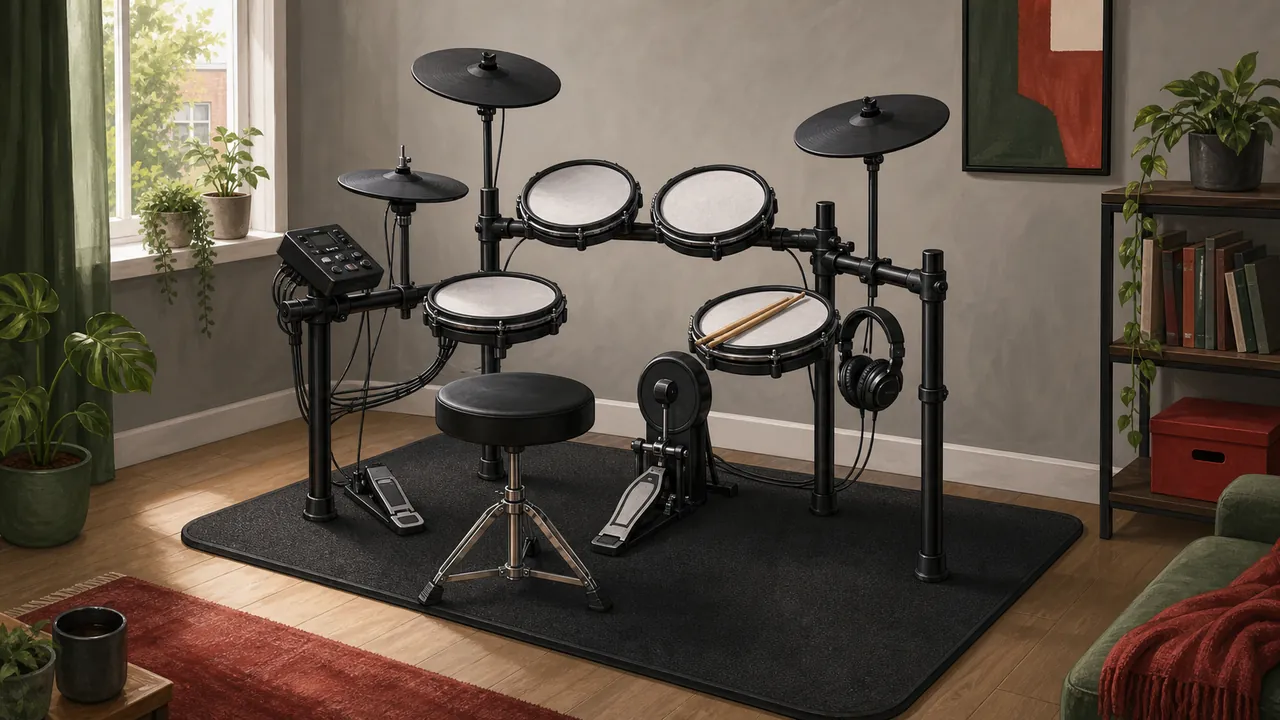
Current bare kits below US$1,000
Best Electronic Drum Sets Under $1,000 for Real Practice
Alesis Nitro Max is the inexpensive mesh starting point. Nitro Pro buys a steel rack, dual-zone toms and a larger mesh kick tower. Roland TD-07DMK is the compact all-mesh-drum choice with USB audio. Yamaha DTX452K favors guided practice and includes a bass pedal. DTX6K-X puts the strongest module and connection set here above simpler rubber toms.
We checked exact maker pages, manuals, Sweetwater, B&H and Thomann on . We did not play, record, measure impact noise or durability-test these kits. Pad response, crosstalk, hi-hat behavior and floor transmission need a local audition and return-window test.
Headphones do not make drums silent. They remove amplified sound from the room, but sticks, rubber cymbals and kick pedals still create airborne and structure-borne impact.
Lowest complete playing start: Nitro Max includes kick pedal, sticks and key, but still budget for throne and headphones or monitor.
Best module-first lane: DTX6K-X adds separate outputs, sample import and deeper editing, but no bass pedal and weak exact-model Europe stock.
Translate the spec sheet
What your hands and feet actually control
Trigger zone
A separately sensed playing area, such as a snare head and rim or ride bow, edge and bell.
More zones can preserve acoustic-drum techniques, but only when the included pad and module support them together.
List the rim, bell and choke articulations your lessons require, then verify each exact pad.
A “three-zone module input” does not turn every single-zone pad into three zones.
Mesh head
A woven drum surface whose tension can usually be adjusted for rebound.
Mesh drums often reduce stick noise and permit feel adjustment compared with solid rubber drum pads.
Set tension evenly and audition soft strokes, rolls and rim hits.
Mesh does not make cymbal pads, pedals or floor vibration silent.
Crosstalk
An unintended trigger caused when vibration from one pad reaches another sensor.
A rack can look stable while a hard tom strike still fires a cymbal or neighboring drum.
Play every two-limb combination at realistic force and adjust threshold/crosstalk settings only after assembly is tight.
Turning sensitivity down can hide crosstalk while also losing intentional soft notes.
Kick tower
A pad struck by the beater of a conventional bass-drum pedal.
It transfers foot technique more directly than a switch-style beaterless controller, but creates more impact through the floor.
Check whether the tower and rack stay put, and whether a double pedal's two beaters land inside the sensed area.
“Double-pedal compatible” does not mean a double pedal is included.
Controller hi-hat
A cymbal pad paired with a separate foot controller that reports open, closed and intermediate states.
All five shortlist kits use a controller-style hi-hat rather than a cymbal mounted on a conventional hi-hat stand.
Test foot splashes, half-open notes and fast open/close timing.
A visually separate pedal can still send continuous position data; appearance alone does not reveal its resolution.
USB audio versus USB MIDI
USB audio carries the module's sound; USB MIDI carries note/velocity instructions to software.
TD-07 and DTX-PRO can send audio and MIDI, while Nitro and DTX402 workflows may use USB primarily for MIDI triggering.
Decide whether you need a finished stereo recording or plan to trigger a computer instrument.
USB-MIDI does not record the module's drum sound by itself.
Latency
The delay between a strike and the heard sound through the complete pad, module, computer and monitoring path.
Adding software, wireless listening or a poorly configured driver can make timing feel late even when the pad triggers correctly.
Monitor directly from the module first, then test the exact computer/audio path.
Bluetooth audio is useful for streaming a backing track into a module; it is not the right path for delay-sensitive drum monitoring.
Selection rule
The cap applies to the bare exact kit
To qualify, an exact current kit had to be ordinarily listed below US$1,000 on the research date and have manufacturer or manual evidence strong enough to map its pads, module and missing hardware. The shortlist favors models visible at large specialists in both North America and Europe. Dated retailer ratings show market engagement only; they cannot establish feel, reliability or sound.
Roland TD-02KV and Yamaha DTX402K remain valid current starters, but their beaterless or simpler configurations duplicate lanes covered by TD-07DMK and DTX452K. Nitro Pro XL adds a tom and cymbal without changing the rack, hi-hat or module decision. Sale prices can expire; none of the five depended on a discount to stay below the cap at the listed regular US price.
Map the technique before counting sounds
| Kit | Drum surfaces | Kick / hi-hat | Computer path | Main refusal |
|---|---|---|---|---|
| Alesis Nitro Max | 10 in dual-zone mesh snare; 3 x 8 in single-zone mesh toms | Kick tower and pedal included; controller hi-hat | USB-MIDI; Bluetooth backing audio | Light aluminum rack, single-zone toms |
| Alesis Nitro Pro | 10 in dual-zone mesh snare; 3 x 8 in dual-zone mesh toms | 8 in mesh double-pedal-capable tower; controller hi-hat | USB-MIDI; Bluetooth backing audio | Still compact pads and controller hi-hat |
| Roland TD-07DMK | 8 in dual-zone mesh snare; 3 x 6 in single-zone mesh toms | KD-2 tower, pedal omitted; controller hi-hat | USB audio/MIDI; Bluetooth backing audio | Small toms; only mini-jack analog output |
| Yamaha DTX452K | 7.5 in rubber three-zone snare; rubber toms | KP65 tower and pedal included; controller hi-hat | USB-MIDI; aux input | No mesh; combined phones/line output |
| Yamaha DTX6K-X | 8 in three-zone TCS snare; 3 x 7 in single-zone rubber toms | KP65 tower, pedal omitted; controller hi-hat | USB audio/MIDI, WAV import, MIDI out | Rubber toms and regional stock gap |
Five kits, each with a reason to walk away
Lowest-cost mesh starter
Alesis Nitro Max Kit
Choose Nitro Max when the first priority is a current mesh-drum kit with kick tower, pedal, sticks, Bluetooth backing audio and strong cross-market availability at roughly $449 regular US pricing.
Useful edge: the 10-inch dual-zone snare is larger than several pricier compact-kit snares, and expansion inputs leave room for one additional tom and cymbal.
Hard limit: its 8-inch toms are single-zone and the four-post rack is aluminum. No current maker footprint or assembled-weight figure was strong enough for room planning.
Avoid if: two-zone tom rims, double-bass technique or the most stable adult-size rack is already part of the lesson plan.
Closest alternative: Nitro Pro for a steel rack, dual-zone toms and larger mesh kick tower.
Verify: player height, snare/rack position, kick pedal creep, headphone connector and the exact optional expansion compatibility.
Found a changed specification or source? Report a correction.
Sturdier mesh and double-pedal preparation
Alesis Nitro Pro Kit
Choose Nitro Pro when a steel rack, dual-zone mesh toms and an 8-inch mesh kick tower justify spending above Nitro Max while keeping the same basic module-and-controller-hi-hat class.
Useful edge: the tower is specified for double pedals, and every drum pad has two zones. The module provides 36 factory and 16 user kits plus standard practice/connectivity tools.
Hard limit: pad diameters remain 10 inches for snare and 8 for toms. A throne, headphones and monitor are outside the bare kit, and the hi-hat still uses a separate controller pedal.
Avoid if: your actual goal is a conventional hi-hat stand, larger cymbals or a major sound-module step.
Closest alternative: TD-07DMK for USB audio and Roland's coaching/module path; DTX6K-X for deeper outputs and sample import.
Verify: exact rack height for the player, two-beater trigger consistency, pedal inclusion by region and software redemption requirements.
Compact mesh practice and USB audio
Roland TD-07DMK
Choose TD-07DMK when all four drum pads must be tunable mesh and direct USB audio/MIDI, coaching and Bluetooth backing tracks matter more than large pad diameters.
Useful edge: Roland publishes a configured 1200 x 1100 mm reference and 18 kg weight, making the system easier to plan than kits with missing assembled dimensions.
Hard limit: the three toms are 6-inch single-zone pads. A kick pedal and throne are excluded, and analog monitoring/output shares one stereo mini jack.
Avoid if: you expect a complete box, quarter-inch main outputs, roomy targets or tom-rim articulations.
Closest alternative: Nitro Pro for larger dual-zone toms and supplied pedal; DTX6K-X for separate main outputs.
Verify: the pedal and beater you will add, output adapter/cable, USB driver mode and whether an extra crash needs a separate mount.
Guided practice with supplied bass pedal
Yamaha DTX452K
Choose DTX452K when ten built-in training functions, a three-zone snare and included conventional bass pedal matter more than mesh playing surfaces.
Useful edge: the snare supports head, rim and cross-stick technique, while the KP65 tower preserves physical beater action. The four-post system has an approximate 1000 x 1000 mm retailer footprint.
Hard limit: all drum pads are rubber, and one standard stereo jack serves headphones or line output. The exact Sweetwater listing has little review history despite older Thomann engagement.
Avoid if: mesh rebound, separate main outputs or quieter stick impact is a non-negotiable requirement.
Closest alternative: Nitro Max for mesh at lower cost; TD-07DMK for mesh plus USB audio.
Verify: app compatibility with the current phone/OS, floor noise, snare-zone recognition and whether one shared output works for lessons.
Module-first recording and detailed snare/ride
Yamaha DTX6K-X
Choose DTX6K-X when the DTX-PRO module, separate L/R outputs, USB audio/MIDI, MIDI out, WAV import and three-zone TCS snare/ride matter more than all-mesh drums.
Useful edge: this is the deepest recording/editing system under the cap, with 40 preset and 200 user kit locations, per-instrument processing and a published 1000 x 1100 mm average footprint.
Hard limit: three 7-inch toms and the kick pad are rubber; no bass pedal is supplied. The exact base K-X was current in the US but absent from Thomann's current range during research.
Avoid if: you are buying in Europe without a confirmed exact-model seller, or expect mesh toms and stand-mounted hi-hat inside $1,000.
Closest alternative: TD-07DMK for cross-market all-mesh drum pads; Nitro Pro for supplied pedal and larger mesh tom targets.
Verify: exact regional stock, OS version, included pedal, chosen sample workflow and the articulation limits of the single-zone crash and tom pads.
Price the first playable hour, not the carton
Put a real number beside every line before comparing two kit prices.
- Playing hardware: bass pedal if omitted, throne at the player's height, sticks, and any double pedal already required.
- Listening: wired headphones with the right plug, or a drum monitor plus correct mono/stereo cables. Do not plan to monitor live strikes over Bluetooth.
- Floor control: non-slip rug, pedal restraint and a tested isolation platform where structure-borne impact matters.
- Computer path: USB cable, adapter, supported driver, audio interface if needed, and software whose license/OS terms are understood.
- Expansion: mount, arm and cable as well as the extra pad. An unused module input is not a complete expansion kit.
Compare totals only after every required line is filled. A $699 pedal-less kit can cost more to start than a $649 kit that includes the foot hardware you need.
Run a room-to-room impact test before calling it apartment-safe
- Place the assembled kit where it will live, with the intended mat or platform and every pedal anchored.
- Have one person play eighth notes on hi-hat, snare and kick at lesson volume for two minutes.
- Listen in the room below, adjoining bedroom and hallway. Record time and location, not a phone decibel number presented as laboratory proof.
- Repeat with headphones disconnected from the module. What remains is mechanical impact and airborne pad noise.
- Ask the affected person whether the pattern is acceptable at the planned practice hours. Change location, isolation or schedule before changing module volume.
Make a five-minute articulation map
Hands: test soft center snare, rimshot/cross-stick, every tom center/rim, cymbal bow/edge/bell and choke. Mark unsupported zones rather than assuming the module can create them.
Feet: test closed, half-open, open and foot-splash hi-hat states, then single/double kick strokes at quiet and loud dynamics. Watch for sliding and missed triggers.
Recording: record module audio if supported, then USB-MIDI into the intended software. Confirm note mapping, dynamic range and monitoring latency separately.
Footprint, materials and support boundaries
A box dimension is not a playing footprint, and a company address is not a factory. Where a current maker did not state assembled dimensions, weight or manufacturing origin, those facts remain unresolved.
| Kit | Size and weight | Construction and origin | Brand record | Warranty/support |
|---|---|---|---|---|
| Alesis Nitro Max Kit | Authoritative assembled footprint and kit weight not stated on current product page; measure the built rack during the return period. | Four-post aluminum rack; mesh snare/toms and rubber cymbal surfaces. Exact manufacturing origin not disclosed. | Alesis, Cumberland, Rhode Island, USA; founded 1984; electronic drums, drum machines and studio equipment. | Regional manufacturer terms and registration limits vary; verify exact seller coverage before software redemption. |
| Alesis Nitro Pro Kit | Authoritative assembled footprint and kit weight not stated on checked exact maker/support pages. | Steel rack; mesh dual-zone drums and rubber cymbal surfaces. Exact manufacturing origin not disclosed. | Alesis, Cumberland, Rhode Island, USA; founded 1984; electronic drums, drum machines and studio equipment. | Use Alesis's regional warranty route and confirm term, registration and authorized-seller requirements. |
| Roland TD-07DMK | 1200 x 1100 x 1200 mm configured reference; 18.0 kg / 39 lb 11 oz excluding bass pedal and throne. | Four-post rack, dual-ply mesh drum heads and rubber cymbal/kick playing surfaces. Exact manufacturing origin not disclosed. | Roland, Hamamatsu, Japan; founded 1972; electronic instruments, rhythm machines and V-Drums. | Exact current regional duration was not established; confirm authorized seller and Roland service route. |
| Yamaha DTX452K | Approximate retailer floor area 1000 x 1000 mm; full assembled weight not stated. B&H's 62.5 lb is package weight. | Four-post rack with rubber drum/cymbal pads and KP65 kick tower. Exact manufacturing origin not disclosed. | Yamaha, Hamamatsu, Japan; founded 1887; musical instruments, drums and professional audio. | B&H lists one-year limited US manufacturer coverage; verify authorized-seller and country terms. |
| Yamaha DTX6K-X | Average footprint 1000 x 1100 mm; 25.2 kg / 55.6 lb; playing height varies with adjustment. | TCS silicone snare, rubber tom/kick/cymbal surfaces; exact rack material breakdown not stated. Exact manufacturing origin not disclosed. | Yamaha, Hamamatsu, Japan; founded 1887; musical instruments, drums and professional audio. | Confirm exact regional category/duration and who services an imported or cross-border unit. |
Questions for the teacher, neighbor and seller
- Which snare, tom, ride and hi-hat articulations appear in the first year of lessons?
- Can the rack place those pads correctly for this player's height without overreaching?
- Is a bass pedal, throne, headphone adapter, USB cable or monitor missing from this exact carton?
- What can the neighbor hear with module volume at zero?
- Can installed software or redeemed lessons affect the return?
- Which local service center accepts this model, and who pays freight for a large warranty return?
Sources checked for pad systems, stock and support
Manufacturer pages and manuals control technical claims. Retailers provide dated price, availability and listing-engagement signals only.
Prices, bundles, stock, software and support terms can change. Confirm the exact carton and region before purchase.